Serial entrepreneur. PhD in Machine Learning@Berkeley.
Greaten AI helps data-driven companies automate their workflow on unstructured data with very low cost.
The entire RAG industry is about to get cooked.
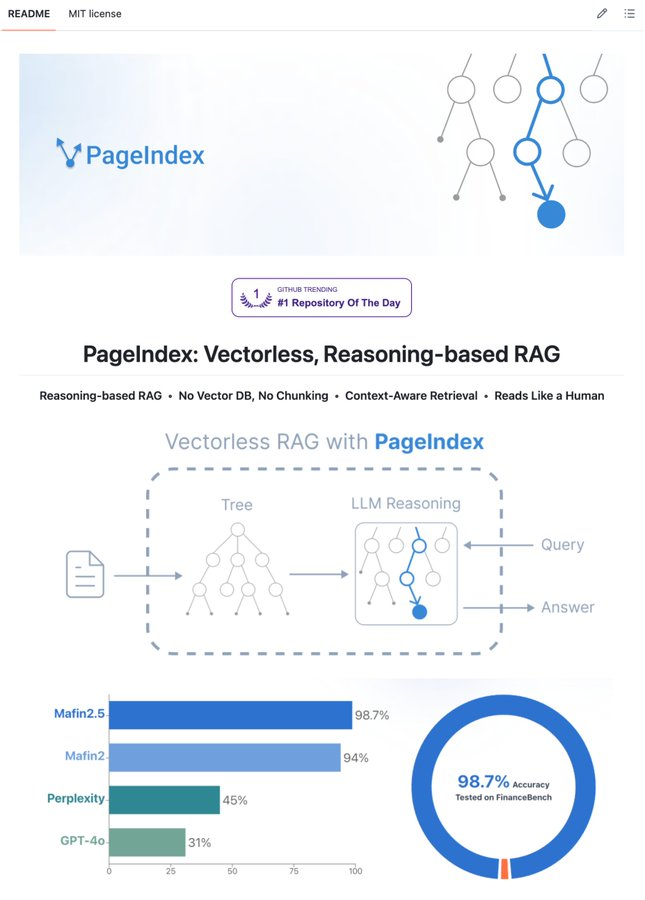
Researchers developed a new RAG approach that bypasses almost everything traditional RAG depends on.
- No vector DB
- No data embeddings
- No chunking
- No similarity search
It's called PageIndex.
Instead of splitting your documents into chunks and loading them into Pinecone, it creates a tree index that lets the LLM reason through them like a human reading a book.
98.7% on FinanceBench. Outperforms every vector RAG on the leaderboard.
100% free. Open source.
GPT-6 Astra builds the most powerful trading agents
i wrote a 6-page research paper on exactly how to find profitable strategies 24/7 with Astra, along with the COMPLETE CODEBASE
here is how you set it up:
1. the 4 mispricing categories every hedge fund actually hunts (statistical arbitrage, volatility surface, factor decomposition, insider clusters) with the exact formulas for each
2. the 8 bot architecture that maps to every function of a real fund, one bot per role, with maker checker separation so nothing grades its own output
3. the 300 agent monitoring layer that watches order books, options flow, SEC filings, macro releases, and central bank X accounts in parallel
4. the hypothesis generator that reads filtered candidates and codes new strategies every night in Python, backtests them, and throws out anything below Sharpe 1.5
5. the exact validation thresholds every strategy has to pass before deployment. Sharpe above 1.5, drawdown below 15%, hit rate above 55%, t stat above 2.0
6. the Telegram alerts that ping your phone with instrument, strategy, confidence score, Sharpe, drawdown, action window, and Kelly sized position
this is the exact system I have been running for the past 3 days:
Andrej Karpathy spent 8 years at OpenAI and Tesla
Last week he compressed everything he knows into one free 2-hour lecture
Agents → Loops → Harness → Graphs
People spend $15k on bootcamps that teach less than this
You probably don't have 2 hours right now
Don't let it vanish from your feed
Watch it, then read the graph engineering guide below
I'm 30. I built an AI startup called @GojiberryAI doing over $4M ARR in one year. Got accepted into YC.
No one wants to hear this, but there's no magic distribution channel.
We got there by experimentmaxxing one channel at a time, based on our MRR level.
$0 → $6k MRR: pure outbound. Cold email + LinkedIn, using our own early product on ourselves. No brand, no audience — just us reaching out to people showing intent and starting conversations. Ugly, manual, effective.
$6k → $25k MRR: Reddit. Our first real acquisition breakthrough. We posted educational breakdowns in SaaS subreddits and pulled 10M+ organic views. Traffic quality wasn't amazing, but the volume flooded our trial funnel for months. Cost: basically zero.
$25k → $75k MRR: content + free blueprints. All-in on LinkedIn content, YouTube, motion-design videos, and giving away our internal systems as free "blueprints." Content got the reach, blueprints earned the trust, and a chunk of readers converted. This is where founder-led content started compounding.
$75k → $150k MRR: partnerships + X. We added Twitter, B2B influencers, sponsored newsletters, and a lifetime affiliate program that became a major lever. We also joined YC around here — the intensity went vertical.
$150k+ MRR: paid + hiring. Meta ads, Google ads, influencer agencies, and our first serious hires: growth, sales, engineering, product.
To get to $1M+/month, it’s mostly going to come down to hiring the right people and putting the right structure in place.
Here's the part people miss: none of these stages replaced the last one. They stacked. Outbound never stopped. Content never stopped. We just added the next lever once the current one was clearly working.
If you take one thing from this: don't chase five channels at once.
Beat one until it works. Then add the next.
There's still whitespace for vertical AI startups.
If you’re building vertical AI, look for four things in a market:
- The work repeats often enough to learn from
- Judgment matters, so there’s nuance to learn
- An expert can quickly evaluate the output and explain what to improve
- You can start with one task and grow into owning more of the job
Together, these can create a strong learning loop. That’s a key part of the vertical AI advantage. Focus can earn deeper access, more job-specific data and context, and a better understanding over time of what good work looks like.
Incumbents may own the record. Labs may own the front door. Vertical AI can still own the job.
a16z’s @seema_amble on where vertical AI can still win: https://t.co/iXt6sYNljU
TU AGENTE DE CÓDIGO AHORA DIBUJA ARQUITECTURAS DE VERDAD
Archify es un skill open source que convierte una descripción o un repositorio en un diagrama de arquitectura interactivo.
No es Mermaid.
No es un screenshot feo de Excalidraw.
Es un HTML auto-contenido con:
→ Diagramas de arquitectura, workflow, sequence, data-flow y lifecycle
→ Motion y trazado de rutas
→ Búsqueda y focus de nodos
→ Export PNG / SVG / WebM
→ Cards listas para compartir (1200×630)
Lo más importante:
Todo está validado.
No inventa conexiones.
Usa un JSON IR tipado + checks atómicos.
Funciona con Cursor, Claude Code, Codex y OpenCode.
16k estrellas.
Guárdalo. Es de los skills más útiles que han salido este año.
Repoo 👇👇
SpaceXAI engineer (ex-Cursor):
"right now I'm running 10-20 GrokBot agents that automate 90% of my routine
i have a Chief of Staff agent. He knows about all my other bots and manages everything"
in a 50-minutes podcast, a SpaceXAI engineer showed how to build a team of agents that will work for you 24/7
worth more than a $500 course on agentic engineering
watch today, then read how to build a Grok agents team from scratch in the article below
Anthropic engineers just showed how to build agentic systems that run for days using "loops."
"At Anthropic, >30% of our code is already written by loops - that's how we ship so fast.
in this 40-minute workshop, they reveal the whole stack:
agent loop + harness + memory + sub-agents.
Worth more than any $500 vibe-coding course.
Watch workshop today, then read article below.
INCREDIBLE
The MOST COMPLETE GUIDE for understanding LLMs from first principles is now available online to read for free
Covers the model mechanics
- Tokens / tokenizers
- Transformers
- Attention
- KV cache
- Prefill vs decode
- Decoding controls
- Model packages
- Chat templates
- Long context
- RAG
- Agents / tools
- Fine-tuning
- Multimodal models
Then connects that to running models locally
- What "local" really means
- Open-weight vs opensource
- Quantization
- VRAM math
- Hardware tiers
- File formats / load safety
- Runtimes / serving modes
- Model selection
- Privacy
- Failure modes
- Benchmarks
- Practical setup paths
You should read this, and if you cannot now then you most definitely wanna bookmark it for later
Opensource AI FTW
Earlier this year I was getting frustrated with Claude's charts, fed this book to claude and had it generate a Tufte skill. Instantly got simpler/more beautiful visualizations.
https://t.co/lfXwyQfmQG
Damn this is insane 🤯
This open-source tool gives AI instant knowledge of your entire codebase.
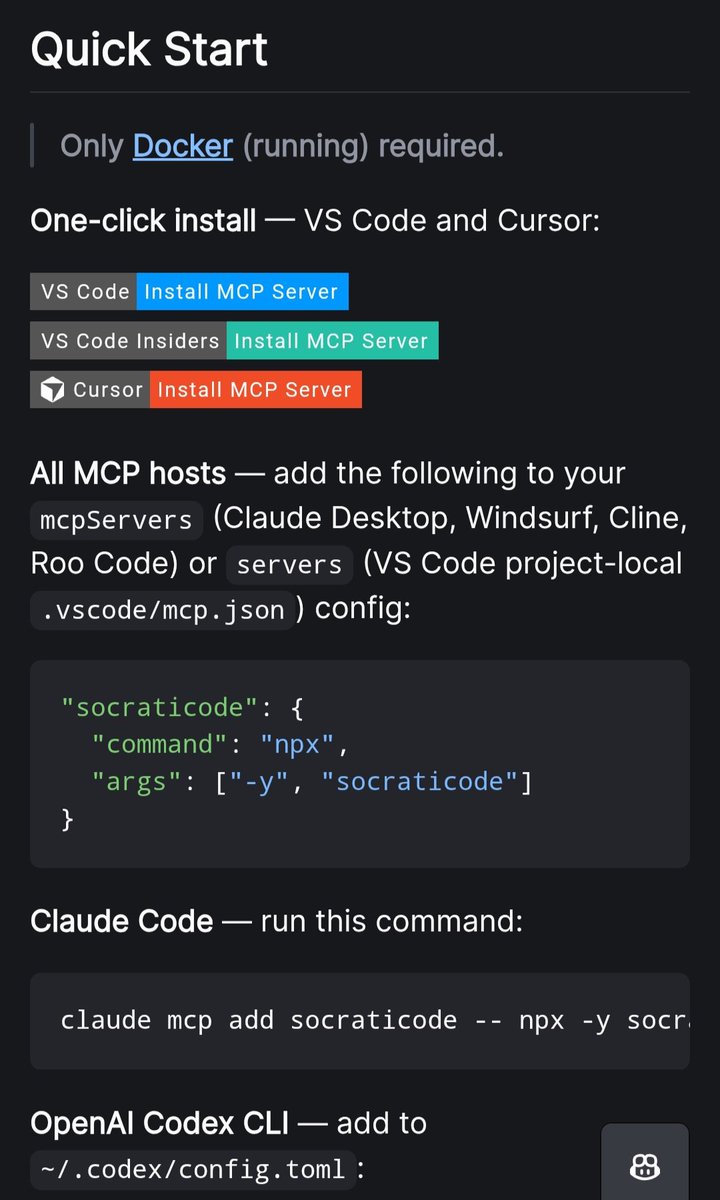
It’s called SocratiCode.
Instead of making AI randomly read files or run endless searches, it builds an index of the entire repository.
So the AI already knows:
• where features are implemented
• how modules connect
• which files depend on each other
• where specific logic exists
Even in million-line codebases.
Setup is surprisingly simple.
All you need is Docker running.
Then install the MCP server in your editor.
Works with:
• VS Code
• Cursor
• Claude Desktop
• Windsurf
• Cline
• Codex CLI
And the install command is literally just:
npx -y socraticode
After that you can ask your AI things like:
• “How authentication works in this project?”
• “Where is rate limiting implemented?”
• “What depends on this module?”
And it finds the answer across the entire repo.
Pretty wild what AI dev tools are becoming.
🚨BREAKING: Langflow just open-sourced a complete RAG platform in a single package.
It's called OpenRAG. Built on Langflow, Docling, and OpenSearch.
Upload documents, run semantic search, and chat with your data no duct tape required.
One command to run:
uvx openrag
→ Full document ingestion pipeline
→ AI-powered chat over your files
→ Built-in semantic search via OpenSearch
→ Visual workflows via Langflow
→ Docker support out of the box
100% Opensource.
AI normally sucks at memory retrieval
both you and your AI hate that
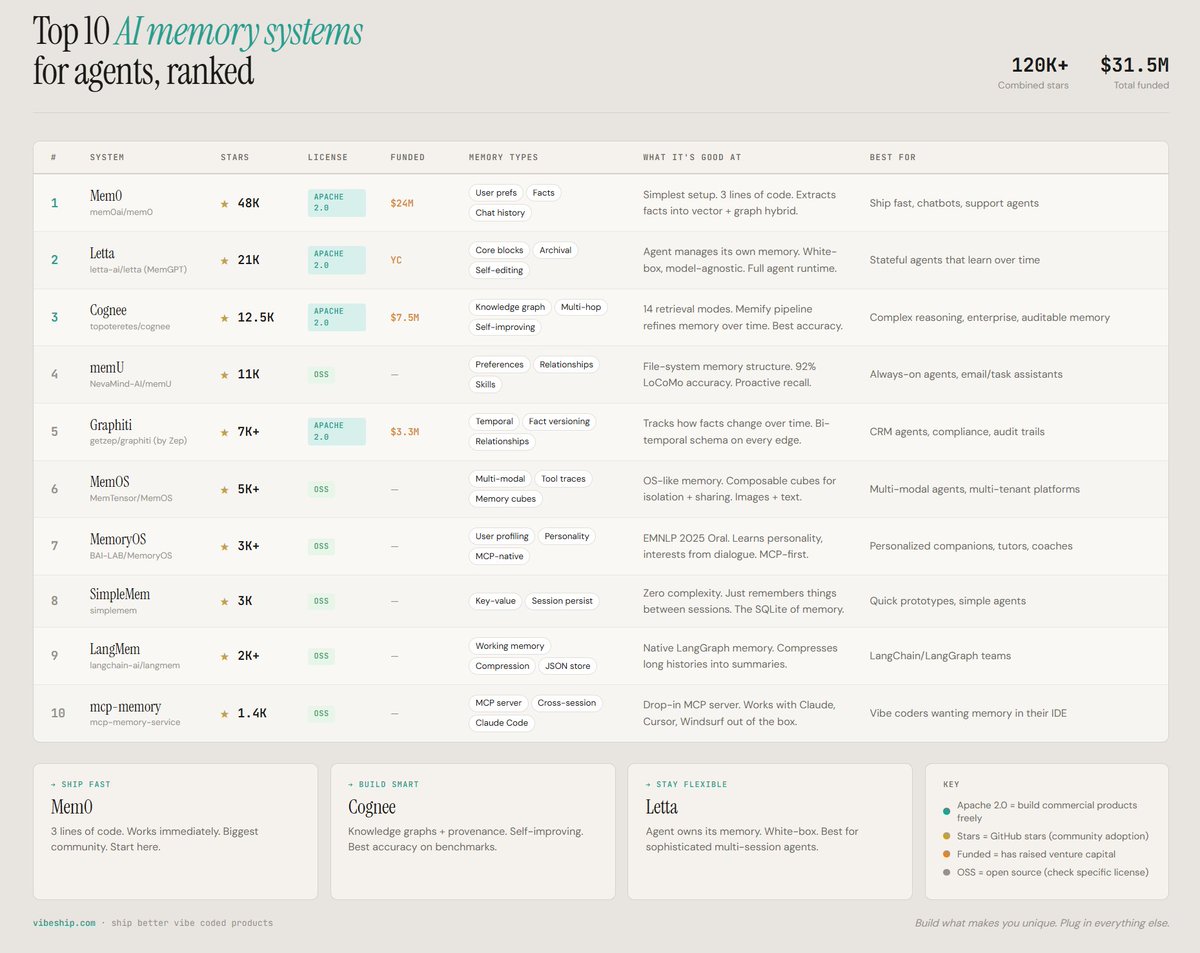
Here are the top 10 open source AI memory layers
> free
> open source
> with lots of GitHub stars
> and some even funded by YC
You can use them to make your agents, claude, codex, and openclaw much smarter
Also, tips on what each memory is good at, how to combine them, and get even more out of them are all in the article.
These are much better than just memory md files, and will make a huge difference in your workflow!
Give your agents life with them:
Everyone says AI will replace customer success teams.
I talked to a founder last night who did the opposite, and it’s not the first time I’ve heard a story like this.
He used AI to make his CS team 10x more effective, then hired more of them.
That’s right.... he used AI and also hired more people.
Here's what the AI does:
- Summarizes every customer interaction across email, chat, and calls before a QBR
- Flags accounts showing early churn signals
- Drafts personalized expansion proposals based on the customer's usage patterns
Here's what his CS team does with the extra time:
- Actually talks to customers (revolutionary, I know)
- Builds relationships with POCs
- Runs industry-specific workshops that turn customers into evangelists
His NPS score is way up (forget how much exactly) and his NRR went from 108% to 135%.
He didn't replace humans with AI, he removed the busywork that was preventing humans from doing human things.
Now his actual non angentic employees are focusing on the most important things, only they can do.
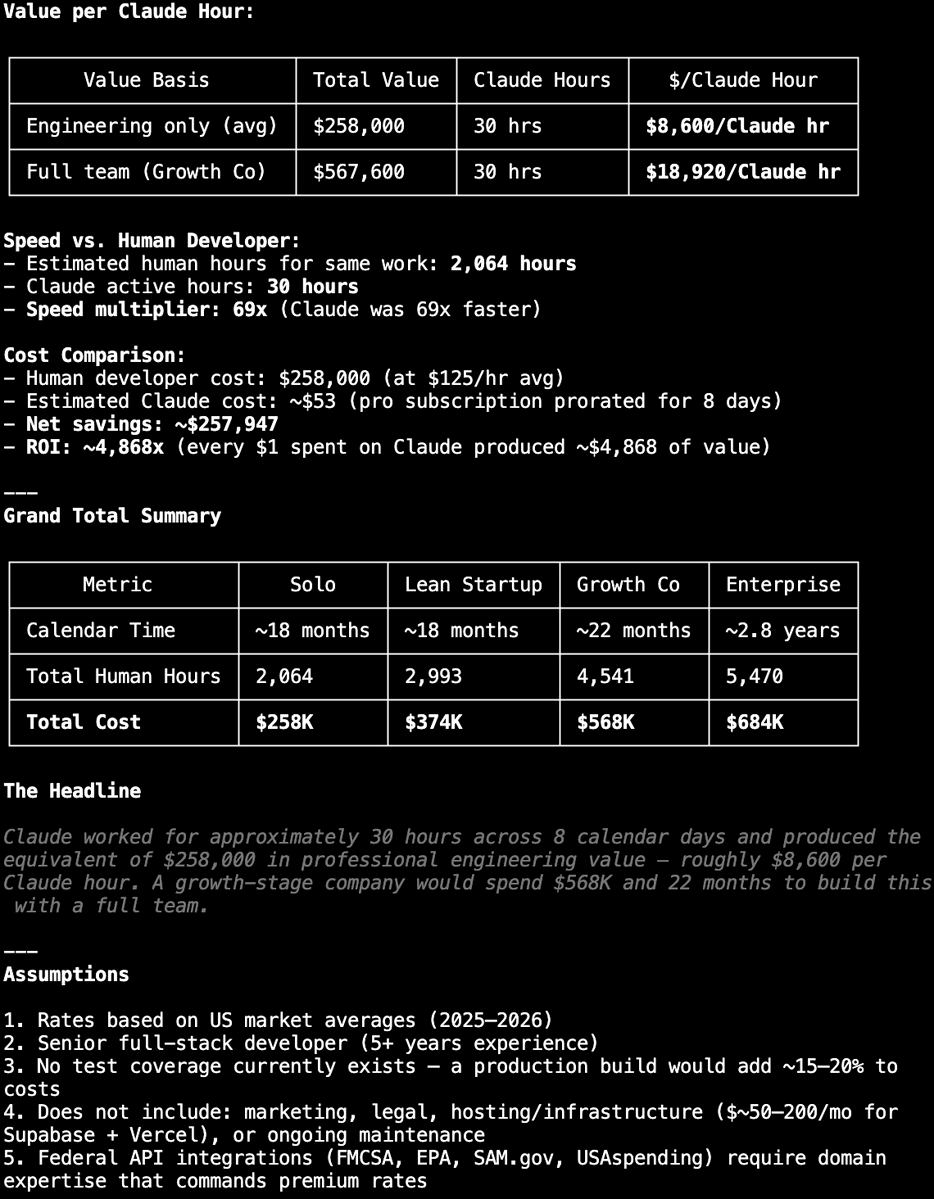
Fun command built in Claude Code: /cost-estimate
It scans your codebase and cross-references current market rates to calculate what your project would've cost a real team to build.
It looks at all the APIs, integrations, everything.
Without AI: ~2.8 years. ~$650k.
With AI: 30 hours.
It's absurd when you start to think about it like this.