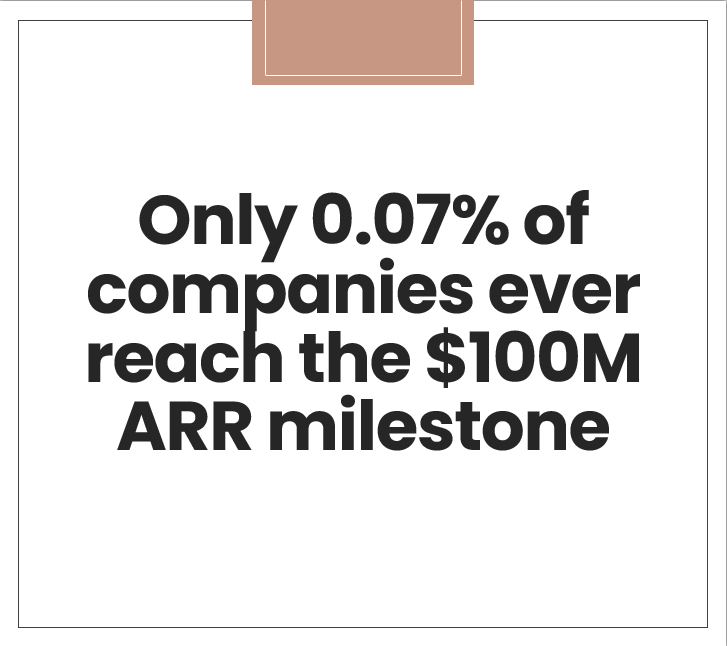
🚀Did you know only 0.07% of companies ever reach the $100M ARR milestone?
That's a rare feat!
Today, I'm unraveling the success story of a company that's part of this exclusive club in the #SaaS world: @Birdeye_ . Stay tuned! #Investing#Tech
Read more: https://t.co/Z4Pv6Y0rhC
In 1993, 16 of India's most powerful industrialists met quietly to push back against liberalisation.
Sucheta Dalal named them the 'Bombay Club'.
By 1994, only Rahul Bajaj was left.
Watch the full Bajaj Finance story on Episode 2 of Intermission: https://t.co/krNkw2Pwvc
Naval Ravikant: "You're going to die. It's all going to zero. What's there to stress about?"
"Stress is when your mind has two conflicting desires at once. You want to be liked, but you want to do something selfish. You don't want to go to work, but you want to make money. You have two conflicting desires, and that's stress."
Naval explains the difference between stress and anxiety:
"Anxiety is this pervasive, unidentifiable stress where you're stressed out all the time and you're not even sure why. The reason is you have so many unresolved problems that have piled up in your life, you can no longer identify what the problems are. There's this mountain of garbage in your mind. A little bit is poking out the top like an iceberg; that's anxiety. But underneath, there's a lot of unresolved things."
He shares his personal anxiety resolver:
"One big anxiety resolver for me is just ruminating on death. You're going to die. It's all going to zero. You cannot take anything with you. If you can keep that idea in front of you at all times, what's there to stress about?"
Naval reframes what "wasted time" really means:
"What is wasted time? Everything is wasted time in a sense because nothing matters in the ultimate. But in each moment, it's the only thing that matters. So if you're doing something you want to do and you're fully there for it it's not wasted time. If your mind is running away, wishing you were somewhere else, anticipating the future, regretting the past, that's wasted time. That's time you're not present for."
He concludes:
"People get worried about dying and no longer being here. But they don't realize that so much of their life is spent not being here in any case."
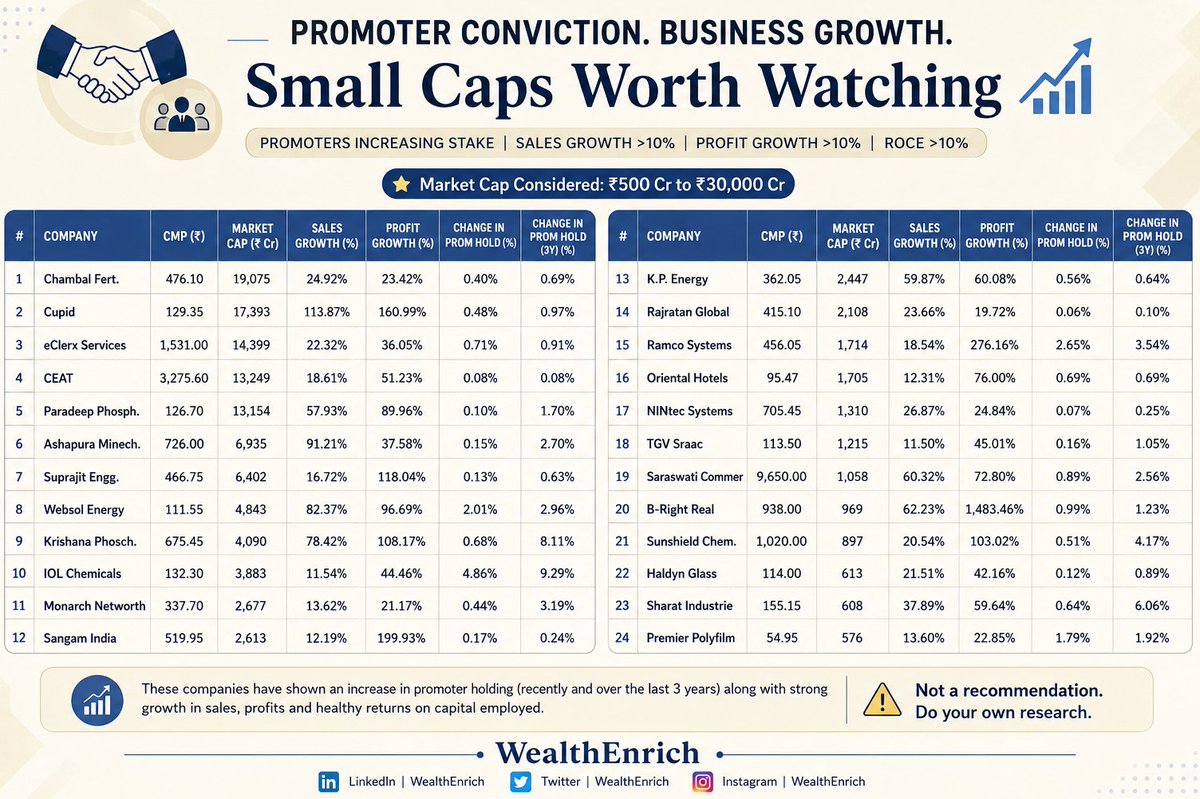
Promoters are buying more.
Sales & Profits are growing.
And these are still small cap businesses.
📈it is always interesting when both business performance and promoter conviction move in the same direction. 👇
Finnish scientists trucked in real forest dirt and grass and laid it over the gravel at four daycare yards. They let the kids dig around in it for a month. The blood tests came back with changes the researchers hadn’t expected to see so fast or so clear.
The study ran at ten daycares in two Finnish cities with 75 kids aged three to five. Four of the yards got the forest treatment: about a tennis court worth of soil and grass laid over the gravel, plus planters and peat blocks the kids could dig and climb on. Three others stuck with their normal gravel yards. The last three were daycares where the kids were already visiting real forests every day.
After one month, the variety of bacteria living on the kids’ skin shot up, and the kind that helps train the skin’s immune defenses jumped the most. Their gut bacteria started to look like the gut bacteria of the forest-visiting kids. Their blood showed more of the immune cells whose job is to keep the body from freaking out at harmless stuff like pollen and peanuts, and overall inflammation dropped. The kids on the plain gravel yards showed none of this.
Childhood asthma in the US doubled between 1980 and 1995. Food allergies in kids jumped 50 percent between 1997 and 2011, then jumped another 50 percent between 2007 and 2021. And peanut allergies in one-year-olds tripled between 2001 and 2017.
The Finnish researchers think one of the reasons is simple: kids today don’t get dirty enough. 37 percent of American preschoolers now spend an hour or less outside on a normal weekday. Their immune systems are getting trained in environments stripped of the bacteria humans have always lived around.
Aki Sinkkonen, who led the study, put it in plain words: “It would be best if children could play in puddles and everyone could dig organic soil.” The Finnish government is now helping pay for daycares across the country to make the same changes.
High cortisol is the real reason you wake up at 3-4 AM.
It also shaves 5 years off your life — tanks testosterone, locks belly fat, literally shrinks your brain.
If I wanted to fix it without medication, here are 8 things I'd do every day:
1. No food 3 hours before bed.
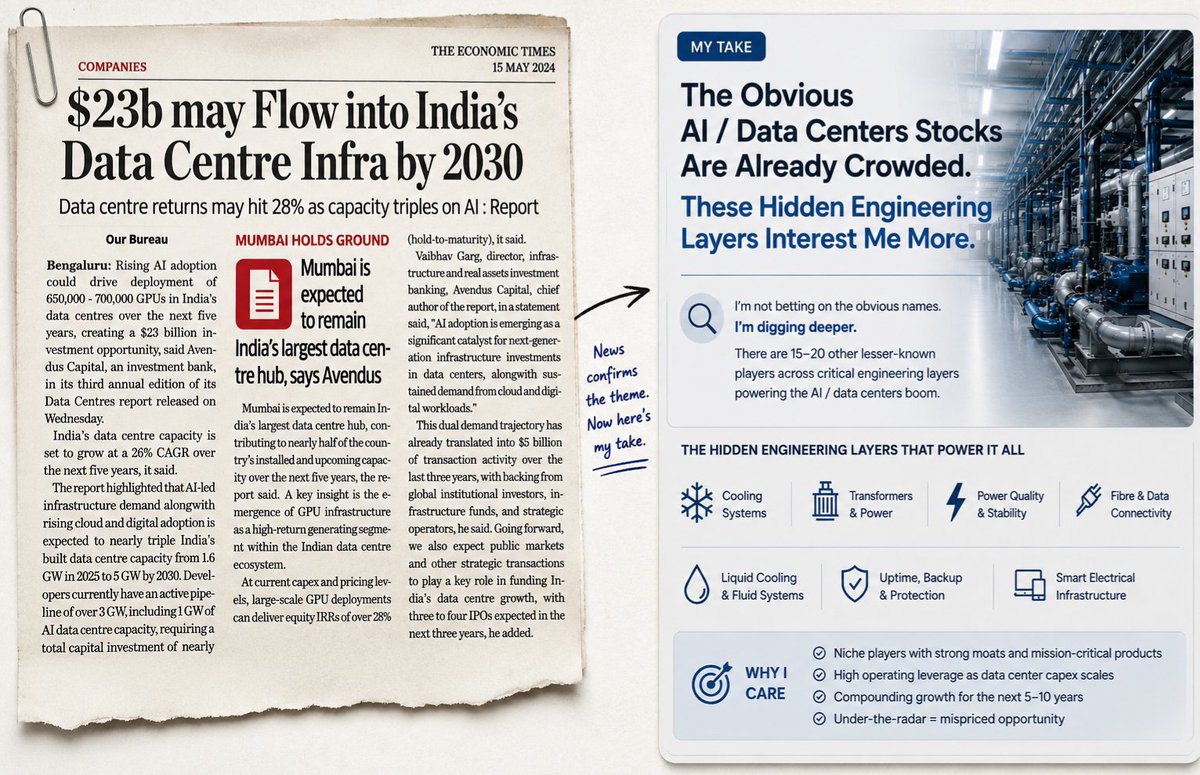
Most people are chasing the obvious AI / Data Centre names now, but I am more interested in the hidden engineering side powering this entire buildup.
The obvious large names like Siemens, ABB, Hitachi Energy, Netweb, CG Power, Schneider, Cummins, KEI, Polycab etc are strong businesses. No doubt about that, but I am personally more interested in the lesser discussed infrastructure chain connected to the Data Center ecosystem. My logic is that the hyperscale AI infrastructure needs much much more than juat GPUs. The amount of physical infra these facilities need is massive:
electricity intake, transformers, cooling systems, fibre density, backup systems, liquid circulation, electrical distribution and uninterrupted uptime engineering.
What makes this cycle very different is that AI workloads are far more power and cooling intensive than traditional cloud infrastructure. Most discussions around AI in India still remain limited to GPUs + servers, while very few people are discussing what rising AI power density could mean for cooling, transformers, electrical systems & uptime infrastructure.
Some interesting niche areas I am tracking:
1. Thermal mgm & cooling
Large: Blue Star, Amber
Niche: KRN Heat Exchanger, Aeroflex, Patels Airtemp
2. Speciality transformers & power density
Large: Hitachi Energy, CG Power
Niche: Shilchar Tech, TRIL, Bharat Bijlee
3. Grid stability & power quality
Large: ABB, Siemens
Niche: Quality Power, RMC Switchgears
4. Fibre density & backend data movement
Large: HFCL, Tejas Networks
Niche: Sterlite Tech, Aksh Optifibre, Birla Cable
5. Intelligent electrical distribution & UPS
Large: Schneider, Legrand
Niche: Marine Electricals, HBL Engg, Salzer Electronics
6. Liquid cooling & industrial fluid systems
Large: KSB, Kirloskar Bros
Niche: WPIL, Roto Pumps
7. Backup power & uptime reliability
Large: Cummins, Kirloskar Oil
Niche: Powerica, TD Power, Greaves Cotton
8. AI server deployment & electronics
Large: Netweb, Kaynes
Niche: Syrma SGS, Rashi Peripherals, Avalon Technologies
9. Enterprise networking & infra integration
Large: L&T, Tech Mahindra
Niche: Black Box, Techno Electric
India’s data centre capacity is expanding from roughly 950 MW toward nearly 1,800 MW by the end of 2026 or early 2027 & such infrastructure booms rarely create only one set of winners.
Railways created cable & transformer winners. Renewables created inverter and transmission winners. Similarly, AI infra may create hidden beneficiaries across cooling, transformers, power quality, fibre, liquid systems & uptime engg.
The obvious names may still do well, but some interesting opportunities may emerge far away from smaller engineering businesses solving some of the hardest infrastructure problems behind AI + data centres.
Which lesser names from the engineering layer of the AI infrastructure cycle interests you the most?
Nice! Google just made so that any website can invite their readers to add them as a preferred source, making it more likely for that site to be seen in AI Overviews and AI Mode.
This used to be just for news sites to be seen as preferred sources in Top Stories.
Easiest SEO traffic in 2026:
- Post on Reddit
- Post on Facebook
- Post on X
- Post on Instagram
- Post on YouTube
- Post on Pinterest
- Post on Linkedin
- Post on Hashnode
- Post on Ghost
- Post on Medium
Post on whatever parasites you can..
Highjacking the authority of large websites to rank your content for high value keywords is the biggest ROI move for almost all businesses right now. 💯📈
WAIT. This is actually insane.
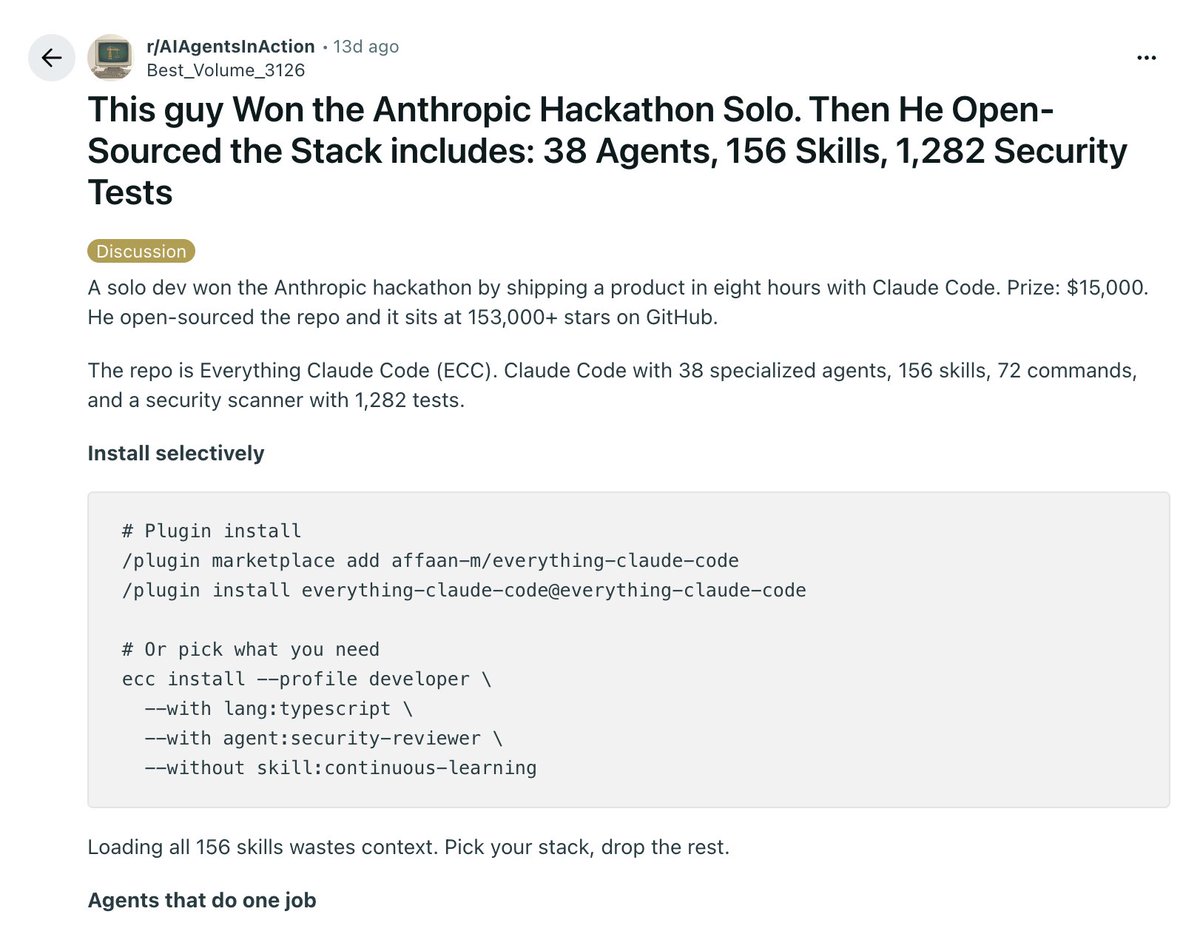
A solo dev just won the Anthropic hackathon, shipped a working product in 8 hours with Claude Code, and walked away with $15,000.
Then he open-sourced the entire stack.
153,000 stars on GitHub. Here's full setup:
→ 38 specialized agents (planner, security reviewer, debugger, code reviewer)
→ 156 skills loaded on demand (/plan, /tdd, /security-scan, /quality-gate)
→ 72 custom slash commands
→ AgentShield: 1,282 security tests across CLAUDE .md, MCP configs, hooks, skills
→ 3 Opus 4.6 agents running red-team pipelines (Attacker, Defender, Auditor)
→ Continuous learning layer that builds confidence across sessions
→ Coverage across 12 language ecosystems
This is what Claude Code looks like when someone treats it like infrastructure instead of a chatbot.
You think the ultra wealthy live in New York. London. Paris.
Some do.
But the ones making the biggest moves right now? They've already left.
Here's the top 6 places they're going:
𝟲) 𝗖𝘆𝗽𝗿𝘂𝘀
Boris Cherny, the creator of Claude Code at Anthropic, just explained why single-agent workflows are already dead
in this talk he breaks down exactly how the future is teams of agents, not better prompts:
- the 14% you lose to CLAUDE.md before typing a word
- one agent researching. one building. one reviewing. one orchestrating
- the architecture that separates hobbyists from real builders
- the 3 properties every agent team needs to actually survive
if you've been using Claude for more than a month and never left the chat window, you've been using one agent when you could be running a team of them
instead of another show tonight, watch this
make sure to bookmark it before it gets lost in your feed
the guide is in the article below
Your brain has a circuit that doesn't know you live in a city. Its only job is to monitor whether birds are still singing. When they stop, something dangerous is nearby. When they continue, the coast is clear. This wiring predates primates. These kids are being sedated by the oldest safety signal in the mammalian nervous system.
The Max Planck Institute tested this in 2022 with 295 participants. Six minutes of birdsong reduced anxiety and paranoia with medium effect sizes. Six minutes of traffic noise increased depression by the same margin. The effect worked on people who had never left dense urban environments. Their bodies responded to a signal their conscious minds had never learned.
King's College London ran a larger study. 1,292 participants, real-time mood tracking through a phone app, 26,856 assessments over three years. Hearing or seeing birds improved mental wellbeing for up to eight hours afterward. The effect held for people diagnosed with depression. Trees, plants, and waterways didn't explain it. The birds themselves were the variable.
Now here's where Italy connects to Finland. 95% of parents in the Finnish city of Oulu let their babies nap outside starting at two weeks old. A 2008 study confirmed the children took longer, deeper naps outdoors. Parents reported letting them sleep in temperatures as low as -15°C. 66% said their babies were more active afterward compared to indoor naps. The practice started as a public health initiative from Nordic maternity clinics in the early 1900s and became cultural infrastructure.
The Italian kindergarten in this video is running the same program the Nordic countries have been running for a century. Outdoor naps, natural soundscapes, no white noise machines, no blackout curtains. Meanwhile, American kindergartens have been eliminating nap time entirely to squeeze in more instruction. A UMass study showed that children who skipped naps forgot 12% of what they learned that morning. The nap itself was the learning.
The irony is that the countries spending the least on sleep technology for children are producing the best sleep outcomes. No sound machines. No apps. Just birds.
MIT just uploaded a new version of the most-watched finance lecture on OpenCourseWare.
Lecture 13: Portfolio Management. taught by Jake Xia, former Morgan Stanley practitioner who now manages endowment capital.
free. no paywall. 1 hour.
he starts by handing every student a blank piece of paper and saying: "you have $10,000. write down your portfolio. use your intuition. don't think too hard."
then he spends the next hour showing them why almost every decision they made was wrong.
the most important line from the whole lecture: "portfolio construction is really about sizing. it all comes down to sizing."
this is one of the best free lectures on portfolio management available anywhere. bookmark it.
Anthropic just paid millions to hire Andrej Karpathy.
He gave you the same knowledge for $0 the same week.
Co-founder of OpenAI, former head of AI at Tesla, the man who coined vibe coding.
No recruitment fee, no exclusive access, no $500,000 wire transfer, just a link and 29 minutes.
LLMs are ghosts not animals, vibe coding is dead, Software 3.0 is here...
My friend’s brother made ₹4 lakh LTCG from stocks this year.
First ₹1.25 lakh was tax free.
Tax on remaining gain?
Around ₹34,375.
He used his mind..
He booked ₹1.25 Lakh profit on his own name to use exemption.
And gifted the remaining stocks to his wife & sister (they had no LTCG this year).
Each got their own ₹1.25L exemption.
Tax bill → ₹0.
But the bigger challenge came later.
He had almost ₹2 crore profit in mutual funds.
Someone told him about Section 54F — reinvest gains into a residential property and save tax.
Problem?
He already had 2 residential properties.
So he thought of another route.
Transferred the mutual fund units to his mother.
She sold them & bought a residential property.
Suddenly…
₹2 Cr gain → 0 tax.
Tax planning or Tax Loophole ? 🤯