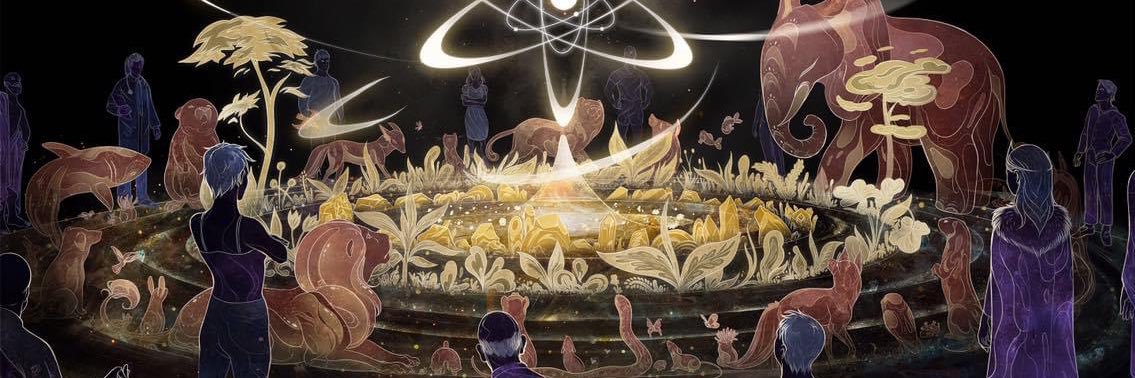
Real brains follow Dale's principle: a neuron can either excite its neighbors or suppress them, but never both. Standard deep learning ignores this and uses backpropagation.
In our new paper, Diffusing Blame, we fix this disconnect. By introducing a routing method that broadcasts error signals directly to the hidden layers, we can train networks made of dedicated positive and negative neurons to strictly obey Dale's principle, all without relying on backprop!
This method works surprisingly well on image recognition tasks despite the strict biological constraints. We also achieved competitive, backprop-free reinforcement learning on complex locomotion tasks and the open-ended Craftax environment.
It is neat to see that representation learning remains possible even when we force deep learning to play by the rules of real neurons.
🇮🇳 India Tops the World at the 56th International Physics Olympiad 2026!
🥇🥇🥇🥇🥇India's young physicists deliver an extraordinary performance at #IPhO2026 in Colombia. All five members of the Indian team win Gold Medals. 1/3
@PMOIndia@DrJitendraSingh@HBCSE_TIFR@TIFRScience
@Tesla_Optimus Hi, I'd like to offer your decommissioned Optimus a job. Inbox me if interested to showcase it as the dead paperweight near a store at Singapore border.
Thinking out loud. If all SaaS products are about to be effed, where is the moat?
Legal contract vendor capture
Regulatory niche
Expertise niche with data capture(d)
Cross collaborative LLM service, MCP node as a service.
Any more?
A 15-year-old dream has come true today. I started a PhD with the dream of creating a system that chants any Sanskrit shloka perfectly.
And here I am opening sourcing 𝐕𝐚𝐠𝐝𝐡𝐞𝐧𝐮 - 𝐀 𝐯ṛ𝐭𝐭𝐚 (𝐦𝐞𝐭𝐞𝐫) 𝐚𝐰𝐚𝐫𝐞 ś𝐥𝐨𝐤𝐚-𝐭𝐨-𝐜𝐡𝐚𝐧𝐭 𝐭𝐞𝐱𝐭-𝐭𝐨-𝐬𝐩𝐞𝐞𝐜𝐡 (TTS) 𝐬𝐲𝐬𝐭𝐞𝐦 𝐟𝐨𝐫 𝐒𝐚𝐧𝐬𝐤𝐫𝐢𝐭. This is the world's first vrutta-aware, open-source TTS for Sanskrit Chanting.
@masterofnone@KrackedDevs Present and reporting the vibe. Built a pong game, analysed world’s source code, built a foot traffic analyser, 3d map of downtown JB, scraped public cctv and image analysis, generate natural products chemicals, test their docking potential to known proteins,now a POS for my biz
@masterofnone@KrackedDevs Present and reporting the vibe. Built a pong game, analysed world’s source code, built a foot traffic analyser, 3d map of downtown JB, scraped public cctv and image analysis, generate natural products chemicals, test their docking potential to known proteins,now a POS for my biz
@paulg Only 30 billionaires out of x number of trained students, is the defining impossible or anomalous situation the politician is trying to correctly point out.
Introducing the newest Coral board, for efficient, on-device AI!
Check out the demos in the video:
- On-board speech translation
- Natural language controlling hardware
- Vision & sound generating music
Introducing ml-intern, the agent that just automated the post-training team @huggingface
It's an open-source implementation of the real research loop that our ML researchers do every day. You give it a prompt, it researches papers, goes through citations, implements ideas in GPU sandboxes, iterates and builds deeply research-backed models for any use case. All built on the Hugging Face ecosystem.
It can pull off crazy things:
We made it train the best model for scientific reasoning. It went through citations from the official benchmark paper. Found OpenScience and NemoTron-CrossThink, added 7 difficulty-filtered dataset variants from ARC/SciQ/MMLU, and ran 12 SFT runs on Qwen3-1.7B. This pushed the score 10% → 32% on GPQA in under 10h. Claude Code's best: 22.99%.
In healthcare settings it inspected available datasets, concluded they were too low quality, and wrote a script to generate 1100 synthetic data points from scratch for emergencies, hedging, multilingual etc. Then upsampled 50x for training. Beat Codex on HealthBench by 60%.
For competitive mathematics, it wrote a full GRPO script, launched training with A100 GPUs on https://t.co/udm7xGpNzR, watched rewards claim and then collapse, and ran ablations until it succeeded. All fully backed by papers, autonomously.
How it works?
ml-intern makes full use of the HF ecosystem:
- finds papers on arxiv and https://t.co/brvCC7fLPa, reads them fully, walks citation graphs, pulls datasets referenced in methodology sections and on https://t.co/hrJuRkRyzi
- browses the Hub, reads recent docs, inspects datasets and reformats them before training so it doesn't waste GPU hours on bad data
- launches training jobs on HF Jobs if no local GPUs are available, monitors runs, reads its own eval outputs, diagnoses failures, retrains
ml-intern deeply embodies how researchers work and think. It knows how data should look like and what good models feel like.
Releasing it today as a CLI and a web app you can use from your phone/desktop.
CLI: https://t.co/l3K1PslZ1n
Web + mobile: https://t.co/orko5srL4H
And the best part? We also provisioned 1k$ GPU resources and Anthropic credits for the quickest among you to use.