My main PhD paper is finally out in Nature Human Behaviour! The question: what cognitive strategies do people use when they teach, and can we nudge them toward a better one? Work with my PhD mentors @yael_niv, @mark_ho_ and @cocosci_lab. 1/5
Of course, there's also a bunch of cool modeling in the paper: the mentalizing teacher is modeled with Bayesian inverse reinforcement learning, inferring what the learner knows from their behavior alone. 5/5
Paper: https://t.co/qj8zLBVKap 5/5
Our work frames teaching as a resource-rational trade-off and why teachers rely on simple but suboptimal heuristics. Incorporating these insights could inform how think about machines that teach people or help teachers teach people more effectively. 3/3
🚨 New preprint alert! 🚨
Thrilled to share new research on teaching!
Work supervised by @cocosci_lab, @yael_niv, and @mark_ho_.
This project asks:
When do people teach by mentalizing vs with heuristics? 1/3
https://t.co/EnFTJrlOSz
Across three experiments we found variability in people’s use of mentalizing vs heuristics, show how people systematically choose to use one or the other strategy, and that brief interventions can reliably shift people toward more or less effortful strategy. 2/3
🚨In press🚨We synthesize neural and behavioral work to ask how predictions and prediction errors lead to memory integration and separation. Super fun collab with this dream team @camillecgasser (first co-author) @TarekAmerPhD@anatmaril1@LilaDavachi! https://t.co/7gHCAum6Jx
I’m thrilled to share the results from my (first) research paper! Grateful to work on an interesting problem, a unique dataset, and with great collaborates. Check it out:
I'm excited to share that my paper on resource-rational task decomposition has been published in PLOS Computational Biology! 🎉🥳
TLDR: People break large tasks down into smaller ones by balancing efficiency and the computational cost of planning.
https://t.co/pnYQ2pVjef
Dopaminergic prediction errors in the rat ventral tegmental area (VTA) must access and update multiple independent predictive streams
https://t.co/z8dkouXx6p
@todd_gureckis I think I came across one of these bots. They had by far the worst performances on my task yet had the most thorough/lengthy open response comments at the end. Showing they "should have" understood the task. Theres probably another explanation but I already got my tin foil hat on
“Feedback should be more work for the recipient than the donor.” @dylanwiliam
A point usually lost in education. If there’s no opportunity to respond to the feedback, what was the point of giving it in the first place?
Check out our new paper:
Du, Y.K., McAvan, A.S., Zheng, J., Ekstrom, A.D. (2023). Spatial memory distortions for the shapes of walked paths occur in violation of physically experienced geometry. PLoS ONE, 18(2), e0281739. https://t.co/ruLyMnKiYc
https://t.co/9RBxehXxFQ
Here at the Society for Neuroscience #SfN conference (my first time!) to share some early work on how our feelings influence whether we consider something to be ‘worth our effort’.
Come say hi at Poster Board QQ11 👋
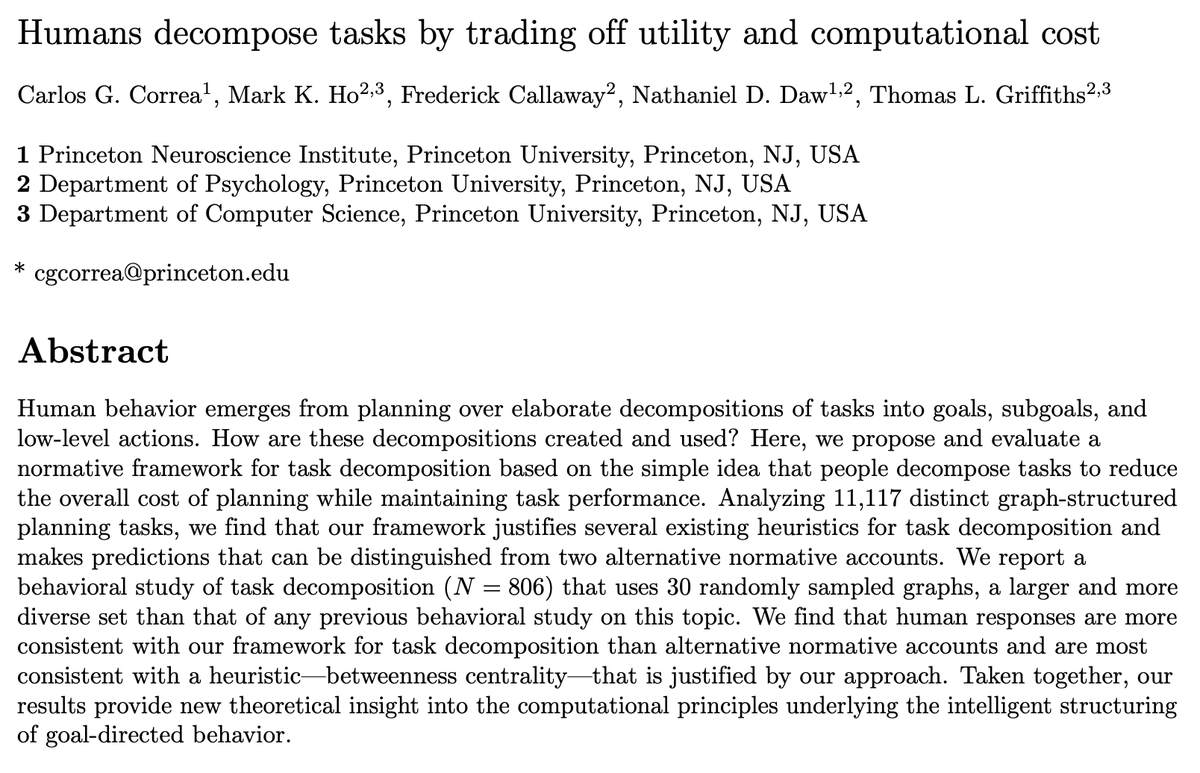
✨Preprint✨ w/ @mark_ho_, @callfredaway, @nathanieldaw, & Tom Griffiths: https://t.co/meUo4sDCys
TLDR: How do people decompose goals into subgoals? We ran a large-scale experiment to test how the computational cost of planning drives subgoal choice.
More in 🧵