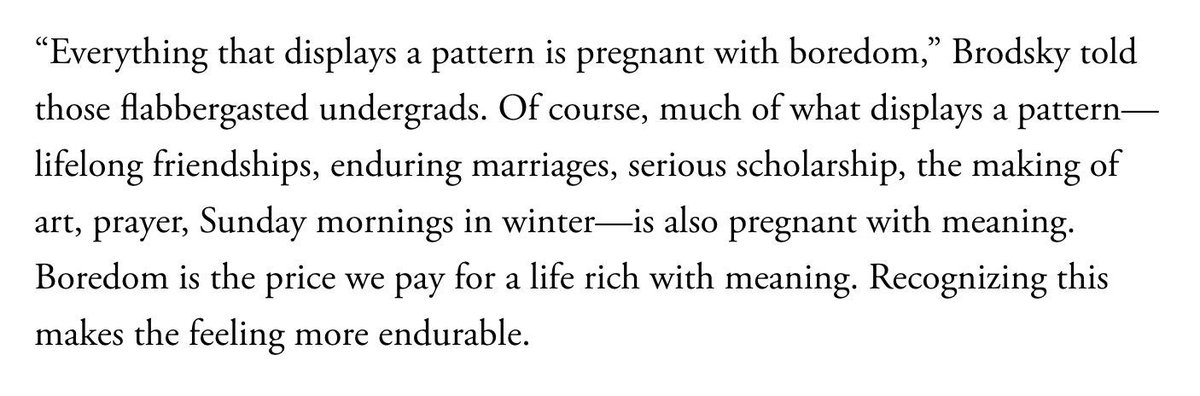
“Boredom is the price we pay for a life rich with meaning.”
This is a lovely point about the value of something we often deride as valueless, from @morbidorigin. https://t.co/bJFSyP7W7I
Most people will read this and think optimists live longer because they eat better and exercise more. The study says something wilder.
Lee et al. controlled for smoking, diet, exercise, alcohol, depression, BMI, and socioeconomic status. The longevity effect still held. The most optimistic quartile lived 11 to 15% longer and had 1.5 to 1.7x odds of reaching 85 even after removing every behavioral difference.
Which means something is happening at the level of biology, not just habits.
Rozanski’s meta-analysis across 229,391 participants found optimists carry 35% lower cardiovascular event risk. Blackburn’s Nobel Prize-winning lab at UCSF found pessimistic attitudes are associated with accelerated telomere shortening. Cortisol suppresses telomerase, the enzyme that rebuilds the protective caps on your chromosomes. So chronic negative expectation literally erodes the structures that keep your cells from aging.
The loop runs: pessimistic cognitive style → sustained HPA axis activation → elevated cortisol → telomere degradation → accelerated cellular senescence. Optimists interrupt that loop at the top. They show less emotional reactivity to stressors, faster recovery from acute stress, and they default to reframing threats as challenges rather than catastrophizing.
The part nobody talks about from this paper: the authors explicitly state optimism is modifiable. This isn’t a personality trait you’re born with. Cognitive reappraisal training, morning sunlight for cortisol rhythm regulation, deliberate breathing protocols for vagal tone, structured gratitude practices. All of these shift the prefrontal cortex patterns that determine where you sit on the optimism spectrum.
A 35% reduction in cardiac events from a trainable psychological variable is a bigger effect size than most supplements on the market. That’s the real story buried in this abstract.
Final interview.
They ask: “Are you willing to relocate or travel 50% of the time?”
Your mind blanks.
You say: “Yes, absolutely! I love traveling!”
Interview ends. No offer.
Here’s what they actually want…
“No matter how isolated you are and how lonely you feel, if you do your work truly and conscientiously, unknown allies will come and seek you.”
— Carl Jung
Jensen Huang on Critical Thinking and How He Uses AI:
"But I have to admit, I'm using AI literally every single day.
I think my cognitive skills are actually advancing.
The reason for that is because I'm not asking it to think for me.
I'm asking it to teach me things that I don't know or help me solve problems that I otherwise wouldn't be able to solve reasonably.
That's important to say, don't use it as a crutch for things you can do.
Use it for things you can't do. I'm not exactly sure what people are using it for that would cause you to not have to think.
For example, the idea of prompting an AI, the idea of asking questions.
For example, you're spending most of your time today asking me questions. In order to ask good questions, it's a highly cognitive skill.
And as a CEO, I spend most of my time asking questions. And 90% of my instructions are actually conflated with questions. It is veiled within questions.
When I'm interacting with AI, it's a questioning system.
You're asking questions. I think that in order to formulate good questions, you have to be thinking, you have to be analytical, you have to be reasoning yourself.
In order to, when you receive an answer from an AI, I wouldn't just receive it.
Usually what I do is I say, are you sure this is the best answer you can provide? I take the answer from one AI, I give it to the other AI, I ask them to critique itself.
This is no different than getting three opinions, three doctors' opinions. I do the same thing.
I ask the same question of multiple AIs, and I ask them to compare each other's notes and then give me the best of all the answers.
I think that process of critiquing, criticizing the answers of your critical thinking enhances cognitive skills.
All the people who were taking those tests, I would advise that they apply critical thinking."