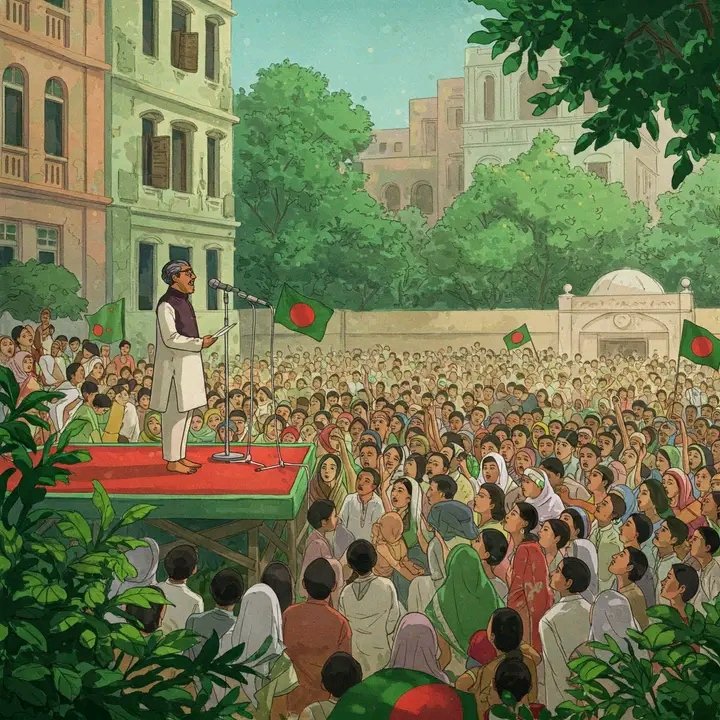
Top Tweets for #Awami_League
The political rights of the #Awami_League have been taken away, Jatiya Party Chairman GM Quader expressed his anger. He also said that by banning a large political party like the Awami League, a large group of their supporters have been kept away from everything political, economic, business and commerce. If this large political group is not given its basic political rights, political stability will not come.
#BangladeshPolitics #AwamiLeague #JatiyaParty #PoliticalRights #SouthAsiaPolitics #CurrentAffairs
The designer of this flag was Shib Narayan Das, a #Hindu and an #Awami_League student leader of Comilla district. The flag was first hoisted on March 2, 1971, marking the beginning of the journey toward a secular democratic Bangladesh.
Joy Bangla! 🇧🇩

I spoke with #Awami_League supporters in some Hindu-majority villages. They face direct life threats. BNP-Jamaat has already warned: if vote count drops, or their candidates lose, #Hindu homes will be #attacked. This is their “Fear Campaign” to seize Awami-aligned vote banks.

Ssc batch 2026, ধন্যবাদ ছোট আপুদের 💥🫶
Chuadanga Govt High School Chuadanga 💥 #Awami_League #Chuadanga #SheikhHasina #reelschallengereelschallenge @highlight ✊✊✊✊✊✊
Sheikh Hasina Hints She and Her Family May Step Back from Awami League Leadership — Reuters Interview
#hasina #Awami_League #Reuters
#InsightX71news #JMConlinemojo @MoJoJamil

বাংলাদেশের স্বাধীনতা বিরোধী দল জামাত যদি ক্ষমা চায়, জাতি কি তাদের ক্ষমা করবে?
#Bangladesh #bangabandhu #sheikh_hasina #bangladesh #awami_league #আওয়ামী_লীগ #yunus #jamaat #jamateislami
https://t.co/OrLynabtnv
A year in review.
জাতিকে মেধাশূণ্য করার এক বছর-Dr Nowrin Tamanna #yunus #ncp #awami_league #বাংলাদেশ
https://t.co/emsOfp1VYE
"Sheikh Hasina has no fear,we have not left the battleground"
Protest marches by #Awami_League and its affiliated organizations on various streets of #Dhaka in protest against the resignation of the #dictator #Yunus, who illegally seized power.
Joy Bangla
Joy Bangabandhu
#Miscreants from #BNP-Jamaat set fire to the house of #Awami_League activist Zakir Hossain in Ward No. 1 of Uttar Joynagar Union No. 4, Daulatkhan Upazila, Bhola District.
#SaveBangladesh
#BangladeshCrisis
#BNPjamatviolence
#Awami_League is the organization of independent Bangla,
AL is the org. of the masses,
AL is the org. of the spirit of the #Liberation_War.
It doesn't matter whether the Razakars' offspring,the so-called #Touhidi_Janata, want it or not.
AL will remain in the hearts of the people.
Home Affairs Adviser Jahangir Alam warned that disciplinary action would be taken against police officials if they fail to control future #Awami_League rallies.
This vindictive response came after Awami League activists held a peaceful procession yesterday in Uttara, Dhaka. Such a blatant directive to suppress rallies of the country’s largest and most historic political party is nothing short of a confession that this government is using state machinery to roll over and crush the party.
The right to assemble and hold rallies is a constitutional guarantee for any legitimate political party. How could someone in such a respected position issue such an autocratic and fascist instruction? From day one, this Yunus-led, unconstitutional and illegitimate government has shown clear hostility toward Awami League supporters—treating them not only as political opponents but as if they are stripped of even basic human rights, let alone political ones.
#BangladeshCrisis
@HCSarahCooke @EUAmbBangladesh @amnestysasia @AusHCBangladesh @GerAmbBD @State_SCA @usembassydhaka @FRauBangladesh @HCCanBangladesh @JusticeMakersBF @RomeIsabelle @MarieMasdupuy @SwedenAmbBD @deepscribble @VishnuNDTV @debdutta_c @palkisu @SamiraHussain15 @naomi2009 @gauravcsawant @smitaprakash @MaryLawlorhrds @OHCHRAsia @volker_turk @CommissionerHR @fidh_en @ProfSuryaDeva @meeganguly
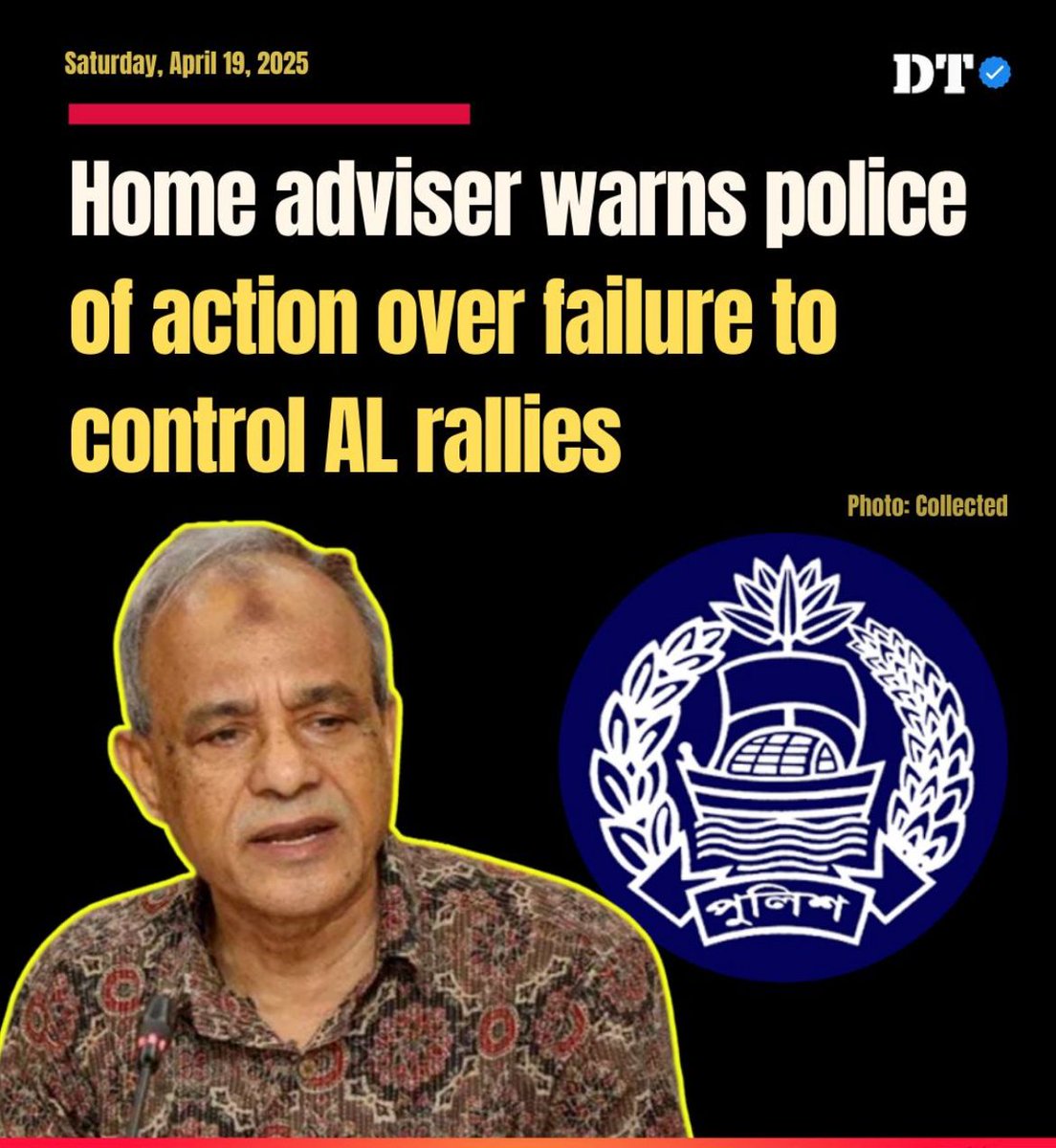
চেষ্টা করেছি (Ghibli style art এর মাধ্যমে) প্রতীকী অর্থে ৭ই মার্চের ভাষণ ও বঙ্গবন্ধুর স্বদেশ প্রত্যাবর্তন তুলে ধরতে।
জয় বাংলা
জয় বঙ্গবন্ধু ✊
#Bangladesh
#bongobondhu #SheikhMujib
#Fatherofthenation
#Awami_League
#Ghibli #ghiblistyle

This is how #Bangladesh is losing to terrorists.Bangladesh has now been transformed into a city of #death.Bangladesh is gripped by #militancy due to misogynistic behavior.This defeat is not only a defeat for the #Awami_League but also for the entire Bangladesh.
#SaveBangladesh
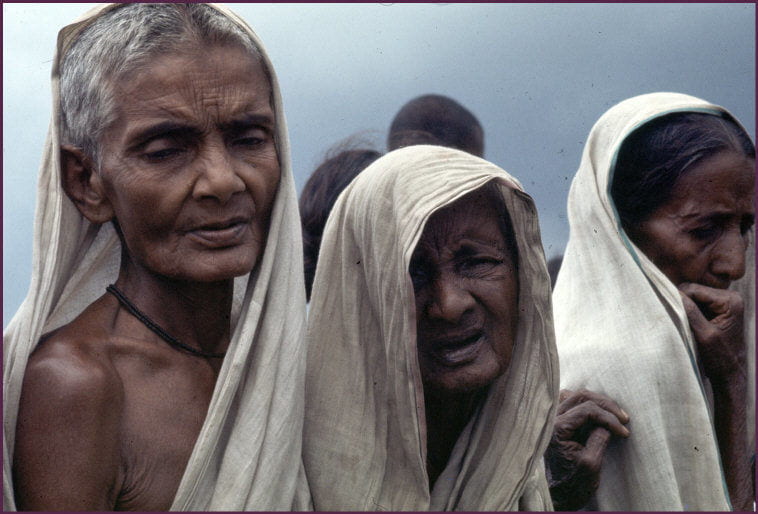
Documentation of 1971 #Hindu_genocide in #Bangladesh
In 1971, the West Pakistani rulers launched an offensive in East Pakistan to subdue the #Awami_League and its supporters, as well as Hindus.
Two major acts of butchery took place on May 20 and 21, 1971—in #Chuknagar of Khulna and #Dakra of Bagerhat—after the formation of the #Razakar force, which had assisted the #Pakistani_Army to carry out the massacres.
These incidents were the result of General Yahya Khan’s plans and orders to eradicate the Hindus and weaken the Awami League—as found in documents by senior West Pakistan government officials and army personnel.
The official wartime narratives prepared by the then-government led by military strongman Ziaur Rahman also do not contain information about the planned killings of roughly 10,000 people in Chuknagar of Khulna and over 2,000 in Dakra of Bagerhat—mostly Hindus trying to cross the border.
Even the timeline of events of 1971, developed by the Liberation War Museum, does not mention the Chuknagar and the Dakar genocide incidents. With these two, there is evidence of at least 42 incidents across the country in which the Hindus were targeted and segregated for butchery during the war.
Other documented incidents in which Hindus were massacred in large numbers include the massacres in Jathibhanga, Jharuar Beel, and Shankharipara.
An article in Time magazine, dated August 2, 1971, stated: “The Hindus, who account for three-fourths of the refugees and a majority of the dead, have borne the brunt of the Muslim military hatred. Pakistan Army Eastern Command headquarters officials in Dhaka made clear the government’s policy on East Bengal. After the elimination or exile of Hindus, their property was going to be shared among the middle-class Muslims.”
Hindus were alleged to have corrupted the Awami League. Pakistani soldiers repeatedly boasted that they came “to kill Hindus” to US Consul General Archer Blood. A witness heard an officer shouting to soldiers: “Why you have killed Muslims? We ordered you to kill only Hindus.”
US government cables noted that the minorities of Bangladesh, especially the Hindus, were specific targets of the Pakistani Army. US consulates reported methodical slaughter of Hindu men in cities starting in the first 24 hours of the crackdown, named Operation Searchlight.
Army units entered villages asking where Hindus lived; it was a “common pattern” to kill Hindu males. Hindus were identified because they were not circumcised. Sometimes the military also massacred Hindu women. There were barely any areas where no Hindus were killed. There was widespread killing of Hindu males and rapes of women.
On April 6, Blood sent a telegram to express dissent of US support for the atrocities committed by Pakistan on the Bangladesh people. The Blood Telegram, as it would become known, reported: “Hindus undeniably special focus of animal brutality.”
Senator Edward Kennedy wrote a report that was part of the United States Senate Committee on Foreign Relations testimony dated November 1, 1971. He visited the refugee camps in India.
He said: “Hardest hit have been members of the Hindu community who have been robbed of their lands and shops, systematically slaughtered, and in some places, painted with yellow patches marked ‘H’. All of this has been officially sanctioned, ordered and implemented under martial law from Islamabad. More than 60% of the Bengali refugees who fled to India were Hindus. It has been alleged that this widespread violence against Hindus was motivated by a policy to purge East Pakistan of what was seen as Hindu and Indian influences. Buddhist temples and Buddhist monks were also attacked through the course of the year.”
Foreign journalists report harrowing tales
Pulitzer Prize–winning journalist Sydney Schanberg covered the start of the war and wrote extensively on the suffering of the East Bengalis, including the Hindus, both during and after the conflict.
In a syndicated column, “The Pakistani Slaughter That Nixon Ignored,” he wrote about his return to liberated Bangladesh in 1972. “Other reminders were the yellow ‘H’ the Pakistanis had painted on the homes of Hindus, particular targets of the Muslim army” (by “Muslim army”, meaning the Pakistan Army, which had targeted Bengali Muslims as well). Bangladesh reported massacres occurring on a daily basis. One priest reported to Schanberg about the slaughter of over a thousand Hindus in the southern district of Barisal in one day. According to another priest, a meeting was called in the northeastern Sylhet district. Later troops arrived and, from the gathered crowd, selected 300 Hindus and shot them dead.
London-based The Sunday Times reported on June 13: “The Government’s policy for East Bengal was spelled out to me in the Eastern Command headquarters at Dacca. It has three elements:
1. The Bengalis have proved themselves unreliable and must be ruled by West Pakistanis.
2. The Bengalis will have to be re-educated along proper Islamic lines. The Islamization of the masses—this is the official jargon—is intended to eliminate secessionist tendencies and provide a strong religious bond with West Pakistan.
3. When the Hindus have been eliminated by death and fight, their property will be used as a golden carrot to win over the underprivileged Muslim middle class. This will provide the base for future administrative and political structures.
According to RJ Rummel, professor of political science at the University of Hawaii: “The genocide and gendercidal atrocities were also perpetrated by lower-ranking officers and ordinary soldiers.”
These “willing executioners” were fueled by an abiding anti-Bengali racism, especially against the Hindu minority. “Bengalis were often compared with monkeys and chickens.”
In his book, Rummel describes a chilling genocidal ritual, reminiscent of Nazi procedure towards Jewish males: “In what became province-wide acts of genocide, Hindus were sought out and killed on the spot. As a matter of course, soldiers would check males for the obligatory circumcision among Moslems. If circumcised, they might live; if not, sure death.”
Rummel writes: “The human death toll over only 267 days was incredible. Just to give for five out of the eighteen districts some incomplete statistics published in Bangladesh newspapers or by an Inquiry Committee, the Pakistani army killed 100,000 Bengalis in Dacca, 150,000 in Khulna, 75,000 in Jessore, 95,000 in Comilla, and 100,000 in Chittagong. For eighteen districts, the total is 1,247,000 killed. This was an incomplete toll, and to this day no one really knows the final toll. Some estimates of the democide are much lower — one is of 300,000 dead — but most range from 1 million to 3 million. … The Pakistani army and allied paramilitary groups killed about one out of every sixty-one people in Pakistan overall; one out of every twenty-five Bengalis, Hindus, and others in East Pakistan. If the rate of killing for all of Pakistan is annualized over the years the Yahya martial law regime was in power (March 1969 to December 1971), then this one regime was more lethal than that of the Soviet Union, China under the communists, or Japan under the military (even through World War II).”
The Wall Street Journal on July 27 reported: “To help control of Bengali population, the army has been setting up a network of peace committees superimposed upon the normal civil administration, which the army cannot fully rely upon. Peace Committee members are drawn from Biharis and from the Muslim Leagues and Jamat-e-Islami. The peace committees serve as the agent of army, informing on civil administration as well as on general populace. They are also in charge of confiscating and redistribution of shops and lands from Hindu and pro-independence Bengalis. The peace committee also recruits Razakars. Many of them are common criminals who have thrown their lots with the (Pakistan) army.”
Journalist Dan Coggin quoted one Pakistani captain as telling him: “We can kill anyone for anything. We are accountable to no one”. This is the arrogance of Power.
Pakistani mindset
Ethnic (Hindu) cleansing, forced pregnancy of Hindu women, and deliberate killing of Hindu males to exterminate Bangalee Hindus as a race were the key agenda of the Pakistani military.
A Pakistani Soldier confessed: “…… we were told to kill the Hindus and Kafirs (non-believer in God). One day in June, we cordoned a village and were ordered to kill the Kafirs in that area. We found all the village women reciting from the Holy Quran, and the men holding special congregational prayers seeking God’s mercy. But they were unlucky. Our commanding officer ordered us not to waste any time.”
Lt Col Aziz Ahmed Khan reported that in May 1971 there was a written order to kill Hindus, and that General Niazi would ask troops how many Hindus they had killed.
General Niazi said: “It was a low lying land of low lying people. The Hindus among the Bengalis were as Jews to the Nazis: scum and vermin that [should] best be exterminated. As to the Moslem Bengalis, they were to live only on the sufferance of the soldiers: any infraction, any suspicion cast on them, any need for reprisal, could mean their death. And the soldiers were free to kill at will.”
The Punjabi Governor of East Pakistan, Firoz Khan Noon described the Bengali voice of dissent as a conspiracy of “clever politicians and disruptionists from within the Muslim community and caste Hindus and communists from Calcutta as well as from inside Pakistan.”
A former Brigadier stated that Farman Ali was the principal architect of the plan to crush the Bengalis with force and was directly involved in the Hindu Basti massacre.
Major Rathore told Anthony Mascarenhas at Comilla in April 1971: “Now under the cover of fighting we have an excellent opportunity of finishing them off…Of course, we are only killing the Hindu men. We are soldiers, not cowards like the rebels.”
At 9th Division HQ at Comilla, Major Bashir justified the military action by stating that Bengali Muslims were “Hindu at heart” and this was a war between pure and impure.
His superior Colonel Naim justified the killing of Hindu civilian population to prevent a Hindu takeover of Bengali commerce and culture. Hindus “undermined the Muslim masses”. He said Bengali culture to a great extent was Hindu culture and “we have to sort them out to restore the land to the people.”
Journalist Dan Coggin quoted one Punjabi captain as telling him: ‘We can kill anyone for anything. We are accountable to no one.’ This is the arrogance of Power.”
In September 1947, the Pakistan government printed currency notes, issued coins, printed money orders and post cards in English and Urdu only. In 1947, the circular of Pakistan Public Service Commission had made provision of Urdu, English, Hindi, Sanskrit, Latin and other languages but made no provision of Bengali.
In an attempt to “purify” Bengali culture of Hindu influences, Pakistan government decided to change the script of Bengali. In total disregard of the local sentiments and even constitution itself, central government set up centres teaching Bengali in Arabic script. The Bengali protest started on this language issue.
Colonel Nadir Ali, retired Army Officer, Punjabi poet and short story writer, said: “I was ordered. I frequently met Mr Fazlul Qadir Chaudhry, Maulana Farid Ahmed and many other Muslim League and Jamaat leaders, ‘it is Mujib’s home district. Kill as many bastards as you can and make sure there is no Hindu left alive.’ In the Army, you wear no separate uniform. We all share the guilt. We may not have killed. But we connived and were part of the same force.”
He added: “During the fateful months preceding the dismemberment of Pakistan, I served as a young Captain, meantime promoted to the rank of the Major, in Dhaka as well as Chittagong. In my position as second-in-command and later as commander, I served with 3 Commando Battalion. My first action was in mid April 1971. ‘It is Mujib-ur-Rahman’s home district. It is a hard area. Kill as many bastards as you can and make sure there is no Hindu left alive,’ I was ordered. I replied, ‘Sir, I do not kill unarmed civilians who do not fire at me.’ ‘Kill the Hindus. It is an order for everyone. Don’t show me your commando finesse!’
He said: “An order was given to kill the Hindus. I received the same order many times and was reminded of it. The West Pakistani soldiery considered that Kosher. The Hamood Ur Rehman Commission Report mentions this order. Of the ninety-three lakh (9.3 million) refugees in India, ninety lakh (9 million) were Hindus.”
Noted Pakistani writer Ahmad Salim, a former professor of the Karachi University, said that before the independence of Bangladesh the Pakistan government told the people of the then West Pakistan that the then East Pakistanis were Hindu due to their multi-dimensional culture.
Explaining the apprehensions of West Pakistanis, Niazi stated: “The government would be formed by Bengalis, the iron fist in the velvet glove would be that of Hindus. After the sweeping victory of Awami League in 1970, Yahya’s intelligence Chief, Major General Akbar Khan, stated ‘we will not hand over power to these bastards.’”
https://t.co/prrwvtgt2b
![probirbidhan's tweet photo. Documentation of 1971 #Hindu_genocide in #Bangladesh
In 1971, the West Pakistani rulers launched an offensive in East Pakistan to subdue the #Awami_League and its supporters, as well as Hindus.
Two major acts of butchery took place on May 20 and 21, 1971—in #Chuknagar of Khulna and #Dakra of Bagerhat—after the formation of the #Razakar force, which had assisted the #Pakistani_Army to carry out the massacres.
These incidents were the result of General Yahya Khan’s plans and orders to eradicate the Hindus and weaken the Awami League—as found in documents by senior West Pakistan government officials and army personnel.
The official wartime narratives prepared by the then-government led by military strongman Ziaur Rahman also do not contain information about the planned killings of roughly 10,000 people in Chuknagar of Khulna and over 2,000 in Dakra of Bagerhat—mostly Hindus trying to cross the border.
Even the timeline of events of 1971, developed by the Liberation War Museum, does not mention the Chuknagar and the Dakar genocide incidents. With these two, there is evidence of at least 42 incidents across the country in which the Hindus were targeted and segregated for butchery during the war.
Other documented incidents in which Hindus were massacred in large numbers include the massacres in Jathibhanga, Jharuar Beel, and Shankharipara.
An article in Time magazine, dated August 2, 1971, stated: “The Hindus, who account for three-fourths of the refugees and a majority of the dead, have borne the brunt of the Muslim military hatred. Pakistan Army Eastern Command headquarters officials in Dhaka made clear the government’s policy on East Bengal. After the elimination or exile of Hindus, their property was going to be shared among the middle-class Muslims.”
Hindus were alleged to have corrupted the Awami League. Pakistani soldiers repeatedly boasted that they came “to kill Hindus” to US Consul General Archer Blood. A witness heard an officer shouting to soldiers: “Why you have killed Muslims? We ordered you to kill only Hindus.”
US government cables noted that the minorities of Bangladesh, especially the Hindus, were specific targets of the Pakistani Army. US consulates reported methodical slaughter of Hindu men in cities starting in the first 24 hours of the crackdown, named Operation Searchlight.
Army units entered villages asking where Hindus lived; it was a “common pattern” to kill Hindu males. Hindus were identified because they were not circumcised. Sometimes the military also massacred Hindu women. There were barely any areas where no Hindus were killed. There was widespread killing of Hindu males and rapes of women.
On April 6, Blood sent a telegram to express dissent of US support for the atrocities committed by Pakistan on the Bangladesh people. The Blood Telegram, as it would become known, reported: “Hindus undeniably special focus of animal brutality.”
Senator Edward Kennedy wrote a report that was part of the United States Senate Committee on Foreign Relations testimony dated November 1, 1971. He visited the refugee camps in India.
He said: “Hardest hit have been members of the Hindu community who have been robbed of their lands and shops, systematically slaughtered, and in some places, painted with yellow patches marked ‘H’. All of this has been officially sanctioned, ordered and implemented under martial law from Islamabad. More than 60% of the Bengali refugees who fled to India were Hindus. It has been alleged that this widespread violence against Hindus was motivated by a policy to purge East Pakistan of what was seen as Hindu and Indian influences. Buddhist temples and Buddhist monks were also attacked through the course of the year.”
Foreign journalists report harrowing tales
Pulitzer Prize–winning journalist Sydney Schanberg covered the start of the war and wrote extensively on the suffering of the East Bengalis, including the Hindus, both during and after the conflict.
In a syndicated column, “The Pakistani Slaughter That Nixon Ignored,” he wrote about his return to liberated Bangladesh in 1972. “Other reminders were the yellow ‘H’ the Pakistanis had painted on the homes of Hindus, particular targets of the Muslim army” (by “Muslim army”, meaning the Pakistan Army, which had targeted Bengali Muslims as well). Bangladesh reported massacres occurring on a daily basis. One priest reported to Schanberg about the slaughter of over a thousand Hindus in the southern district of Barisal in one day. According to another priest, a meeting was called in the northeastern Sylhet district. Later troops arrived and, from the gathered crowd, selected 300 Hindus and shot them dead.
London-based The Sunday Times reported on June 13: “The Government’s policy for East Bengal was spelled out to me in the Eastern Command headquarters at Dacca. It has three elements:
1. The Bengalis have proved themselves unreliable and must be ruled by West Pakistanis.
2. The Bengalis will have to be re-educated along proper Islamic lines. The Islamization of the masses—this is the official jargon—is intended to eliminate secessionist tendencies and provide a strong religious bond with West Pakistan.
3. When the Hindus have been eliminated by death and fight, their property will be used as a golden carrot to win over the underprivileged Muslim middle class. This will provide the base for future administrative and political structures.
According to RJ Rummel, professor of political science at the University of Hawaii: “The genocide and gendercidal atrocities were also perpetrated by lower-ranking officers and ordinary soldiers.”
These “willing executioners” were fueled by an abiding anti-Bengali racism, especially against the Hindu minority. “Bengalis were often compared with monkeys and chickens.”
In his book, Rummel describes a chilling genocidal ritual, reminiscent of Nazi procedure towards Jewish males: “In what became province-wide acts of genocide, Hindus were sought out and killed on the spot. As a matter of course, soldiers would check males for the obligatory circumcision among Moslems. If circumcised, they might live; if not, sure death.”
Rummel writes: “The human death toll over only 267 days was incredible. Just to give for five out of the eighteen districts some incomplete statistics published in Bangladesh newspapers or by an Inquiry Committee, the Pakistani army killed 100,000 Bengalis in Dacca, 150,000 in Khulna, 75,000 in Jessore, 95,000 in Comilla, and 100,000 in Chittagong. For eighteen districts, the total is 1,247,000 killed. This was an incomplete toll, and to this day no one really knows the final toll. Some estimates of the democide are much lower — one is of 300,000 dead — but most range from 1 million to 3 million. … The Pakistani army and allied paramilitary groups killed about one out of every sixty-one people in Pakistan overall; one out of every twenty-five Bengalis, Hindus, and others in East Pakistan. If the rate of killing for all of Pakistan is annualized over the years the Yahya martial law regime was in power (March 1969 to December 1971), then this one regime was more lethal than that of the Soviet Union, China under the communists, or Japan under the military (even through World War II).”
The Wall Street Journal on July 27 reported: “To help control of Bengali population, the army has been setting up a network of peace committees superimposed upon the normal civil administration, which the army cannot fully rely upon. Peace Committee members are drawn from Biharis and from the Muslim Leagues and Jamat-e-Islami. The peace committees serve as the agent of army, informing on civil administration as well as on general populace. They are also in charge of confiscating and redistribution of shops and lands from Hindu and pro-independence Bengalis. The peace committee also recruits Razakars. Many of them are common criminals who have thrown their lots with the (Pakistan) army.”
Journalist Dan Coggin quoted one Pakistani captain as telling him: “We can kill anyone for anything. We are accountable to no one”. This is the arrogance of Power.
Pakistani mindset
Ethnic (Hindu) cleansing, forced pregnancy of Hindu women, and deliberate killing of Hindu males to exterminate Bangalee Hindus as a race were the key agenda of the Pakistani military.
A Pakistani Soldier confessed: “…… we were told to kill the Hindus and Kafirs (non-believer in God). One day in June, we cordoned a village and were ordered to kill the Kafirs in that area. We found all the village women reciting from the Holy Quran, and the men holding special congregational prayers seeking God’s mercy. But they were unlucky. Our commanding officer ordered us not to waste any time.”
Lt Col Aziz Ahmed Khan reported that in May 1971 there was a written order to kill Hindus, and that General Niazi would ask troops how many Hindus they had killed.
General Niazi said: “It was a low lying land of low lying people. The Hindus among the Bengalis were as Jews to the Nazis: scum and vermin that [should] best be exterminated. As to the Moslem Bengalis, they were to live only on the sufferance of the soldiers: any infraction, any suspicion cast on them, any need for reprisal, could mean their death. And the soldiers were free to kill at will.”
The Punjabi Governor of East Pakistan, Firoz Khan Noon described the Bengali voice of dissent as a conspiracy of “clever politicians and disruptionists from within the Muslim community and caste Hindus and communists from Calcutta as well as from inside Pakistan.”
A former Brigadier stated that Farman Ali was the principal architect of the plan to crush the Bengalis with force and was directly involved in the Hindu Basti massacre.
Major Rathore told Anthony Mascarenhas at Comilla in April 1971: “Now under the cover of fighting we have an excellent opportunity of finishing them off…Of course, we are only killing the Hindu men. We are soldiers, not cowards like the rebels.”
At 9th Division HQ at Comilla, Major Bashir justified the military action by stating that Bengali Muslims were “Hindu at heart” and this was a war between pure and impure.
His superior Colonel Naim justified the killing of Hindu civilian population to prevent a Hindu takeover of Bengali commerce and culture. Hindus “undermined the Muslim masses”. He said Bengali culture to a great extent was Hindu culture and “we have to sort them out to restore the land to the people.”
Journalist Dan Coggin quoted one Punjabi captain as telling him: ‘We can kill anyone for anything. We are accountable to no one.’ This is the arrogance of Power.”
In September 1947, the Pakistan government printed currency notes, issued coins, printed money orders and post cards in English and Urdu only. In 1947, the circular of Pakistan Public Service Commission had made provision of Urdu, English, Hindi, Sanskrit, Latin and other languages but made no provision of Bengali.
In an attempt to “purify” Bengali culture of Hindu influences, Pakistan government decided to change the script of Bengali. In total disregard of the local sentiments and even constitution itself, central government set up centres teaching Bengali in Arabic script. The Bengali protest started on this language issue.
Colonel Nadir Ali, retired Army Officer, Punjabi poet and short story writer, said: “I was ordered. I frequently met Mr Fazlul Qadir Chaudhry, Maulana Farid Ahmed and many other Muslim League and Jamaat leaders, ‘it is Mujib’s home district. Kill as many bastards as you can and make sure there is no Hindu left alive.’ In the Army, you wear no separate uniform. We all share the guilt. We may not have killed. But we connived and were part of the same force.”
He added: “During the fateful months preceding the dismemberment of Pakistan, I served as a young Captain, meantime promoted to the rank of the Major, in Dhaka as well as Chittagong. In my position as second-in-command and later as commander, I served with 3 Commando Battalion. My first action was in mid April 1971. ‘It is Mujib-ur-Rahman’s home district. It is a hard area. Kill as many bastards as you can and make sure there is no Hindu left alive,’ I was ordered. I replied, ‘Sir, I do not kill unarmed civilians who do not fire at me.’ ‘Kill the Hindus. It is an order for everyone. Don’t show me your commando finesse!’
He said: “An order was given to kill the Hindus. I received the same order many times and was reminded of it. The West Pakistani soldiery considered that Kosher. The Hamood Ur Rehman Commission Report mentions this order. Of the ninety-three lakh (9.3 million) refugees in India, ninety lakh (9 million) were Hindus.”
Noted Pakistani writer Ahmad Salim, a former professor of the Karachi University, said that before the independence of Bangladesh the Pakistan government told the people of the then West Pakistan that the then East Pakistanis were Hindu due to their multi-dimensional culture.
Explaining the apprehensions of West Pakistanis, Niazi stated: “The government would be formed by Bengalis, the iron fist in the velvet glove would be that of Hindus. After the sweeping victory of Awami League in 1970, Yahya’s intelligence Chief, Major General Akbar Khan, stated ‘we will not hand over power to these bastards.’”
https://t.co/prrwvtgt2b](https://pbs.twimg.com/media/Gk6GVXlWMAAv7dd.jpg)
আগামী নির্বাচনে আওয়ামী লীগ অংশগ্রহণ করবে কি না...
#Rtvonline #election #Awami_League
https://t.co/UDQJt3Un3m

⚠️"New government will take over," said Bangladesh Army Chief General Waker Uz Zaman.
📢#Bangladeshi_Army has announced #Military_Rule in B'desh !
Shocking turns of events!
🚨 From students' protests to overthrowing the ruling #Awami_League Govt !
#SheikhHasina

#Bangladesh_Chhatra_League a student wing of #Awami_League, they are open firing on students.
#WE_NEED_YOUR_HELP
#StepDownHasina
#DictatorHasina
#HasinaMustStepDown
#StudentGenocide
#QuotaMovement
#QuotaReformationMovement
#StudentsUnderAttack
#BangladeshBleeding
#StudentProtest
The civilians aren't safe from the #Bangladesh_Chhatra_League a student wing of #Awami_League. They are carrying #Guns, #Local_Weapons & etc to attack on students.
#WE_NEED_YOUR_HELP
#QuotaMovement
#StudentsUnderAttack
#StepDownHasina
#DictatorHasina
#BangladeshBleeding
#BBC
#CNN
Todays evening, #Bangladesh_Chhatra_League a student wing of #Awami_League were carrying illegal weapons in Uttara sector 11. Ruthlessly they are attacking students.
#WE_NEED_YOUR_HELP
#QuotaMovement
#QuotaReformationMovement
#StudentsUnderAttack
#StepDownHasina
#DictatorHasina

Last Seen Hashtags on Sotwe
teenageee
Seen from United States
snapchat
Seen from Ukraine
public whore
Seen from Turkey
Bokep anak sekolah
Seen from Indonesia
maltepetrAvesti
Seen from Turkey
angelemily
Seen from Turkey
bursatravesti
Seen from Turkey
cockmassage
Seen from Belgium
kyliepage
Seen from Saudi Arabia
kayseripasif
Seen from Turkey
Most Popular Users

Elon Musk 
@elonmusk
241.5M followers

Barack Obama 
@barackobama
118.8M followers

Cristiano Ronaldo 
@cristiano
114.5M followers

Donald J. Trump 
@realdonaldtrump
111.8M followers

Narendra Modi 
@narendramodi
107.1M followers

Rihanna 
@rihanna
98.7M followers

NASA 
@nasa
92.3M followers

Justin Bieber 
@justinbieber
91.8M followers

KATY PERRY 
@katyperry
90M followers

Taylor Swift 
@taylorswift13
84M followers

Lady Gaga 
@ladygaga
75.5M followers

Virat Kohli 
@imvkohli
73.5M followers

Kim Kardashian 
@kimkardashian
70.9M followers

YouTube 
@youtube
68.8M followers

Neymar Jr 
@neymarjr
66.5M followers

Bill Gates 
@billgates
65.3M followers

Selena Gomez 
@selenagomez
63.1M followers

The Ellen Show
@theellenshow
62.2M followers

CNN 
@cnn
61.7M followers

X 
@x
60.7M followers


![probirbidhan's tweet photo. Documentation of 1971 #Hindu_genocide in #Bangladesh
In 1971, the West Pakistani rulers launched an offensive in East Pakistan to subdue the #Awami_League and its supporters, as well as Hindus.
Two major acts of butchery took place on May 20 and 21, 1971—in #Chuknagar of Khulna and #Dakra of Bagerhat—after the formation of the #Razakar force, which had assisted the #Pakistani_Army to carry out the massacres.
These incidents were the result of General Yahya Khan’s plans and orders to eradicate the Hindus and weaken the Awami League—as found in documents by senior West Pakistan government officials and army personnel.
The official wartime narratives prepared by the then-government led by military strongman Ziaur Rahman also do not contain information about the planned killings of roughly 10,000 people in Chuknagar of Khulna and over 2,000 in Dakra of Bagerhat—mostly Hindus trying to cross the border.
Even the timeline of events of 1971, developed by the Liberation War Museum, does not mention the Chuknagar and the Dakar genocide incidents. With these two, there is evidence of at least 42 incidents across the country in which the Hindus were targeted and segregated for butchery during the war.
Other documented incidents in which Hindus were massacred in large numbers include the massacres in Jathibhanga, Jharuar Beel, and Shankharipara.
An article in Time magazine, dated August 2, 1971, stated: “The Hindus, who account for three-fourths of the refugees and a majority of the dead, have borne the brunt of the Muslim military hatred. Pakistan Army Eastern Command headquarters officials in Dhaka made clear the government’s policy on East Bengal. After the elimination or exile of Hindus, their property was going to be shared among the middle-class Muslims.”
Hindus were alleged to have corrupted the Awami League. Pakistani soldiers repeatedly boasted that they came “to kill Hindus” to US Consul General Archer Blood. A witness heard an officer shouting to soldiers: “Why you have killed Muslims? We ordered you to kill only Hindus.”
US government cables noted that the minorities of Bangladesh, especially the Hindus, were specific targets of the Pakistani Army. US consulates reported methodical slaughter of Hindu men in cities starting in the first 24 hours of the crackdown, named Operation Searchlight.
Army units entered villages asking where Hindus lived; it was a “common pattern” to kill Hindu males. Hindus were identified because they were not circumcised. Sometimes the military also massacred Hindu women. There were barely any areas where no Hindus were killed. There was widespread killing of Hindu males and rapes of women.
On April 6, Blood sent a telegram to express dissent of US support for the atrocities committed by Pakistan on the Bangladesh people. The Blood Telegram, as it would become known, reported: “Hindus undeniably special focus of animal brutality.”
Senator Edward Kennedy wrote a report that was part of the United States Senate Committee on Foreign Relations testimony dated November 1, 1971. He visited the refugee camps in India.
He said: “Hardest hit have been members of the Hindu community who have been robbed of their lands and shops, systematically slaughtered, and in some places, painted with yellow patches marked ‘H’. All of this has been officially sanctioned, ordered and implemented under martial law from Islamabad. More than 60% of the Bengali refugees who fled to India were Hindus. It has been alleged that this widespread violence against Hindus was motivated by a policy to purge East Pakistan of what was seen as Hindu and Indian influences. Buddhist temples and Buddhist monks were also attacked through the course of the year.”
Foreign journalists report harrowing tales
Pulitzer Prize–winning journalist Sydney Schanberg covered the start of the war and wrote extensively on the suffering of the East Bengalis, including the Hindus, both during and after the conflict.
In a syndicated column, “The Pakistani Slaughter That Nixon Ignored,” he wrote about his return to liberated Bangladesh in 1972. “Other reminders were the yellow ‘H’ the Pakistanis had painted on the homes of Hindus, particular targets of the Muslim army” (by “Muslim army”, meaning the Pakistan Army, which had targeted Bengali Muslims as well). Bangladesh reported massacres occurring on a daily basis. One priest reported to Schanberg about the slaughter of over a thousand Hindus in the southern district of Barisal in one day. According to another priest, a meeting was called in the northeastern Sylhet district. Later troops arrived and, from the gathered crowd, selected 300 Hindus and shot them dead.
London-based The Sunday Times reported on June 13: “The Government’s policy for East Bengal was spelled out to me in the Eastern Command headquarters at Dacca. It has three elements:
1. The Bengalis have proved themselves unreliable and must be ruled by West Pakistanis.
2. The Bengalis will have to be re-educated along proper Islamic lines. The Islamization of the masses—this is the official jargon—is intended to eliminate secessionist tendencies and provide a strong religious bond with West Pakistan.
3. When the Hindus have been eliminated by death and fight, their property will be used as a golden carrot to win over the underprivileged Muslim middle class. This will provide the base for future administrative and political structures.
According to RJ Rummel, professor of political science at the University of Hawaii: “The genocide and gendercidal atrocities were also perpetrated by lower-ranking officers and ordinary soldiers.”
These “willing executioners” were fueled by an abiding anti-Bengali racism, especially against the Hindu minority. “Bengalis were often compared with monkeys and chickens.”
In his book, Rummel describes a chilling genocidal ritual, reminiscent of Nazi procedure towards Jewish males: “In what became province-wide acts of genocide, Hindus were sought out and killed on the spot. As a matter of course, soldiers would check males for the obligatory circumcision among Moslems. If circumcised, they might live; if not, sure death.”
Rummel writes: “The human death toll over only 267 days was incredible. Just to give for five out of the eighteen districts some incomplete statistics published in Bangladesh newspapers or by an Inquiry Committee, the Pakistani army killed 100,000 Bengalis in Dacca, 150,000 in Khulna, 75,000 in Jessore, 95,000 in Comilla, and 100,000 in Chittagong. For eighteen districts, the total is 1,247,000 killed. This was an incomplete toll, and to this day no one really knows the final toll. Some estimates of the democide are much lower — one is of 300,000 dead — but most range from 1 million to 3 million. … The Pakistani army and allied paramilitary groups killed about one out of every sixty-one people in Pakistan overall; one out of every twenty-five Bengalis, Hindus, and others in East Pakistan. If the rate of killing for all of Pakistan is annualized over the years the Yahya martial law regime was in power (March 1969 to December 1971), then this one regime was more lethal than that of the Soviet Union, China under the communists, or Japan under the military (even through World War II).”
The Wall Street Journal on July 27 reported: “To help control of Bengali population, the army has been setting up a network of peace committees superimposed upon the normal civil administration, which the army cannot fully rely upon. Peace Committee members are drawn from Biharis and from the Muslim Leagues and Jamat-e-Islami. The peace committees serve as the agent of army, informing on civil administration as well as on general populace. They are also in charge of confiscating and redistribution of shops and lands from Hindu and pro-independence Bengalis. The peace committee also recruits Razakars. Many of them are common criminals who have thrown their lots with the (Pakistan) army.”
Journalist Dan Coggin quoted one Pakistani captain as telling him: “We can kill anyone for anything. We are accountable to no one”. This is the arrogance of Power.
Pakistani mindset
Ethnic (Hindu) cleansing, forced pregnancy of Hindu women, and deliberate killing of Hindu males to exterminate Bangalee Hindus as a race were the key agenda of the Pakistani military.
A Pakistani Soldier confessed: “…… we were told to kill the Hindus and Kafirs (non-believer in God). One day in June, we cordoned a village and were ordered to kill the Kafirs in that area. We found all the village women reciting from the Holy Quran, and the men holding special congregational prayers seeking God’s mercy. But they were unlucky. Our commanding officer ordered us not to waste any time.”
Lt Col Aziz Ahmed Khan reported that in May 1971 there was a written order to kill Hindus, and that General Niazi would ask troops how many Hindus they had killed.
General Niazi said: “It was a low lying land of low lying people. The Hindus among the Bengalis were as Jews to the Nazis: scum and vermin that [should] best be exterminated. As to the Moslem Bengalis, they were to live only on the sufferance of the soldiers: any infraction, any suspicion cast on them, any need for reprisal, could mean their death. And the soldiers were free to kill at will.”
The Punjabi Governor of East Pakistan, Firoz Khan Noon described the Bengali voice of dissent as a conspiracy of “clever politicians and disruptionists from within the Muslim community and caste Hindus and communists from Calcutta as well as from inside Pakistan.”
A former Brigadier stated that Farman Ali was the principal architect of the plan to crush the Bengalis with force and was directly involved in the Hindu Basti massacre.
Major Rathore told Anthony Mascarenhas at Comilla in April 1971: “Now under the cover of fighting we have an excellent opportunity of finishing them off…Of course, we are only killing the Hindu men. We are soldiers, not cowards like the rebels.”
At 9th Division HQ at Comilla, Major Bashir justified the military action by stating that Bengali Muslims were “Hindu at heart” and this was a war between pure and impure.
His superior Colonel Naim justified the killing of Hindu civilian population to prevent a Hindu takeover of Bengali commerce and culture. Hindus “undermined the Muslim masses”. He said Bengali culture to a great extent was Hindu culture and “we have to sort them out to restore the land to the people.”
Journalist Dan Coggin quoted one Punjabi captain as telling him: ‘We can kill anyone for anything. We are accountable to no one.’ This is the arrogance of Power.”
In September 1947, the Pakistan government printed currency notes, issued coins, printed money orders and post cards in English and Urdu only. In 1947, the circular of Pakistan Public Service Commission had made provision of Urdu, English, Hindi, Sanskrit, Latin and other languages but made no provision of Bengali.
In an attempt to “purify” Bengali culture of Hindu influences, Pakistan government decided to change the script of Bengali. In total disregard of the local sentiments and even constitution itself, central government set up centres teaching Bengali in Arabic script. The Bengali protest started on this language issue.
Colonel Nadir Ali, retired Army Officer, Punjabi poet and short story writer, said: “I was ordered. I frequently met Mr Fazlul Qadir Chaudhry, Maulana Farid Ahmed and many other Muslim League and Jamaat leaders, ‘it is Mujib’s home district. Kill as many bastards as you can and make sure there is no Hindu left alive.’ In the Army, you wear no separate uniform. We all share the guilt. We may not have killed. But we connived and were part of the same force.”
He added: “During the fateful months preceding the dismemberment of Pakistan, I served as a young Captain, meantime promoted to the rank of the Major, in Dhaka as well as Chittagong. In my position as second-in-command and later as commander, I served with 3 Commando Battalion. My first action was in mid April 1971. ‘It is Mujib-ur-Rahman’s home district. It is a hard area. Kill as many bastards as you can and make sure there is no Hindu left alive,’ I was ordered. I replied, ‘Sir, I do not kill unarmed civilians who do not fire at me.’ ‘Kill the Hindus. It is an order for everyone. Don’t show me your commando finesse!’
He said: “An order was given to kill the Hindus. I received the same order many times and was reminded of it. The West Pakistani soldiery considered that Kosher. The Hamood Ur Rehman Commission Report mentions this order. Of the ninety-three lakh (9.3 million) refugees in India, ninety lakh (9 million) were Hindus.”
Noted Pakistani writer Ahmad Salim, a former professor of the Karachi University, said that before the independence of Bangladesh the Pakistan government told the people of the then West Pakistan that the then East Pakistanis were Hindu due to their multi-dimensional culture.
Explaining the apprehensions of West Pakistanis, Niazi stated: “The government would be formed by Bengalis, the iron fist in the velvet glove would be that of Hindus. After the sweeping victory of Awami League in 1970, Yahya’s intelligence Chief, Major General Akbar Khan, stated ‘we will not hand over power to these bastards.’”
https://t.co/prrwvtgt2b](https://pbs.twimg.com/media/Gk6GVXWbQAEwUe2.jpg)
![probirbidhan's tweet photo. Documentation of 1971 #Hindu_genocide in #Bangladesh
In 1971, the West Pakistani rulers launched an offensive in East Pakistan to subdue the #Awami_League and its supporters, as well as Hindus.
Two major acts of butchery took place on May 20 and 21, 1971—in #Chuknagar of Khulna and #Dakra of Bagerhat—after the formation of the #Razakar force, which had assisted the #Pakistani_Army to carry out the massacres.
These incidents were the result of General Yahya Khan’s plans and orders to eradicate the Hindus and weaken the Awami League—as found in documents by senior West Pakistan government officials and army personnel.
The official wartime narratives prepared by the then-government led by military strongman Ziaur Rahman also do not contain information about the planned killings of roughly 10,000 people in Chuknagar of Khulna and over 2,000 in Dakra of Bagerhat—mostly Hindus trying to cross the border.
Even the timeline of events of 1971, developed by the Liberation War Museum, does not mention the Chuknagar and the Dakar genocide incidents. With these two, there is evidence of at least 42 incidents across the country in which the Hindus were targeted and segregated for butchery during the war.
Other documented incidents in which Hindus were massacred in large numbers include the massacres in Jathibhanga, Jharuar Beel, and Shankharipara.
An article in Time magazine, dated August 2, 1971, stated: “The Hindus, who account for three-fourths of the refugees and a majority of the dead, have borne the brunt of the Muslim military hatred. Pakistan Army Eastern Command headquarters officials in Dhaka made clear the government’s policy on East Bengal. After the elimination or exile of Hindus, their property was going to be shared among the middle-class Muslims.”
Hindus were alleged to have corrupted the Awami League. Pakistani soldiers repeatedly boasted that they came “to kill Hindus” to US Consul General Archer Blood. A witness heard an officer shouting to soldiers: “Why you have killed Muslims? We ordered you to kill only Hindus.”
US government cables noted that the minorities of Bangladesh, especially the Hindus, were specific targets of the Pakistani Army. US consulates reported methodical slaughter of Hindu men in cities starting in the first 24 hours of the crackdown, named Operation Searchlight.
Army units entered villages asking where Hindus lived; it was a “common pattern” to kill Hindu males. Hindus were identified because they were not circumcised. Sometimes the military also massacred Hindu women. There were barely any areas where no Hindus were killed. There was widespread killing of Hindu males and rapes of women.
On April 6, Blood sent a telegram to express dissent of US support for the atrocities committed by Pakistan on the Bangladesh people. The Blood Telegram, as it would become known, reported: “Hindus undeniably special focus of animal brutality.”
Senator Edward Kennedy wrote a report that was part of the United States Senate Committee on Foreign Relations testimony dated November 1, 1971. He visited the refugee camps in India.
He said: “Hardest hit have been members of the Hindu community who have been robbed of their lands and shops, systematically slaughtered, and in some places, painted with yellow patches marked ‘H’. All of this has been officially sanctioned, ordered and implemented under martial law from Islamabad. More than 60% of the Bengali refugees who fled to India were Hindus. It has been alleged that this widespread violence against Hindus was motivated by a policy to purge East Pakistan of what was seen as Hindu and Indian influences. Buddhist temples and Buddhist monks were also attacked through the course of the year.”
Foreign journalists report harrowing tales
Pulitzer Prize–winning journalist Sydney Schanberg covered the start of the war and wrote extensively on the suffering of the East Bengalis, including the Hindus, both during and after the conflict.
In a syndicated column, “The Pakistani Slaughter That Nixon Ignored,” he wrote about his return to liberated Bangladesh in 1972. “Other reminders were the yellow ‘H’ the Pakistanis had painted on the homes of Hindus, particular targets of the Muslim army” (by “Muslim army”, meaning the Pakistan Army, which had targeted Bengali Muslims as well). Bangladesh reported massacres occurring on a daily basis. One priest reported to Schanberg about the slaughter of over a thousand Hindus in the southern district of Barisal in one day. According to another priest, a meeting was called in the northeastern Sylhet district. Later troops arrived and, from the gathered crowd, selected 300 Hindus and shot them dead.
London-based The Sunday Times reported on June 13: “The Government’s policy for East Bengal was spelled out to me in the Eastern Command headquarters at Dacca. It has three elements:
1. The Bengalis have proved themselves unreliable and must be ruled by West Pakistanis.
2. The Bengalis will have to be re-educated along proper Islamic lines. The Islamization of the masses—this is the official jargon—is intended to eliminate secessionist tendencies and provide a strong religious bond with West Pakistan.
3. When the Hindus have been eliminated by death and fight, their property will be used as a golden carrot to win over the underprivileged Muslim middle class. This will provide the base for future administrative and political structures.
According to RJ Rummel, professor of political science at the University of Hawaii: “The genocide and gendercidal atrocities were also perpetrated by lower-ranking officers and ordinary soldiers.”
These “willing executioners” were fueled by an abiding anti-Bengali racism, especially against the Hindu minority. “Bengalis were often compared with monkeys and chickens.”
In his book, Rummel describes a chilling genocidal ritual, reminiscent of Nazi procedure towards Jewish males: “In what became province-wide acts of genocide, Hindus were sought out and killed on the spot. As a matter of course, soldiers would check males for the obligatory circumcision among Moslems. If circumcised, they might live; if not, sure death.”
Rummel writes: “The human death toll over only 267 days was incredible. Just to give for five out of the eighteen districts some incomplete statistics published in Bangladesh newspapers or by an Inquiry Committee, the Pakistani army killed 100,000 Bengalis in Dacca, 150,000 in Khulna, 75,000 in Jessore, 95,000 in Comilla, and 100,000 in Chittagong. For eighteen districts, the total is 1,247,000 killed. This was an incomplete toll, and to this day no one really knows the final toll. Some estimates of the democide are much lower — one is of 300,000 dead — but most range from 1 million to 3 million. … The Pakistani army and allied paramilitary groups killed about one out of every sixty-one people in Pakistan overall; one out of every twenty-five Bengalis, Hindus, and others in East Pakistan. If the rate of killing for all of Pakistan is annualized over the years the Yahya martial law regime was in power (March 1969 to December 1971), then this one regime was more lethal than that of the Soviet Union, China under the communists, or Japan under the military (even through World War II).”
The Wall Street Journal on July 27 reported: “To help control of Bengali population, the army has been setting up a network of peace committees superimposed upon the normal civil administration, which the army cannot fully rely upon. Peace Committee members are drawn from Biharis and from the Muslim Leagues and Jamat-e-Islami. The peace committees serve as the agent of army, informing on civil administration as well as on general populace. They are also in charge of confiscating and redistribution of shops and lands from Hindu and pro-independence Bengalis. The peace committee also recruits Razakars. Many of them are common criminals who have thrown their lots with the (Pakistan) army.”
Journalist Dan Coggin quoted one Pakistani captain as telling him: “We can kill anyone for anything. We are accountable to no one”. This is the arrogance of Power.
Pakistani mindset
Ethnic (Hindu) cleansing, forced pregnancy of Hindu women, and deliberate killing of Hindu males to exterminate Bangalee Hindus as a race were the key agenda of the Pakistani military.
A Pakistani Soldier confessed: “…… we were told to kill the Hindus and Kafirs (non-believer in God). One day in June, we cordoned a village and were ordered to kill the Kafirs in that area. We found all the village women reciting from the Holy Quran, and the men holding special congregational prayers seeking God’s mercy. But they were unlucky. Our commanding officer ordered us not to waste any time.”
Lt Col Aziz Ahmed Khan reported that in May 1971 there was a written order to kill Hindus, and that General Niazi would ask troops how many Hindus they had killed.
General Niazi said: “It was a low lying land of low lying people. The Hindus among the Bengalis were as Jews to the Nazis: scum and vermin that [should] best be exterminated. As to the Moslem Bengalis, they were to live only on the sufferance of the soldiers: any infraction, any suspicion cast on them, any need for reprisal, could mean their death. And the soldiers were free to kill at will.”
The Punjabi Governor of East Pakistan, Firoz Khan Noon described the Bengali voice of dissent as a conspiracy of “clever politicians and disruptionists from within the Muslim community and caste Hindus and communists from Calcutta as well as from inside Pakistan.”
A former Brigadier stated that Farman Ali was the principal architect of the plan to crush the Bengalis with force and was directly involved in the Hindu Basti massacre.
Major Rathore told Anthony Mascarenhas at Comilla in April 1971: “Now under the cover of fighting we have an excellent opportunity of finishing them off…Of course, we are only killing the Hindu men. We are soldiers, not cowards like the rebels.”
At 9th Division HQ at Comilla, Major Bashir justified the military action by stating that Bengali Muslims were “Hindu at heart” and this was a war between pure and impure.
His superior Colonel Naim justified the killing of Hindu civilian population to prevent a Hindu takeover of Bengali commerce and culture. Hindus “undermined the Muslim masses”. He said Bengali culture to a great extent was Hindu culture and “we have to sort them out to restore the land to the people.”
Journalist Dan Coggin quoted one Punjabi captain as telling him: ‘We can kill anyone for anything. We are accountable to no one.’ This is the arrogance of Power.”
In September 1947, the Pakistan government printed currency notes, issued coins, printed money orders and post cards in English and Urdu only. In 1947, the circular of Pakistan Public Service Commission had made provision of Urdu, English, Hindi, Sanskrit, Latin and other languages but made no provision of Bengali.
In an attempt to “purify” Bengali culture of Hindu influences, Pakistan government decided to change the script of Bengali. In total disregard of the local sentiments and even constitution itself, central government set up centres teaching Bengali in Arabic script. The Bengali protest started on this language issue.
Colonel Nadir Ali, retired Army Officer, Punjabi poet and short story writer, said: “I was ordered. I frequently met Mr Fazlul Qadir Chaudhry, Maulana Farid Ahmed and many other Muslim League and Jamaat leaders, ‘it is Mujib’s home district. Kill as many bastards as you can and make sure there is no Hindu left alive.’ In the Army, you wear no separate uniform. We all share the guilt. We may not have killed. But we connived and were part of the same force.”
He added: “During the fateful months preceding the dismemberment of Pakistan, I served as a young Captain, meantime promoted to the rank of the Major, in Dhaka as well as Chittagong. In my position as second-in-command and later as commander, I served with 3 Commando Battalion. My first action was in mid April 1971. ‘It is Mujib-ur-Rahman’s home district. It is a hard area. Kill as many bastards as you can and make sure there is no Hindu left alive,’ I was ordered. I replied, ‘Sir, I do not kill unarmed civilians who do not fire at me.’ ‘Kill the Hindus. It is an order for everyone. Don’t show me your commando finesse!’
He said: “An order was given to kill the Hindus. I received the same order many times and was reminded of it. The West Pakistani soldiery considered that Kosher. The Hamood Ur Rehman Commission Report mentions this order. Of the ninety-three lakh (9.3 million) refugees in India, ninety lakh (9 million) were Hindus.”
Noted Pakistani writer Ahmad Salim, a former professor of the Karachi University, said that before the independence of Bangladesh the Pakistan government told the people of the then West Pakistan that the then East Pakistanis were Hindu due to their multi-dimensional culture.
Explaining the apprehensions of West Pakistanis, Niazi stated: “The government would be formed by Bengalis, the iron fist in the velvet glove would be that of Hindus. After the sweeping victory of Awami League in 1970, Yahya’s intelligence Chief, Major General Akbar Khan, stated ‘we will not hand over power to these bastards.’”
https://t.co/prrwvtgt2b](https://pbs.twimg.com/media/Gk6GVUVWkAAp9Yz.jpg)