

Top Tweets for #BIC12

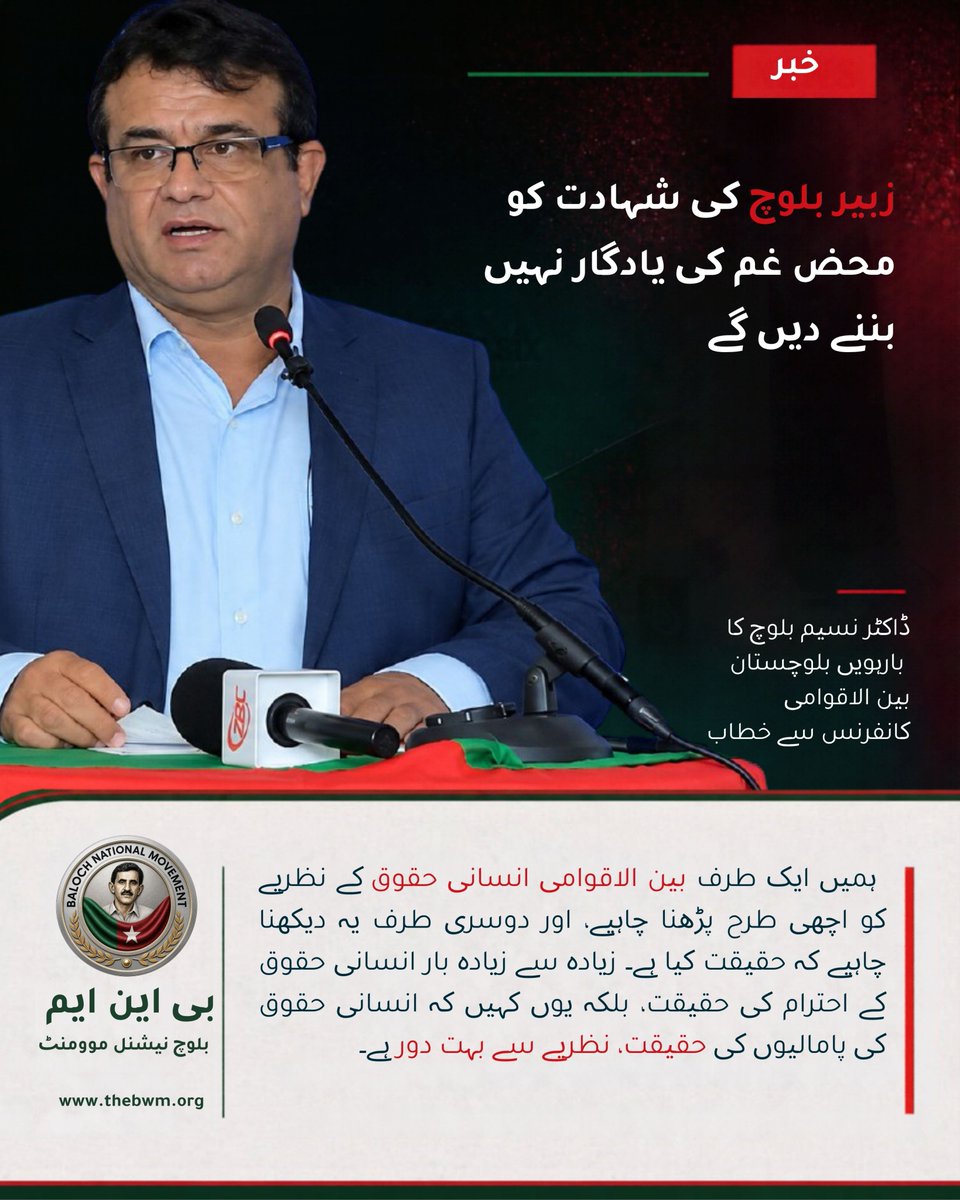
زبیر بلوچ کی شہادت کو محض غم کی یادگار نہیں بننے دیں گے ، ڈاکٹر نسیم بلوچ کا کا جنیوا میں خطاب
https://t.co/ABiIjK0isX
#BIC12
#BNMatUNSep2026
#BNMGlobalCampaign

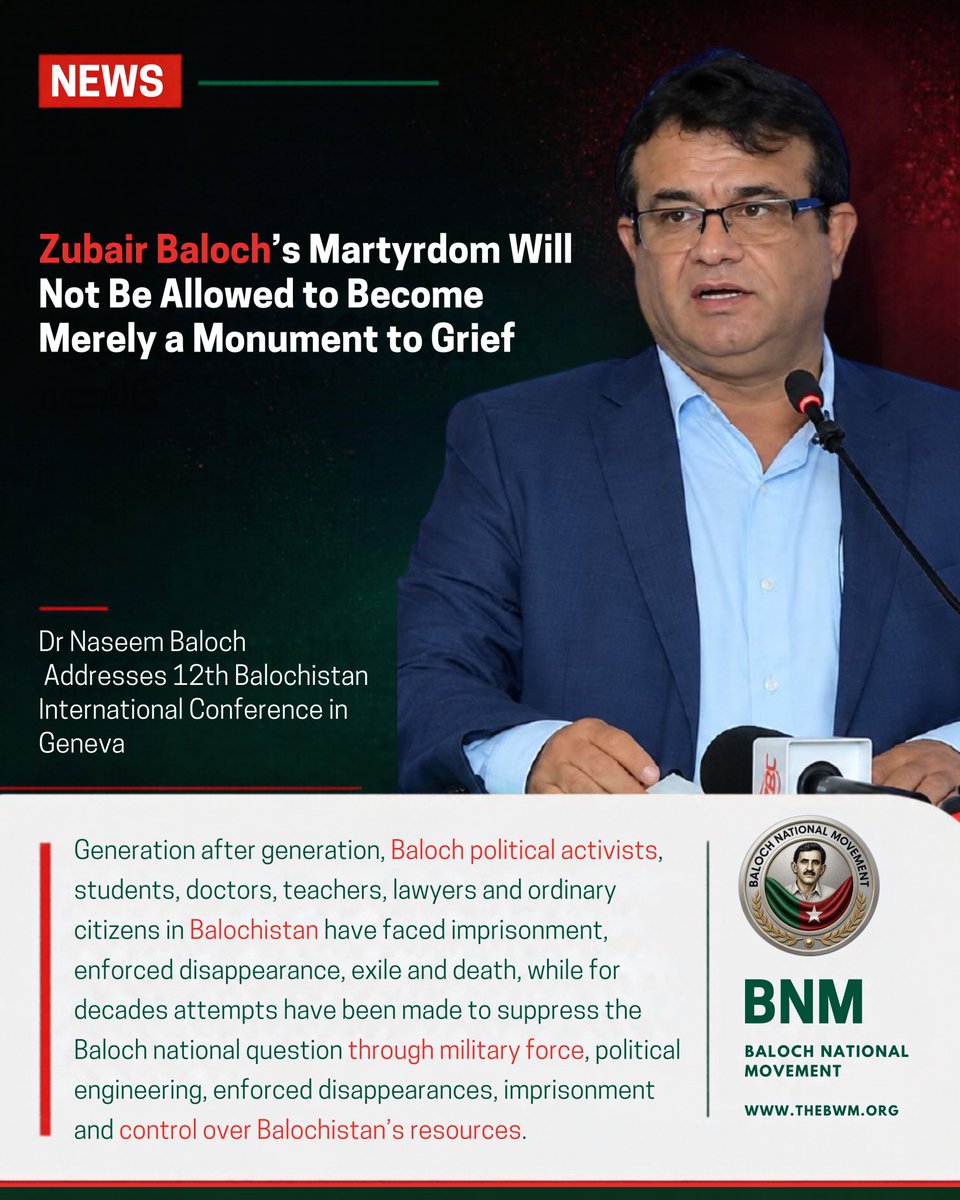
Zubair Baloch’s Martyrdom Will Not Be Allowed to Become Merely a Monument to Grief , Dr Naseem Baloch Addresses Geneva
Friday, 25 September 2026 | #BIC12
https://t.co/f3CzuGIRfh
Baloch National Movement (BNM) Chairman Dr Naseem Baloch, addressing the 12th Balochistan International Conference in Geneva, said that generation after generation, Baloch political activists, students, doctors, teachers, lawyers and ordinary citizens in Balochistan have faced imprisonment, enforced disappearance, exile and death, while for decades attempts have been made to suppress the Baloch national question through military force, political engineering, enforced disappearances, imprisonment and control over Balochistan’s resources.
He said that despite this, the Baloch national question has not disappeared, and new generations continue to enter political life.
Addressing human rights defenders, representatives of different nations and organisations, members of the media and Baloch political activists in Geneva, the BNM Chairman said that the conference is not simply another political gathering, but an effort to bring to the world the voices of those facing the human consequences of the ongoing crisis in Balochistan.
He said, “We have gathered here not simply to hold another conference. We are here because behind every report, every photograph and every statistic from Balochistan, there is a human being.”
According to him, there is a mother waiting for her disappeared son, there is a child growing up without a father, and there is a family searching from one prison to another, from one court to another, asking a very simple question: “Where is our loved one?”
He said that there are also people who have paid with their lives for refusing to remain silent.
In his speech, the BNM Chairman also remembered Dr Abdul Rasheed, known to us as Dr Nokaap Baloch, a member of the Central Committee of the Baloch National Movement, who was recently killed. He said that on 10 September, “we lost Dr Abdul Rasheed, known to us as Dr Nokaap Baloch,” and that his loss is still very fresh for the BNM.
“His killing is still very fresh for us. This is not something I can speak about merely as a political incident. He was our colleague. He was our comrade. He was someone who had spent his life among his people.”
The BNM Chairman held Pakistani state agents responsible for the killing of Dr Nokaap Baloch, saying that armed men posing as patients came to him and killed a man whose profession was to heal people.
He said that Dr Nokaap Baloch was a political activist, physician and educator who devoted his entire life to the cause of Baloch national freedom, serving humanity and spreading the light of knowledge.
“His martyrdom is an irreparable loss for the BNM, supporters of the Baloch national movement, and Baloch refugees, for whom he was a source of hope, medical care and education.”
He said, “Today, his chair is empty. But the values he lived for remain with us.”
He said that Dr Nokaap Baloch is not the only person they are mourning.
The BNM Chairman devoted most of his speech to remembering the political life, struggle and martyrdom of Chairman Zubair Baloch.
He said that the conference was not held simply to remember Chairman Zubair Baloch or to mourn his absence, but to pay national tribute to a political leader who sacrificed his life and ultimately his blood for the struggle for Baloch national freedom.
He said, “Whenever I think of Chairman Zubair, one question comes to my mind: How deeply did he love the land of Balochistan and the cause of Baloch national freedom that even holding the chairmanship of a student wing affiliated with the National Party could not change his direction?”
The BNM Chairman criticised the National Party, saying that, in alliance with the Pakistani state, it secured a puppet provincial government to undermine the Baloch national movement. According to him, the National Party continues even today to pursue a politics that seeks to keep the Baloch nation in permanent subjugation to Pakistan.
He said that after completing his student political career, an easy path lay before Zubair Baloch. He could have joined the National Party, gained privileges and positions, and secured a comfortable political future. He could have pursued high office and personal benefits. But Zubair Baloch rejected that path. Instead, he reached out to the Baloch National Movement and chose the difficult path — the path of struggle for national freedom.
The BNM Chairman said that whenever he spoke with Zubair Baloch, he saw in him a mature political leader, a national activist with a clear vision, and a true lover of his homeland who was prepared to sacrifice everything for its freedom.
He said that Zubair Baloch’s life, his politics, his unwavering voice in the face of his adversaries, and ultimately his martyrdom stand as undeniable testimony to this.
According to him, his life teaches us that the freedom of nations is not achieved through desire alone. It requires a clear vision. It requires organised struggle. It requires steadfast character. And it requires a constant readiness to make the greatest sacrifices.
The BNM Chairman said that Zubair Baloch’s politics was not driven by temporary emotions, personal interests or an ambition for office. His political position was clear, his character was steadfast, and his struggle was consistent.
He said that the Pakistani state killed Zubair Baloch because he was a politically conscious, principled and influential national leader.
According to him, Zubair Baloch was not killed because of a personal dispute, an accidental incident or an ordinary security operation.
He said that he was targeted because of his commitment to Baloch national freedom, his rejection of Pakistan’s occupation over Balochistan, and his efforts to awaken national consciousness among Baloch youth.
The BNM Chairman said, “The enemy took Zubair Baloch from us, but it could not take away his political vision.”
He told the conference participants that Zubair Baloch’s martyrdom should not be allowed to become merely a monument to grief. “We will make his political consciousness our guide. We will make his steadfastness our strength. And we will make his sacrifice our national responsibility.”
On this occasion, he said, “The flag that he raised high with his blood is now our shared responsibility to carry forward until it reaches its destination.”
The BNM Chairman said that the purpose of the 12th Balochistan International Conference is not simply to remember individuals, but also to draw attention to the wider political and human rights crisis in Balochistan.
He asked why, generation after generation, Baloch political activists, students, doctors, teachers, lawyers and ordinary citizens have found themselves facing imprisonment, disappearance, exile or death. “This is the question that the international community must confront.”
He said that the political and human rights crisis in Balochistan continues today.
The BNM Chairman referred to the life imprisonment sentences of Dr Mahrang Baloch and Sibghatullah Shahji, saying that they were sentenced to life imprisonment by an Anti-Terrorism Court in June.
He said that UN human rights experts later described Dr Mahrang Baloch’s punishment as a “grave injustice” and raised serious concerns about the fairness of the proceedings and the use of counter-terrorism laws against peaceful political activism.
The BNM Chairman said that other leaders and members of the Baloch Yakjehti Committee remain imprisoned.
He further said that only days ago, Gulzadi Baloch was also sentenced to life imprisonment by a court in Shaal in fake charges. “We strongly condemn her life sentence.”
The BNM Chairman said that the central question of the crisis in Balochistan is the Baloch national question.
According to him, for decades, attempts have been made to deal with this question through military force, imprisonment, enforced disappearances, political engineering and control over Balochistan’s resources, but the conflict has not ended.
He said that women who once waited outside prisons and government offices searching for their disappeared relatives are today leading some of the peaceful political movements taking place in Balochistan.
According to him, young people are also asking the same questions that their parents and grandparents asked before them: Who controls our land? Who controls our coast? Who decides how our natural resources are used? Why do decisions concerning Balochistan continue to be taken without the meaningful consent of the Baloch people?
The BNM Chairman said that Balochistan is also becoming increasingly important in international politics.
He mentioned China’s heavy investment through the China-Pakistan Economic Corridor and said that international companies are interested in Balochistan’s copper, gold and other natural resources.
He said that governments around the world are looking for new supplies of critical minerals, but there is a voice that is too often missing from these discussions: the voice of the Baloch nation themselves.
Addressing governments and international investors, he said: “The political question of Balochistan cannot simply be bypassed.”
According to him, discussions about Balochistan’s resources, minerals and international investment cannot be separated from the question of the political future of the Baloch nation. “Our political position is a free and independent Balochistan.”
The BNM Chairman made the political position of his organisation clear, saying, “For the Baloch National Movement, the answer to this long-running crisis is clear. Our political position is a free and independent Balochistan.”
He said that this is why, for the BNM, its struggle for human rights and its struggle for national freedom cannot be separated from one another. “Our struggle for human rights and our struggle for national freedom cannot be separated from one another.”
According to him, the lasting solution to the conflict, repression and recurring crises in Balochistan is the freedom of the Baloch nation and its right to determine its own future.
In the final part of his speech, the BNM Chairman again mentioned Dr Nokaap Baloch. He said, “There is something deeply painful about losing a person whose whole life was dedicated to saving lives. He could have chosen an easier life. He could have remained silent. He did not.”
He said, “He treated the sick. He taught those who needed education. This is how I want us to remember him. Not only by how he martyred, but by how he lived.”
He said that the same is true of Chairman Zubair Baloch. “We should not remember our colleagues simply as victims.”
According to him, future generations should hear these voices for themselves. “A nation preserves its struggle not only through political organisations, but through memory.”
“Through the stories of people who refused to abandon what they believed in.”
Addressing the families of the disappeared in Balochistan, political prisoners, colleagues living in exile and Baloch families who have lost their loved ones, the BNM Chairman said, “Your pain is part of our collective memory.”
He remembered Dr Nokaap Baloch, Chairman Zubair Baloch and all those who are no longer physically among them.
“Your absence is deeply felt. But the questions you raised remain. The cause to which you gave your lives remains.”
At the conclusion of his speech, the BNM Chairman once again made the organisation’s political position clear, saying: “The political position of the Baloch National Movement remains clear: we believe that the lasting solution to the conflict, repression and recurring crises in Balochistan is the freedom of Balochistan and the right of the Baloch nation to determine its own future.”
#BNMatUNSep2026
#BNMGlobalCampaign


VIDEO | BNM’s Global Diplomatic Campaign for Balochistan Continues in Geneva
Participants share their views and reflections on BNM’s ongoing international diplomatic campaign for Balochistan.
Featured: Antonio Stango،
political scientist and prominent international human rights expert.
Language: English
#BNMatUNSep2026
#BNMGlobalCampaign
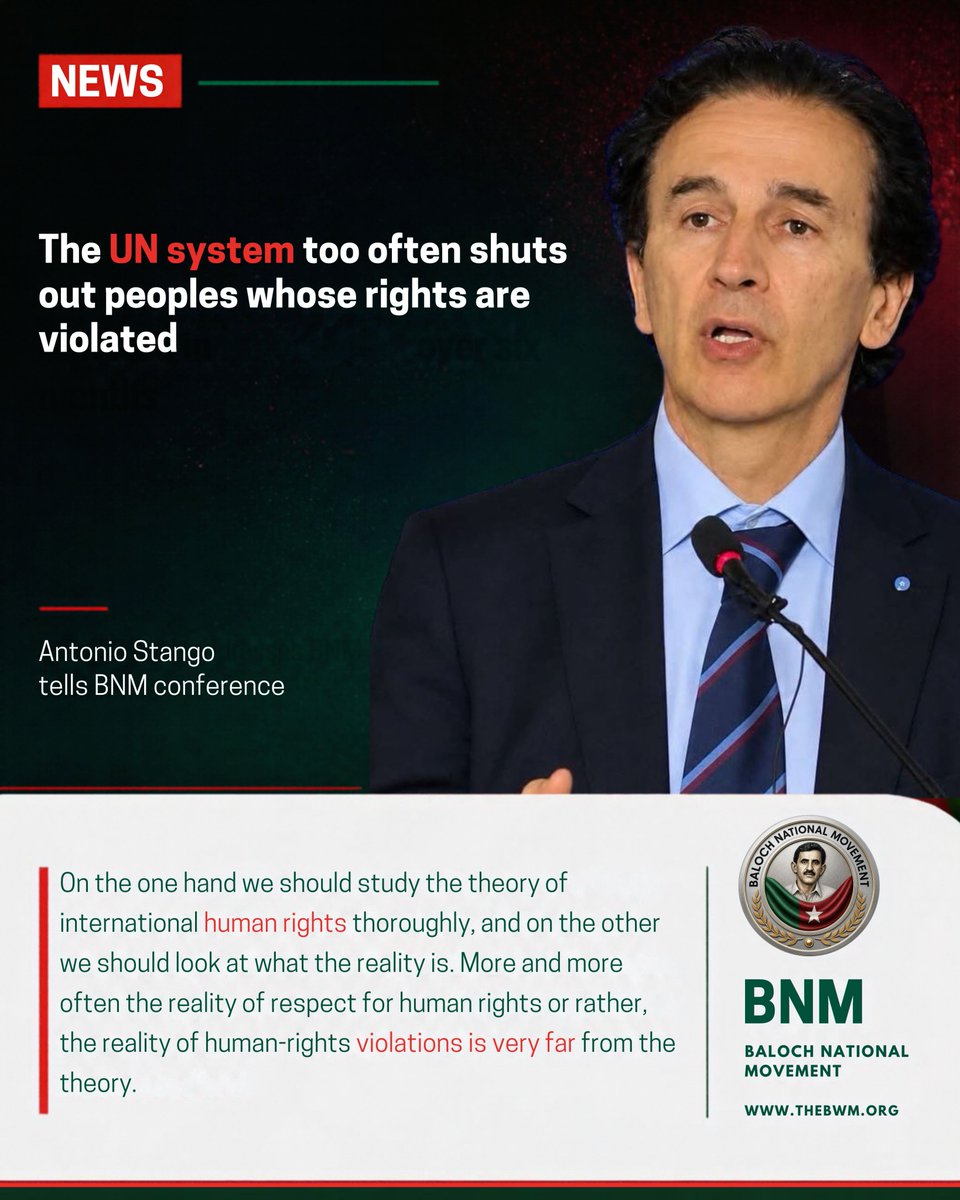
The UN system too often shuts out peoples whose rights are violated: Antonio Stango addresses the 12th Balochistan conference
Friday, 25 September 2026 | #BIC12
https://t.co/H4shz6bSnY
Human-rights expert Antonio Stango, addressing the Baloch National Movement’s (BNM) 12th Balochistan International Conference, said the gap between the theory of international human rights and the reality of their violation is widening, and that peoples whose collective rights are taken from them still too often do not get access to United Nations rooms.
Antonio Stango, president of the Italian Federation for Human Rights (FIDU) and professor of international organisations and human rights at Rome Link Campus University, speaking at BNM’s conference in the Geneva Press Club, further said he had spent most of his life working on this subject as a civil-society expert and had not remained confined only to academic circles.
He said that on the one hand we should study the theory of international human rights thoroughly, and on the other we should look at what the reality is. More and more often the reality of respect for human rights or rather, the reality of human-rights violations is very far from the theory.
He said this is true for individuals and for peoples as well. Most of you have been victims of specific violations of the rights of the Baloch nation.
He pointed to those provisions that on paper protect the rights of groups who share a language, history, religion or other ethnic features, including Article 27 of the International Covenant on Civil and Political Rights. He said states have begun to forget these articles.
He said that in Europe history has mostly been understood as the history of Western empires. Some speakers mentioned Pakistani imperialism. This is something we in Europe do not know. People read only a few headlines. They open television and social media and see titles and slogans, which do not go deep into the major problems of our planet.
He said when it is a matter of millions of people whose collective rights have been systematically violated for decades, I believe this should be a concern not only for those directly affected, but for all of us.
He said human rights are universal and belong to every person from birth. Authoritarian governments of different political types reply that rights are universal, but that they should be applied in a “regional or relative” way. In his view, relativism is a major danger to respect for human rights.
In that connection, citing figures given by other speakers at the conference, he said that in recent years there have been hundreds of enforced disappearances in Balochistan, while over a longer period tens of thousands of people in Balochistan have been forcibly disappeared and thousands have been killed. He said millions of people live in misery, even though their historical land is rich in natural resources.
He said engagement with the UN system is both necessary and difficult. It is no coincidence that the meeting is being held at the Geneva Press Club, not in the nearby United Nations conference hall. I suspect some governments would oppose holding such a meeting there.
Recalling the organisation of UN side events for non-governmental organisations, he said that when representatives of peoples whose collective rights have been violated are invited, official representatives ask why they are in the room. They are terrorists. They should be imprisoned; they should not be allowed to speak at a UN forum.
He said there is a diplomatic confrontation with the UN system, even though that system in theory at least allows every voice to be heard and should give every people the chance to speak about their conditions.
He said he fully agreed with the point put to the conference: there is no lasting peace without justice; there is no reconciliation without trust.
He said we all share this need and this strong hope that there will be peace in your country as well, as in other parts of the world. But we know there can be no peace without justice.
He said that about thirty years ago he was part of the movement that helped create the International Criminal Court in The Hague. One organisation in that movement was called No Peace Without Justice. It still exists, and work still remains.
He said more states are leaving that court because governments fear being judged. In his view the court does not decide on a political basis. It hears only the gravest international crimes: genocide, crimes against humanity, war crimes and, in some cases, aggression. States should not be afraid of standing before international justice.
He also mentioned the theoretical possibility that a person can be tried for crimes against humanity even in a state of which he or she is not a citizen. He said: “International justice must work. A great deal remains to be done to reach effective international justice.”
Restating his commitment, he said FIDU and the Italian Helsinki Committee want close cooperation between civil society, international organisations and national liberation movements, however difficult that may be.
#BNMatUNSep2026
#BNMGlobalCampaign

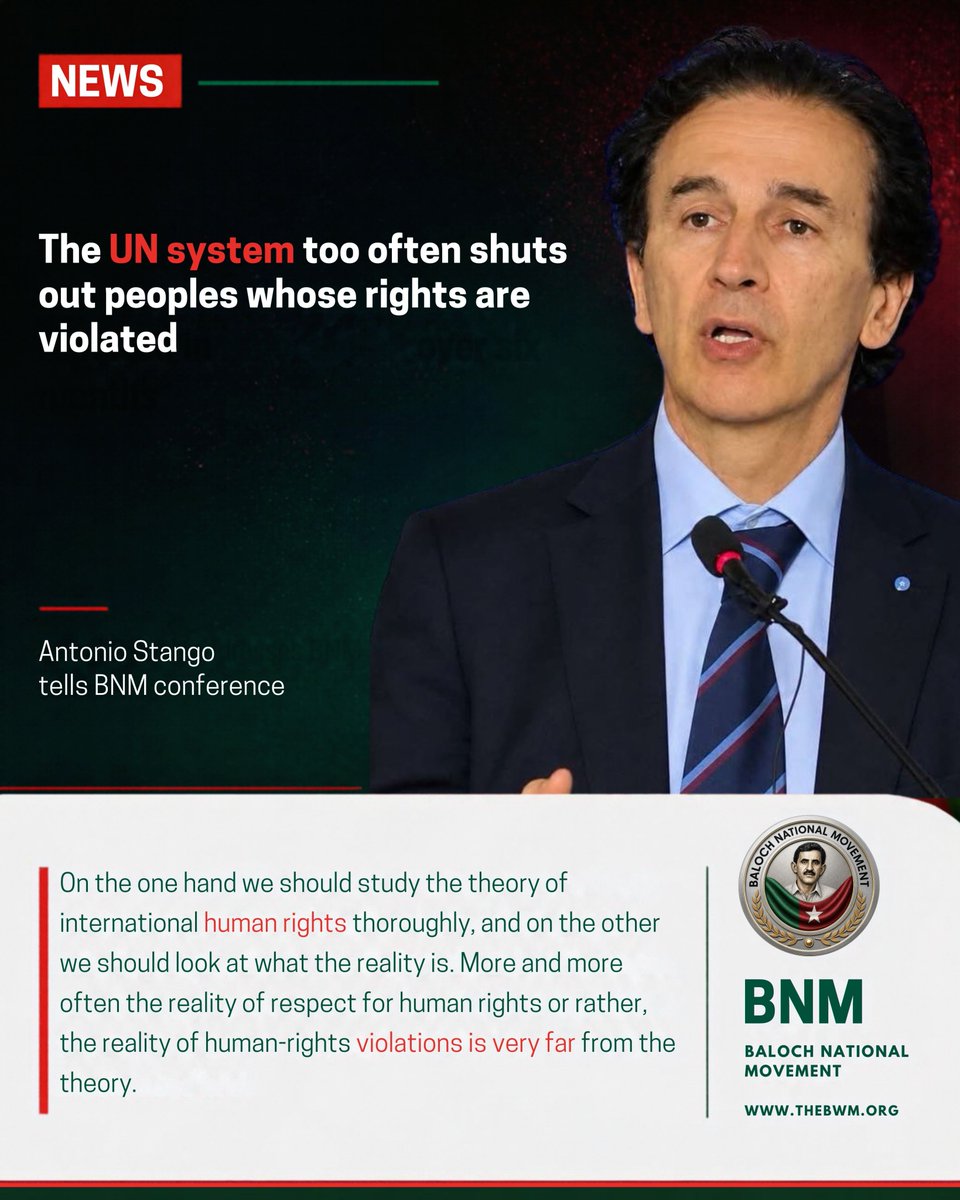
The UN system too often shuts out peoples whose rights are violated: Antonio Stango addresses the 12th Balochistan conference
Friday, 25 September 2026 | #BIC12
https://t.co/H4shz6bSnY
Human-rights expert Antonio Stango, addressing the Baloch National Movement’s (BNM) 12th Balochistan International Conference, said the gap between the theory of international human rights and the reality of their violation is widening, and that peoples whose collective rights are taken from them still too often do not get access to United Nations rooms.
Antonio Stango, president of the Italian Federation for Human Rights (FIDU) and professor of international organisations and human rights at Rome Link Campus University, speaking at BNM’s conference in the Geneva Press Club, further said he had spent most of his life working on this subject as a civil-society expert and had not remained confined only to academic circles.
He said that on the one hand we should study the theory of international human rights thoroughly, and on the other we should look at what the reality is. More and more often the reality of respect for human rights or rather, the reality of human-rights violations is very far from the theory.
He said this is true for individuals and for peoples as well. Most of you have been victims of specific violations of the rights of the Baloch nation.
He pointed to those provisions that on paper protect the rights of groups who share a language, history, religion or other ethnic features, including Article 27 of the International Covenant on Civil and Political Rights. He said states have begun to forget these articles.
He said that in Europe history has mostly been understood as the history of Western empires. Some speakers mentioned Pakistani imperialism. This is something we in Europe do not know. People read only a few headlines. They open television and social media and see titles and slogans, which do not go deep into the major problems of our planet.
He said when it is a matter of millions of people whose collective rights have been systematically violated for decades, I believe this should be a concern not only for those directly affected, but for all of us.
He said human rights are universal and belong to every person from birth. Authoritarian governments of different political types reply that rights are universal, but that they should be applied in a “regional or relative” way. In his view, relativism is a major danger to respect for human rights.
In that connection, citing figures given by other speakers at the conference, he said that in recent years there have been hundreds of enforced disappearances in Balochistan, while over a longer period tens of thousands of people in Balochistan have been forcibly disappeared and thousands have been killed. He said millions of people live in misery, even though their historical land is rich in natural resources.
He said engagement with the UN system is both necessary and difficult. It is no coincidence that the meeting is being held at the Geneva Press Club, not in the nearby United Nations conference hall. I suspect some governments would oppose holding such a meeting there.
Recalling the organisation of UN side events for non-governmental organisations, he said that when representatives of peoples whose collective rights have been violated are invited, official representatives ask why they are in the room. They are terrorists. They should be imprisoned; they should not be allowed to speak at a UN forum.
He said there is a diplomatic confrontation with the UN system, even though that system in theory at least allows every voice to be heard and should give every people the chance to speak about their conditions.
He said he fully agreed with the point put to the conference: there is no lasting peace without justice; there is no reconciliation without trust.
He said we all share this need and this strong hope that there will be peace in your country as well, as in other parts of the world. But we know there can be no peace without justice.
He said that about thirty years ago he was part of the movement that helped create the International Criminal Court in The Hague. One organisation in that movement was called No Peace Without Justice. It still exists, and work still remains.
He said more states are leaving that court because governments fear being judged. In his view the court does not decide on a political basis. It hears only the gravest international crimes: genocide, crimes against humanity, war crimes and, in some cases, aggression. States should not be afraid of standing before international justice.
He also mentioned the theoretical possibility that a person can be tried for crimes against humanity even in a state of which he or she is not a citizen. He said: “International justice must work. A great deal remains to be done to reach effective international justice.”
Restating his commitment, he said FIDU and the Italian Helsinki Committee want close cooperation between civil society, international organisations and national liberation movements, however difficult that may be.
#BNMatUNSep2026
#BNMGlobalCampaign


Baloch National Movement stages anti-Pakistan protest in Geneva over human rights abuses
Read @ANI Story| https://t.co/8AY7G7Emlr
#BalochNationalMovement #AntiPakistanProtest #Geneva #HumanRightsAbuse
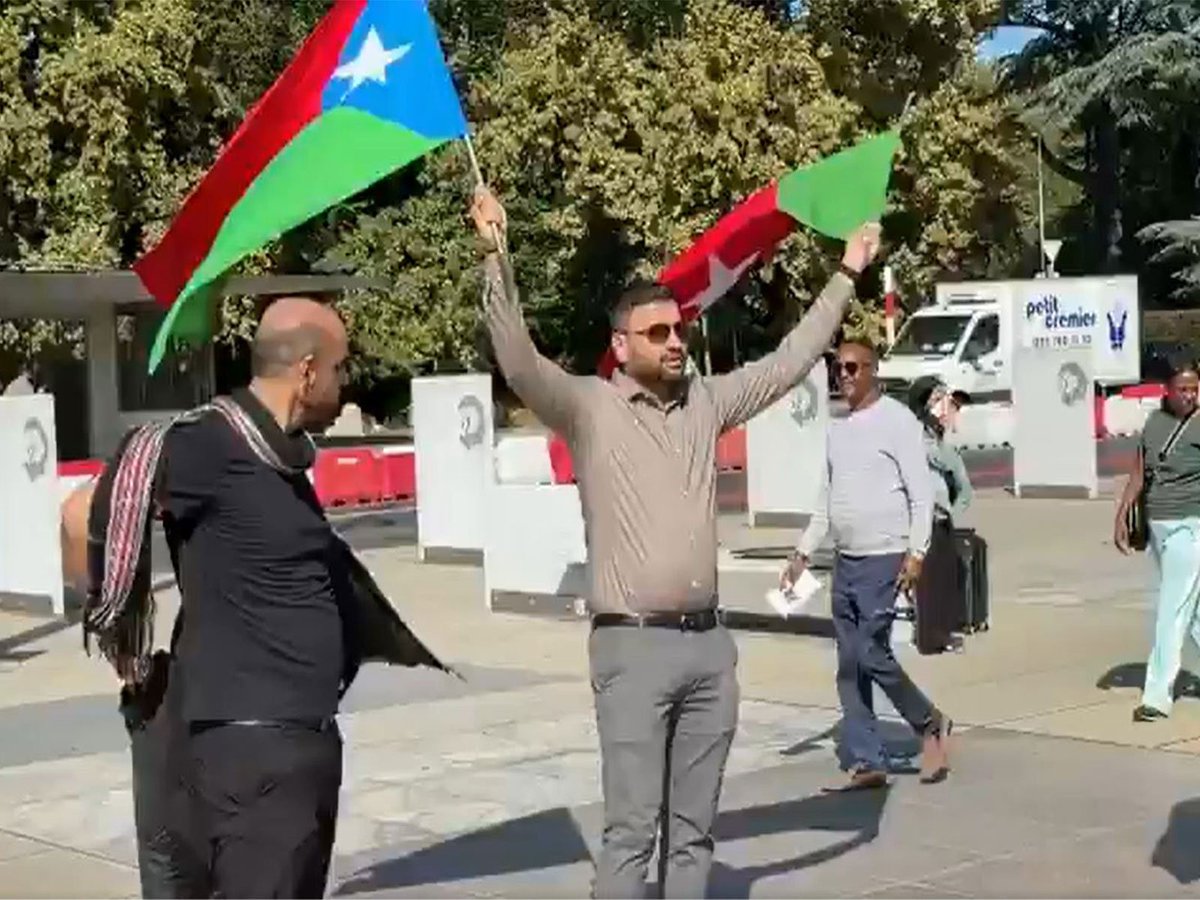


The Baloch National Movement holds a protest rally against Pakistan Army in Geneva during the 63rd UN Human Rights Council session, seeking international attention to human rights concerns in the region.
#𝗕𝗡𝗠𝗚𝗹𝗼𝗯𝗮𝗹𝗖𝗮𝗺𝗽𝗮𝗶𝗴𝗻 #𝗕𝗡𝗠𝗮𝘁𝗨𝗡𝗦𝗲𝗽𝟮𝟬𝟮𝟲
#𝗕𝗡𝗠𝗮𝘁𝗨𝗡𝗦𝗲𝗽𝟮𝟬𝟮𝟲
#BIC12 https:#BIC12
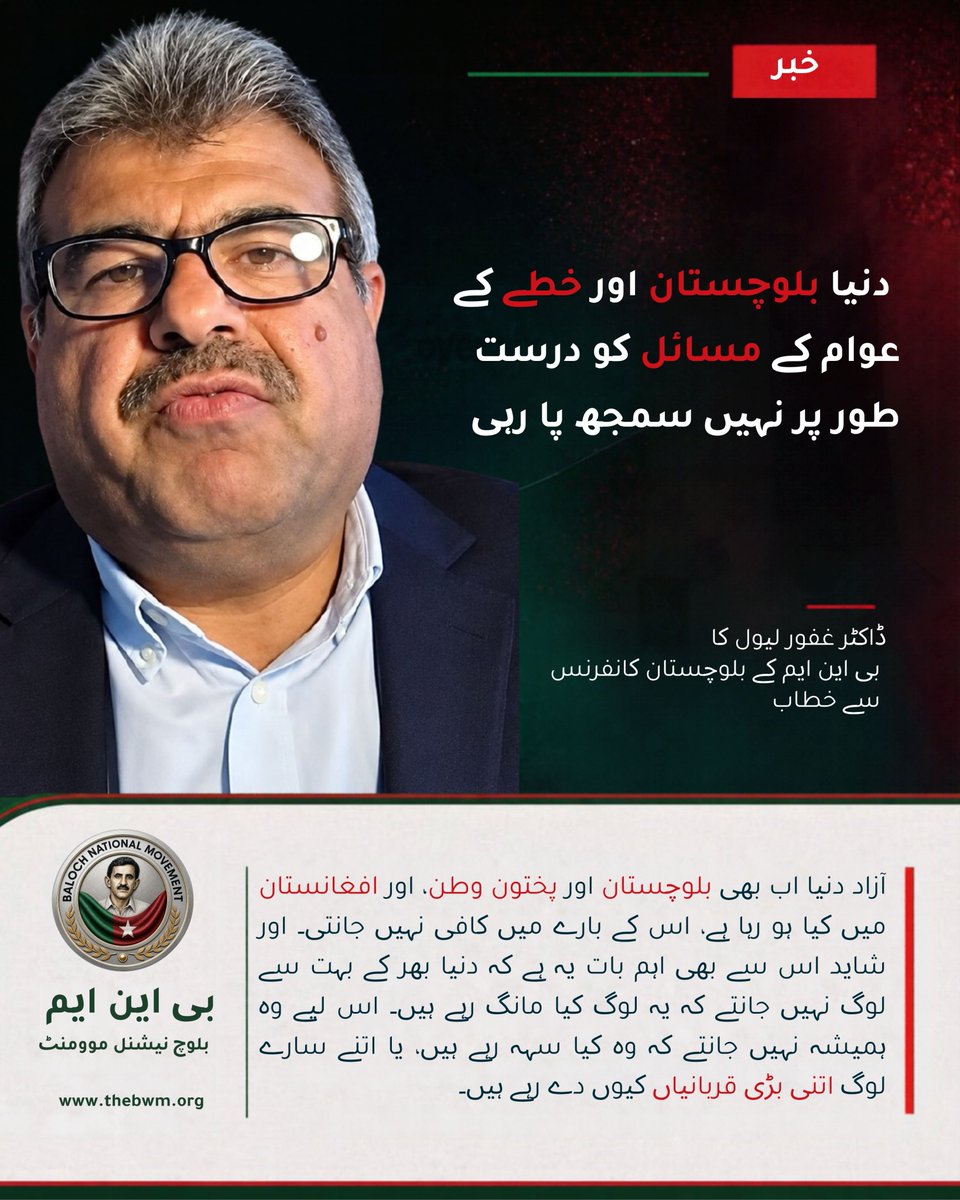
بی ��ین ایم کی بلوچستان کانفرنس: دنیا بلوچستان اور خطے کے عوام کے مسائل کو درست طور پر نہیں سمجھ پا رہی، ڈاکٹر غفور لیول
https://t.co/EwAHm57jXm
#BIC12
#BNMatUNSep2026
#BNMGlobalCampaign

BNM 12th International Campaign🚨
Geneva: Baloch political party #BNM held a rally in Geneva marking the 63rd session of the UN Human Rights Council. Protesters raised slogans against human rights violations in Balochistan.
The campaign included a conference, photo exhibition, and rally, with participants from various nationalities. BNM continues to push for the political internationalization of the Baloch issue.
BNM’s Balochistan conference: the world is not correctly understanding the issues of the people of Balochistan and the region, Dr Ghafoor Liwal
Friday, 25 September, 2026 |#BIC12
https://t.co/lswzkQ59b3
Afghan writer and former ambassador to Iran Dr Ghafoor Liwal, addressing BNM’s 12th Balochistan International Conference in Geneva, said that human-rights violations in Balochistan and among Pashtun communities have still not been correctly at the international level, and that information and awareness are a very important part of the struggle.
He said one of the biggest concerns for the people of our region is the violation of human rights. This repression is faced by the people of Balochistan and the people of Afghanistan, which we are enduring together. I want to free this nation from this bad situation and to share the suffering of all oppressed people.
He said we stand with humanity, whose children, women, the elderly and other innocent and defenceless people lose their lives because of state policies, military actions and crises. The Baloch have been afflicted by hardship for years. For many years Pashtuns too have suffered because of interference from Pakistan.
“Families have lost their loved ones. Innocent people live in fear and have little peace. I hear reports of what is happening in Balochistan: women and children are taken from their homes. The tortured bodies of many are found later. Thousands remain forcibly disappeared , mothers and sisters, political and community leaders, activists, women and ordinary citizens.”
He said there are also reports of torture and other serious human-rights violations. But in my view another serious problem is that the world is not hearing these things correctly.
“The free world still does not know enough about what is happening in Balochistan and the Pashtun homeland, and also in Afghanistan. And perhaps even more importantly, many people around the world do not know what these people are asking for. So they do not always know what they are suffering, or why so many people are making such great sacrifices.”
He said when we talk about defending human rights we need to work on two important fronts. At the local level we must help our own people understand what is happening. The international community needs reliable information about human-rights violations, enforced disappearances, killings, torture and other forms of injustice.
“We must help suppressed people understand their own rights: who is responsible when rights are violated; what they can do; where free expression is, where justice is. And most importantly, people must know that they have the right to speak, to protest, and to stand against injustice.”
He said it is difficult for people living under pressure and repression to do all this work themselves. They do not have security. They cannot have access to international organisations. They cannot speak openly. That is why I believe intellectuals, journalists, writers, activists and patriotic Afghan communities living outside the country have an important responsibility. We must become the voice of those who cannot speak freely.
He said this is especially important today. We live in an age of fast communication. In one sense every person can become a small media outlet. We all have the ability to share information. We can use social media, radio, YouTube, interviews and other forms of communication. But we must remember one important thing: we need to take the right message at the right time to the right people. Our information must be effective, based on facts and understandable. In other words we need a strategy. Content is truly important in raising the voice of nations under the pressure of occupation and political violence.
Turning to literature, he said some argue that poets and writers are the living archives of an entire people. Their feeling and national ideas can give hope. They can bring people together. They can help a nation grow its identity, dignity and future. He cited Khushal Khan Khattak and other poets, writers and national figures.
“If we use these ideas of dignity, unity, knowledge and feeling to bring our people together, we can build a stronger front. I believe our literature should be an important part of our struggle. Words, dreams, literature, journalism, history and art have all played an important role. They can change minds. They can give hope to the people and tell the world of their history and the suffering of our people. The struggle for human rights is not only a struggle of facts. It is also a struggle for an audience. It is a struggle for truth. It is a struggle for education. And it is a struggle to have someone’s voice heard.”
#BIC12
#BNMatUNSep2026
#BNMGlobalCampaign


Images displayed at BNM’s Geneva exhibition show infants victims of Pakistani State collective punishment in #Balochistan.
Some children were killed while others were forcibly disappeared, with their whereabouts unknown.
#BIC12 #BNMGlobalCampaign #BNMatUN2026
@UNICEF
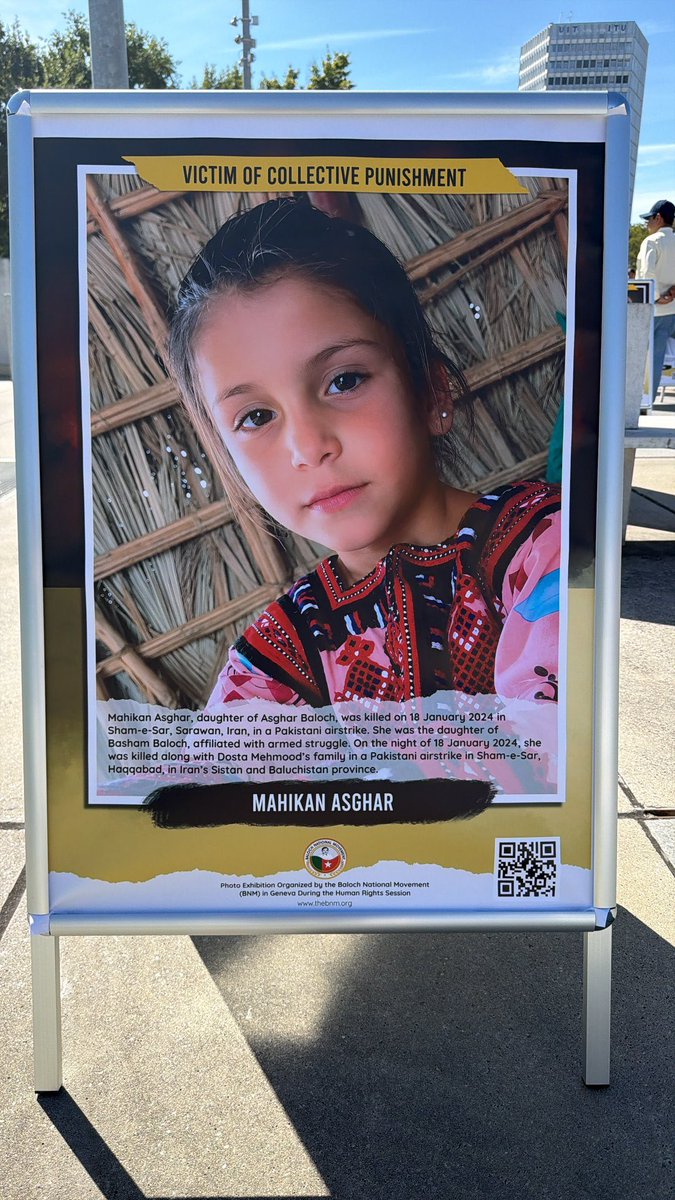
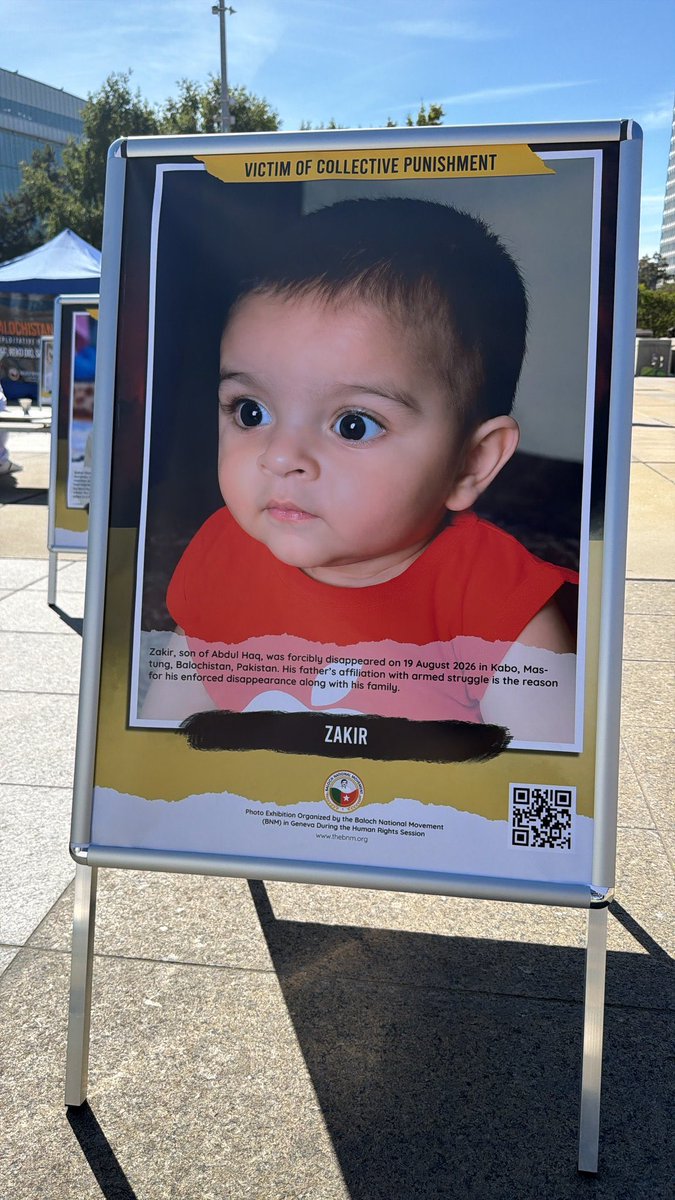
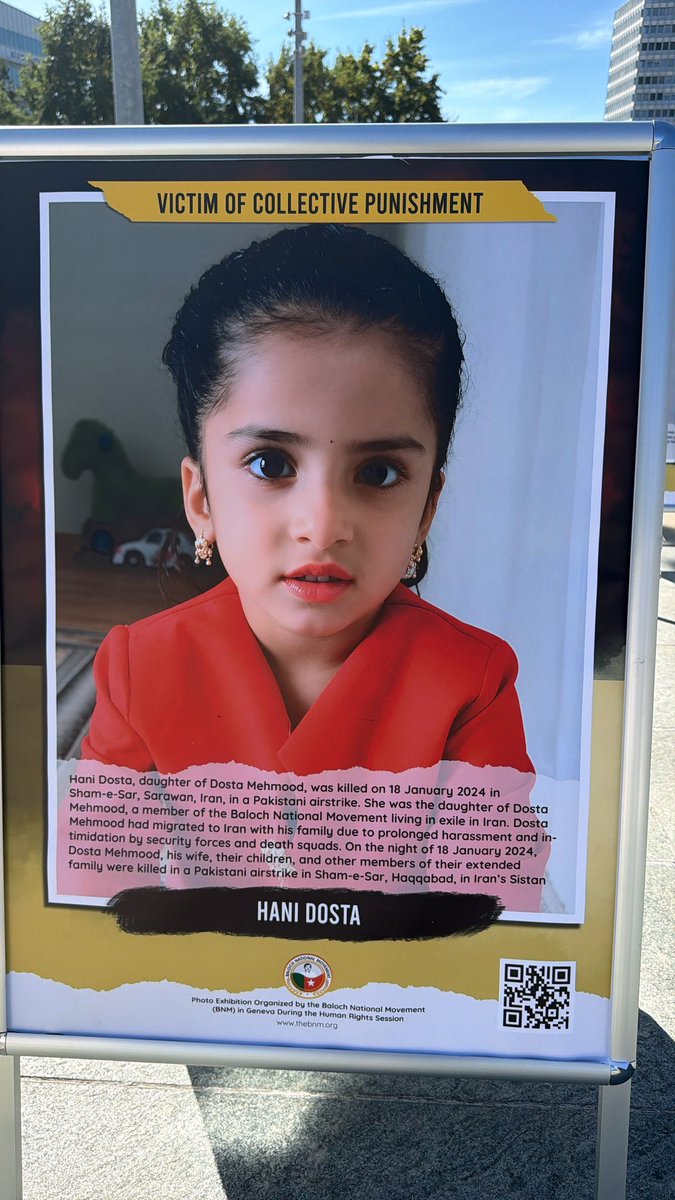
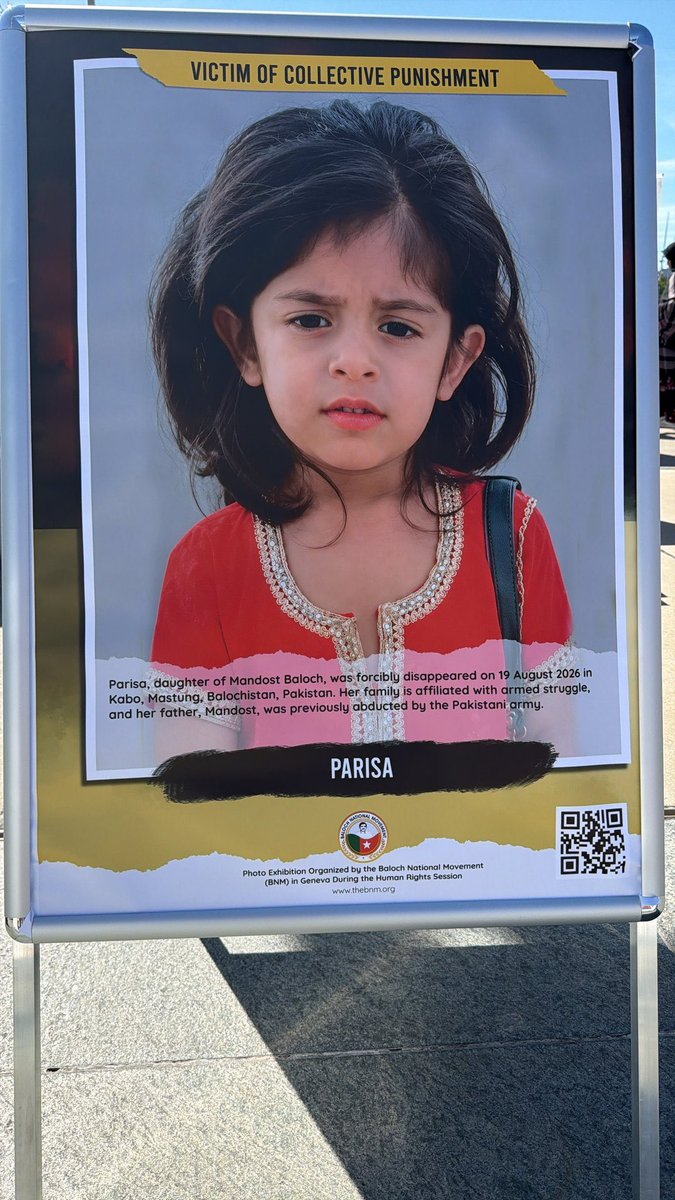
In Geneva, Dr. Naseem Baloch, Chairman of BNM, said the organisation came to highlight Pakistan’s occupation of Balochistan and escalating human rights violations, including enforced disappearances and “kill and dump” cases.
#BIC12 #BNMGlobalCampaign #BNMatUN2026
@BNMovement_

#WATCH | Geneva, Switzerland: Dr. Naseem Baloch, Chairman of the Baloch National Movement, says, "We are presently in Geneva. The purpose of our visit—including the photo exhibition, protests, and other activities—is to show the world that Pakistan has forcibly occupied Balochistan. Following this forced occupation, various forms of human rights violations have been taking place there, and these have escalated significantly in recent years... In the last few years, there has been a sharp intensification of what we call the "kill and dump" policy, where people are abducted and forcibly disappeared on a daily basis, and their bodies are subsequently dumped. Our objective in coming here—and the aim of the photo exhibition and protests—is to demonstrate to the world that Balochistan is a land where severe atrocities are being committed."

The Baloch National Movement holds a protest rally against Pakistan Army in Geneva during the 63rd UN Human Rights Council session, seeking international attention to human rights concerns in the region.
A photo exhibition accompanied the protest, featuring images that organisers said documented the violations.
#WATCH | Geneva, Switzerland: Foreign Secretary, Baloch National Movement, Faheem Baloch says, "Today we had a long march in Geneva to tell the world what kind of atrocities are going on in Balochistan. The people are being abducted, tortured, and killed... The security forces have started abducting the family members of those talking about the human rights violations and killings."
#WATCH | Geneva, Switzerland: Dr. Naseem Baloch, Chairman of the Baloch National Movement, says, "We are presently in Geneva. The purpose of our visit—including the photo exhibition, protests, and other activities—is to show the world that Pakistan has forcibly occupied Balochistan. Following this forced occupation, various forms of human rights violations have been taking place there, and these have escalated significantly in recent years... In the last few years, there has been a sharp intensification of what we call the "kill and dump" policy, where people are abducted and forcibly disappeared on a daily basis, and their bodies are subsequently dumped. Our objective in coming here—and the aim of the photo exhibition and protests—is to demonstrate to the world that Balochistan is a land where severe atrocities are being committed."
The Baloch National Movement holds a protest rally against Pakistan Army in Geneva during the 63rd UN Human Rights Council session, seeking international attention to human rights concerns in the region.
A photo exhibition accompanied the protest, featuring images that organisers said documented the violations.


BNM Chairman Dr Naseem Baloch leads a delegation meeting UN Working Group Chair-Rapporteur Ms Grażyna Baranowska in Geneva.
#𝗕𝗡𝗠𝗮𝘁𝗨𝗡𝗦𝗲𝗽𝟮𝟬𝟮𝟲
#𝗕𝗡𝗠𝗚𝗹𝗼𝗯𝗮𝗹𝗖𝗮�#𝗕𝗡𝗠𝗚𝗹𝗼𝗯𝗮𝗹𝗖𝗮𝗺𝗽𝗮𝗶𝗴𝗻 https://t.co/ElA
The Baloch National Movement holds a protest rally against Pakistan Army in Geneva during the 63rd UN Human Rights Council session, seeking international attention to human rights concerns in the region.
A photo exhibition accompanied the protest, featuring images that organisers said documented the violations.
Last Seen Hashtags on Sotwe
anxiouspanda
Seen from Turkey
踩鸡
Seen from Japan
minichat()********** *filter:native_video()
Seen from Belgium
animal #sex
Seen from Italy
คลังของเฮียแบงค์
Seen from Thailand
minichat()
Seen from Netherlands
vazouvideo
Seen from United States
campkrem
Seen from United States
cnckink
Seen from United States
Trends for you
Most Popular Users

Elon Musk 
@elonmusk
241.7M followers

Barack Obama
@barackobama
119M followers

Cristiano Ronaldo
@cristiano
114.4M followers

Donald J. Trump
@realdonaldtrump
111.9M followers

Narendra Modi
@narendramodi
107.2M followers

Rihanna
@rihanna
98.7M followers

NASA
@nasa
92.4M followers

Justin Bieber
@justinbieber
91.8M followers

KATY PERRY
@katyperry
90M followers

Taylor Swift
@taylorswift13
83.9M followers

Lady Gaga
@ladygaga
75.4M followers

Virat Kohli
@imvkohli
73.4M followers

Kim Kardashian
@kimkardashian
70.9M followers

YouTube
@youtube
68.8M followers

Neymar Jr
@neymarjr
66.4M followers

Bill Gates
@billgates
65.2M followers

Selena Gomez
@selenagomez
63.1M followers

The Ellen Show
@theellenshow
62.3M followers

CNN
@cnn
61.8M followers

X
@x
60.7M followers