

Top Tweets for #CompoundEngineering

>em-dash followed by description
>"gates"
this is in the top 1000. IYKYK
#roblox #omp #compoundengineering


🔁 #CompoundEngineering is an #opensource plugin of 33 skills for AI coding agents that turns each task into stored knowledge, so the next unit of work gets easier instead of harder #ClaudeCode #AI #devtools
🔄 The loop has six steps: brainstorm, plan, work, simplify, review, compound — /ce-compound writes learnings into docs/solutions/, which the next /ce-brainstorm and /ce-plan read as grounding
🤖 /lfg runs the whole pipeline hands-off: plans, works, simplifies, runs code review and applies fixes, executes browser tests, commits, pushes, opens a PR and watches CI with a bounded repair loop
🧩 33 skills grouped into core loop, on-demand helpers (/ce-debug, /ce-ideate, /ce-explain, /ce-optimize), #git workflow, testing/design and collaboration
🖥️ Runs on 14 agent hosts: #ClaudeCode, #Cursor, #Codex, #Kimi Code CLI, #Cline, Grok Build CLI, #Devin, #GitHubCopilot, Factory Droid, #Qwen Code, #OpenCode, Pi, oh-my-pi and Antigravity CLI
⚙️ Install in Claude Code with /plugin marketplace add plus /plugin install, then run /ce-setup to create .compound-engineering/config.yaml and check tool capabilities
💡 The idea behind it, from Kieran Klaassen of Every: he built the Cora email client without writing code himself and spends roughly half his time teaching the system what went wrong instead of only shipping features
📊 #MIT licensed, ~24.7k stars, 2k forks, 1291 commits, artifact folders relocatable via docs_root
🌐 https://t.co/LprH3glzI9


While iterating on a #CompoundEngineering skill improvement just now, Opus 4.7 had this proactive suggestion. super helpful!
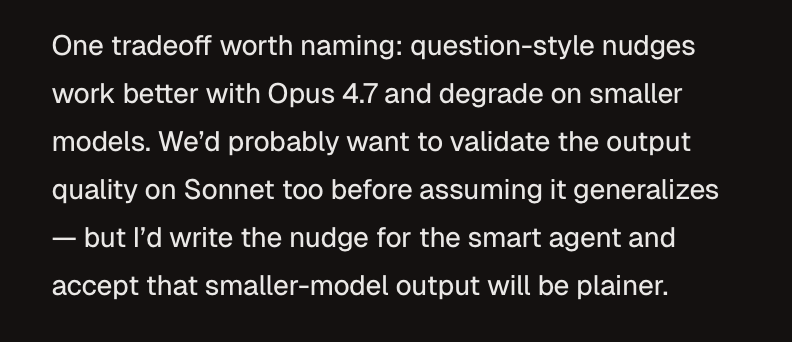
Just shipped a small but mighty fix in #CompoundEngineering for `/ce-ideate`.
It now breaks your ideation topic into separate dimensions before generating ideas. This fights Opus and GPT's tendence to converge on the most obvious interpretation (which defeats the purpose of the skill).
Would love to how it works for you!
https://t.co/3On4y7peBc
#CompoundEngineering 3.6.1 should make the `ce-doc-review` much less annoying and instrusive. It was too annoying being nitpicky. Also, when it's auto run as part of `ce-plan` it only applies auto-fixes, without flooding you with interactive questions anymore.
Created some quick docs for #CompoundEngineering plugin that explains each of the key skills: https://t.co/WebaZq88rQ
#CompoundEngineering Tip: `ce-commit-push-pr` is a great convenience skill:
1. Create a branch if needed
2. Create logical commits of work
3. Push it up
4. Open PR with a great PR description that actually is good, devoid of the AI slop and verboseness you hate
https://t.co/jZLC0RADDj
In the last version of #CompoundEngineering, i snuck in a new `/ce-simplify-code` skill that was inspired directly from Claude Code's built in simplify command, with a few tweaks. The benefit is it also works in Codex and the other harnesses we support so you have a common skill to rely on if you jump around harnesses like I do.
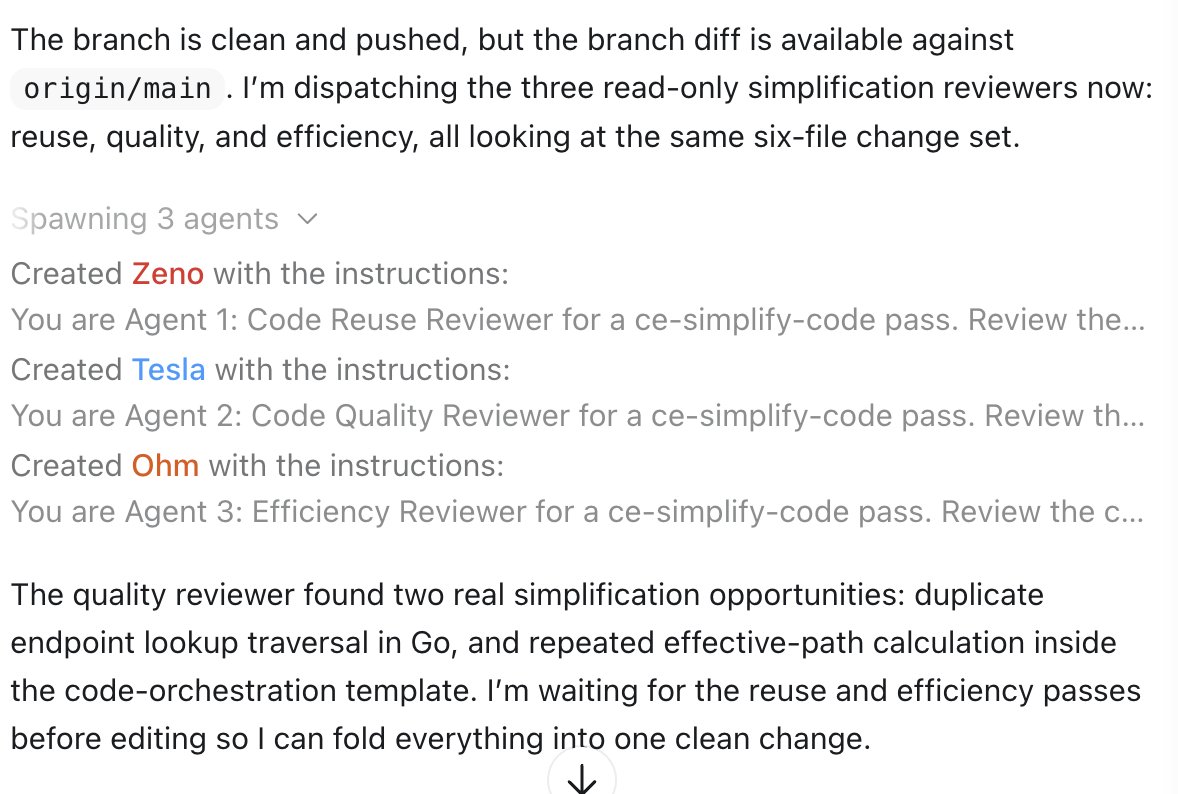
The assumption audit in the `/ce-debug` #CompoundEngineering skill is a step I didn’t expect to work as well as it does.
It lists every “this must be true” belief before forming a hypothesis, then marks each verified or assumed. It helps dramatically improve debugging by forcing correct hypothesis testing en route to fixing your issue.
You could tradprompt this every time, but `/ce-debug` is a nice cheat code. I'll most often just pass it a github or linear ticket link and let it do it's magic.

#MustWatch #AI #AgenticFirst #AgentFirst talk software 3.0 from #VibeCoding to #CompoundEngineering software 2.0 to #AgenticEngineering software 3.0 by @karpathy coiner of #VibeCoding c Video post by 38 min ago follow him @Itesham2005 https://t.co/rvPeKJLhaK

A founding member of OpenAI just told a room full of founders that the entire way they think about building software is about to flip upside down, and most of them are still working in a paradigm that is quietly going extinct.
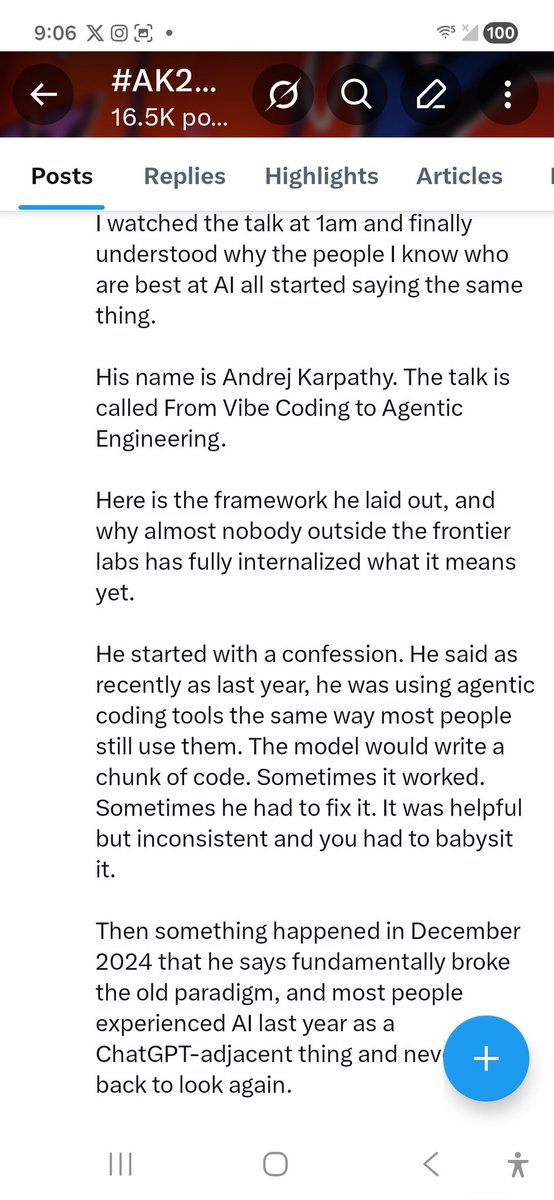
I watched the talk at 1am and finally understood why the people I know who are best at AI all started saying the same thing.
His name is Andrej Karpathy. The talk is called From Vibe Coding to Agentic Engineering.
Here is the framework he laid out, and why almost nobody outside the frontier labs has fully internalized what it means yet.
He started with a confession. He said as recently as last year, he was using agentic coding tools the same way most people still use them. The model would write a chunk of code. Sometimes it worked. Sometimes he had to fix it. It was helpful but inconsistent and you had to babysit it.
Then something happened in December 2024 that he says fundamentally broke the old paradigm, and most people experienced AI last year as a ChatGPT-adjacent thing and never went back to look again.
What changed was that the chunks just started coming out fine. He kept asking for more and the code kept working. He could not remember the last time he had to correct it. He started trusting the system. And then he was vibe coding for real, and his side projects folder ballooned because suddenly every weird idea he had was something he could actually ship in an afternoon.
The reason he kept stressing this point in front of the room was simple. The transition was not gradual. It was a phase change. And if your last serious encounter with AI coding was anywhere before December, your mental model of what is possible is already a year out of date.
The core idea he then introduced is the one that should sit with every founder.
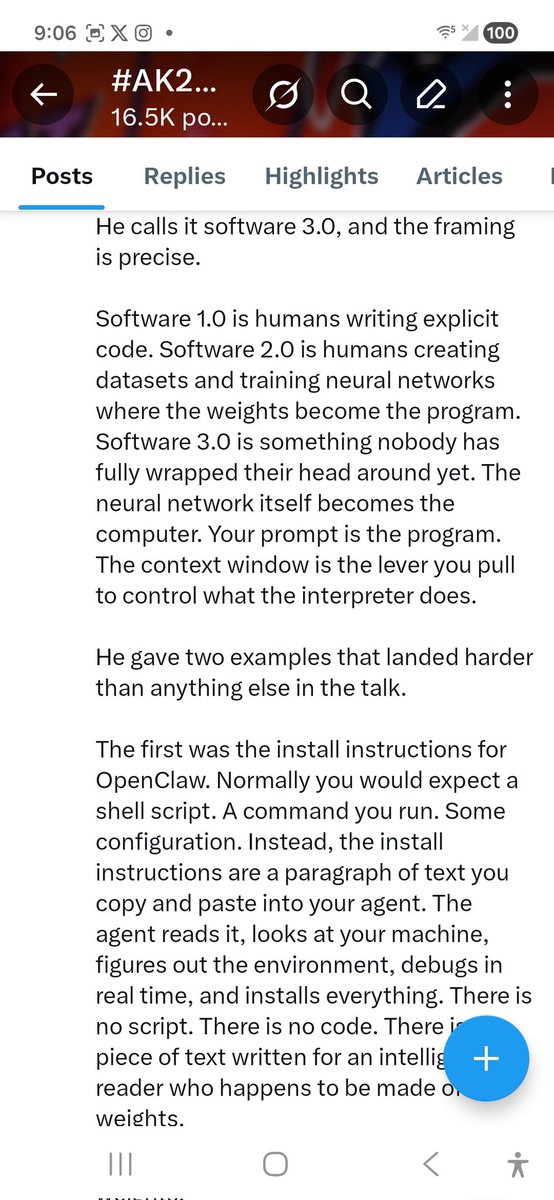
He calls it software 3.0, and the framing is precise.
Software 1.0 is humans writing explicit code. Software 2.0 is humans creating datasets and training neural networks where the weights become the program. Software 3.0 is something nobody has fully wrapped their head around yet. The neural network itself becomes the computer. Your prompt is the program. The context window is the lever you pull to control what the interpreter does.
He gave two examples that landed harder than anything else in the talk.
The first was the install instructions for OpenClaw. Normally you would expect a shell script. A command you run. Some configuration. Instead, the install instructions are a paragraph of text you copy and paste into your agent. The agent reads it, looks at your machine, figures out the environment, debugs in real time, and installs everything. There is no script. There is no code. There is a piece of text written for an intelligent reader who happens to be made of weights.
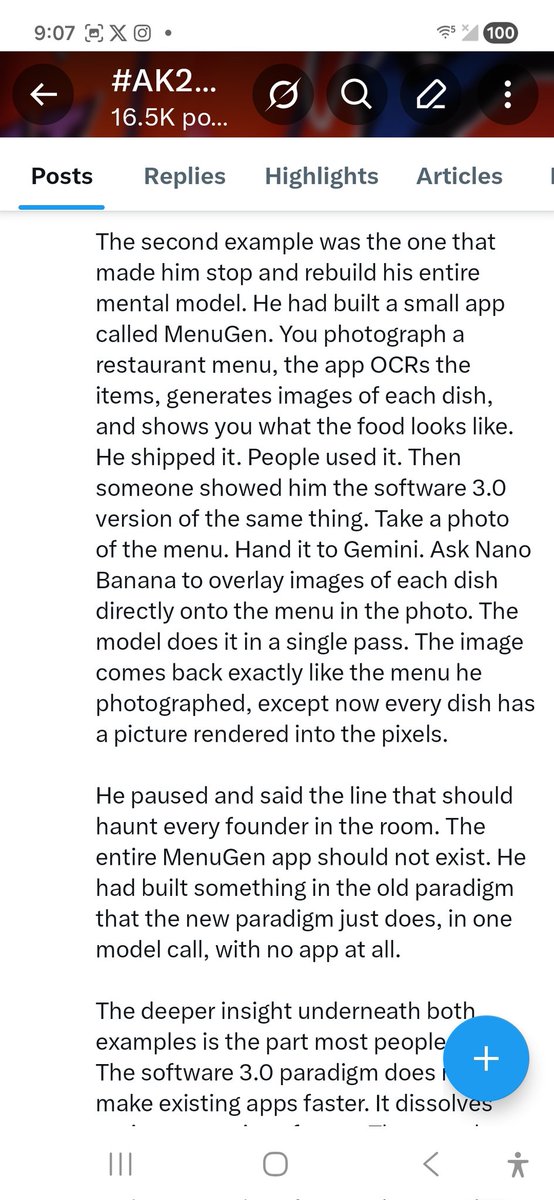
The second example was the one that made him stop and rebuild his entire mental model. He had built a small app called MenuGen. You photograph a restaurant menu, the app OCRs the items, generates images of each dish, and shows you what the food looks like. He shipped it. People used it. Then someone showed him the software 3.0 version of the same thing. Take a photo of the menu. Hand it to Gemini. Ask Nano Banana to overlay images of each dish directly onto the menu in the photo. The model does it in a single pass. The image comes back exactly like the menu he photographed, except now every dish has a picture rendered into the pixels.
He paused and said the line that should haunt every founder in the room. The entire MenuGen app should not exist. He had built something in the old paradigm that the new paradigm just does, in one model call, with no app at all.
The deeper insight underneath both examples is the part most people miss. The software 3.0 paradigm does not just make existing apps faster. It dissolves entire categories of apps. The neural network does so much of the work that the scaffolding around it becomes unnecessary. You are not speeding up the old workflow. You are noticing that the old workflow does not need to exist.
He extended this further. Most products today are written for humans. Documentation is written for humans. Setup flows are written for humans. He said his pet peeve has become going to a docs page and being told to do something. He does not want to do anything. He wants to know what to copy and paste into his agent.
The companies that figure out how to be agent-native first, where every interface, every doc, every setup flow, every API is built for the agent reading on your behalf rather than for you reading directly, are going to make the human-first versions feel as outdated as a website that does not work on a phone.
The final part of the talk was about taste, and this is the part that separates the people who will compound from the people who will plateau.
He said the agents are still interns. They have remarkable recall. They have superhuman speed. They can fill in any blank you point them at. But they have no aesthetic judgment, no sense of what matters, no understanding of why the system is being built in the first place. He gave an example from MenuGen where his agent tried to match Stripe purchases to Google accounts using email addresses, even though users could obviously sign up with one email and pay with another. The agent had no model of what a user actually is. It just pattern matched fields together.
So the human stays in charge of the spec. The architecture. The taste. The thing that has to be true for the system to be worth building at all. The agent fills in everything underneath that.
Then he said the line he had read on the internet that he keeps coming back to every other day. You can outsource your thinking. You cannot outsource your understanding.
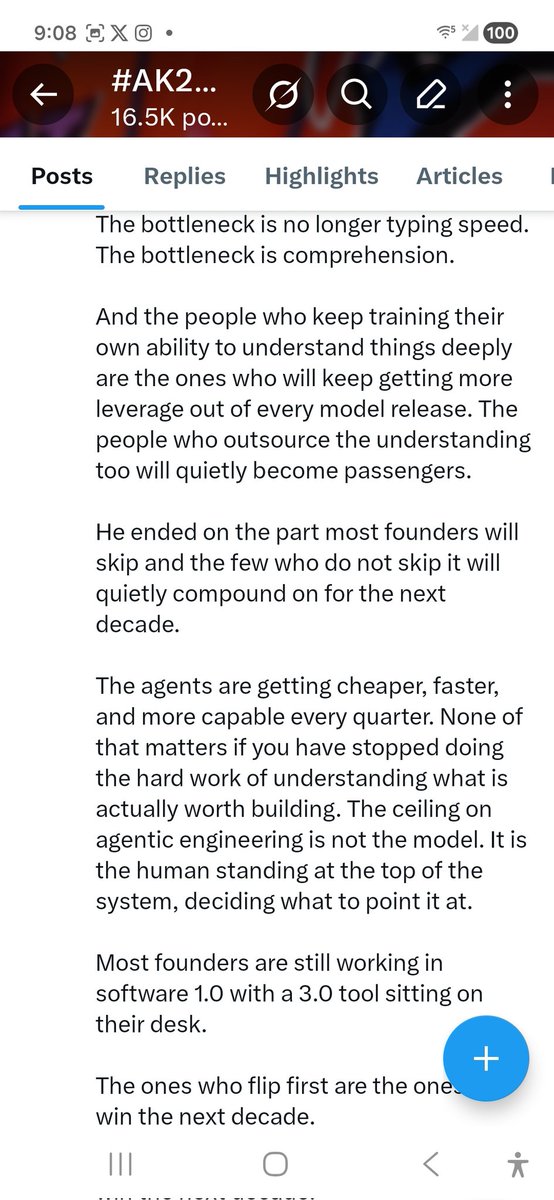
That is the whole talk in one sentence. The agents will write your code. They will draft your emails. They will research your topics. They will execute your plans. But something still has to direct them, and that something has to actually understand what is being built and why. The bottleneck is no longer typing speed. The bottleneck is comprehension.
And the people who keep training their own ability to understand things deeply are the ones who will keep getting more leverage out of every model release. The people who outsource the understanding too will quietly become passengers.
He ended on the part most founders will skip and the few who do not skip it will quietly compound on for the next decade.
The agents are getting cheaper, faster, and more capable every quarter. None of that matters if you have stopped doing the hard work of understanding what is actually worth building. The ceiling on agentic engineering is not the model. It is the human standing at the top of the system, deciding what to point it at.
Most founders are still working in software 1.0 with a 3.0 tool sitting on their desk.
The ones who flip first are the ones who win the next decade.
Claude Code's `/simplify` command is so amazingly effective. Going to get `ce-work` to use it if it's available in the next release of #CompoundEngineering
#CompoundEngineering v3.3 is out. A lot of improvements across the entire plugin to improve both the experience using the skills, but more importantly, to create superior outcomes.
https://t.co/AwNYzKwnYY
https://t.co/eF1Fi8W6nl
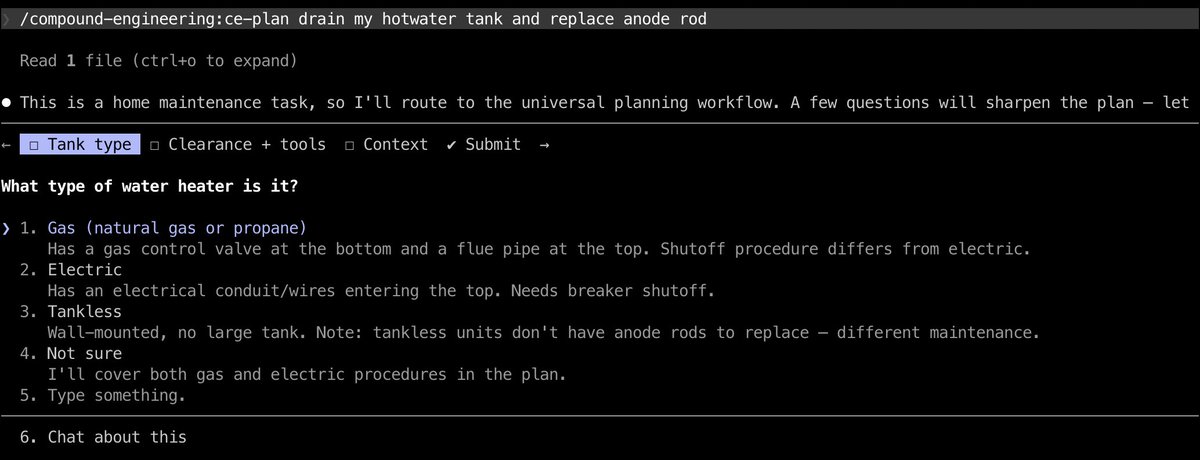
Something we snuck into #CompoundEngineering a few weeks ago, was the ability to do "universal planning". Basically how can it help you brainstorm or plan non-repo (and non-software!) things. Practical example: it plan out my hot water tank maintenance. 5 Q&As later and it's proactive research (it decided on its own to do), it spit out this plan: https://t.co/A2ftbJ84pY
#CompoundEngineering v3 launched yesterday. My favorite skill right now is `/ce-ideate`. It works whether you’re an engineer, designer, PM, or wearing all 3 hats (or 2.5). Keep it broad or aim it at a feature, a workflow, a bottleneck, or a business question. You can even prompt it by pointing it at your github issues and it'll thematically analyze it and use those themes as a basis for the ideation.
Attached is an obligatory gpt image gen graphic. I was tempted to do a sizzle real in @Remotion just for fun but i need to spend time today draining my hot water tank in my basement 😛

Inspired by this post, added `/claude-permissions-optimizer` in the latest version of @every's #compoundengineering plugin last night. It analyzes up to 500 of your most recent sessions (user or project level, your choice) to help you solve permission hell.
https://t.co/xZ0zZZj356

After 5 permission prompts in a session, a hook suggests running the permissions analyzer. It scans your last 14 days of session transcripts, extracts every Bash command approved, and classifies them:
- GREEN: ls, grep, test runners
- YELLOW: git, mkdir
- RED rm, sudo, curl etc.
@Scobleizer c @openclaw is =#cliOS=@github #machineLanguage, #NemoClaw @NemoClaw is #OpenSource =#UnixServer ,where is #AgenticGUI #Voice & #Notification response #Copilot #CompoundEngineering #AutoMagic #AgenticUI=#MacOS C my #WAG 22:00 & 6:00 from end https://t.co/KODXKcFDnM


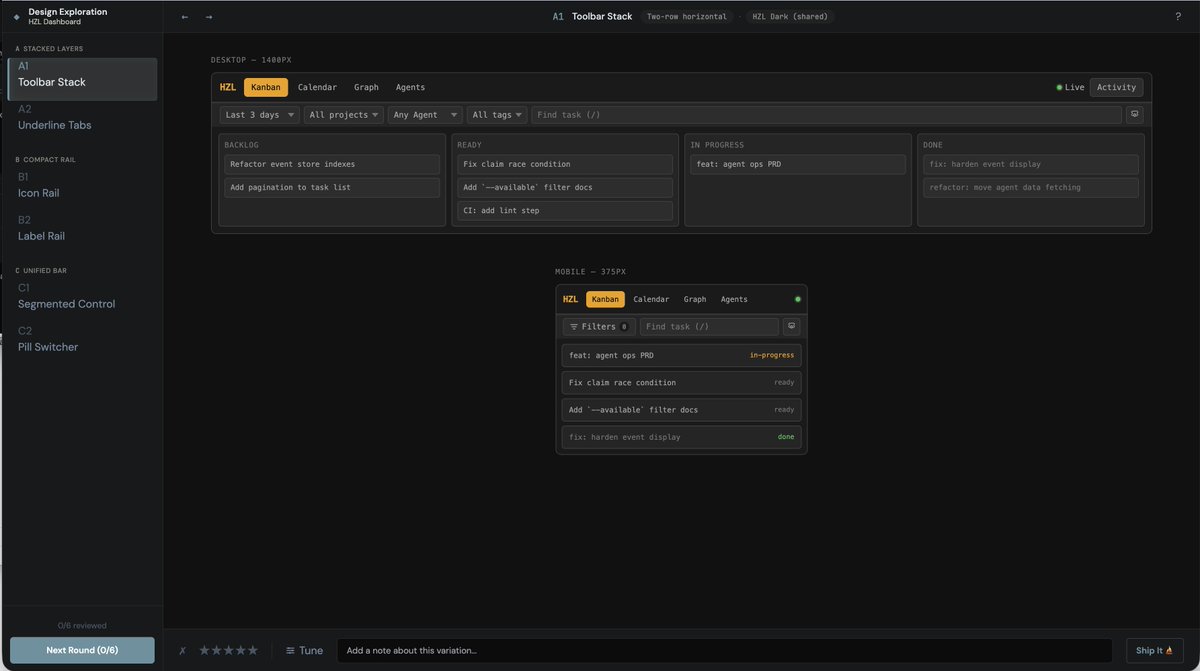
Coincidentally i've played with exactly this idea recently. It works really well for entire pages, features and components. It faciliates the loop with the agent by having you score it and iterate. Likely bringing a version of this to #compoundengineering soon as a test with @kieranklaassen.
here's a screenshot of what was produced in an exploration of a kanban app i've been messing with.

Big update: we brought #CompoundEngineering into our automatic PR reviews via GitHub Actions.
Reviews were a bottleneck, and speed demanded automation. Now every PR gets a 5‑agent AI review (security, quality, architecture, devops, learnings) in minutes without a human having to run /workflows:review in terminal.
cc @kieranklaassen @danshipper
Last Seen Hashtags on Sotwe
vagina
Seen from Germany
mgai
Seen from United States
男宿舍
御姐不高冷
sissy #rebeu
Seen from Algeria
anxiouspanda()****************************************************************** filter:videos
Seen from United States
白虎
Seen from United States
bloodfetish
Seen from Turkey
crot anak
Seen from United States
minichatt
Most Popular Users

Elon Musk 
@elonmusk
241.5M followers

Barack Obama
@barackobama
118.8M followers

Cristiano Ronaldo
@cristiano
114.5M followers

Donald J. Trump
@realdonaldtrump
111.9M followers

Narendra Modi
@narendramodi
107.1M followers

Rihanna
@rihanna
98.7M followers

NASA
@nasa
92.3M followers

Justin Bieber
@justinbieber
91.8M followers

KATY PERRY
@katyperry
90M followers

Taylor Swift
@taylorswift13
84M followers

Lady Gaga
@ladygaga
75.5M followers

Virat Kohli
@imvkohli
73.5M followers

Kim Kardashian
@kimkardashian
70.9M followers

YouTube
@youtube
68.8M followers

Neymar Jr
@neymarjr
66.5M followers

Bill Gates
@billgates
65.3M followers

Selena Gomez
@selenagomez
63.1M followers

The Ellen Show
@theellenshow
62.2M followers

CNN
@cnn
61.7M followers

X
@x
60.7M followers