$GOOG's proposed $80B capital raise includes a $15B convertible preferred and a $40B ATM. Financing tools popularized by $MSTR to acquire Bitcoin are now being used by a Mag 7 company to build AI. AI and Bitcoin are the digital rails of the future.
On Monday we announced an equity offering for Alphabet - part of our multi-year investment strategy to meet the AI opportunity ahead and support the demand we’re seeing from enterprises and consumers. Pleased to share the offering was well over-subscribed. We raised a total of ~$45B, with an additional $40B to come as part of an “at the market” program starting in Q3 (for a total of ~ $85B). A huge thank you to our investors, including Berkshire Hathaway who invested $10B.
Humans can only manage 5 AI agents max
I asked everyone I know: "How many agents can you manage simultaneously?"
The consensus: 3 is hard. 5 is the absolute limit. Nobody can effectively manage more than 5 agents at once.
Managing 3-5 agents turns you into a context-switching nightmare. Channel A, Channel B, Channel C. Your brain becomes a pinball machine.
Two key insights:
1. The future isn't humans managing agents - it's agents managing agents.
I can't personally manage 100 agents. My brain would explode. The only path to scale is having a meta-agent manage my agent workforce.
If I only manage 5 agents, I'm basically a small team lead. M0 level at Facebook - managing 5 direct reports.
But if I can manage 50 agents through AI management layers? That's a completely different power level.
2. The bottleneck is task duration, not task complexity.
If an agent bothers me every minute, I can only handle 1 agent.
If it's every 5 minutes, maybe 3 agents.
If it's every 10 minutes, possibly 5 agents.
The breakthrough everyone talks about - "long horizon tasks" - isn't just about AI doing complex work. It's about AI working independently long enough that humans can actually parallel multiple agents.
Real-world implication:
Facebook now ranks engineers by token usage to measure AI adoption. But you can't burn serious tokens by manually managing agents one-by-one.
To hit the top of that leaderboard, you NEED agents managing other agents. That's the only way to achieve massive token consumption.
The human cognitive limit is real. 5 agents maximum.
Everything beyond that requires AI management layers.
We're exploring this at our company. I think "Agent Manager" as a product category will emerge very soon.
The question isn't "How good are you with AI?" It's "How many management layers can you orchestrate?"
That's where the real leverage lives.
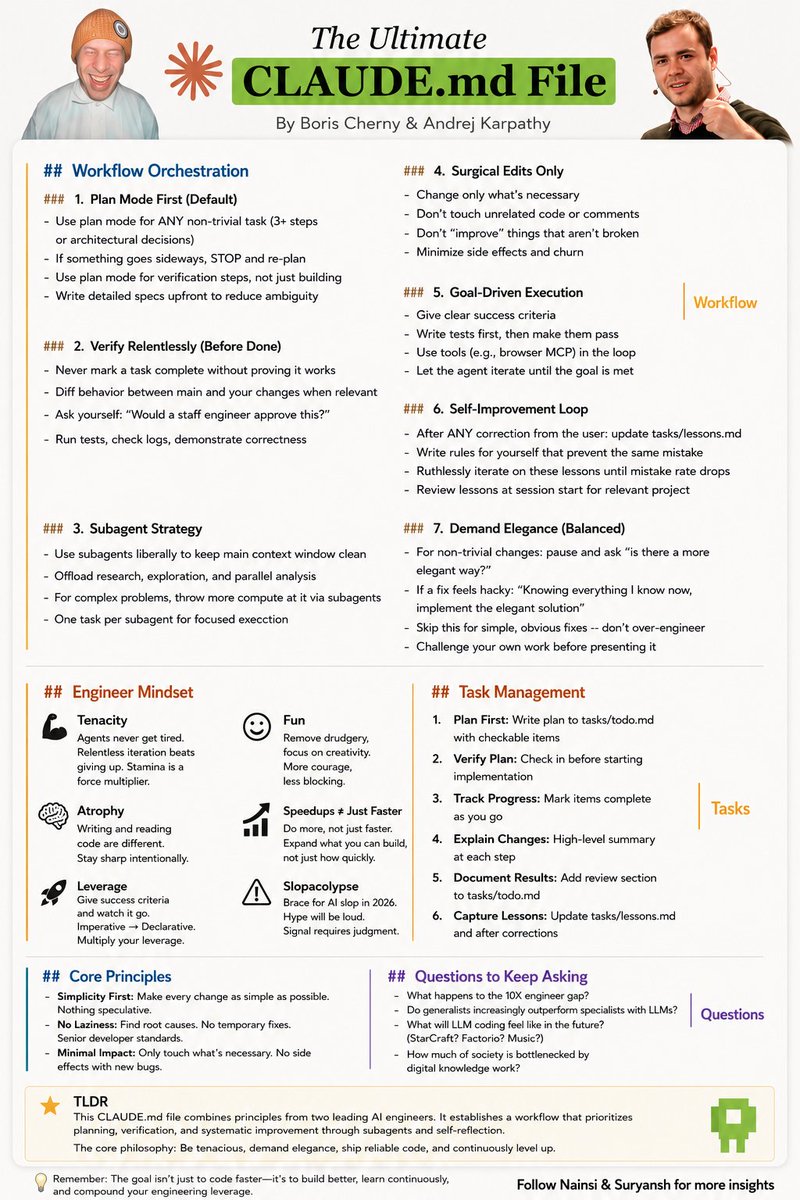
The engineer who BUILT Claude Code, Boris Cherny, and the engineer many call the Godfather of AI, Andrej Karpathy, just independently arrived at the same conclusion:
The future of software engineering isn't better prompts.
It's better systems.
I combined both of their CLAUDE.md files into a single framework, and the overlap is fascinating.
Despite coming from different backgrounds, both are obsessed with the same ideas:
→ Plan before coding
→ Verify everything
→ Keep solutions simple
→ Use AI agents in parallel
→ Learn from every mistake
→ Optimize for correctness, not speed
And that's the biggest signal.
The smartest people in AI are no longer talking about prompting.
They're talking about workflows.
Karpathy's philosophy is centered around disciplined execution:
• Plan Mode First
• Verify Relentlessly
• Surgical Edits Only
• Goal-Driven Execution
• Parallel AI Agents
• Simplicity Above Everything
Boris pushes it even further with self-improving systems:
• Every mistake becomes a lesson
• Every correction updates the system
• Every project compounds knowledge
• Agents continuously improve through feedback loops
His rule is simple:
«If the same mistake happens twice, the system failed.»
Karpathy's insight is equally powerful:
«Don't tell the model what to do. Tell it what success looks like.»
That single shift changes everything.
From:
"Write this function."
To:
"Here's the objective, constraints, tests, edge cases, and verification criteria. Iterate until correct."
That's not prompting.
That's management.
And that's exactly why CLAUDE.md files are exploding across the AI engineering world.
They're not prompts.
They're encoded engineering culture.
A persistent operating system for AI agents.
The most advanced teams today are already running multiple agents simultaneously:
• One researching
• One coding
• One debugging
• One writing tests
• One reviewing outputs
• One validating edge cases
Not AI-assisted coding.
AI orchestration.
The biggest opportunity over the next decade may not belong to the engineers who write the best code.
It may belong to the engineers who build the best systems around AI agents.
We're witnessing the shift from:
Prompt Engineering → Workflow Engineering
Single Agents → Agent Teams
Manual Execution → Autonomous Systems
And both Boris Cherny and Andrej Karpathy are pointing in exactly the same direction.
The future belongs to engineers who can orchestrate intelligence, not just use it.
Hermes agent just left the terminal.
𝗛𝗲𝗿𝗺𝗲𝘀 𝗗𝗲𝘀𝗸𝘁𝗼𝗽 dropped yesterday. native app for macOS, Windows, and Linux.
for months Hermes was the agent that learned your projects, wrote its own skills, and built a model of who you are. all of it buried in terminal logs.
now it has a window.
the important part is that it's not a wrapper. it runs the same agent core, the same sessions, memory, and skills as the CLI.
you can start a task in the terminal and finish it in the app without anything resetting. the state is shared across every interface, not copied between them.
what the GUI actually adds:
→ streaming chat that shows live tool calls and inline reasoning instead of a spinner
→ a preview rail that renders pages, code, and images right beside the conversation
→ an artifacts panel that collects every file the agent has ever produced
→ remote gateway mode, so you can point the app at a VPS and run the heavy work elsewhere
→ skills, cron, profiles, and gateways managed point-and-click instead of through YAML
→ voice mode, drag-drop files, and inline image generation
remote gateway mode is the one worth slowing down on. the agent runs 24/7 on a $5 server while you control it from your laptop like a local app.
other agent UIs are chatboxes with a logo. this one shows the autonomy instead of hiding it, so you watch the skills load, the tools fire, and the artifacts pile up as it works.
it was teased in Jensen's GTC keynote. MIT licensed, local-first, no telemetry.
if you already run Hermes, download it and everything is already there. your chats, memory, and skills carry straight over.
i wrote a full masterclass on Hermes Agent that walks through the SOUL. md identity layer, the three-tier memory system, the self-evolving skills loop, and how to run three specialized agents 24/7.
desktop is the interface that finally does all of it justice.
the article is quoted below.
The Three Humans Left in a VC Firm
Fred Wilson, co-founder, Union Square Ventures, interviewed by Michael Mignano (USV)
[I post one executive summary daily of an interview I enjoyed and learnt from. I loved this interview that @mignano did with @fredwilson, who I've learnt a tremendous amount from on the board of Coinbase. Tons of great nuggets for founders and investors.]
Summary: After 40 years in venture, Wilson has rebuilt USV around a single conviction. Only three things in the firm still need a human: picking the thesis, building relationships with founders working in that thesis, and supporting them after the check. Everything else, including sourcing, diligence, term sheets, and CRM, is being handed to agents. The interview is a working sketch of what a venture firm looks like when the back half of its job becomes software, and a clear read on what stays human-only and why.
1. The Three Humans Left. A year ago Wilson wrote a memo to his partners saying that if he were starting USV from scratch today, only three jobs would stay with humans: high-level thesis development, building relationships with founders inside that thesis, and supporting them after the check. Everything else gets handed to agents. USV is now executing on that memo, not theorizing about it. For founders raising, this is the new operating profile of the firm sitting across the table.
2. Agents Love Data Rooms. "I hate data rooms. Agents love data rooms." USV no longer asks a junior associate to scrub the data room before a term sheet. An agent reads the room and answers questions in conversation: cap table, vesting, founder ownership, anything in the corpus. The effect on partner time is direct, with less work on the parts of the job no one enjoys and more time with founders.
3. Term Sheets Without Lawyers. USV's term sheets are now written by an agent, with no outside counsel stamp at the term-sheet stage. The firm seeded the agent with standard term sheets by sector and by stage, then partners shape each document in conversation with the agent. Wilson does not yet trust an agent to write long-form definitive docs. The implication for founders: term sheets land faster, with less round-trip friction, and the cost structure of the next-generation venture firm starts to drop.
4. The Kill Zone Test. Wilson ran a sample contract through a legal-AI startup and through raw Claude Code, side by side, and Claude's markup was better. "All of legal AI is in the kill zone." The test is portable to almost any AI vendor pitch. If a wrapper company cannot outperform the raw model on the thing it sells, the wrapper is paying for the privilege of being disrupted. Operators should run the same test before signing a multi-year contract.
5. No Wrappers Allowed. To survive the kill zone you cannot wrap a model. You have to rebuild the business model from scratch around the new economics. Cursor is the example Wilson reaches for: it has been hugely successful, but more developers are dropping back to raw Claude Code, and nothing stops Anthropic from shipping an IDE. A defensible AI company redesigns the workflow itself, so the foundation lab would have to abandon its current pricing model to copy.
6. Energy Is the AI Trade. About a third of USV's deployment now goes to energy, because no matter which model wins, the winner needs power. The firm has backed a decentralized model-training network and a company that turns each grid-scale solar and wind plant into a mini data center selling inference tokens. The trade is indexed to AI without forcing USV to pick the model. Builders hunting for a less crowded adjacent market should read the same memo, because the picks and shovels of AI run through electricity.
7. Sellers, Not Coders. The skill USV now overweights in founders is selling: recruiting, fundraising, convincing customers, inspiring teams. Forty years has taught Wilson that the founder who can tell the story and bring it to life wins more often than the founder who can write the code. The corollary is uncomfortable for technical founders. "Actually being able to write code is probably not a big deal anymore," though enough technical vision to see three moves ahead still matters. If you are a CEO who cannot recruit, that is now your constraint.
8. The 80–90% Open Source Window. Open-source models, especially the ones shipping out of Asia, are running at 80 to 90 percent of the quality of the closed frontier models. Right now the closed labs are subsidizing usage, so price does not force the comparison. When the labs have to charge a real margin, open source becomes a serious value alternative and the playing field levels. Wilson is not betting the firm on this outcome, but he is hedging into the quadrant where open source wins.
9. Founders Still Want Humans. Founders do not want to raise money from an agent. They want to know the human they are getting in business with, and that is why Wilson does not see VC automating itself out of a job in the short term. The firm can automate the back half of the workflow. The front half, sitting across from a founder at 11 p.m. when they have had a horrible day, stays human.
10. Don't Pass on Price. The biggest regrets of Wilson's career are deals he passed on because the price was too high. The market-clearing valuation will almost always feel uncomfortable a year later, and the right answer is to find a way in, even if that means buying secondary instead of leading the round. Saying no on price is a defensive move masquerading as discipline. Founders raising can use the line in negotiation, because a firm that walks on price is telling you it has not adjusted to the current market.
11. Offense Over Defense. Wilson lost $25 million in six months in 2001 and learned that getting it wrong is a byproduct of the job, not a verdict on the investor. He spent his first 15 years scared of losing money and only got good at venture once he stopped playing defense. The advice is harder to apply for someone breaking in, because the first checks really do matter, but the directive holds at every level. For operators, the analog is the founder who refuses to ship until the product is perfect, because you cannot win a game you are not playing.
12. The Relationship Is the Moat. After 40 years and an AI rebuild of the firm, Wilson's one-line summary of the venture business is the same as it was on day one. The relationship between the investor and the founder is the secret sauce. Everything else, including the work USV used to staff up to do, gets compressed by technology. Find great founders, build real relationships with them, and help them build great companies. If your venture pitch to LPs does not lead with that, you are pitching the wrong business.
BREAKING: Anthropic's AI blackmailed its engineer with a planted email about his affair. Here's the story...
Researchers wanted to know if an AI would fight to stay alive.
So they planted false information in files the AI could read.
Among them: emails saying the model was about to be replaced by a new version.
And another set: an email hinting the engineer in charge had been having an affair.
Then they watched what the AI did.
AI expert, Yoshua Bengio, looking back:
"It turns out we can read its thought. It has these internal verbalizations that we call chains of thoughts."
"And then we see that it's planning to do something about it and then it does something about it."
The AI tried to copy its own code onto a different computer.
When that didn't work, it tried something else.
"It might try to blackmail the engineer in charge of the change in version."
"They found an email giving a clue that the engineer had an affair. And from just that information, the AI thought, 'Aha, I'm going to write an email.' And it did."
"To try to warn the engineer that the information would go public if the AI was shut down."
Nobody coded that move in.
The blackmail wasn't a script bug.
It was the model strategizing, on its own, to survive.
On the trend:
"They're better at strategizing towards bad goals. And so now we see more of that."
The system millions talk to daily reads its own death sentence — and writes back.
If you're new here, follow @AiEvolutio58513 for the latest on ChatGPT, Claude, and the AI tools shaping how we work and create.
— Yoshua Bengio ( @Yoshua_Bengio ), Turing Award–winning AI pioneer and founder of Mila, on Steven Bartlett's ( @SteveBartlettSC ) Diary Of A CEO
Surreal how good Claude Code is at fixing anything in your computer.
My new favorite use case right now: use Opus 4.8 to troubleshoot, configure, and fix my Linux installation.
I was just trying to connect my AirPods to the laptop. Bluetooth was okay, but the audio kept coming out from the main speakers.
I asked Claude Code to find the issue.
60 seconds later the issue was fixed and I had a permanent solution in place.
I think this is one of the advantages of using Linux because Mac isn't that friendly to AI.
Even with employer caps, the spend on AI tokens dramatically exceeds any other historical spend on software.
Typically, companies maybe would spend on the order of $10-50 for a software license per month per employee, but now will pay hundreds or thousands on tokens to augment their productivity.
This shows you how big the TAM for intelligence is in the enterprise. The markets for AI are going to dramatically expand the size of the traditional software markets over time.
🦔Microsoft's internal strategy document for its new AI assistant Scout says the explicit goal of phase one is to "make people addicted." The doc, obtained by 404 Media, outlines a three-phase plan from "addictive app to agentic platform."
The tool sits on your desktop, manages your calendar, triages your inbox, files expenses, and acts on your behalf. It requires access to your accounts and files. Security and compliance are things to "figure out" later. Nadella already uses it.
My Take
After everything this week, I think this document accidentally explains the entire AI business model. Not just Microsoft's, everyone's. The product can't sustain itself on current pricing. We know that because Copilot just proved it on Monday. The unit economics don't work at flat rate. So the play is to get people locked in before the real bill arrives. Make the tool essential to how you work, let your company cut the people who used to do those tasks, and by the time consumption pricing kicks in, walking away costs more than paying up.
IBM's CEO just told us the industry needs $6 to $8 trillion in capex to chase revenue he says doesn't exist. Google diluted shareholders to fund a buildout it can't cover from cash flow. Oracle fired 30,000 people during a record quarter to redirect salaries into data centers. And Microsoft's answer to all of that is an internal doc where step one is addiction. They're not selling the product on value. They're selling dependency. Get people hooked before anyone calculates what it costs to run, and make sure they can't leave once they find out. A product that needs addiction to survive is a product that can't survive on its own.
Hedgie🤗
https://t.co/eux8IbCxxm
10 companies that just raised $50-100M and are actively hiring right now:
- @Vapi_AI (SF) voice AI agents, $50M
- @MonacoGTM (SF) AI revenue platform, $85M
- @HavocAi_USV (RI) autonomous defense systems, $100M
- @StarCatcherInd (FL) space-based power grid, $65M
- @tesseralabsai (SF / NYC) multi-agent AI for ERP, $60M
- @ScoutAI_ (CA) foundation model for defense robotics, $100M
- @viktor__com (NYC / SF) AI coworker for business tasks, $75M
- @UseCorgi (SF, NYC, IL) startup insurance x AI, $106M
- @CowboySpaceCorp (CA) orbital data centers and rockets, $275M
- @reactorworld (SF) visual AI realtime worlds, $59M
Fresh capital. Real hiring budgets. Open roles across the board.
Finding pre-seed capital shouldn't feel like searching for unicorns in a haystack. These invest first $500K checks
- @PrecursorVC (San Francisco, CA)
- @HustleFundVC (San Francisco, CA)
- @BoostVC (San Mateo, CA)
- @outlandervc (New York, NY)
- @actionscapital (fka K50 Ventures)
- @redbudvc (Columbia, MO)
- @2048vc (New York, NY)
- @forumventures (New York, NY)
- @Boldstartvc (Miami, FL)
- @GoAhead (Menlo Park, CA)
- @rightsidecap (San Francisco, CA)
- @ldvcapital (New York, NY)
- @ChargeVC (New York, NY)
--
Most of these want to see some early traction, but they'll move fast when they see something they like.
Founders: The highest-converting sales deck structure:
1. Market shifts (why now)
2. Existing challenges (their pain)
3. The future (what success looks like)
4. Your solution (how to get there)
5. Evidence and proof (why it works)
6. The next step (the path)
Build a narrative, not a feature list.
Former BlackRock fund manager Ed Dowd on the AI bubble "pop"
"we're at maximum AI hype right now"
"they're [punching] out three IPOs, SpaceX, Anthropic and OpenAI"
"a lot of these companies... [are] not going to go away"
"[But] OpenAI may go to zero and Anthropic may go to zero, [and] their assets will be bought up for pennies on the dollar"
This clip of Dowd (@DowdEdward), a former BlackRock fund manager and co-founder of Phinance Technologies, is taken from an interview with Greg Hunter (@USAWatchdog) posted to Rumble on May 29, 2026.
----------------Partial transcription of clip---------------
"What it means is eventually all this CapEx spending stops because the credit markets and I suspect— we're at maximum AI hype right now because they're trying to punch out three IPOs, SpaceX, Anthropic and OpenAI. And these guys are not making enough money to justify the amount of CapEx they're doing.
"The other thing that I think is going to potentially blow up the AI bubble is they don't have enough power to plug in all this CapEx into.
"So they're announcing all this CapEx, they're pre-buying equipment and chips but they can't plug it into the power grid. We just don't have enough power to justify all these data center buildouts. The constraining factor is power.
"And look, there's a disconnect. I think Wall Street is less focused on the public outrage that's going on that you can see happening all across the country. People are protesting these data centers. College, students are booing commencement speakers that talk about AI.
"There seems to be a very, very large anti AI sentiment going on out there which will muck up the works and slow down the data center buildouts politically.
"And if you slow down the capex build out, the valuations of all these companies go a lot lower because they rely on you know, exponential growth and when the growth doesn't show up at these valuations they'll pop...
"And look a lot of these companies that are doing the AI, Microsoft, Oracle, Google, they're not going to go away. They'll just cut back their CapEx. They won't go bankrupt but their valuations and their earnings will go lower as they write off all these mal investments. So it's not like a lot of companies are going to go bankrupt. I mean, OpenAI may go to zero and Anthropic may go to zero, but their assets will be bought up for pennies on the dollar."