

Top Tweets for #LoAC

@RoKhanna @BernieSanders @Israel Oh, and as an added bonus, here is a companion post to the article linked above that also addresses doctrinal #LOAC compliance & the unconstitutionality of the legislative veto in the context of the Foreign Assistance Act & security assistance to 🇮🇱. ⤵️
https://t.co/bNnds7Es5G

False. Purporting to merge int'l human rights law (#IHRL) & law of armed conflict (#LOAC) didn't happen "aeons" ago (even figuratively).
That movement can be traced to mid-1960's as 20th anniversary of Universal Declaration of Human Rights approached.
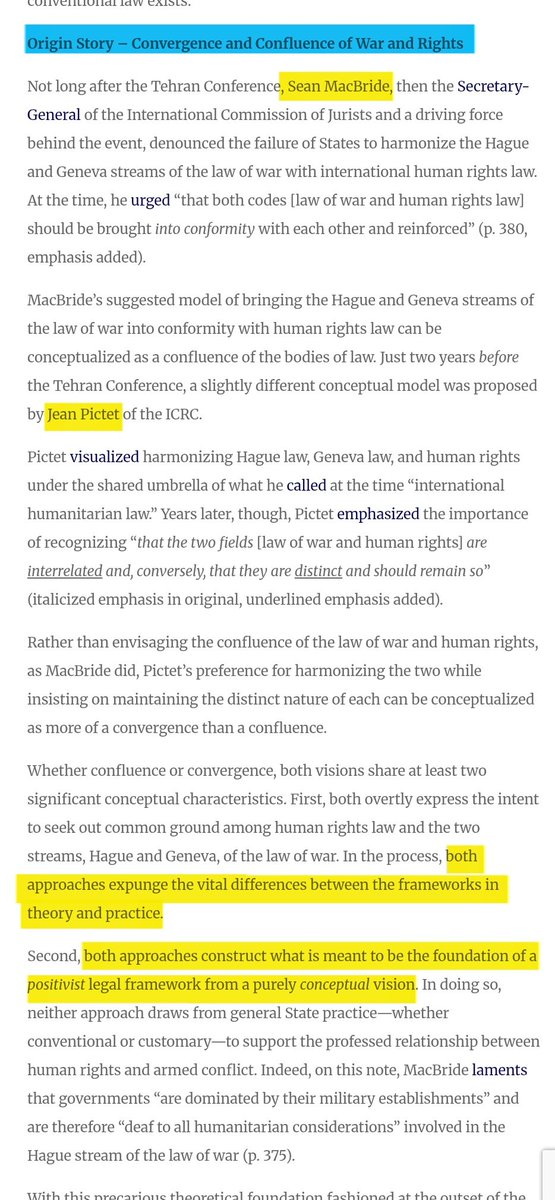
It's also when Jean Pictet @ICRC coined the term "international humanitarian law" (#IHL) we still use today. That phrase was based on the conceptual model he simply constructed in his own mind then wrote about in a set of 3 journal articles published in International Review of the Red Cross beginning in Sep 1966 (pic 1, left).
Now, you won't be shocked to learn that I don't make it a habit to respond to or take seriously some rando anonymous social media account with a penguin as a profile pic + a generally bad attitude. But I've come to respect both @shamziman & @ElliotMalin during my time here @X, and they've been engaged in this 🧵 for a while now - so I'll join in as well.
Plus, this is an opportunity to at least briefly outline why the movement to merge LOAC & IHRL has always been misguided, and why that matters for us today.
So, to the original point at the very top of this 🧵: the "nexus" between LOAC & IHRL is most certainly not "basic stuff in int law man." As mentioned above, this movement took shape in the mid-1960's as an attempt to essentially hitch humanitarian advocacy to the rising star of human rights rhetoric.
I doubt you'll find anyone who knows more about this subject than me tbh. I've studied it from practical, conceptual & historical approaches since the "nexus" between LOAC & IHRL emerged as a decisive issue on a file I was assigned in 2014 as Chief of International and Operational Law for Regional Command-East in 🇦🇫.
Due to the current forum, I won't go into detail about that file. But that's what sparked my realization that this issue ("nexus" between LOAC & IHRL) isn't just some theoretical, academic concern. It is that, but it's also vitally important in practice.
Fast forward almost exactly 10 years after that deployment, and I graduated from Cornell Law (where I also teach, of course) with a JSD degree. Any guesses what the topic of my dissertation was?
That's right. The "nexus" between LOAC & IHRL (pic 2).
What I learned in that study - a lesson I continue to refine - is that there is not, nor has there ever actually been, a "nexus" or "relationship" between the two.
That's bc when initial architects like Pictet & Sean McBride were busy fabricating the "relationship" in their own minds by merging LOAC & IHRL then trying to convince everyone of the legitimacy of their theoretical frameworks in the mid-1960's, they completely erased & ignored all the conceptual & practical characteristics that differentiate the two bodies of law (pic 3, excerpt of my article at: https://t.co/hEge2xxqht).
The problem is, those incongruent characteristics matter. A lot. They always have (my dissertation traced historical connections from the Marius-Sulla rivalry in late Roman Republic to today), and they always will.
That conceptual & historical background sets up the question: why is this relevant & important now?
Simple. The "relationship" between these two separate bodies of law (LOAC & IHRL) has always been problematic, yet it is THE mechanism that connects groups like @hrw & @amnesty to the context of armed conflict.
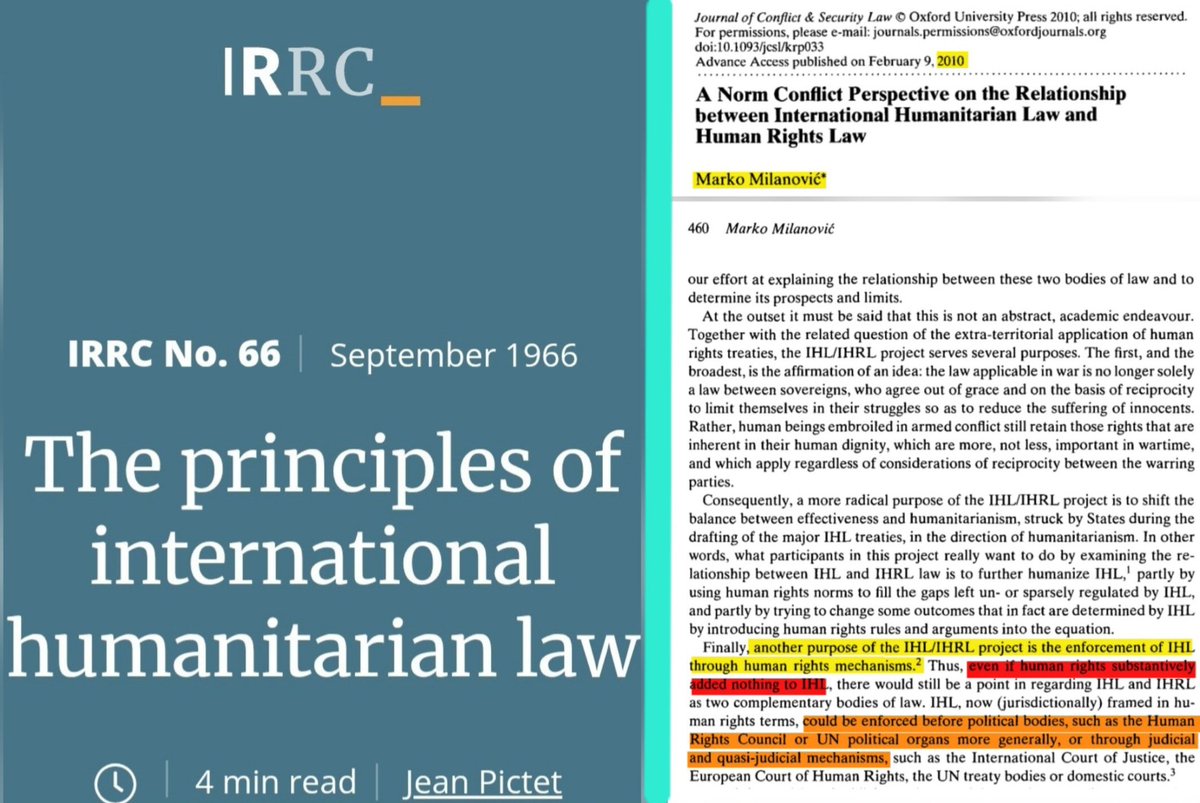
That's the whole point of at least rhetorically merging the two. It's simply a matter of framing armed conflict in LANGUAGE of human rights to expand the pool of groups & entities who can claim a stake in "enforcement" & advocacy (pic 1, right).
Which brings us back to the main point from my OP back in Oct last year. These human rights groups aren't ACTUALLY "experts" at LOAC - conceptually or methodologically (pic 4, my article at https://t.co/HUUfycPmhT).
Yes, genocide CAN be committed in both peacetime & war. But when the broader context is armed conflict, advocacy from these general human rights groups is not actually convincing.



Was US seizure of Iran ship illegal?
What maritime framework says?
:Explained by Sh Arav Shah
#USA #Iran
#IranWar #StraitOfHormuz
#NavalBlockade #GulfOfOman #Touska #USSpruance #Piracy #InternationalLaw
#UNCLOS
#LOAC
#Ceasefire #Peacetime #Wartime
#UPSC
Source: IE

Dear @tedlieu: Actually, YOU are wrong. For a JAG veteran @usairforce, it's shocking how little you know about #LOAC. Don't worry. I'm a retired @USArmy judge advocate myself + a current int'l law prof, and I'm here to help.
Before you go threatening all our servicemembers @DeptofWar with the specter of future "war crimes" prosecutions with "no statute of limitations", let's get a few things straight right now.
1. Federal law does NOT "require our military to follow the principle of proportionality." Although you don't cite what "federal law" you mean (rookie mistake), it seems you may be referring to 18 USC § 2441 on "War Crimes". If that IS what you claim requires "our military to follow the principle of proportionality," you maybe should have asked one of your staffers to check the actual text of the law before you tweeted this nonsense.
Too late now, but let's walk through it together so I can explain.
As you can see from pic 1 attached, this statute establishes the term "war crime", for purposes of this federal law, means conduct in 1 of 4 specific circumstances. Let's go through them 1 by 1, but here's your spoiler alert: none of them apply here.
First is grave breaches of 1949 Geneva Conventions. All 4 GCs have a provision on grave breaches. BUT unfortunately for your credibility, none of them address #LOAC proportionality rule (look it up for yourself if you don't believe me...don't expect me to do ev-er-ything for you). You'll notice I lined through the part about "any protocol to which" 🇺🇸 is a party since the main treaty establishing the proportionality rule - Additional Protocol I (1977) to the 1949 Geneva Conventions (AP I) - we have NOT ratified. womp womp.
Second is Hague Convention (IV) of 1907. Also no LOAC proportionality provision (just Google it if you're not sure...I didn't have to look it up, because I already am sure).
Third is Common Article 3 to the 1949 Geneva Conventions. This provision doesn't apply (not that it addresses proportionality anyway) since the statute makes clear this aspect applies only in the context of "an armed conflict not of an international character." Any guesses what conflict is of an international character? That's right...the one you're commenting on!
And fourth is (amended) Protocol II to the Convention on Conventional Weapons (CCW) involving mines, booby-traps, and other devices (Protocol II does, that is). Now, that component could apply, and it does have a proportionality provision (art. 3(8)(c), not pictured). BUT, there's a problem here. Any guesses what that might be, since we're talking now about a protocol that applies to anti-personnel landmines & such? That's right! Restrictions in that treaty apply to..."mines, booby-traps, and other devices" (art. 1(1), also not pictured). So unless you think DoW personnel are going to violate the LOAC proportionality rule by launching anti-personnel landmines to decimate power infrastructure & bridges & such (more about that below in point # 2), this provision of the statute you seem to be citing...also doesn't apply.
So, before we move on, let's take stock of the circumstances in which this statute applies:
❌Grave breaches of 1949 GCs & protocols thereto
❌ Hague IV (1907)
❌ Common Article 3 to 1949 GCs
❌ CCW, Protocol II (amended
For the reasons addressed immediately above, none of these circumstances apply in the context to which you're purporting to apply this federal law. So, if you are talking about 18 USC § 2441, then you're whole tweet deserves an ❌ as well.
Now, even if that weren't the case, there's still a provision of this federal statute that you would need to consider in order to support your outlandish claim about potential prosecutions for war crimes. As you can see from pic 2 attached, the intent required for relevant violations (if they did apply under the circumstances, which they don't anyway) precludes incidents involving "collateral damage; or death, damage, or injury incident to a lawful attack."
So even if you weren't wrong about the applicability of this statute, we would need to consider what conduct you're alleging could amount to prosecutable "war crimes" in order to confirm whether we could demonstrate the attacks would be "unlawful" to begin with. That brings us to the next point, about dual-use objects & LOAC violations.
2. Let's talk a bit more about what are often referred to in targeting parlance as "dual-use" objects. See, you're quoting a post @ABC reporting that @USAmbUN defended @POTUS @realDonaldTrump's "renewed threat to decimate Iran's power infrastructure and bridges amid his push to try to strike a deal with the country ahead of another round of in-person talks in Pakistan on Monday."
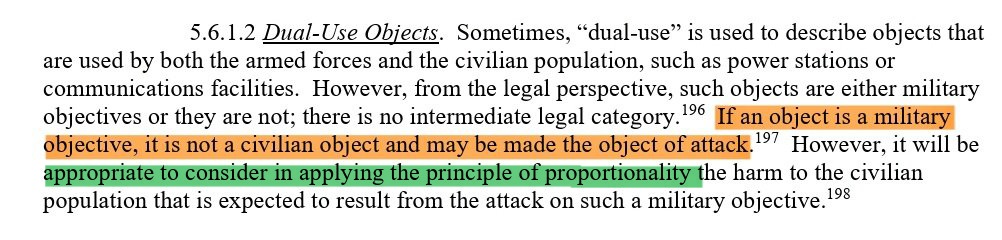
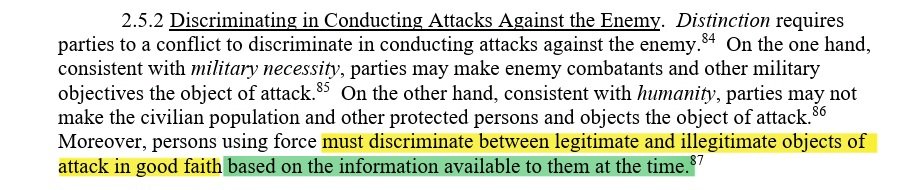
Now, attacking power infrastructure & bridges & such most certainly can qualify as a war crime. BUT in order to confirm that, the first step would be to demonstrate EACH & EVERY ONE of the incidents you're condemning was not an attack directed at a military objective. As the DoD Law of War Manual indicates on the subject, "If an object is a military objective, it is not a civilian object and may be made the object of attack" (pic 3).
Contrary to what seems to be popular belief (including among way too many of your @TheDemocrats friends in #Congress, unfortunately), attacking power infrastructure & bridges & such is not a war crime. It is a war crime to intentionally direct an attack against a civilian person (not DPH) or object. And to determine if an actual crime was committed, you almost always need actual evidence of intent & knowledge of personnel responsible for each attack AT THE TIME.
If you don't have that, you don't know whether the thing that was attacked was believed AT THE TIME to qualify as a military objective. And if you can't do that, then you're not conducting a proper war crime assessment.
Besides, refraining from attacking something that could be destroyed because it's a military objective and then deciding to go ahead & attack it later isn't a war "crime". It's just...war. Based on what I can tell from your bio, it doesn't appear you would personally know anything about that. If that's the case, it shows.
Now, what I said above about confirming whether power infrastructure & bridges & such was perceived to be a military objective before you can confirm a war crime was committed is only partially correct. Because we're likely talking about "dual-use" objects, we're almost certainly expecting some degree of incidental damage from attacking these.
As the DoD LoW Manual also notes (still pic 3), in that case "it will be appropriate to consider" the proportionality rule. So, let's do that next - not as a matter of federal law as you mistakenly claimed (see point # 1 above), but simply as a matter of basic LOAC compliance.
3. I hate to break it to you (actually, no I don't), but you just made the same mistake humanitarian activists @hrw + @amnesty & such often make. Most of them have never served a day in any military, let alone received any formal LOAC training in the applied military context. Not sure what your excuse is, but the way you articulate the proportionality rule is pretty pathetic.
Here's what you said in the post I'm QT'ing here: Bombing "every single Power Plant, and every single Bridge" causes excessive civilian harm, which are war crimes."
Now, I'm not going to go into, yet again, the difference between Trump's geopolitical rhetoric on social media & actual guidance carried out by the military bc I've already addressed that adequately before - maybe if I remember after I post this, I'll pull up one of those earlier tweets & include it as 1st reply to this one.
For now, let's focus on the part I emphasized with bold + italics text from your quote about proportionality.
As you should know, as a former USAF JAG & all, LOAC targeting rules - including (especially!!) proportionality - are not evaluated based on the outcome. That is, not on what degree of civilian harm they cause.
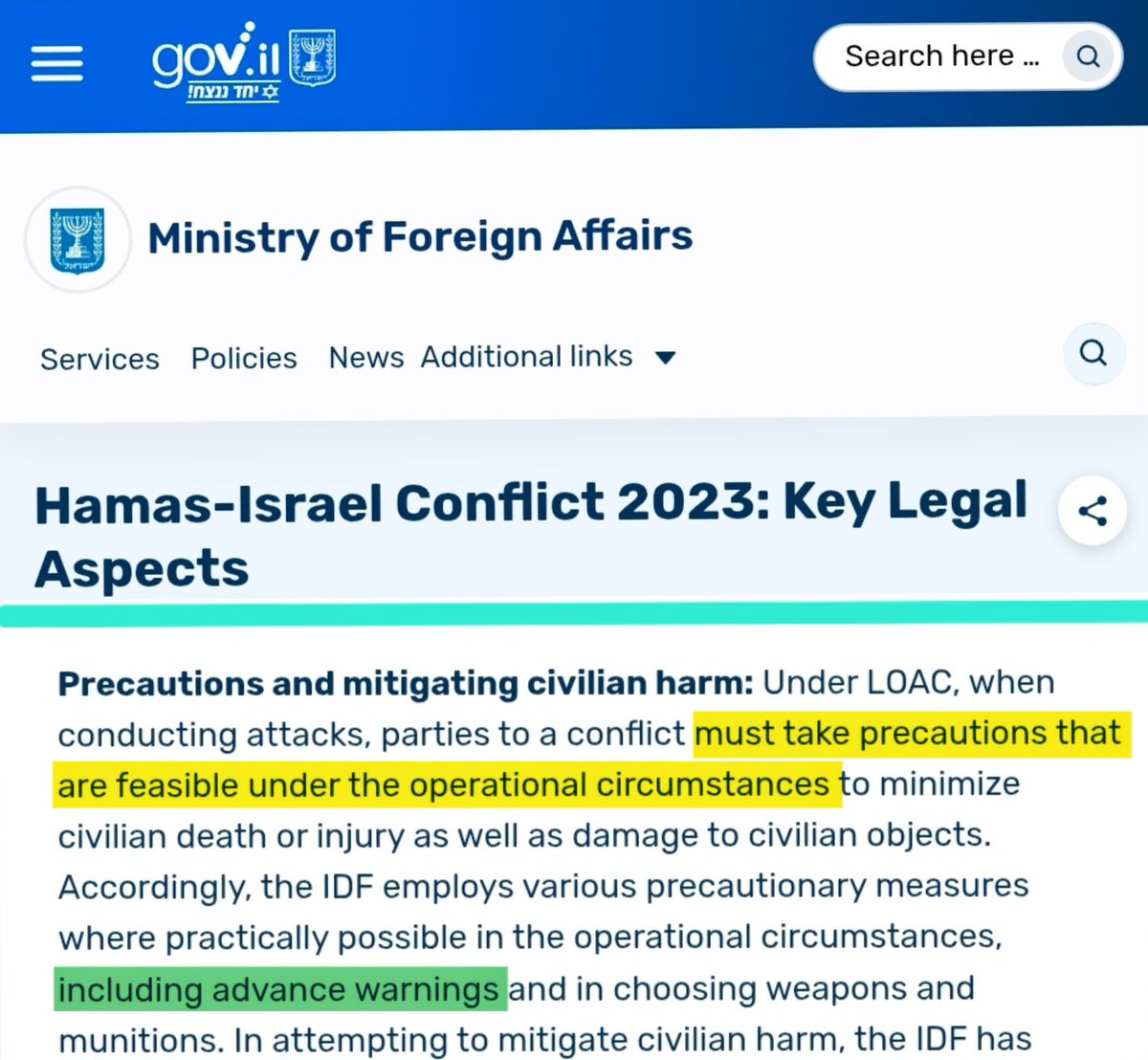
This is because the doctrinal proportionality rule prohibits attacks in which the expected incidental damage is excessive in relation to the direct & concrete military advantage expected (pic 4, DoD LoW Manual; proportionality formulation reflected in AP I is substantially similar fwiw). Not the degree of incidental damage caused, but that which is expected.
See the difference? Evaluating compliance with your rubbish version allows us to just observe how much incidental damage was caused AFTER an attack then make a judgement call whether it seems "excessive." The doctrinal version requires evidence of knowledge & intent of personnel responsible for each attack AT THE TIME of the attack. This is not something you can adequately gather from just looking at the aftermath of an attack & saying, "Oooohhhh. That seems excessive. Must be a war crime!!"
Ok, here's the bottom line. We don't waive our hand & say "war crime" then pursue prosecutions on that basis alone in military practice. You shouldn't either in public discourse - especially as a member of Congress ffs.
That goes for all 435+100 of y'all. But it's even more true for you, as a USAF veteran & former judge advocate.
Because let's be completely honest. This nonsense you just posted - in public - is an embarrassment. It's an embarrassment to you, your reputation, the Democrats, and tbh all of Congress.
But it's also an embarrassment for the U.S. Air Force JAG Corps. And I have close friends who have served or continue to serve as USAF JA's. Your very public ignorance on LOAC as a former USAF JA yourself is an embarrassment to them. For that, you should feel deep shame above all else.
I'll close this little LOAC lesson with the same message I've conveyed to your comrades in Congress, like @RepVindman & @RoKhanna & others, I've had to correct here @X on similar subjects:
Stay in your lane. You were elected to legislate. So do that. Leave LOAC compliance to actual practitioners in the Dept' of War & the commentary to actual experts...like me.




Dear @USAmbUN: You are wrong. Federal law requires our military to follow the principle of proportionality. Bombing “every single Power Plant, and every single Bridge” causes excessive civilian harm, which are war crimes.
And there is no statute of limitations for war crimes.
"War correspondent" who doesn't have a clue about law of war. So original.
Assuming facts @cbonneauimages is "reporting" are true, it indicates @IDF is implementing #LOAC feasible precautions rule.
Pro tip for journos: Learn facts. Understand law. THEN report. In that order.⤵️


@BrianCox_RLTW Always appreciate your logical and clear approach accompanied by receipts. Certainly the most insightful and thoughtful consideration of #LOAC that I see consistently. Thank you.

@Aussie_Truth25 @AustralianArmy @benmckelvey @defense_news @australian @DVAAus @_AUSDEF @DefenceFamilies @PaulineHansonOz @AngusTaylorMP @BenFordhamLive @steveheraldsun @SamPayne50 I suggest you research what the Laws of Armed Combat (#LOAC), Orders For Opening Fire (#OFOF), Rules of Engagement (#RoE) and for the Joint Priority Effects List (#JPEL) for Australian soldiers were in Afghanistan, before making extremely innacurate comments!


If you find yourself finding a way to defend the possibility of Trump bombing power plants and bridges, you might need to get your head checked.
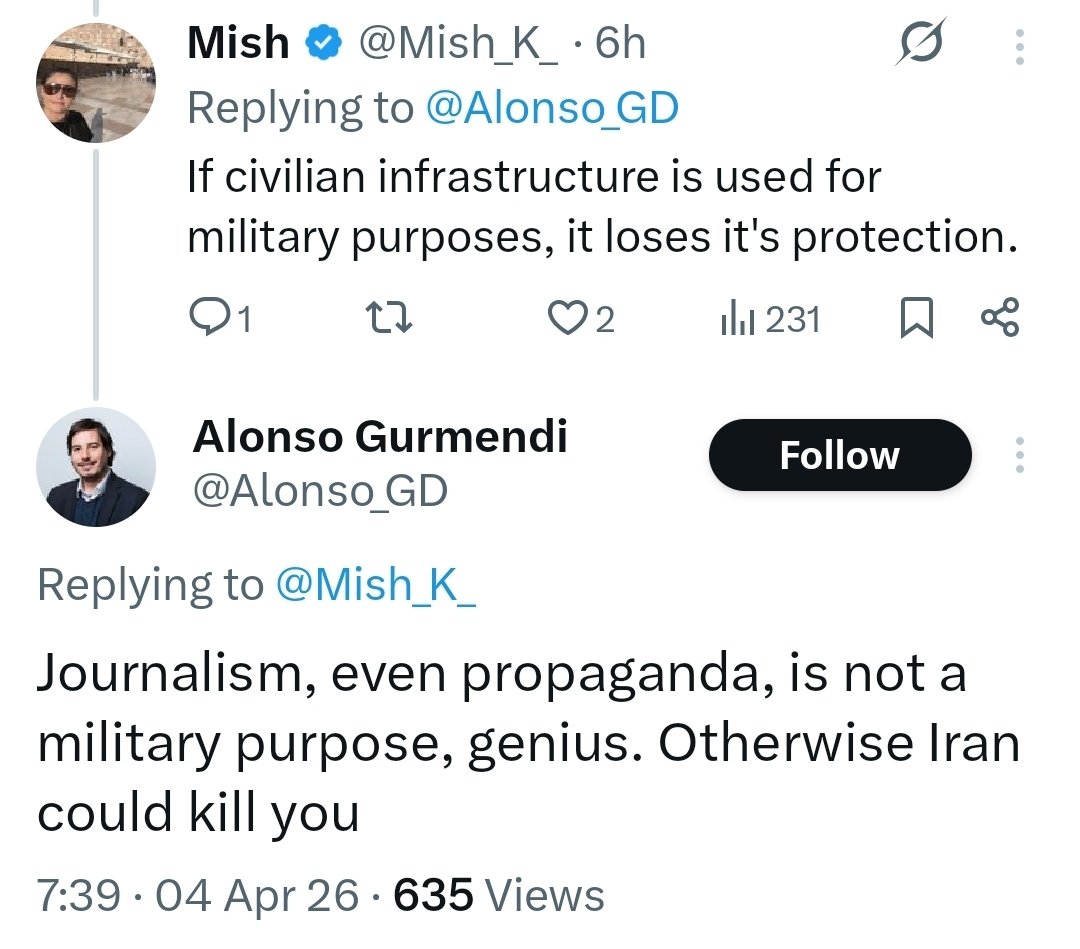
Here's the problem with Alonso's drivel. Well, one anyway.
He seems to genuinely believe ppl like him can "reinterpret" #LOAC to fit their preferred progressive / pacifist / decolonial / etc sociopolitical agenda.
But STATES are the primary source of int'l law. And journalists CAN be considered DPH pursuant to LOAC as it exists in doctrine...whether Alonso here likes it or not.
As enlightening as this exchange has been though, Alonso, believe it or not I do have better shit to do with my time than constantly point out @X how little you actually understand about LOAC as it exists in doctrine.
So, here's my challenge to you. Next time you show up in my mentions, it better be to explain - with reference to doctrinal sources - why you believe "'Journalism', even propaganda, is not a military purpose." If you show up instead spewing your usual bullshit non-doctrinal "analysis" or drivel that actually has nothing to do with the law, I won't hesitate to block you - as I probably should have done long ago.
And I can assure you I won't spare another thought about you (with apologies to your devout fans @OJ_PitchBot), since you've demonstrated over & over again that you are not to be taken seriously.



Thanks for watching my channel Brian! And yes: you may hate it, but you don’t live in the 19th century. Since 1965, you live at a time when IHL is changing - because we value human rights differently now. Formalism is bad law. I know it’s where you thrive. But it’s bad
This is because the law of armed conflict doesn't ACTUALLY exist to "protect" civilians.
Humanitarian advocates, activists & academics insist on framing #LOAC as though one of its primary purposes is "protection of civilians."
Doctrinally, civilian "protection" is an ancillary aspect of LOAC compliance (pic 1). Primarily, LOAC prohibits INTENTIONALLY directing attacks against civilian persons/objects - that means knowingly & not by accident (pic 2).
With all respect that is possibly due to @UNReliefChief, it's obvious from his commentary he doesn't know the first thing about LOAC. Objects such as power infrastructure, bridges & even schools absolutely CAN qualify as military objectives - and assessing whether attacks on these objects comply with relevant aspects of LOAC requires evidence of knowledge & intent of personnel responsible for EACH attack, EACH time.
In actual military practice, we don't waive our hand & say "war crime" to evaluate LOAC compliance. Activists like Tom Fletcher shouldn't either in public discourse.
And for anyone ACTUALLY concerned with "how we talk about" LOAC, a suggested first step would be to stop framing it as an effects-based construct that exists primarily for the "protection of civilians."


"This has been a gradual and then very sudden deterioration in the way we talk about protection of civilians, in the way that we talk about international humanitarian law."
Nice. Those points explain why prospective targets qualify for the definition of military objective, despite the parallel civilian character as well.
A couple other points to consider might be:
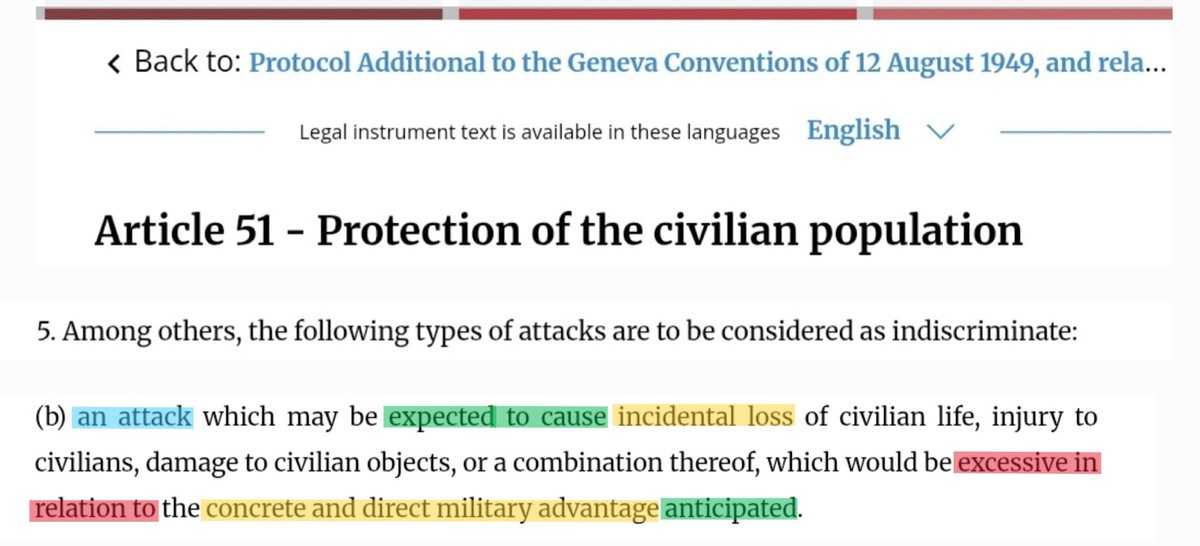
1) Any time someone characterizes the #LOAC proportionality rule along the lines a claim that an attack or operation would be "disproportionate to military purpose," it's an immediate indication they've missed the mark. This is a rule that gets paraphrased all the time, which is part of the reason it's so widely misunderstood. The articulation in art. 51(5)(b) of AP I seems generally consistent with customary law: It prohibits "an attack which may be expected to cause incidental loss of civilian life, injury to civilians, damage to civilian objects, or a combination thereof, which would be excessive in relation to the concrete and direct military advantage anticipated." So this had to be assessed based on EACH ATTACK (bold) rather than a series of attacks. It also requires evidence of what level of incidental harm is EXPECTED (italics + bold), not that occurred after the fact, and what degree of concrete & direct mil advantage was ANTICIPATED (italics + bold) in order to determine whether the former truly was EXCESSIVE IN RELATION TO the latter (italics). Just a hand wave & accompanying claim that an entire series of proposed attacks will be "disproportionate to military purpose"(as the other dude does) without evidence of the incidental harm ANTICIPATED & mil advantage EXPECTED is insufficient as a matter of doctrine.
2) Any time someone says "geneva conventions" to refer to LOAC as a whole (as the other dude also does), it's an immediate indication they don’t understand LOAC. Each of the 4 Conventions of 1949 addresses a specific topic, none of which focus on targeting. The Additional Protocols do, but not all countries (including USA, which is proposing the strikes in question) have ratified them. So yes someone may argue the attacks violate LOAC if they cover all the doctrinal standards, but those aren't to be found in "the geneva conventions." And directing someone to the ICRC website for the doctrinal standards is like calling a carpenter to build a skyscraper. ICRC has some tools, like their commentaries & customary "IHL" study, but they're not equipped to serve as a source for genuine doctrinal standards. He'd be better off referring you to the DoD Law of War Manual in this context...but if he did that his argument would unravel! (see for example para 5.6.1.2)
3) One point really no one seems to have addressed so far is the issue of reprisals. Iran has no legal justification as far as I can tell for completely closing Hormuz Strait to all commercial traffic (unless I'm missing something?). POTUS is threatening these attacks to encourage Iran to cease it's (seemingly?) unlawful actions. That's the definition of reprisals. Yes AP I establishes, "Attacks against the civilian population or civilians by way of reprisals are prohibited." But 🇺🇸 hasn't ratified AP I and we don't consider that prohibition to reflect customary law (DoD Law of War Manual para 18.18.3.4). So even if these proposed attacks would otherwise be considered unlawful (doubtful), they may nonetheless constitute permissible reprisals under these circumstances.
Well done on the points you make regarding these potential strikes. The above comments are just some of my additional reflections on the subject. 🎩
Now here's the important "context" Alex fails to cover.
While it is true that "disagreements with journos do not justify assassinating them" pursuant to international law, attacking a civilian taking direct part in hostilities IS permitted by #LOAC (and not "assassination"). ⤵️


Israeli military spokespeople are claiming one of the senior Lebanese journalists killed in a drone strike today was ‘an aggressor, a threatener, an instigator, and a provocateur’. Leb President has pointed out disagreements with journos do not justify assassinating them under int laws
@JBasest @academic_la @DanielOzerel @AkaLazarus @ElliotMalin Lol I remember the 1st time I encountered this fruitcake named Shaiel. It was when I schooled him on how the #LOAC proportionality rule works. Put up with his bile for weeks before I eventually blocked him...but I'd be glad to debate that poser anytime! 🤣
https://t.co/LBZSh8qbFB
This is not how proportionality works - and mischaracterizing it in this way damages the perceived legitimacy of int'l law while encouraging distorted legal narratives to be weaponized in an information war against a belligerent party (in this case, @Israel).
So let's start by affirming how #LOAC proportionality actually works. Attached to this post are 4 examples of doctrinal LOAC proportionality rules excerpted from: a) Additional Protocol I (1977) to the 1949 Geneva Conventions (AP I); b) Rome Statute of @IntlCrimCourt; c) int'l law info paper published by @IsraelMFA; d) @DeptofDefense Law of War Manual. Each has slightly different wording, but here are a few things they all have in common.
1) Each requires an evaluation of one individual attack (blue highlights). "Attack" is defined in AP I as "acts of violence against the adversary, whether in offence or in defence" (art. 49(1), not pictured). So evaluating "carry[ing] out an attack" (c) MFA info paper) or "launching an attack" (b) Rome Statute), for example, must be accomplished for each and every "act of violence" in the conduct of hostilities for which incidental damage is anticipated. Let's say one operation results in "destruction" of one hospital. Evaluating compliance with LOAC proportionality rule requires an assessment of every individual act of violence ("attack") that supported the operation. That means every bomb that was dropped, every Hellfire missile that was launched, every mortar or artillery shell called in, every burst of small arms fire. You must assess each and every one individually if incidental damage was anticipated since each was an attack (act of violence) - not the entire operation, and not "every hospital in Gaza" collectively.
2) The reason I emphasized for which "incidental damage was anticipated" in 1) above is doctrinal LOAC proportionality rule is centered on expectation of military advantage & incidental damage at the time of the attack, not effects observed afterward (green highlights). Don't believe me? Go back and read the doctrinal examples again. Take your pick - they all establish the same thing. Just to avoid unnecessary repetition, I'll select text of b) Rome Statute - though you could substitute language from any doctrinal source and reach same conclusion. The war crime established in this treaty is, "Intentionally launching an attack in the knowledge that such attack will cause [incidental damage] which would be clearly excessive in relation to the concrete and direct overall military advantage anticipated." "Intentionally" (purple highlight) is italicized bc that's one component demonstrating we need evidence of what personnel responsible for (each) attack expected incidental damage & mil advantage to be. "Intentional" in Rome Statute is defined as awareness that a circumstance exists & conduct wasn't accidental (paraphrasing art. 30, mental element). The "in the knowledge" and "anticipated" are emphasized bc they also demonstrate we need to understand what person(s) responsible for (each) attack expected or anticipated at the time. Pointing out that a hospital was "destroyed" involves effects you observe after attacks, but this doesn't constitute evidence of degree of incidental damage & mil advantage attacker(s) expected at the time. If you don't have that evidence, you're not engaging in a legitimate proportionality assessment.
3) Even if you DO have actual evidence of attacker(s) knowledge & intent for EVERY single attack (you don't), you NOW have to determine whether attacker believed incidental damage (yellow highlights) expected would be "excessive in relation to" (red highlights) concrete & direct mil advantage (also yellow highlights) anticipated. Sometimes proportionality is described as a balancing test, but this is incorrect. "Balance" suggests if scale tips just a fraction in favor of expected incidental damage, attack is unlawful. Doctrinally, though, anticipated incidental damage must be excessive in relation to concrete & direct mil advantage expected ("clearly" excessive for b) Rome Statute). So, you not only require evidence of what attacker expected FOR EACH ATTACK (act of violence), you also need to determine whether she/he/they assessed incidental damage anticipated would be EXCESSIVE in relation to concrete & direct mil advantage expected AND they launched attack anyway. If you haven't determined this for each & every act of violence, you haven't done a legitimate proportionality assessment.
4) We haven't even addressed the fact that #Hamas is known to deliberately hide & fight among civilian population - including hospitals. Every time they do, they invalidate protected status of that "hospital." It's now a military objective (something that by its nature, location, purpose, or use makes an effective contribution to military action) that also happens to function as a hospital. Effective advance warning must still be provided before attacking it because it is a medical facility, but that does not constitute an outright prohibition on attacking it. As @Ostrov_A @SpencerGuard & I have previously written @TheHillOpinion, "Those who truly care about the wellbeing of civilians in Gaza ... would be well advised to direct their outrage at Hamas, which continues to unconscionably and illegally turn hospitals into their personal control and command centers and severely risk the lives of innocent civilians" (link in first comment).
Bottom line: nothing @academic_la says in QT'd post constitutes legitimate discourse involving int'l law. If we're inclined to ask each other rhetorical questions, ask yourself this. Why do you insist on utilizing language of int'l law you clearly don't understand in order to construct criticism of one belligerent party to an ongoing armed conflict? Are you aware that you are personally contributing to the gradual erosion of the perceived legitimacy of int'l law by distorting the doctrinal version of LOAC states (including 🇮🇱) actually apply in practice during conduct of armed hostilities? If you are aware, do you care? Finally, why is constructing ways to criticize Israel's conduct in #Gaza so important to you ideologically that you insist on mischaracterizing int'l law in this way to support your critical rhetoric? Take your time.
![BrianCox_RLTW's tweet photo. This is not how proportionality works - and mischaracterizing it in this way damages the perceived legitimacy of int'l law while encouraging distorted legal narratives to be weaponized in an information war against a belligerent party (in this case, @Israel).
So let's start by affirming how #LOAC proportionality actually works. Attached to this post are 4 examples of doctrinal LOAC proportionality rules excerpted from: a) Additional Protocol I (1977) to the 1949 Geneva Conventions (AP I); b) Rome Statute of @IntlCrimCourt; c) int'l law info paper published by @IsraelMFA; d) @DeptofDefense Law of War Manual. Each has slightly different wording, but here are a few things they all have in common.
1) Each requires an evaluation of one individual attack (blue highlights). "Attack" is defined in AP I as "acts of violence against the adversary, whether in offence or in defence" (art. 49(1), not pictured). So evaluating "carry[ing] out an attack" (c) MFA info paper) or "launching an attack" (b) Rome Statute), for example, must be accomplished for each and every "act of violence" in the conduct of hostilities for which incidental damage is anticipated. Let's say one operation results in "destruction" of one hospital. Evaluating compliance with LOAC proportionality rule requires an assessment of every individual act of violence ("attack") that supported the operation. That means every bomb that was dropped, every Hellfire missile that was launched, every mortar or artillery shell called in, every burst of small arms fire. You must assess each and every one individually if incidental damage was anticipated since each was an attack (act of violence) - not the entire operation, and not "every hospital in Gaza" collectively.
2) The reason I emphasized for which "incidental damage was anticipated" in 1) above is doctrinal LOAC proportionality rule is centered on expectation of military advantage & incidental damage at the time of the attack, not effects observed afterward (green highlights). Don't believe me? Go back and read the doctrinal examples again. Take your pick - they all establish the same thing. Just to avoid unnecessary repetition, I'll select text of b) Rome Statute - though you could substitute language from any doctrinal source and reach same conclusion. The war crime established in this treaty is, "Intentionally launching an attack in the knowledge that such attack will cause [incidental damage] which would be clearly excessive in relation to the concrete and direct overall military advantage anticipated." "Intentionally" (purple highlight) is italicized bc that's one component demonstrating we need evidence of what personnel responsible for (each) attack expected incidental damage & mil advantage to be. "Intentional" in Rome Statute is defined as awareness that a circumstance exists & conduct wasn't accidental (paraphrasing art. 30, mental element). The "in the knowledge" and "anticipated" are emphasized bc they also demonstrate we need to understand what person(s) responsible for (each) attack expected or anticipated at the time. Pointing out that a hospital was "destroyed" involves effects you observe after attacks, but this doesn't constitute evidence of degree of incidental damage & mil advantage attacker(s) expected at the time. If you don't have that evidence, you're not engaging in a legitimate proportionality assessment.
3) Even if you DO have actual evidence of attacker(s) knowledge & intent for EVERY single attack (you don't), you NOW have to determine whether attacker believed incidental damage (yellow highlights) expected would be "excessive in relation to" (red highlights) concrete & direct mil advantage (also yellow highlights) anticipated. Sometimes proportionality is described as a balancing test, but this is incorrect. "Balance" suggests if scale tips just a fraction in favor of expected incidental damage, attack is unlawful. Doctrinally, though, anticipated incidental damage must be excessive in relation to concrete & direct mil advantage expected ("clearly" excessive for b) Rome Statute). So, you not only require evidence of what attacker expected FOR EACH ATTACK (act of violence), you also need to determine whether she/he/they assessed incidental damage anticipated would be EXCESSIVE in relation to concrete & direct mil advantage expected AND they launched attack anyway. If you haven't determined this for each & every act of violence, you haven't done a legitimate proportionality assessment.
4) We haven't even addressed the fact that #Hamas is known to deliberately hide & fight among civilian population - including hospitals. Every time they do, they invalidate protected status of that "hospital." It's now a military objective (something that by its nature, location, purpose, or use makes an effective contribution to military action) that also happens to function as a hospital. Effective advance warning must still be provided before attacking it because it is a medical facility, but that does not constitute an outright prohibition on attacking it. As @Ostrov_A @SpencerGuard & I have previously written @TheHillOpinion, "Those who truly care about the wellbeing of civilians in Gaza ... would be well advised to direct their outrage at Hamas, which continues to unconscionably and illegally turn hospitals into their personal control and command centers and severely risk the lives of innocent civilians" (link in first comment).
Bottom line: nothing @academic_la says in QT'd post constitutes legitimate discourse involving int'l law. If we're inclined to ask each other rhetorical questions, ask yourself this. Why do you insist on utilizing language of int'l law you clearly don't understand in order to construct criticism of one belligerent party to an ongoing armed conflict? Are you aware that you are personally contributing to the gradual erosion of the perceived legitimacy of int'l law by distorting the doctrinal version of LOAC states (including 🇮🇱) actually apply in practice during conduct of armed hostilities? If you are aware, do you care? Finally, why is constructing ways to criticize Israel's conduct in #Gaza so important to you ideologically that you insist on mischaracterizing int'l law in this way to support your critical rhetoric? Take your time.](https://pbs.twimg.com/media/GoltXk5WkAgfQoZ.jpg)
![BrianCox_RLTW's tweet photo. This is not how proportionality works - and mischaracterizing it in this way damages the perceived legitimacy of int'l law while encouraging distorted legal narratives to be weaponized in an information war against a belligerent party (in this case, @Israel).
So let's start by affirming how #LOAC proportionality actually works. Attached to this post are 4 examples of doctrinal LOAC proportionality rules excerpted from: a) Additional Protocol I (1977) to the 1949 Geneva Conventions (AP I); b) Rome Statute of @IntlCrimCourt; c) int'l law info paper published by @IsraelMFA; d) @DeptofDefense Law of War Manual. Each has slightly different wording, but here are a few things they all have in common.
1) Each requires an evaluation of one individual attack (blue highlights). "Attack" is defined in AP I as "acts of violence against the adversary, whether in offence or in defence" (art. 49(1), not pictured). So evaluating "carry[ing] out an attack" (c) MFA info paper) or "launching an attack" (b) Rome Statute), for example, must be accomplished for each and every "act of violence" in the conduct of hostilities for which incidental damage is anticipated. Let's say one operation results in "destruction" of one hospital. Evaluating compliance with LOAC proportionality rule requires an assessment of every individual act of violence ("attack") that supported the operation. That means every bomb that was dropped, every Hellfire missile that was launched, every mortar or artillery shell called in, every burst of small arms fire. You must assess each and every one individually if incidental damage was anticipated since each was an attack (act of violence) - not the entire operation, and not "every hospital in Gaza" collectively.
2) The reason I emphasized for which "incidental damage was anticipated" in 1) above is doctrinal LOAC proportionality rule is centered on expectation of military advantage & incidental damage at the time of the attack, not effects observed afterward (green highlights). Don't believe me? Go back and read the doctrinal examples again. Take your pick - they all establish the same thing. Just to avoid unnecessary repetition, I'll select text of b) Rome Statute - though you could substitute language from any doctrinal source and reach same conclusion. The war crime established in this treaty is, "Intentionally launching an attack in the knowledge that such attack will cause [incidental damage] which would be clearly excessive in relation to the concrete and direct overall military advantage anticipated." "Intentionally" (purple highlight) is italicized bc that's one component demonstrating we need evidence of what personnel responsible for (each) attack expected incidental damage & mil advantage to be. "Intentional" in Rome Statute is defined as awareness that a circumstance exists & conduct wasn't accidental (paraphrasing art. 30, mental element). The "in the knowledge" and "anticipated" are emphasized bc they also demonstrate we need to understand what person(s) responsible for (each) attack expected or anticipated at the time. Pointing out that a hospital was "destroyed" involves effects you observe after attacks, but this doesn't constitute evidence of degree of incidental damage & mil advantage attacker(s) expected at the time. If you don't have that evidence, you're not engaging in a legitimate proportionality assessment.
3) Even if you DO have actual evidence of attacker(s) knowledge & intent for EVERY single attack (you don't), you NOW have to determine whether attacker believed incidental damage (yellow highlights) expected would be "excessive in relation to" (red highlights) concrete & direct mil advantage (also yellow highlights) anticipated. Sometimes proportionality is described as a balancing test, but this is incorrect. "Balance" suggests if scale tips just a fraction in favor of expected incidental damage, attack is unlawful. Doctrinally, though, anticipated incidental damage must be excessive in relation to concrete & direct mil advantage expected ("clearly" excessive for b) Rome Statute). So, you not only require evidence of what attacker expected FOR EACH ATTACK (act of violence), you also need to determine whether she/he/they assessed incidental damage anticipated would be EXCESSIVE in relation to concrete & direct mil advantage expected AND they launched attack anyway. If you haven't determined this for each & every act of violence, you haven't done a legitimate proportionality assessment.
4) We haven't even addressed the fact that #Hamas is known to deliberately hide & fight among civilian population - including hospitals. Every time they do, they invalidate protected status of that "hospital." It's now a military objective (something that by its nature, location, purpose, or use makes an effective contribution to military action) that also happens to function as a hospital. Effective advance warning must still be provided before attacking it because it is a medical facility, but that does not constitute an outright prohibition on attacking it. As @Ostrov_A @SpencerGuard & I have previously written @TheHillOpinion, "Those who truly care about the wellbeing of civilians in Gaza ... would be well advised to direct their outrage at Hamas, which continues to unconscionably and illegally turn hospitals into their personal control and command centers and severely risk the lives of innocent civilians" (link in first comment).
Bottom line: nothing @academic_la says in QT'd post constitutes legitimate discourse involving int'l law. If we're inclined to ask each other rhetorical questions, ask yourself this. Why do you insist on utilizing language of int'l law you clearly don't understand in order to construct criticism of one belligerent party to an ongoing armed conflict? Are you aware that you are personally contributing to the gradual erosion of the perceived legitimacy of int'l law by distorting the doctrinal version of LOAC states (including 🇮🇱) actually apply in practice during conduct of armed hostilities? If you are aware, do you care? Finally, why is constructing ways to criticize Israel's conduct in #Gaza so important to you ideologically that you insist on mischaracterizing int'l law in this way to support your critical rhetoric? Take your time.](https://pbs.twimg.com/media/GoltVoNWkAACLZo.jpg)
![BrianCox_RLTW's tweet photo. This is not how proportionality works - and mischaracterizing it in this way damages the perceived legitimacy of int'l law while encouraging distorted legal narratives to be weaponized in an information war against a belligerent party (in this case, @Israel).
So let's start by affirming how #LOAC proportionality actually works. Attached to this post are 4 examples of doctrinal LOAC proportionality rules excerpted from: a) Additional Protocol I (1977) to the 1949 Geneva Conventions (AP I); b) Rome Statute of @IntlCrimCourt; c) int'l law info paper published by @IsraelMFA; d) @DeptofDefense Law of War Manual. Each has slightly different wording, but here are a few things they all have in common.
1) Each requires an evaluation of one individual attack (blue highlights). "Attack" is defined in AP I as "acts of violence against the adversary, whether in offence or in defence" (art. 49(1), not pictured). So evaluating "carry[ing] out an attack" (c) MFA info paper) or "launching an attack" (b) Rome Statute), for example, must be accomplished for each and every "act of violence" in the conduct of hostilities for which incidental damage is anticipated. Let's say one operation results in "destruction" of one hospital. Evaluating compliance with LOAC proportionality rule requires an assessment of every individual act of violence ("attack") that supported the operation. That means every bomb that was dropped, every Hellfire missile that was launched, every mortar or artillery shell called in, every burst of small arms fire. You must assess each and every one individually if incidental damage was anticipated since each was an attack (act of violence) - not the entire operation, and not "every hospital in Gaza" collectively.
2) The reason I emphasized for which "incidental damage was anticipated" in 1) above is doctrinal LOAC proportionality rule is centered on expectation of military advantage & incidental damage at the time of the attack, not effects observed afterward (green highlights). Don't believe me? Go back and read the doctrinal examples again. Take your pick - they all establish the same thing. Just to avoid unnecessary repetition, I'll select text of b) Rome Statute - though you could substitute language from any doctrinal source and reach same conclusion. The war crime established in this treaty is, "Intentionally launching an attack in the knowledge that such attack will cause [incidental damage] which would be clearly excessive in relation to the concrete and direct overall military advantage anticipated." "Intentionally" (purple highlight) is italicized bc that's one component demonstrating we need evidence of what personnel responsible for (each) attack expected incidental damage & mil advantage to be. "Intentional" in Rome Statute is defined as awareness that a circumstance exists & conduct wasn't accidental (paraphrasing art. 30, mental element). The "in the knowledge" and "anticipated" are emphasized bc they also demonstrate we need to understand what person(s) responsible for (each) attack expected or anticipated at the time. Pointing out that a hospital was "destroyed" involves effects you observe after attacks, but this doesn't constitute evidence of degree of incidental damage & mil advantage attacker(s) expected at the time. If you don't have that evidence, you're not engaging in a legitimate proportionality assessment.
3) Even if you DO have actual evidence of attacker(s) knowledge & intent for EVERY single attack (you don't), you NOW have to determine whether attacker believed incidental damage (yellow highlights) expected would be "excessive in relation to" (red highlights) concrete & direct mil advantage (also yellow highlights) anticipated. Sometimes proportionality is described as a balancing test, but this is incorrect. "Balance" suggests if scale tips just a fraction in favor of expected incidental damage, attack is unlawful. Doctrinally, though, anticipated incidental damage must be excessive in relation to concrete & direct mil advantage expected ("clearly" excessive for b) Rome Statute). So, you not only require evidence of what attacker expected FOR EACH ATTACK (act of violence), you also need to determine whether she/he/they assessed incidental damage anticipated would be EXCESSIVE in relation to concrete & direct mil advantage expected AND they launched attack anyway. If you haven't determined this for each & every act of violence, you haven't done a legitimate proportionality assessment.
4) We haven't even addressed the fact that #Hamas is known to deliberately hide & fight among civilian population - including hospitals. Every time they do, they invalidate protected status of that "hospital." It's now a military objective (something that by its nature, location, purpose, or use makes an effective contribution to military action) that also happens to function as a hospital. Effective advance warning must still be provided before attacking it because it is a medical facility, but that does not constitute an outright prohibition on attacking it. As @Ostrov_A @SpencerGuard & I have previously written @TheHillOpinion, "Those who truly care about the wellbeing of civilians in Gaza ... would be well advised to direct their outrage at Hamas, which continues to unconscionably and illegally turn hospitals into their personal control and command centers and severely risk the lives of innocent civilians" (link in first comment).
Bottom line: nothing @academic_la says in QT'd post constitutes legitimate discourse involving int'l law. If we're inclined to ask each other rhetorical questions, ask yourself this. Why do you insist on utilizing language of int'l law you clearly don't understand in order to construct criticism of one belligerent party to an ongoing armed conflict? Are you aware that you are personally contributing to the gradual erosion of the perceived legitimacy of int'l law by distorting the doctrinal version of LOAC states (including 🇮🇱) actually apply in practice during conduct of armed hostilities? If you are aware, do you care? Finally, why is constructing ways to criticize Israel's conduct in #Gaza so important to you ideologically that you insist on mischaracterizing int'l law in this way to support your critical rhetoric? Take your time.](https://pbs.twimg.com/media/GoltSxkXYAAR1oQ.jpg)
![BrianCox_RLTW's tweet photo. This is not how proportionality works - and mischaracterizing it in this way damages the perceived legitimacy of int'l law while encouraging distorted legal narratives to be weaponized in an information war against a belligerent party (in this case, @Israel).
So let's start by affirming how #LOAC proportionality actually works. Attached to this post are 4 examples of doctrinal LOAC proportionality rules excerpted from: a) Additional Protocol I (1977) to the 1949 Geneva Conventions (AP I); b) Rome Statute of @IntlCrimCourt; c) int'l law info paper published by @IsraelMFA; d) @DeptofDefense Law of War Manual. Each has slightly different wording, but here are a few things they all have in common.
1) Each requires an evaluation of one individual attack (blue highlights). "Attack" is defined in AP I as "acts of violence against the adversary, whether in offence or in defence" (art. 49(1), not pictured). So evaluating "carry[ing] out an attack" (c) MFA info paper) or "launching an attack" (b) Rome Statute), for example, must be accomplished for each and every "act of violence" in the conduct of hostilities for which incidental damage is anticipated. Let's say one operation results in "destruction" of one hospital. Evaluating compliance with LOAC proportionality rule requires an assessment of every individual act of violence ("attack") that supported the operation. That means every bomb that was dropped, every Hellfire missile that was launched, every mortar or artillery shell called in, every burst of small arms fire. You must assess each and every one individually if incidental damage was anticipated since each was an attack (act of violence) - not the entire operation, and not "every hospital in Gaza" collectively.
2) The reason I emphasized for which "incidental damage was anticipated" in 1) above is doctrinal LOAC proportionality rule is centered on expectation of military advantage & incidental damage at the time of the attack, not effects observed afterward (green highlights). Don't believe me? Go back and read the doctrinal examples again. Take your pick - they all establish the same thing. Just to avoid unnecessary repetition, I'll select text of b) Rome Statute - though you could substitute language from any doctrinal source and reach same conclusion. The war crime established in this treaty is, "Intentionally launching an attack in the knowledge that such attack will cause [incidental damage] which would be clearly excessive in relation to the concrete and direct overall military advantage anticipated." "Intentionally" (purple highlight) is italicized bc that's one component demonstrating we need evidence of what personnel responsible for (each) attack expected incidental damage & mil advantage to be. "Intentional" in Rome Statute is defined as awareness that a circumstance exists & conduct wasn't accidental (paraphrasing art. 30, mental element). The "in the knowledge" and "anticipated" are emphasized bc they also demonstrate we need to understand what person(s) responsible for (each) attack expected or anticipated at the time. Pointing out that a hospital was "destroyed" involves effects you observe after attacks, but this doesn't constitute evidence of degree of incidental damage & mil advantage attacker(s) expected at the time. If you don't have that evidence, you're not engaging in a legitimate proportionality assessment.
3) Even if you DO have actual evidence of attacker(s) knowledge & intent for EVERY single attack (you don't), you NOW have to determine whether attacker believed incidental damage (yellow highlights) expected would be "excessive in relation to" (red highlights) concrete & direct mil advantage (also yellow highlights) anticipated. Sometimes proportionality is described as a balancing test, but this is incorrect. "Balance" suggests if scale tips just a fraction in favor of expected incidental damage, attack is unlawful. Doctrinally, though, anticipated incidental damage must be excessive in relation to concrete & direct mil advantage expected ("clearly" excessive for b) Rome Statute). So, you not only require evidence of what attacker expected FOR EACH ATTACK (act of violence), you also need to determine whether she/he/they assessed incidental damage anticipated would be EXCESSIVE in relation to concrete & direct mil advantage expected AND they launched attack anyway. If you haven't determined this for each & every act of violence, you haven't done a legitimate proportionality assessment.
4) We haven't even addressed the fact that #Hamas is known to deliberately hide & fight among civilian population - including hospitals. Every time they do, they invalidate protected status of that "hospital." It's now a military objective (something that by its nature, location, purpose, or use makes an effective contribution to military action) that also happens to function as a hospital. Effective advance warning must still be provided before attacking it because it is a medical facility, but that does not constitute an outright prohibition on attacking it. As @Ostrov_A @SpencerGuard & I have previously written @TheHillOpinion, "Those who truly care about the wellbeing of civilians in Gaza ... would be well advised to direct their outrage at Hamas, which continues to unconscionably and illegally turn hospitals into their personal control and command centers and severely risk the lives of innocent civilians" (link in first comment).
Bottom line: nothing @academic_la says in QT'd post constitutes legitimate discourse involving int'l law. If we're inclined to ask each other rhetorical questions, ask yourself this. Why do you insist on utilizing language of int'l law you clearly don't understand in order to construct criticism of one belligerent party to an ongoing armed conflict? Are you aware that you are personally contributing to the gradual erosion of the perceived legitimacy of int'l law by distorting the doctrinal version of LOAC states (including 🇮🇱) actually apply in practice during conduct of armed hostilities? If you are aware, do you care? Finally, why is constructing ways to criticize Israel's conduct in #Gaza so important to you ideologically that you insist on mischaracterizing int'l law in this way to support your critical rhetoric? Take your time.](https://pbs.twimg.com/media/GoltQb8WkAALK5w.jpg)
False. Assessing #LOAC proportionality rule requires evidence of incidental harm and concrete & direct mil advantage EXPECTED from EACH ATTACK.
Anyone claiming otherwise is either ignorant or trying to mislead you. Considering the track record of this source, it's likely both.⤵️



Israel's attack on a main bridge in south Lebanon is a war crime (disproportionate). Whatever the bridge's modest military value is vastly outweighed by its role for civilian movement. But the Israeli military typically cares little about Arab civilians. https://t.co/zzEBdVPufZ
Hi there, Rep. Khanna. Retired Army JAG here & current prof of int'l law. And you are way out of your depth.
You should consider sticking to legislating & leaving #LOAC commentary to actual specialists. Like me.
Allow me to explain.
First off, if a power plant is "dual use," then attacking it is, by definition, NOT an "indiscriminate bombing." Here's why.
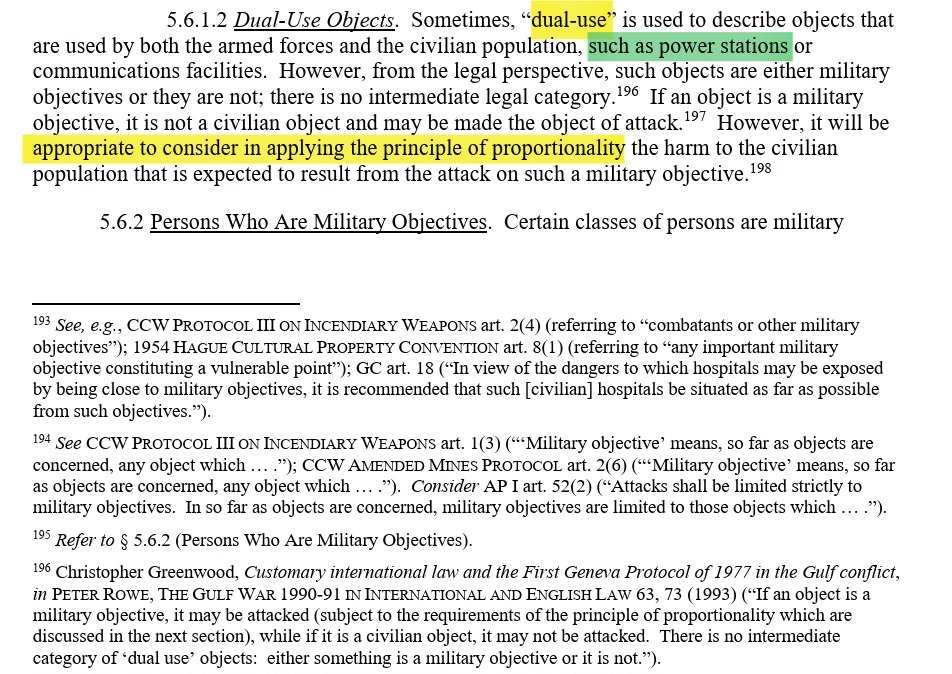
As DoD Law of War Manual notes, this term is often "used to describe objects that are used by both the armed forces and the civilian population, such as power stations" (pic 1).
The Manual also correctly points out this term has no legal significance. Either something qualifies as a military objective such that directing an attack against it is permitted, or it's a civilian object such that it may not be made the object of attack.
See the problem yet? That's right! If something is "dual-use," it qualifies as a military objective...and directing an attack against a military objective is, by definition, NOT "indiscriminate" (pic 2).
Back to pic 1, the Manual also notes that when attacking "dual-use" objects, "it will be appropriate to consider in applying the principle of proportionality the harm to the civilian population expected to result from the attack on such a military objective."
You might notice I emphasized "proportionality" & "expected" there, and I did so because it's a preview to your next massive error.
Here's what you claim about proportionality in your 🧵:
"Proportionality forbids attacks where expected incidental civilian harm including effects like loss of hospital power, water pumps failing, food spoilage or extreme heat or cold exposure. This is excessive compared to the concrete military gain per Article 51(5)(b)."
We'll get to your selection of source (AP I) later. For now, let's focus on how badly you botched the proportionality rule. To describe what the actual rule is supposed to look like, let's go back to the Manual.
As it observes, personnel engaged in hostilities "must refrain from attacks in which the expected loss of civilian life, injury to civilians, and damage to civilian objects incidental to the attack would be excessive in relation to the concrete and direct military advantage expected to be gained" (pic 3).
Now, I added bold text to the "expected" at the beginning & end because this highlights your next mistake. Yes you correctly note expected incidental harm is part of the equation, but you left out "expected" on the military advantage component.
This is a massive error because you need to be able to tell what the expected incidental harm is & the expected (or anticipated) concrete & direct military advantage is for each attack in order to assess whether the former was "excessive in relation to" the latter.
And, do you have any intel indicating what degree of incidental harm AND concrete & direct military advantage is for each attack you purport to be addressing? No, of course you don't.
As such, you're not conducting a legitimate proportionality assessment. Which, is easy if you don't properly articulate law. Hell, you can make pretty much anything seem illegal if you can come up with any bullshit articulation of the legal standard you feel like fabricating.
But we're not allowed to do that in actual practice. And so, you shouldn't either in public discourse, or else you're creating a false impression that potentially lawful conduct is illegal.
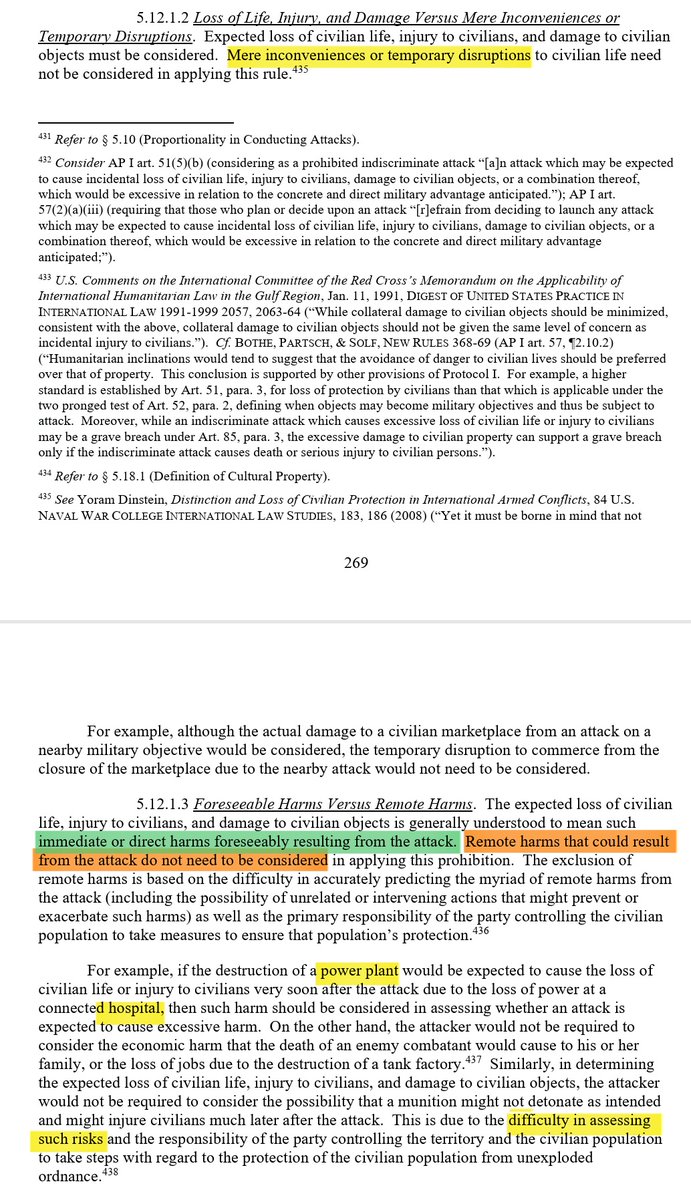
And another thing - I noticed you left off the direct part of "concrete & direct military advantage" in your bullshit version of proportionality. That matters because remote harms need not be factored (pic 4). Some prospective harms you mentioned probably are direct enough, but others...not so much.
Finally, I also noticed you claim AP I binds 🇺🇸 "as customary international law." But not all of AP I is customary, which is why I draw from the Manual instead.
I'll finish off with a simple pro tip: stay in your lane. Leave LOAC analysis to @DeptofWar. And actual experts...like me.


(Thread) Indiscriminate bombing of Iran’s power plants would violate core principles of the laws of war rooted in the Geneva Conventions and Additional Protocol I which bind the U.S. as customary international law.
Retired Army JAG here. And former infantry soldier & officer. And current law professor.
And YOU are full of shit.
No quarter ORDERS do violate #LOAC. Giving that order is a war crime even if it's not carried out.
But that is NOT an order @SecWar @PeteHegseth gave. And that is why you are full of shit.
See, I've also trained hundreds of soldiers on LOAC in the applied context. Thousands, actually. And I've advised commanders & decision makers on LOAC in combat, in Afghanistan as Chief of International & Operational Law for CJTF-101/RC-E (OEF XIV).
That's why I know the difference between what SECWAR said in a press briefing yesterday & a war crime. Apparently you don't - so I'll do you a favor & spell it out for you step by step, in simple language that you'll hopefully understand.
Let's start off with what Hegseth ACTUALLY said:
"It's a mess for them. Who's in charge? Iran may not even know. With every passing hour, we know and we know they know, that the military capabilities of their evil regime are crumbling. They can barely communicate, let alone coordinate; they're confused and we know it.
Our response? We will keep pressing. We will keep pushing, keep advancing, no quarter, no mercy for our enemies."
(https://t.co/5DSRnR9sM2)
Alright, if we consider this "no quarter" observation in context, we see Hegseth's intent is to convey that @DeptofWar is going to exert max pressure on our adversary. We know their military capabilities "are crumbling" & we're not going to back off. Keep pushing, keep advancing.
"No quarter. No mercy."
See, content & intent are important. This is how we differentiate political rhetoric from war crime. Reality from...bullshit.
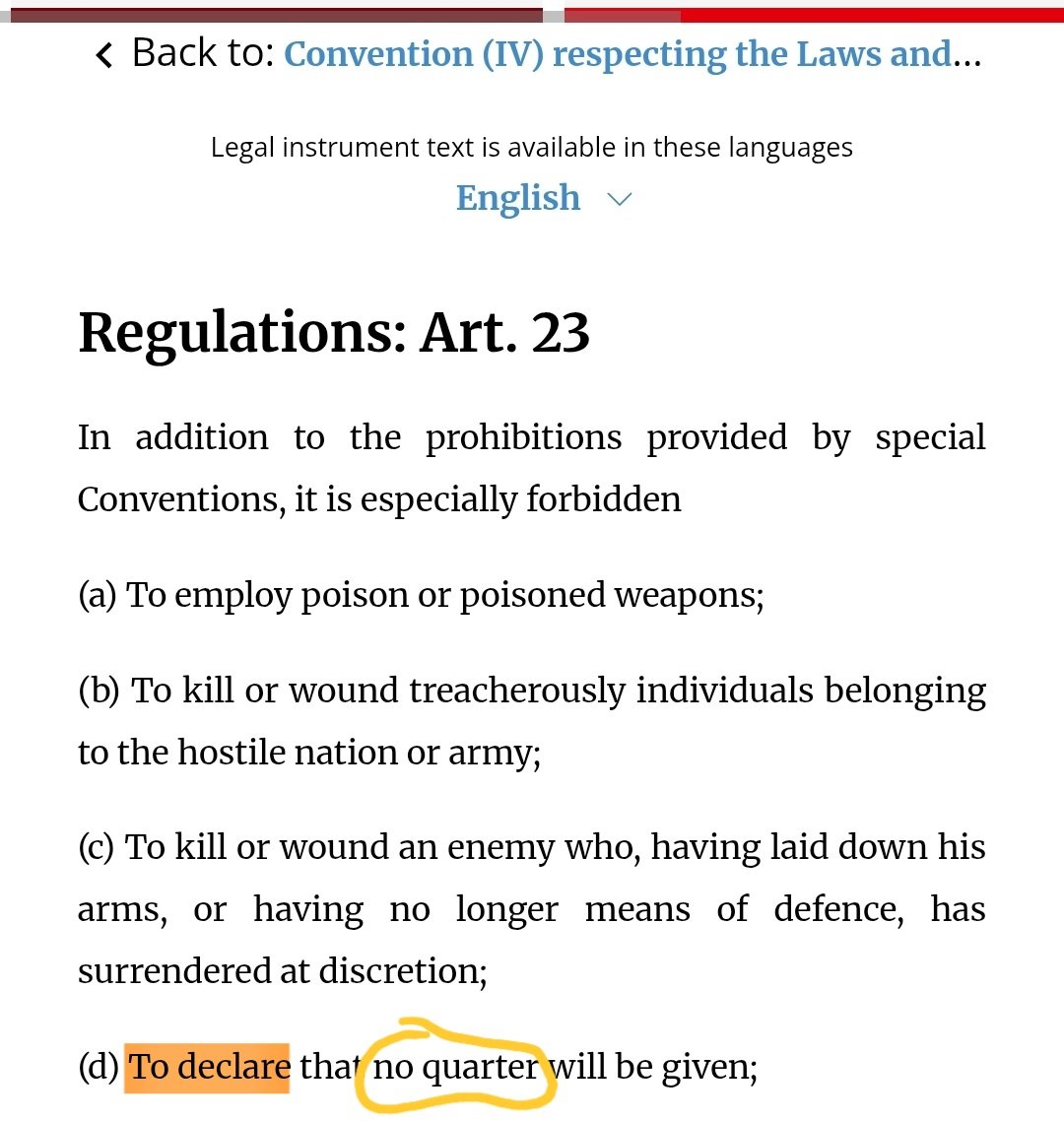
If we go all the way back to Hague, II (1899) & Hague, IV (1907), the Regulations annexed to both Conventions make it forbidden, "To declare that no quarter will be given" (pic 1, from Hague, IV).
Seems legit, right? Isn't that what SECWAR just "declared"? Well, if LOAC development stopped at 1907, maybe you could make that argument.
But, it didn't. In negotiations for later treaties, delegates decided to be more clear about what exactly that prohibition should entail.
So, next we'll consider 2 later treaties 🇺🇸 hasn't ratified but we were deeply involved in shaping - Additional Protocol I (1977) to 1949 Geneva Conventions & Rome Statute @IntlCrimCourt (1998).
As we'll see below, these sources confirm Hegseth's political rhetoric is NOT a LOAC violation or war crime...and US DoW doctrine is consistent with relevant text of these treaties.
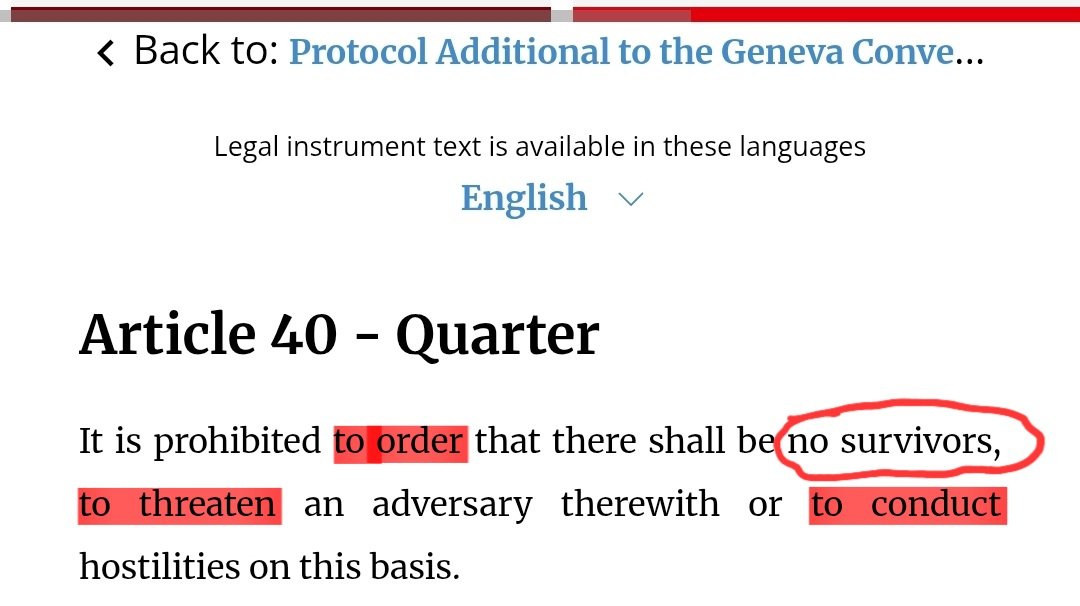
Let's start with AP I. As we see from art. 40, this treaty clarifies (7 decades after Hague IV), "It is prohibited to ORDER that there shall be no survivors, to THREATEN an adversary therewith or to CONDUCT hostilities on this basis" (pic 2).
So, 3 specific verbs to highlight + 1 condition. No ordering, threatening, or conducting (verbs) armed hostilities under condition(s) of NO SURVIVORS.
Now, reach all the way back in your memory - like 2 minutes ago - when you read actual text of Hegseth's remarks.
Do you genuinely believe SECWAR just ordered or threatened there will be no survivors, even if an enemy IRGC member tries to surrender - or that we are now as a result conducting hostilities on that basis? Be honest.
Of course not. And no one in the military is going to hear/read his remarks and think, "SECWAR just ordered me to take no prisoners." Seriously.
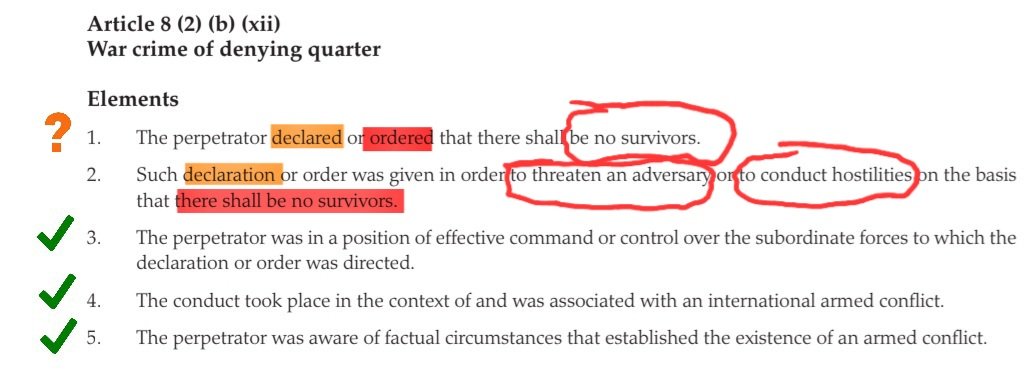
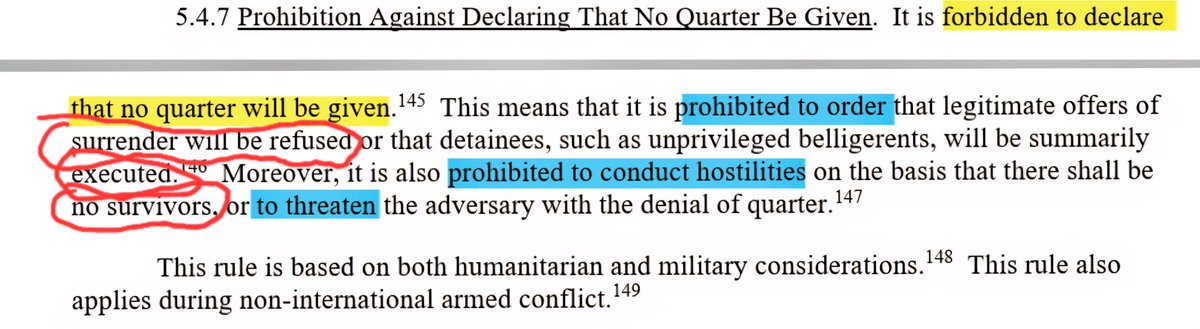
Moving on from AP I, art. 8(2)(b)(xii) of Rome Statute essentially copies text of Hague IV, art. 23(d) to make "declaring no quarter will be given" a war crime (not pictured). BUT the elements of crimes follows AP I (pic 3), as does DoD Law of War Manual (pic 4).
Yes, actual no quarter ORDERS do violate LOAC. Just the order alone is a war crime.
But max pressure political rhetoric is not the same as an ORDER "that there shall be no survivors."
Which means Sec Hegseth's comments are neither LOAC violation nor war crime. Which also means Rep Vindman is full of 💩.

Former Army JAG here. No quarter orders are a violation of the law of war and Geneva conventions.
This is the same order reportedly given during the Caribbean boat strikes. @SecWar is establishing a pattern of issuing illegal orders.
I’ve trained hundreds of soldiers on the law of war — our service members have an obligation to follow that law.
So you've heard allegations @SecWar @PeteHegseth violated #LOAC - probably even committed a(nother) war crime - with this no quarter "order," but you're not sure if these claims are legit (🚫)?
Ever get this sense that @RepVindman is full of shit (✅️)?
Stay tuned for more 👀
Former Army JAG here. No quarter orders are a violation of the law of war and Geneva conventions.
This is the same order reportedly given during the Caribbean boat strikes. @SecWar is establishing a pattern of issuing illegal orders.
I’ve trained hundreds of soldiers on the law of war — our service members have an obligation to follow that law.
@_JoelRayner @ElliotMalin Love your confidence Joel, but this is legally wrong, materially misleading & relies on an oversimplification that collapses under even basic #LOAC.
WP isn't restricted AT ALL pursuant to Protocol III, CCW bc...it doesn't qualify as an incendiary weapon⤵️
https://t.co/ZpzdVzo7i4
More #journalisticmalpractice covering int'l law involving armed conflict, this time @Reuters by Pesha Magid (@PMagid, reporting) & Philippa Fletcher (editing).
So much wrong in just news story, but let's start here:
@hrw says under #LOAC "use of airburst white phosphorus over populated areas is unlawful."
Two things to point out here.
First, this is false. Use of white phosphorus is not unlawful pursuant to LOAC, even if it is "over populated areas." More about why that is below.
Second, any time a news story starts a sentence with "Human Rights Watch says..." and doesn't immediately contradict what HRW said, you know you're being misled. Just like in this story.
Ok. How do we know this "Willy Pete is unlawful" narrative is false? And that HRW is misleading the journalist, who is misleading the editor, who is misleading the audience?
Easy. In fact, the answer is right there IN the article.
Specifically, let's consider this passage from the story:
"White phosphorus is considered an incendiary weapon under Protocol III of the Convention on the Prohibition of Use of Certain Conventional Weapons."
Nope. But don't just take my word for it - and whatever you do don't take HRW word for it either. It's easy enough to find CCW, Protocol III on incendiary weapons with a simple Google search.
If you do, you'll find that Article 1 contains definitions. What does - and does not - qualify as an incendiary weapon?
As you can see from pic 1, it is a weapon or munition that is PRIMARILY DESIGNED to set fire to objects or cause burn injuries (red highlight). Para 1a then gives helpful examples.
Uh oh. Then para 1b gives examples of what is NOT an incendiary weapon. For example, "Munitions which may have INCIDENTAL incendiary effects, such as illuminants, tracers, smoke or signalling systems."
So why did I put PRIMARILY DESIGNED from 1a & INCIDENTAL from 1b in all caps? That's right!
Because Willy Pete's incendiary effects are incidental & it's not primarily designed to set fire or cause burn injuries. As you can see from pic 2, DoD Law of War Manual reaches the same conclusion for the same reason.
Ok, so what was that claim from our "trusted" news source again?
WP "is considered an incendiary weapon under" Prot. III, CCW.
Wrong. And the article actually points out that @Israel hasn't ratified Prot. III. So if @IDF is supposedly dropping Willy Pete, why are we even covering Prot. III of the CCW?
It's not necessarily customary, so it doesn't represent "the" int'l law. It doesn't apply as a matter of conventional law if 🇮🇱 hasn't ratified.
Even so, if we're going to cover text of a treaty (even if it's not directly relevant) - ffs AT LEAST we should report it correctly to begin with.
Now let's circle back to what we get in this article from HRW.
First is a statement from Lebanon researcher Ramzi Kaiss:
"The incendiary effects of white phosphorus can cause death or cruel injuries that result in lifelong suffering," said @kaiss_ramzi.
Sure can. When it's used against personnel, it can cause death, injuries or suffering. Just like any weapon.
Then later we encounter HRW says under LOAC "use of airburst white phosphorus over populated areas is unlawful."
Well there isn't a general prohibition to that effect, so maybe they're referring to Prot. III, CCW? It's not directly applicable, but let's check anyway.
"It is prohibited in all circumstances to make any military objective located within a concentration of civilians the object of attack by air-delivered INCENDIARY WEAPONS" (pic 3).
Why all caps here? You betcha. WP doesn't qualify as an incendiary weapon. And it's not uncommon to use them against enemy personnel ON PURPOSE (pic 4).
So remember. Whatever "HRW says" involving LOAC, you're safe to reflexively believe the opposite.
And if it shows up like this in a news story? You're being misled - by the reporter(s), editor(s), AND the media outlet that uncritically ran #legaldisinformation from the likes of HRW.


I'm not sure who gives af about your feelings on use of white phosphorus - but I can assure you I do not.
I do care about countering rampant #LOAC #legaldisinformation so perception of compliance matches operational reality. You should try it sometime ⤵️
https://t.co/RUWvCwCKhh
More #journalisticmalpractice covering int'l law involving armed conflict, this time @Reuters by Pesha Magid (@PMagid, reporting) & Philippa Fletcher (editing).
So much wrong in just news story, but let's start here:
@hrw says under #LOAC "use of airburst white phosphorus over populated areas is unlawful."
Two things to point out here.
First, this is false. Use of white phosphorus is not unlawful pursuant to LOAC, even if it is "over populated areas." More about why that is below.
Second, any time a news story starts a sentence with "Human Rights Watch says..." and doesn't immediately contradict what HRW said, you know you're being misled. Just like in this story.
Ok. How do we know this "Willy Pete is unlawful" narrative is false? And that HRW is misleading the journalist, who is misleading the editor, who is misleading the audience?
Easy. In fact, the answer is right there IN the article.
Specifically, let's consider this passage from the story:
"White phosphorus is considered an incendiary weapon under Protocol III of the Convention on the Prohibition of Use of Certain Conventional Weapons."
Nope. But don't just take my word for it - and whatever you do don't take HRW word for it either. It's easy enough to find CCW, Protocol III on incendiary weapons with a simple Google search.
If you do, you'll find that Article 1 contains definitions. What does - and does not - qualify as an incendiary weapon?
As you can see from pic 1, it is a weapon or munition that is PRIMARILY DESIGNED to set fire to objects or cause burn injuries (red highlight). Para 1a then gives helpful examples.
Uh oh. Then para 1b gives examples of what is NOT an incendiary weapon. For example, "Munitions which may have INCIDENTAL incendiary effects, such as illuminants, tracers, smoke or signalling systems."
So why did I put PRIMARILY DESIGNED from 1a & INCIDENTAL from 1b in all caps? That's right!
Because Willy Pete's incendiary effects are incidental & it's not primarily designed to set fire or cause burn injuries. As you can see from pic 2, DoD Law of War Manual reaches the same conclusion for the same reason.
Ok, so what was that claim from our "trusted" news source again?
WP "is considered an incendiary weapon under" Prot. III, CCW.
Wrong. And the article actually points out that @Israel hasn't ratified Prot. III. So if @IDF is supposedly dropping Willy Pete, why are we even covering Prot. III of the CCW?
It's not necessarily customary, so it doesn't represent "the" int'l law. It doesn't apply as a matter of conventional law if 🇮🇱 hasn't ratified.
Even so, if we're going to cover text of a treaty (even if it's not directly relevant) - ffs AT LEAST we should report it correctly to begin with.
Now let's circle back to what we get in this article from HRW.
First is a statement from Lebanon researcher Ramzi Kaiss:
"The incendiary effects of white phosphorus can cause death or cruel injuries that result in lifelong suffering," said @kaiss_ramzi.
Sure can. When it's used against personnel, it can cause death, injuries or suffering. Just like any weapon.
Then later we encounter HRW says under LOAC "use of airburst white phosphorus over populated areas is unlawful."
Well there isn't a general prohibition to that effect, so maybe they're referring to Prot. III, CCW? It's not directly applicable, but let's check anyway.
"It is prohibited in all circumstances to make any military objective located within a concentration of civilians the object of attack by air-delivered INCENDIARY WEAPONS" (pic 3).
Why all caps here? You betcha. WP doesn't qualify as an incendiary weapon. And it's not uncommon to use them against enemy personnel ON PURPOSE (pic 4).
So remember. Whatever "HRW says" involving LOAC, you're safe to reflexively believe the opposite.
And if it shows up like this in a news story? You're being misled - by the reporter(s), editor(s), AND the media outlet that uncritically ran #legaldisinformation from the likes of HRW.
Trends for you
Most Popular Users

Elon Musk 
@elonmusk
241M followers

Barack Obama
@barackobama
119.2M followers

Cristiano Ronaldo
@cristiano
112.1M followers

Donald J. Trump
@realdonaldtrump
111.8M followers

Narendra Modi
@narendramodi
107.1M followers

Rihanna
@rihanna
98.1M followers

NASA
@nasa
92.2M followers

Justin Bieber
@justinbieber
91.3M followers

KATY PERRY
@katyperry
88.5M followers

Taylor Swift
@taylorswift13
82.4M followers

Lady Gaga
@ladygaga
73.9M followers

Virat Kohli
@imvkohli
71.3M followers

Kim Kardashian
@kimkardashian
70.2M followers

YouTube
@youtube
68.7M followers

Bill Gates
@billgates
64.4M followers

Neymar Jr
@neymarjr
64.1M followers

The Ellen Show
@theellenshow
62.4M followers

CNN
@cnn
61.8M followers

Selena Gomez
@selenagomez
61.6M followers

X
@x
60.8M followers