

Top Tweets for #MolecularClassification

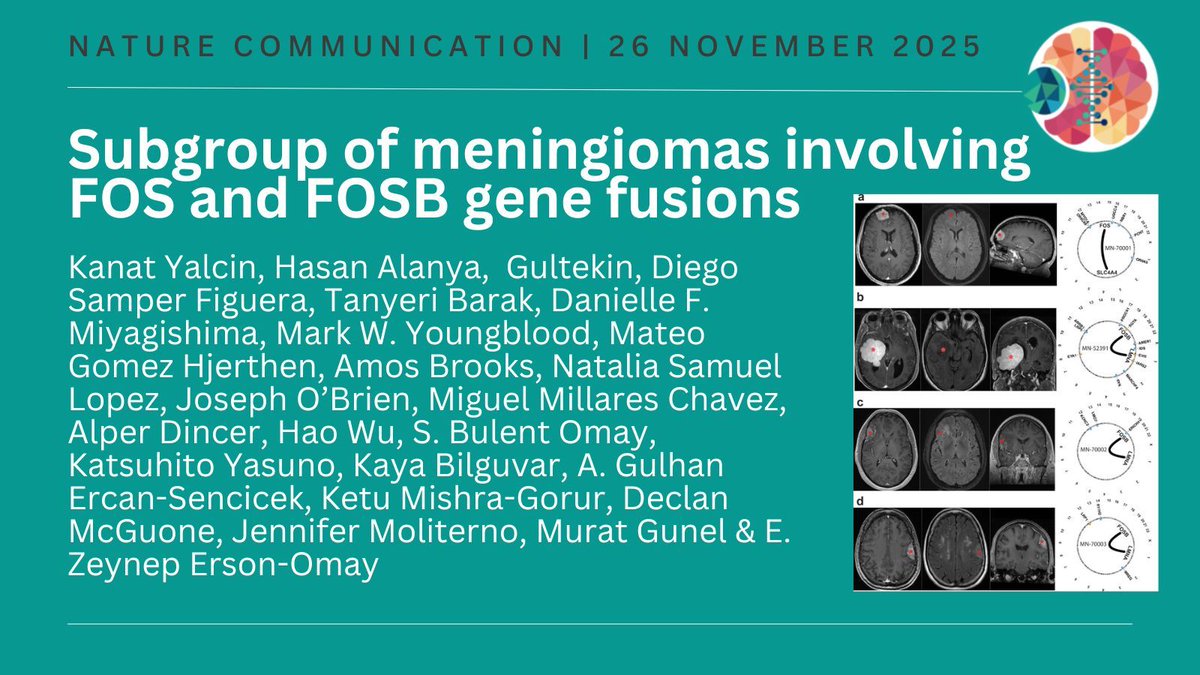
Read the new study in @NatureComms which identifies a #meningioma subgroup with distinct genetic, transcriptomic, and clinical features, expanding the #MolecularClassification of meningiomas and opening new avenues for targeted treatment strategies:
https://t.co/56UfoGu2TI

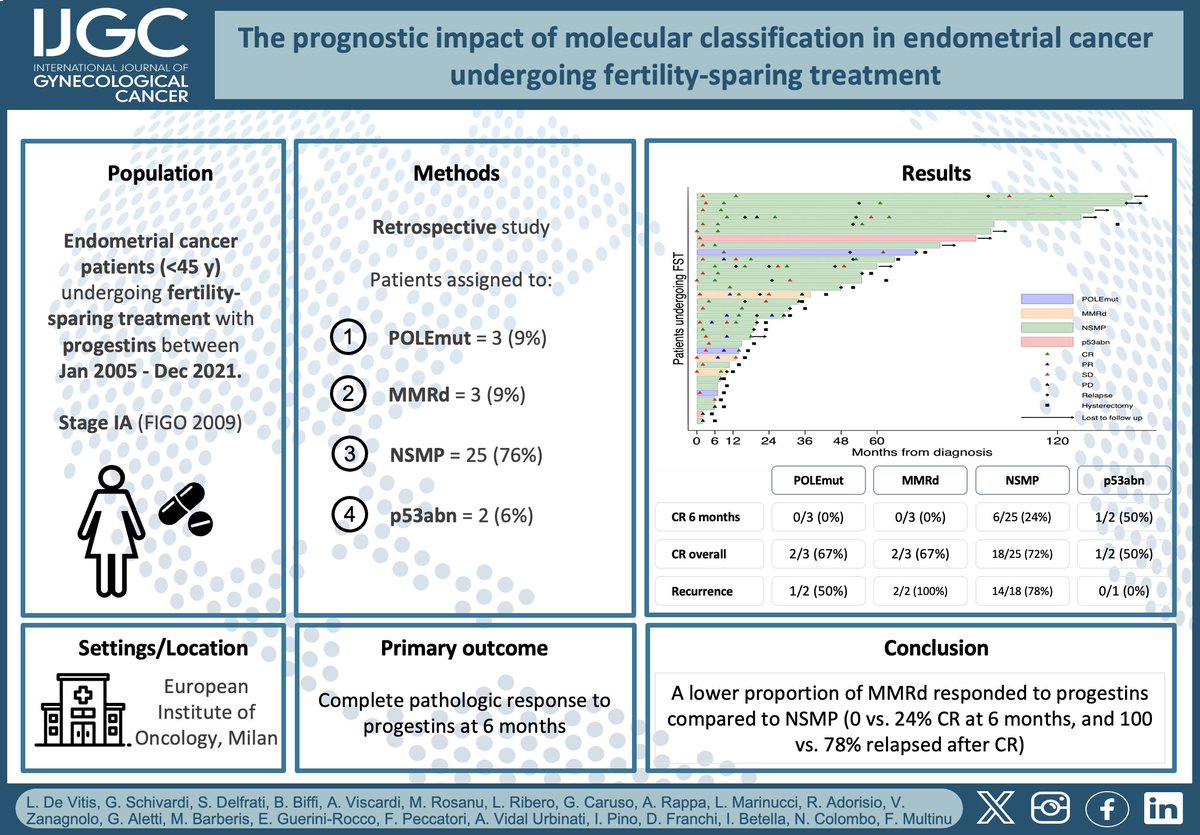
#EditorsChoice The prognostic impact of #molecularclassification in #endometrialcancer that undergoes fertility-sparing treatment @LuigiDEvitis
🔍 https://t.co/D9a6WhH7Ro
@pedroramirezMD @HsuMd @JayrajAarthi @AndreFernandes2 @IGCSociety @ESGO_society @ENYGO_official @OncoAlert @IJGCfellows @GynMe4 @thomasbartlMD @kfischermd @claritasantia @stephjeangill @MMontesinos_Alb @braunchristian1 @mattmarchettiMD @yates_elisemann @jhgelissen
Impact of #molecularclassification on recurrence risk in #endometrialcancer patients with lymph node metastasis
⭐ https://t.co/a8Ni1vo85q
@pedroramirezMD @HsuMd @JayrajAarthi @AndreFernandes2 @IGCSociety @ESGO_society @ENYGO_official @OncoAlert @IJGCfellows @GynMe4 @Jc_vilches @erodriguezglez @daggezmine @astraubhar @raikhanbo @gcarusomd @Cucinella_G @Fmultinu @glaucobaiocchi @GaSchivardi

#EditorsChoice Prognosis of ITC and use of #molecularclassification in early stage endometrioid #endometrialcancer
🔎 https://t.co/mVmj251Xkf
@pedroramirezMD @HsuMd @JayrajAarthi @AndreFernandes2 @IGCSociety @ESGO_society @ENYGO_official @OncoAlert @IJGCfellows @GynMe4 @RiosDoriaMD @leitaomd @aburustummd @TeamEndo_MSK


Congratulations to Dr. Jessica McAlpine and Dr. Amy Jamieson for receiving the 2024 @CIHR_IRSC Spring Project Grant for their project on #MolecularClassification of #VulvarCancer! 🎉
Learn more about the STRIVE study here 👉 https://t.co/7LT8mChwo9


@IJGConline @LuigiDEvitis @FMultinu @pedroramirezMD @HsuMd @JayrajAarthi @AndreFernandes2 @IGCSociety @ESGO_society @ENYGO_official @OncoAlert @IJGCfellows @GynMe4 #Molecularclassification is a game-changer for #endometrialcancer and atypical endometrial hyperplasia patients receiving fertility-sparing treatment. Our study shows that molecular classification can predict treatment response. Welcome the discussion! 👉 https://t.co/hvvqeEco1C
Exciting new #molecularclassification paper by the @GCI_Cluster Research Team!
💡Targeted and shallow whole-genome sequencing identifies therapeutic opportunities in 75% of patients with p53abn #endometrialcancer 🧬https://t.co/NjdaL92fcM
@DrAmyJamieson @YvetteDrew @BCCancer
#Editorial #Molecularclassification can predict the recurrence pattern of #endometrialcancer❓
By @LuigiDEvitis @Fmultinu
🖇️ https://t.co/l87fs1O8lr
@pedroramirezMD @HsuMd @JayrajAarthi @AndreFernandes2 @IGCSociety @ESGO_society @ENYGO_official @OncoAlert @IJGCfellows @GynMe4

The necessity to adopt the new classification when considering therapeutic options - Angela Mastronuzzi
@FrontiersIn @bambinogesu
#Cancer #Frontiers #MolecularClassification #OncoDaily #Oncology #TumorBiology #ClinicalTrials #Genetics
https://t.co/w4SwBTCCye
While #molecularclassification has been shown to better direct vulvar cancer care, Dr. Lien Hoang highlights on ongoing efforts to educate and onboard #pathologists as to improve identification #vulvarcancer subtypes

We are also joined by Dr. Jessica McAlpine and Dr. Blake Gilks who share with us the value of ProMisE, a revolutionary #molecularclassification tool for #endometrialcancer 🧬


FINAL THOUGHTS for #UterineCancerAwarenessMonth
- Our integrated method of #MolecularClassification has a high agreement with the ProMisE algorithm and highlights an alternative method for the subtyping endometrial carcinomas (EC)
- As the use of next-generation sequencing widens and becomes more cost-effective, our integrated & hierarchical classification criteria may provide a template for increasing the amount of ECs to be classified
- This work, along with that of so many others working in this space, will ultimately benefit patients with #EndometrialCancer as tumor classification begins to be integrated into clinical care
Overall, this study & database will lead the way for further exciting projects from @MSKCancerCenter/ @TeamEndo_MSK. I am excited to see it continue to develop, especially as we continue to utilize molecular subtyping in ongoing clinical trials and incorporate them with the latest FIGO 2023 staging.
Thanks for following along this week!
FULL ARTICLE LINK
https://t.co/2U7MjI3ZdR
@IGCSociety @IJGConline @IJGCfellows @ENYGO_official @ESGO_society @MSKLibrary @UWashOBGYN @SwisherLiz @BillzamMD @RyanKahnMD1 @tsialater @GreggNelsonERAS @gyncsm @OncoAlert @WAGO_org @RAINBOprogram @JennyMueller_ @pedroramirezMD @leitaomd @SGO_org @GYNCancer @LatinxOncology @gynoncjnls #gyncsm #gyncancer #meded #onctwitter #uterinecancer
I'm incredibly proud and thankful to have the work I have done throughout my time at @MSKCancerCenter to be published in next month's @GynOncJnls
"Integration of clinical sequencing and immunohistochemistry for the molecular classification of endometrial carcinoma"
This paper shows clinical sequencing and IHC data can be used together to determine #MolecularClassification, is highly concordant with existing surrogates, allows more tumors to be classified, & has prognostic value across all stages and histologic types of #EndometrialCancer (EC).
MOLECULAR LANDSCAPE
We looked at 2,115 individual patients with EC that had MSK-IMPACT (MSKCC proprietary & FDA-authorized next-generation sequencing) between 1/2014-12/2020. Excluding tumor purity <20%, lack of somatic mutations, unclassifiable tumors, and duplicate tumors, there were 1,834 total patients with EC classified. Using a hierarchical classifying approach, Figure 1C (below) provides an overview of molecular classification distribution of ECs. Very proud of this figure which conveys the distribution in a condensed & understandable way.
Key points: POLE, MSI-H, CN-H, & CN-L had a diverse representation with nearly all histologies present within each subtype. Of the 1,834 tumors: 5% POLE, 23% MSI-H, 40% CN-H, & 31% CN-L.
WHAT A RIDE
It was an honor to present this on the podium at @SGO_org in 2022. After further data refinement and analysis, the paper is finally here! This timely release may aid in providing an alternative roadmap for molecular classification as the new @FIGOHQ endometrial cancer staging guidelines have been released, which include the use of molecular subtypes.
There are so many people to thank for making this project possible, including all of my co-authors: @AmirMomeniBr, @ClaireFriedma19, @antoniomarraMD, @leitaomd, @AlexiaIasonos, @sonodamd, @ejewellmd, @YingLiu88, @dchimd, @DmitriyZamarin, @aburustummd, @JennyMueller_, & all those not on Twitter.
June is coming to a close, and so is Endometrial/Uterine Cancer Awareness Month. Stay tuned, as I'll highlight further results from this paper throughout the week!
Full Article Link: https://t.co/0RTEC0IZI8
@TeamEndo_MSK @IGCSociety @IJGConline @IJGCfellows @ENYGO_official @ESGO_society @MSKLibrary @UWashOBGYN @SwisherLiz @RenUrban30 @BillzamMD @RyanKahnMD1 @tsialater @GreggNelsonERAS @gyncsm @OncoAlert @WAGO_org @RAINBOprogram @pedroramirezMD

After characterizing the #MolecularClassification within #EndometrialCancer at @MSKCancerCenter, we next sought to understand clinical outcomes
SURVIVAL CURVES
Key inclusion for our survival analysis included patients who underwent upfront surgical staging with @TeamEndo_MSK & had MSK-IMPACT performed prior to documented a recurrence. This left us with 925 patients for survival analysis.
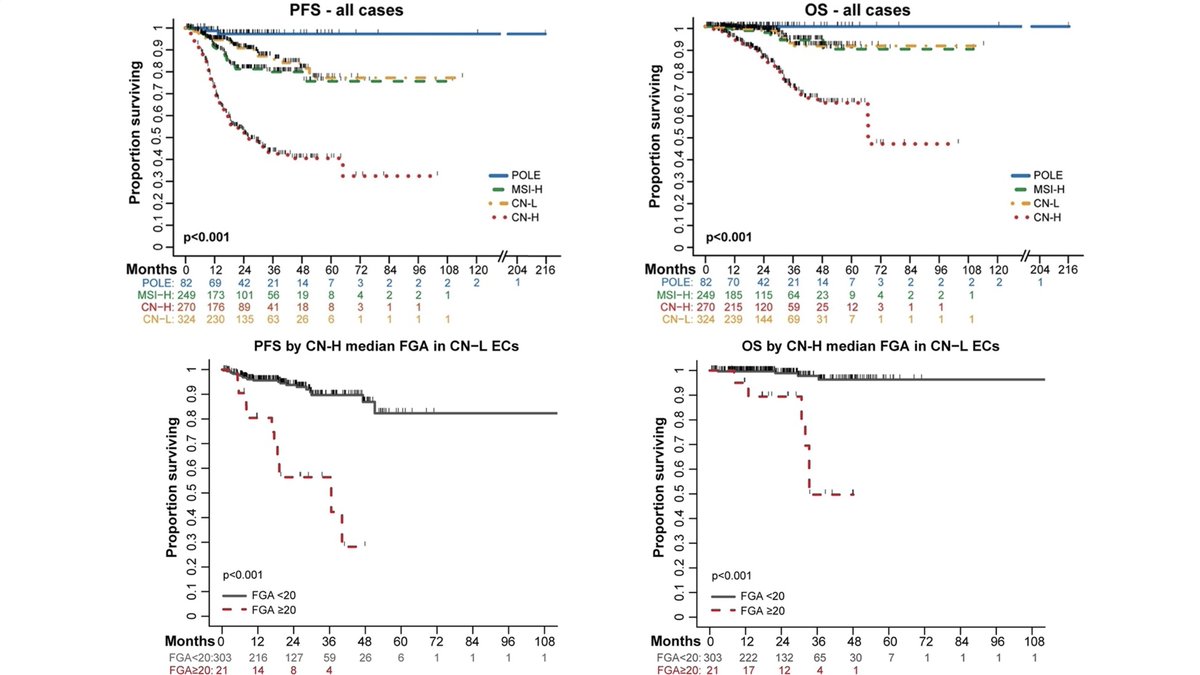
Our survival plots below are consistent with existing literature, including TCGA. Multivariate analysis identified patients w/ the following to have worse PFS outcomes:
- MSI-H molecular subtype
- CN-H molecular subtype
- Age ≥ 60 years/diagnosis
- FIGO stages III/IV
- Non-endometrioid histology
A DEEPER LOOK AT STAGE
We also stratified the data and looked at outcomes by subtypes for only Stage I/II (all histologies), Stage III/IV (all histologies), and Stage I/II endometrioid only (not pictured below). Each cohort had statistically significant differences in survival with varying degrees of outcomes for each subtype.
A DEEPER LOOK AT CN-H
We know the CN-H subtype portends the worse prognosis and noted the Fraction of Genome Altered (FGA) of CN-H #carcinosarcoma endometrial carcinoma (EC) was highest (median 34.5) compared to CN-H serous EC (median 22.3), and CN-H endometrioid (median 12.9).
Despite this statistical finding, there was no difference between these three paired subtype-histologies on survival analysis.
WHAT ABOUT MSI-H & CN-L WITH HIGH FGA?
After observing that the majority but not all CN-H ECs (92%) in the original TCGA study had TP53 mutations, we sought to understand if FGA may be additive to molecular classification by assessing patient outcomes.
Using our cohort's CN-H median FGA, we determined the patient survival outcomes for MSI-H & CN-L ECs by assessing those below, at or above the median. We see these subtypes with previously intermediate outcomes become worse with higher FGA.
Will wrap up this series later today as #UterineCancerAwarenessMonth comes to a close!
@IGCSociety @IJGConline @IJGCfellows @ENYGO_official @ESGO_society @MSKLibrary @UWashOBGYN @SwisherLiz @BillzamMD @RyanKahnMD1 @tsialater @GreggNelsonERAS @gyncsm @OncoAlert @WAGO_org @GynOncJnls @LatinxOncology #gyncancer #gyncsm
I'm incredibly proud and thankful to have the work I have done throughout my time at @MSKCancerCenter to be published in next month's @GynOncJnls
"Integration of clinical sequencing and immunohistochemistry for the molecular classification of endometrial carcinoma"
This paper shows clinical sequencing and IHC data can be used together to determine #MolecularClassification, is highly concordant with existing surrogates, allows more tumors to be classified, & has prognostic value across all stages and histologic types of #EndometrialCancer (EC).
MOLECULAR LANDSCAPE
We looked at 2,115 individual patients with EC that had MSK-IMPACT (MSKCC proprietary & FDA-authorized next-generation sequencing) between 1/2014-12/2020. Excluding tumor purity <20%, lack of somatic mutations, unclassifiable tumors, and duplicate tumors, there were 1,834 total patients with EC classified. Using a hierarchical classifying approach, Figure 1C (below) provides an overview of molecular classification distribution of ECs. Very proud of this figure which conveys the distribution in a condensed & understandable way.
Key points: POLE, MSI-H, CN-H, & CN-L had a diverse representation with nearly all histologies present within each subtype. Of the 1,834 tumors: 5% POLE, 23% MSI-H, 40% CN-H, & 31% CN-L.
WHAT A RIDE
It was an honor to present this on the podium at @SGO_org in 2022. After further data refinement and analysis, the paper is finally here! This timely release may aid in providing an alternative roadmap for molecular classification as the new @FIGOHQ endometrial cancer staging guidelines have been released, which include the use of molecular subtypes.
There are so many people to thank for making this project possible, including all of my co-authors: @AmirMomeniBr, @ClaireFriedma19, @antoniomarraMD, @leitaomd, @AlexiaIasonos, @sonodamd, @ejewellmd, @YingLiu88, @dchimd, @DmitriyZamarin, @aburustummd, @JennyMueller_, & all those not on Twitter.
June is coming to a close, and so is Endometrial/Uterine Cancer Awareness Month. Stay tuned, as I'll highlight further results from this paper throughout the week!
Full Article Link: https://t.co/0RTEC0IZI8
@TeamEndo_MSK @IGCSociety @IJGConline @IJGCfellows @ENYGO_official @ESGO_society @MSKLibrary @UWashOBGYN @SwisherLiz @RenUrban30 @BillzamMD @RyanKahnMD1 @tsialater @GreggNelsonERAS @gyncsm @OncoAlert @WAGO_org @RAINBOprogram @pedroramirezMD
After defining the landscape of #EndometrialCarcinoma #MolecularClassification in 1,834 tumor specimens, we next sought to compare this integrated approach to the conventional surrogate molecular subtyping approach (ProMisE algorithm)
INTEGRATED APPROACH
Overall, the combined use of next-generation sequencing (NGS) and immunohistochemistry (IHC) allows for classifying more tumors than ProMisE alone.
By using NGS in addition to IHC, we were able to subtype 86.7% of our total cohort (1,834/2,115). The use of MMR & p53 IHC only with POLE testing (ProMisE) from NGS only resulted in classifying 65.5% of our total cohort (1,387/2,115) (p<0.001).
Figure 2C (below) shows the overlap and agreement between both approaches amongst our final cohort of 1,834 classifications. Importantly, our integrated approach found misclassifications in certain instances:
- MMRp IHC, despite being MSIsensor-high on NGS (i.e. classified as MMRd/MSI-H)
- p53 WT on IHC, despite TP53 mutations on NGS (i.e. classified as CN-H)
The light gray exemplifies all cases without IHC available and, thus, no possible subtyping in the stepwise classifying algorithm without the use of NGS. By integrating NGS data, we found ECs that would have had a different or missing TCGA classification if based only on POLE mutation sequencing plus MMR/p53 IHC results.
When focusing only on ECs classifiable by ProMisE (n=1,208) within our final cohort, there was a near-perfect agreement when compared to the integrated approach (Kappa=0.962).
Stay tuned for the next post going over the clinicopathologic and somatic genomic features of the molecular subtypes
Full article: https://t.co/ARgdtiiWDs
@TeamEndo_MSK @JennyMueller_ @IGCSociety @IJGConline @IJGCfellows @ENYGO_official @ESGO_society @MSKLibrary @UWashOBGYN @SwisherLiz @BillzamMD @RyanKahnMD1 @tsialater @GreggNelsonERAS @gyncsm @OncoAlert @WAGO_org @GynOncJnls @LatinxOncology @RAINBOprogram #endometrialcancer #gyncsm #gyncancer #onctwitter #meded #medtwitter #obgyn #uterinecancer

I'm incredibly proud and thankful to have the work I have done throughout my time at @MSKCancerCenter to be published in next month's @GynOncJnls
"Integration of clinical sequencing and immunohistochemistry for the molecular classification of endometrial carcinoma"
This paper shows clinical sequencing and IHC data can be used together to determine #MolecularClassification, is highly concordant with existing surrogates, allows more tumors to be classified, & has prognostic value across all stages and histologic types of #EndometrialCancer (EC).
MOLECULAR LANDSCAPE
We looked at 2,115 individual patients with EC that had MSK-IMPACT (MSKCC proprietary & FDA-authorized next-generation sequencing) between 1/2014-12/2020. Excluding tumor purity <20%, lack of somatic mutations, unclassifiable tumors, and duplicate tumors, there were 1,834 total patients with EC classified. Using a hierarchical classifying approach, Figure 1C (below) provides an overview of molecular classification distribution of ECs. Very proud of this figure which conveys the distribution in a condensed & understandable way.
Key points: POLE, MSI-H, CN-H, & CN-L had a diverse representation with nearly all histologies present within each subtype. Of the 1,834 tumors: 5% POLE, 23% MSI-H, 40% CN-H, & 31% CN-L.
WHAT A RIDE
It was an honor to present this on the podium at @SGO_org in 2022. After further data refinement and analysis, the paper is finally here! This timely release may aid in providing an alternative roadmap for molecular classification as the new @FIGOHQ endometrial cancer staging guidelines have been released, which include the use of molecular subtypes.
There are so many people to thank for making this project possible, including all of my co-authors: @AmirMomeniBr, @ClaireFriedma19, @antoniomarraMD, @leitaomd, @AlexiaIasonos, @sonodamd, @ejewellmd, @YingLiu88, @dchimd, @DmitriyZamarin, @aburustummd, @JennyMueller_, & all those not on Twitter.
June is coming to a close, and so is Endometrial/Uterine Cancer Awareness Month. Stay tuned, as I'll highlight further results from this paper throughout the week!
Full Article Link: https://t.co/0RTEC0IZI8
@TeamEndo_MSK @IGCSociety @IJGConline @IJGCfellows @ENYGO_official @ESGO_society @MSKLibrary @UWashOBGYN @SwisherLiz @RenUrban30 @BillzamMD @RyanKahnMD1 @tsialater @GreggNelsonERAS @gyncsm @OncoAlert @WAGO_org @RAINBOprogram @pedroramirezMD
#2023SpecialIssue
Update in the #MolecularClassification of #EndometrialCarcinoma 🧬
🔗 https://t.co/d1oPSTRNRT
@AliciaLenCasti1 @pedroramirezMD @HsuMd @agz_eriksson @JayrajAarthi @AndreFernandes2 @IGCSociety @ESGO_society @OncoAlert @IJGCfellows @GynMe4

Excellent podcast on #MolecularClassification & risk stratification for #EndometrialCancer. Congrats to @BillzamMD & @JennyMueller_ on this important work 👏🏾
Listen here: 🎧 https://t.co/D5T5zdPyPN
#gyncsm @PedroRamirezMD @IJGConline @RyanKahnMD1 @IJGCfellows
The future is here!
Dr. @pedroramirezMD is joined by Drs. @JennyMueller_ & @BillzamMD to discuss #MolecularClassification & risk stratification in #EndometrialCancer @MSKCancerCenter
🎙️ https://t.co/qqVDq8WhAl
@HsuMd @JayrajAarthi @AndreFernandes2 @agz_eriksson @IJGCfellows
The future is here!
Dr. @pedroramirezMD is joined by Drs. @JennyMueller_ & @BillzamMD to discuss #MolecularClassification & risk stratification in #EndometrialCancer @MSKCancerCenter
🎙️ https://t.co/qqVDq8WhAl
@HsuMd @JayrajAarthi @AndreFernandes2 @agz_eriksson @IJGCfellows
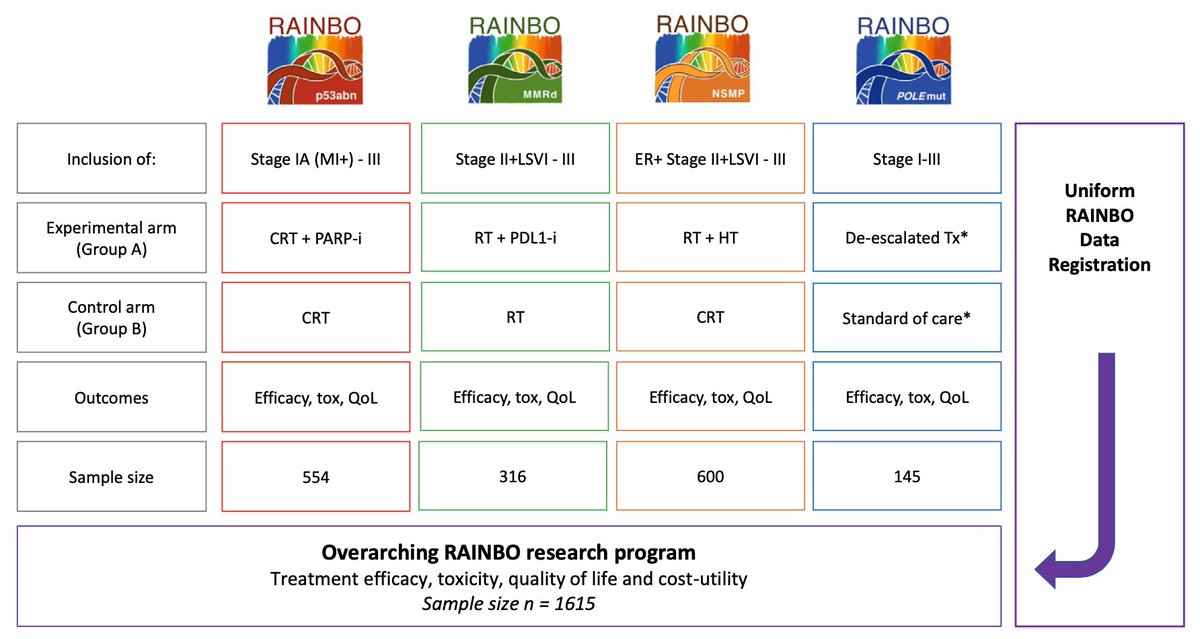
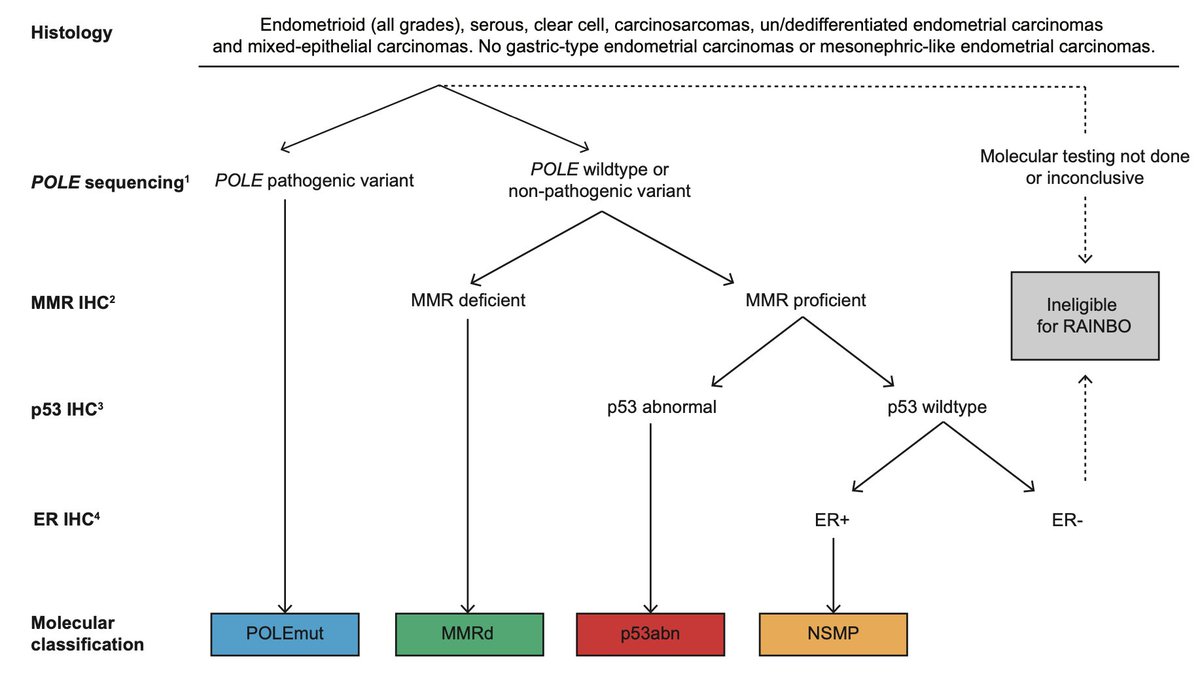
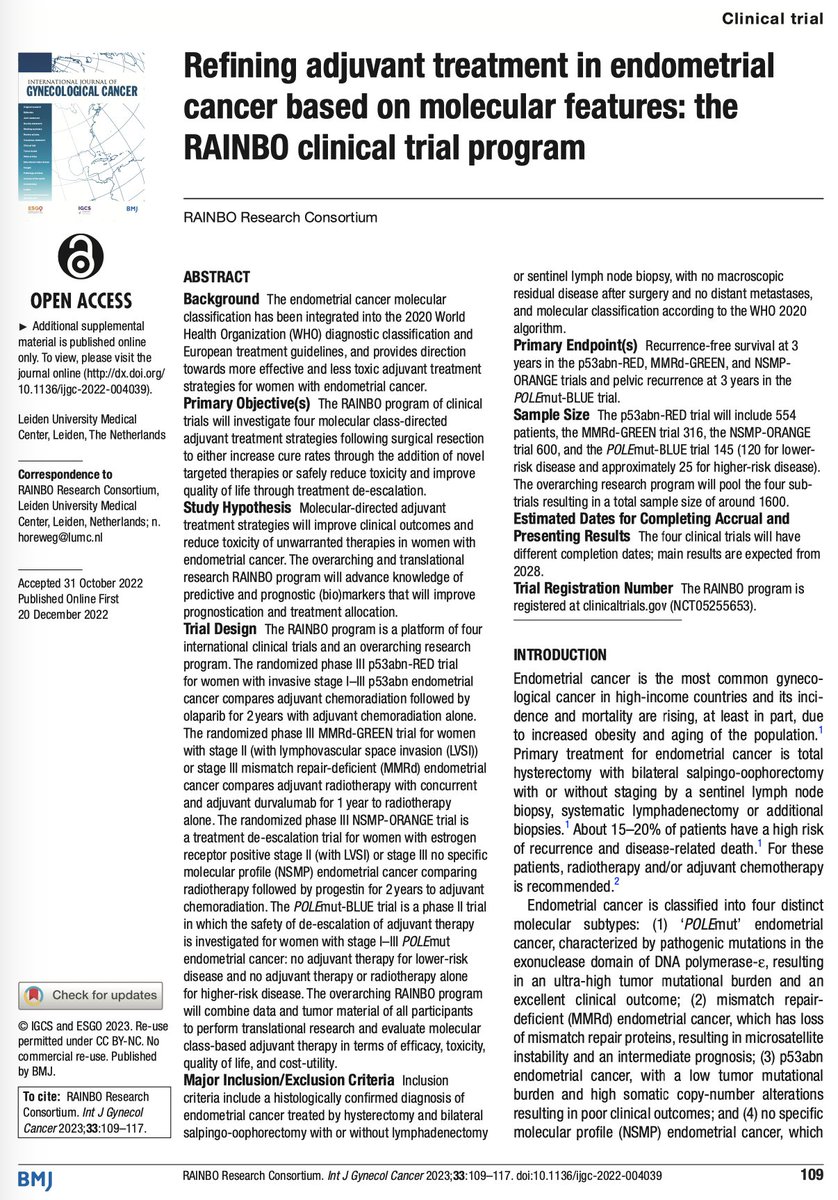
#ClinicalTrial Refining adjuvant treatment in #endometrialcancer based on molecular features: the #RAINBO clinical trial program 🌈 #MolecularClassification @RAINBOprogram
👉 https://t.co/pF7WmVj1c2
@pedroramirezMD @agz_eriksson @HsuMd @JayrajAarthi @AndreFernandes2


#AI and #cancer Interpretable deep learning model to predict the #molecularclassification in #endometrialcancer ‼️@ESGO_society @IGCSociety @gyncsm @OncoAlert @IstTumori @GynMe4 @cancer_womb @IJGCfellows @SGO_org ➡️https://t.co/aAqponGprf
Also missing everyone at @TeamEndo_MSK & @TeamOvary_MSK!
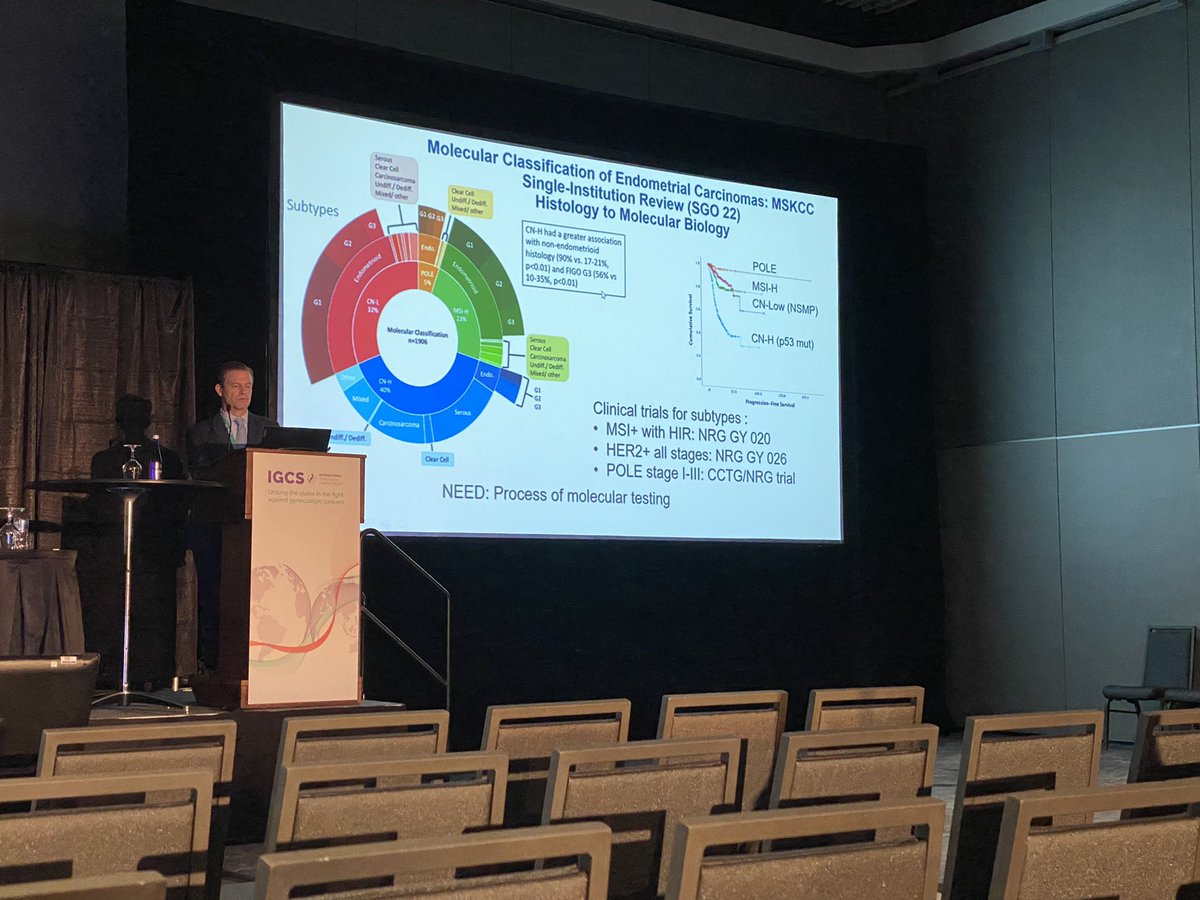
🤩 Great to see Dr. @MatthewAPowell showcasing slides from my @SGO_org plenary! Thanks, @Doctor_Beryl, for sharing from @IGCSociety #IGCS2022 #molecularclassification #endometrialcancer

Missing @RiosDoriaMD at #IGCS2022 but his graphics live on. Still love this breakdown-> a great first step as we better target and tailor management. Less may be more, but only if data inform our practice!
Last Seen Hashtags on Sotwe
Most Popular Users

Elon Musk 
@elonmusk
240.2M followers

Barack Obama
@barackobama
119.3M followers

Donald J. Trump
@realdonaldtrump
111.6M followers

Cristiano Ronaldo
@cristiano
109.4M followers

Narendra Modi
@narendramodi
106.9M followers

Rihanna
@rihanna
97.4M followers

NASA
@nasa
92.1M followers

Justin Bieber
@justinbieber
90.7M followers

KATY PERRY
@katyperry
87.1M followers

Taylor Swift
@taylorswift13
80.9M followers

Lady Gaga
@ladygaga
72.5M followers

Kim Kardashian
@kimkardashian
69.5M followers

Virat Kohli
@imvkohli
69M followers

YouTube
@youtube
68.6M followers

Bill Gates
@billgates
63.5M followers

The Ellen Show
@theellenshow
62.5M followers

CNN
@cnn
61.9M followers

Neymar Jr
@neymarjr
61.6M followers

X
@x
60.9M followers

Selena Gomez
@selenagomez
60.2M followers