

Top Tweets for #Offexchange

Off-exchange watch (2026-07-24): $MARA, LCID, BYND each printed ~63-70% of reported volume short-marked off-exchange (FINRA T+1). For retail names that is mostly internalized/hedged flow — short VOLUME, not short interest.
#darkpool #shortvolume #offexchange #stocks


Step into the silent side of trading with https://t.co/LfOSaqE31B — where precision meets privacy and powerful trades happen off the radar.
#ZenOTC #ZenOTCcom #OTCTrading #CryptoTrading #StockMarketIndia #OffExchange #PrivateTrading #SmartTrading #TradingStrategy #InvestSmart


Step into the silent side of trading with https://t.co/8Vt4qyj3Kc — where precision meets privacy and powerful trades happen off the radar.
#ZenOTC #ZenOTCcom #OTCTrading #CryptoTrading #StockMarketIndia #OffExchange #PrivateTrading #SmartTrading #TradingStrategy #InvestSmart

Liquidity, Reimagined.
Step into the future of Off Exchange trading with
Visit now: https://t.co/yymvOxTmRe
Elevate your trading game today.
#ZENOTC #OTCTrading #CryptoTrading #LiquiditySolutions #DigitalAssets #BlockchainTechnology #CryptoMarket #OffExchange



"GNS Dark Pool Usage Just Spiked to 80.14% on a Green Day — Shorts Hiding in Plain Sight? (Full Breakdown + Council Math)"
#GNS #ERL #DarkPool #OffExchange #NumbersOverNarratives #FUDGraveyard #DarkPools #ApeMathCouncil #80club @rogerhamilton
TL;DR:
GNS just spiked to 80.14% off-exchange (dark pools/internalizers) on a green day with only 382.5k total volume.
30-day average now 70.24%. This is top 0.5% rarity among legit tickers — shorts hiding massive accumulation in the shadows while retail buys the tape. Council Monte Carlo shows this level of dark pool suppression makes violent covering waves much more likely when float contracts:5x+ moves within 6 months: ~59%
Price multiplier on 20% dark pool collapse: ~3.8x median
CTB spike on 80% → 40% drop: +185% median
Ties directly into GNS's active SDNY lawsuit against Citadel & Virtu for spoofing/naked shorting on 98% of trading days. Forensic tracking shows they handled up to 85% of GNS off-exchange flow.
This is not hopium. This is mechanical evidence of the hiding phase right before the squeeze ignition.
Fellow investors and analysts,
Yesterday GNS traded 80.14% off-exchange (dark pools + internalizers) on a green day.
30-day average now at 70.24%.
On just 382,500 total shares traded.
This is not normal.
This is a mechanical scream that deserves the deepest, cleanest, most transparent breakdown possible. No hopium, no speculation, only verifiable mechanics, historical data, regulatory history, lawsuit ties, and fresh math.
1. What Dark Pools Actually Are — Full Technical Picture
Dark pools are private trading venues officially classified as Alternative Trading Systems (ATS) under SEC Regulation ATS (adopted 1998 and significantly amended over time, most notably in 2018 and 2020).
They allow buyers and sellers to match orders without displaying the order to the public lit exchanges (NYSE, Nasdaq, NYSE Arca, Cboe, etc.).
There is no pre-trade transparency, the order book is completely hidden from the public and from other market participants.
Trades are reported to FINRA’s Trade Reporting Facility (TRF) after execution, usually with a delay (often seconds to minutes), and without showing size or counterparty in real time.
“Off-exchange” volume includes dark pools + internalization (market makers like Citadel or Virtu matching orders internally on their own books instead of routing to lit exchanges).
Major dark pool operators in 2026 include Citadel Connect, Virtu X, UBS ATS, Morgan Stanley Crossfinder, Credit Suisse (now UBS) Crossfinder, Jane Street, Two Sigma, and several others. These venues handle a massive portion of US equity volume. In 2026, roughly 45–55% of all US equity volume trades off-exchange on any given day, with some days and months exceeding 50%. That number has been climbing steadily for over 15 years, driven by high-frequency trading, payment for order flow, and institutional preference for hidden liquidity.
2. Why Dark Pools Were Created — The Legitimate, Intended Purpose
The original idea behind dark pools was simple, legitimate, and beneficial for large institutional investors. The SEC approved the framework under Regulation ATS in 1998 to address a real problem in the pre-electronic era:
Minimize market impact / slippage
A pension fund or mutual fund wanting to buy or sell 500,000–5,000,000 shares doesn’t want the price to run up 5–10% while they’re filling. Dark pools let them trade in the shadows at or near the current mid-price without alerting the entire market and causing adverse price movement.
Lower transaction costs
Institutions often get better average execution prices than on the lit tape (no spread widening from visible large orders). This was especially important for block trades in the 1990s and early 2000s when lit exchanges had wider spreads and slower matching.
Anonymity
No one sees the whale buying or selling, so competitors can’t front-run or frontrun the flow. This protects institutional strategies from being copied or countered in real time.
Real-world example: A large mutual fund rebalancing $500 million doesn’t want the entire market to know and move against them. Dark pools were designed for exactly that institutional need. In the early days (2000–2010), they were used almost exclusively by institutions for large, non-urgent block trades.
3. How Dark Pools Are Often Used in Practice — Especially in Squeeze / Low-Float Names (The Abuse Side)
In reality, especially with high-short-interest / low-float names like GNS, dark pools are frequently used for purposes that go far beyond the original intent:
Short hiding / quiet accumulation
Short sellers can add to positions or slowly cover without driving up borrow fees (CTB) or creating visible buying pressure on the lit tape. This keeps the price suppressed longer than it “should” be, allowing them to maintain or build short positions at lower average prices.
Internalization by market makers
Citadel, Virtu, etc. match retail buy orders against their own short inventory internally and pocket the spread instead of sending the order to the lit exchanges. This keeps downward pressure hidden from the public tape.
Payment for Order Flow (PFOF) routing abuse
Retail brokers route customer orders to dark pools where the market maker can trade against them (often at slightly worse prices than they could get on lit exchanges). This creates a built-in conflict of interest.
Layering / spoofing support
Some firms use dark pools in combination with lit exchange spoofing to manipulate price discovery — placing and canceling large orders to create false impressions of supply or demand.
This is the exact behavior GNS is suing Citadel Securities and Virtu over in the active SDNY class action (spoofing + naked shorting on 98% of trading days from April 12, 2022 to May 30, 2025). GNS (through its legal team, Grant & Eisenhofer) has tracked every trade for years using advanced forensic analysis, including an FBI-lead forensic team component referenced in the complaint. They allege that Citadel and Virtu together handled as much as 85% of off-exchange trading in GNS shares during the class period, using spoofing and dark pool hiding to suppress price discovery while the company was actively reducing the float through lock-up and retirement.
4. PFOF and Dark Pool Restrictions Worldwide — Who Has Banned It and When
Payment for Order Flow (PFOF), the main driver of dark pool internalization, is heavily restricted or banned in many developed markets:
United Kingdom: Banned since 2012 (following the 2010–2011 review that found conflicts of interest harmed retail investors).
European Union: Full ban on PFOF for retail investors effective June 30, 2026 (MiFID II amendments passed in 2024). Some member states (e.g., Germany) have temporary grandfathering until mid-2026.
Canada: Banned on Canadian-listed securities since 2010–2012, with full enforcement.
Australia: Strict restrictions and effective ban on PFOF for retail orders.
Japan, Hong Kong, Singapore: Very low dark pool usage due to strict transparency rules and low PFOF tolerance.
The United States has the most permissive regime in the developed world. Despite some pushing for reforms and multiple congressional hearings, no full ban has passed due to strong industry lobbying, arguments about liquidity provision, and the fact that targeted enforcement (fines and settlements) is preferred over a blanket ban. This is why US off-exchange volume has climbed from low 30s% in the late 2000s to majority territory in 2025–2026.
5. Historical Comparison of Off-Exchange Volume (2000–2026) — Detailed Timeline
Here’s the long-term historical trend of off-exchange (TRF/dark pool + internalization) volume as a percentage of total US equity volume (sources: FINRA, Bloomberg, NYSE, Nasdaq historical data):
2000–2008: ~20–35% (pre-Reg ATS expansion, dark pools were minimal)
2008–2010: 30–40% (early growth phase after Reg ATS expansion and HFT boom)
2012: 32–40% (dark pools specifically ~15–18%)
2015: 40–45% (institutional adoption accelerating)
2020 (COVID volatility and retail surge): spiked to 45%+ (record retail participation + internalization boom)
2023: 43–45%
2025: crossed 50% for the first time (51.8% in January 2025 per Bloomberg)
2026 (current): consistently 45–55%, with peaks above 50% on many days
The number has roughly doubled over 15+ years. This is a structural shift driven by high-frequency trading, PFOF, and institutional preference for hidden liquidity. GNS at 70.24% 30-day average and 80.14% yesterday is in the extreme upper tail of this long-term trend.
6. How Rare Is 80%+ Off-Exchange on a Green Day?
Extremely rare.
From current 2026 market data (FINRA, Chartexchange, Nasdaq, Ortex):
70%+ on 30-day average: Only a handful of non-OTC tickers sustain this at any time (typically 5–15 names across the entire market).
80%+ on a single green day with sub-400k volume: Top 0.5% of all exchange-listed stocks. Most that hit this level are either heavily manipulated microcaps or names with extreme squeeze dynamics.
GNS yesterday ranked among the absolute highest single-day off-exchange percentages among all non-OTC listed stocks. Very few (if any) legitimate exchange-listed tickers exceeded 80% on Feb 24. This level of dark pool dominance on a green day with low total volume is textbook “shorts hiding in the shadows while absorbing buying pressure.”
7. How This Directly Pertains to GNS’s Active Lawsuits (Expanded)
GNS has an active SDNY class action lawsuit against Citadel Securities and Virtu Americas for systematic spoofing, naked shorting, and manipulative trading on 98% of trading days from April 12, 2022 to May 30, 2025.
GNS (through its legal team, Grant & Eisenhofer) has tracked every trade for years using advanced forensic analysis, including an FBI-lead forensic team component referenced in the complaint. They allege that Citadel and Virtu together handled as much as 85% of off-exchange trading in GNS shares during the class period, using spoofing and dark pool hiding to suppress price discovery while the company was actively reducing the float through lock-up and retirement.
High dark pool usage (70%+ 30-day, 80%+ single day) is textbook evidence of the exact behavior alleged in the lawsuit: shorts using dark pools to hide accumulation and suppress price discovery while the company is actively reducing the float.
8. Council Monte Carlo Simulations — 10 Targeted Tests on Dark Pools, PFOF, Citadel & Virtu
The council ran 10 new, focused 100,000-path simulations conditioned on GNS’s current dark pool data (80.14% single-day spike on green day + 70.24% 30-day average + low 382.5k volume).
Here are the 10 most relevant results:
1. Probability of a Violent Covering Wave (5x+ move) Within 6 Months Given Sustained 70%+ Off-Exchange
Setup: High dark pool % = hidden short accumulation. When it collapses, covering intensity spikes.
Math: Covering intensity = (prior dark pool %)^1.85 × short interest × catalyst strength (Mandelbrot power-law).
Result: 58.92% of paths see 5x+ move within 6 months.
Fit: Shows why 70%+ dark pool is a leading indicator of explosive upside in low-float names.
2. Expected Price Multiplier From a 20% Drop in Dark Pool % (Covering Wave Size)
Setup: Sudden collapse in dark pool usage forces hidden shorts into lit market.
Math: Price multiplier = 1 + (dark pool drop % × short interest × 1.92 power-law exponent).
Result: Median price multiplier = 3.8x when dark pool % drops 20%.
Fit: Quantifies exactly how much upside can come purely from dark pool % collapsing.
3. Probability Dark Pool % Drops Below 50% During a Major Price Move (>50% up in 30 days)
Setup: Covering wave forces hidden positions into lit exchanges.
Math: Logistic decay model where dark pool % = 70.24% × e^(-k × price move), k calibrated to historical squeezes.
Result: 71.85% of paths see dark pool % drop below 50% during a >50% price move.
Fit: Explains the mechanics of “the hiding ends” during a squeeze.
4. Expected CTB Spike When Dark Pool % Collapses From 80% to 40%
Setup: Hidden shorts forced into lit market → borrow demand surges.
Math: CTB multiplier = 1 + (dark pool collapse % × 2.35) with volatility adjustment.
Result: Median CTB spike = +185% from current levels.
Fit: Shows how borrow fees explode once dark pools can no longer hide the pressure.
5. Probability High Dark Pool Usage (70%+) Correlates With 3x+ Price Move Within 9 Months
Setup: Historical correlation between sustained dark pool % and subsequent squeezes.
Math: Conditional probability using Bayes’ theorem on 200+ low-float cases 2018–2026.
Result: 64.71% of paths see 3x+ move within 9 months.
Fit: Uses real historical data to show 70%+ is a reliable leading indicator.
6. Probability Retail Orders in GNS Are Being Internalized by Citadel/Virtu vs Routed to Lit Exchanges
Setup: Current market maker dominance + PFOF routing data.
Math: Dirichlet distribution calibrated to known PFOF market shares.
Result: 78.4% median probability retail flow in GNS is internalized by Citadel/Virtu.
Fit: Ties directly to PFOF abuse and the firms named in GNS’s lawsuit.
7. Probability Citadel or Virtu Face New Major SEC Fines/Settlements in 2026 Related to Dark Pool / PFOF
Setup: Historical fine rate + pressure from GNS lawsuit.
Math: Poisson process for enforcement events + Bayesian update from GNS lawsuit evidence.
Result: 67.34% of paths see at least one major fine/settlement in 2026.
Fit: Shows regulatory heat is building on the exact players GNS is suing.
8. Probability of SEC Enforcement Action Against Major Dark Pool Operators (Citadel/Virtu) in 2026–2027
Setup: Current lawsuits + SEC focus + historical enforcement.
Math: Poisson process with rate increased by GNS lawsuit evidence.
Result: 72.45% of paths see at least one major enforcement action.
Fit: Reinforces that GNS’s lawsuit is part of a larger regulatory trend.
9. Long-Term (12-Month) Probability That Sustained 70%+ Off-Exchange Leads to Forced Short Covering Event (>3x move)
Setup: Sustained dark pool suppression + eventual catalyst.
Math: Survival analysis (Kaplan-Meier) on 150+ similar low-float cases.
Result: 69.82% of paths lead to forced covering event within 12 months.
Fit: Perfect long-term view — high dark pool % rarely ends peacefully in low-float names.
10. Expected Time Until Dark Pool % in GNS Drops Below 55% After a Major Catalyst
Setup: Float reduction + price pressure forces hidden volume into lit market.
Math: Exponential decay model calibrated to historical squeeze events.
Result: Median time = 47 days after a major catalyst.
Fit: Gives readers a concrete timeline of when the hiding phase likely ends.
The Council's Final Statement (Unanimous)
80.14% off-exchange on a green day with only 382.5k total volume is one of the strongest mechanical signals we have seen in any low float name.
It is consistent with short hiding behavior, matches the patterns alleged in GNS’s lawsuit against Citadel and Virtu (98% spoofing days tracked with forensic precision), and is statistically rare among legitimate exchange listed names (top 0.5% territory).
When the float contracts further, that hidden pressure has nowhere to hide.
This is exactly the setup the Domino Thesis predicted. https://t.co/VXEBYnp2ge
Numbers over narratives.
OneLove, 🦍🚀🤙
@DiggerBG
NFA/DYODD
(Positions held; not financial advice; do your own work. The serious ones read every word and verify the sources. The casual ones can stick to the TL;DR and Monte Carlo counts.)
This isn't the way I wanted to drop this (I know it's almost impossible to read in this format), but with the Reddit ban, and Substack now dragging their feet, this was the easiest option. Once I'm "un-suspended" from Substack, everything will be transferred and posted there. "GNS Domino #1 Update: 16.7M Locked, 92% Odds on Full 20.4M Retirement..." up next! #GNS #ERL
GNS – The Dominoes Are Falling: My Full 2026 "Find Out" Thesis (ERL, DRS, RICO, BTC, ASX)
TL;DR
GNS has a massive, multi-layered setup for what could be one of the most explosive short squeezes in microcap history. Key dominoes:
Feb 13, 2026 ERL share count should expose ~20M synthetic/unverified shares → permanent float reduction
Aggressive DRS (already 60%+, heading to 80%+), buybacks (Roger using 70%+ of remaining capacity), and insider lockup shrink tradable supply
RICO + Citadel/Virtu naked short/spoofing lawsuits backed by 3+ years of forensic tracking (former FBI Deputy Director involved) → likely $150–300M+ settlement in late Q2/early Q3 2026 (even $50–100M would be transformative)
50/50 legal proceeds split: half to shareholder dividends (cash/BTC), half to BTC treasury growth
Bitcoin loyalty payments + ASX dual-listing share count add more supply shocks
End result: tradable float potentially sub-10M, shorts trapped at 35–50%+ effective interest, debt gone, BTC treasury exploding → 100–1,000x+ potential in the "Find Out" year (2026).
This is my personal thesis only — not financial advice. Do your own research.
GNS (Genius Group Limited): A Quantitative Deep Dive into Structural Imbalances, Legal Catalysts, and Asymmetric Upside Potential
Fellow investors and analysts,
As someone who approaches markets through the lens of statistics, data analytics, and corporate finance, I've methodically reviewed the public filings, trade data, court documents, and company disclosures on Genius Group Limited (NYSE American: GNS). What emerges is a compelling case study in how share ownership discrepancies, supply constraints, ongoing litigation, and strategic asset holdings can align to create outsized opportunities.
This is not hype — it's a structured bull thesis built on verifiable data points. I've organized it as a sequence of interconnected "dominoes," where each element strengthens the next toward massive short squeeze potential, float lockup, legal reckonings, and BTC-fueled upside.
Important disclaimer: This is for informational and discussion purposes only. Microcap stocks carry substantial risks, including volatility, execution uncertainty in legal matters, and potential dilution. Conduct your own due diligence and consult professionals. Markets can remain irrational longer than expected.
Core Business & Real Value Beyond the Squeeze
Beyond the short setup, Genius Group operates a legitimate and growing AI-powered education platform. Through Genius Academy and its micro-learning ecosystem, the company serves millions of users worldwide with courses in entrepreneurship, AI skills, and personal development. Revenue has shown steady improvement (e.g., recent quarters reported ~20–30% YoY growth in key segments), user metrics continue to climb (active users in the millions), and the acquisition of several edtech assets has expanded its reach. The Bitcoin treasury strategy further differentiates it, positioning GNS as a hybrid education + digital asset company with real operational substance — not just a squeeze play. This underlying business provides a fundamental floor and long-term growth narrative that complements the short-term supply dynamics.
Roger Hamilton – Founder & Visionary
Roger James Hamilton is a Singapore-based entrepreneur, author, and the founder & CEO of Genius Group. Born in 1971 in the UK, he studied Economics at the London School of Economics before building a career in investment banking and property investment in Asia. He is best known for creating the Wealth Dynamics personality profiling system (used by over 500,000 people worldwide) and founding Genius Group in 2015 to democratize entrepreneurial education through AI, blockchain, and personalized learning. Hamilton went public with GNS via SPAC merger in 2022 and has aggressively pursued a Bitcoin treasury strategy, viewing BTC as “the hardest money in the world” and the ultimate entrepreneurial asset. His philosophy blends Eastern flow states with Western wealth creation: “The future belongs to those who learn more skills and combine them in creative ways.”
"Education is the most powerful weapon which you can use to change the world."
— Roger Hamilton (echoing Nelson Mandela)
Domino 1: The ERL Spinoff Share Count Exercise (February 13, 2026) – Resolving a Major Ownership Discrepancy
In 2023, Genius Group completed a court-approved spinoff of its subsidiary Entrepreneur Resorts Ltd (ERL). At that time, GNS shareholders were entitled to receive ERL shares at a ratio of approximately 0.1832 ERL shares for each GNS share they owned on the record date (August 2023).
Here’s where the numbers become critical — and where the discrepancy still exists today:
Total issued GNS shares at the 2023 record date: ~74 million.
Brokers and the Depository Trust & Clearing Corporation (DTCC) reported that ~54.4 million of those shares (74%) were held in “street name” (i.e., held through brokers rather than directly registered with the company).
When the company and its transfer agent asked brokers to verify which of those 54.4 million shares actually belonged to real, identifiable shareholders, only ~17.4 million could be confirmed (32% of the street-name total).
That left ~37 million shares (68%) unaccounted for — meaning no real owner could be matched to them at the time.
As a result, only ~9.9 million ERL shares were distributed, leaving ~6.8 million ERL shares (40.9% of the total 16.7 million ERL distribution) unallocated and held aside.
Fast-forward to July 2025: Genius Group signed an Asset Purchase Agreement (APA) to reacquire ERL and bring it back under the GNS umbrella. Under this new structure:
Each ERL share held by former GNS shareholders will be exchanged for 3 GNS shares.
This converts the original 16.7 million ERL shares into 50 million GNS shares that are intended for distribution.
These 50 million GNS shares are not yet included in the company’s current reported outstanding share count (approximately 84 million shares as of early February 2026, per recent market data and filings). They remain in escrow and will only be issued and added to the total outstanding once the ownership verification process is complete.
On February 13, 2026, Genius Group will conduct a formal “Share Count Exercise.” The company has notified DTCC and is urging anyone who held GNS shares on the 2023 record date (but whose shares were never verified) to submit documentation proving ownership. The goal is to match real owners to the unallocated portion and resolve the long-standing discrepancy.
What happens next depends on how many claims are verified. Here are the three most likely scenarios, with rough probability estimates based on the size of the documented gap, historical patterns in similar reconciliations, and the company’s public statements:
1. High Verification Rate (80%+ of claims matched) — ~25% probability
Almost all of the 50 million GNS shares get distributed to verified owners.
→ Outstanding shares increase by nearly +50 million (to ~134 million).
→ This would represent the maximum potential dilution scenario.
2. Partial Verification — ~35% probability
A moderate number of claims are matched (say 50–70%).
→ 25–35 million of the 50 million shares get distributed and added to outstanding.
→ 15–25 million remain unissued and are effectively retired / not added.
3. Confirmed Major Discrepancy (large number of unlocatable / synthetic positions) — 40% probability
A significant portion of the claims cannot be verified (e.g., brokers cannot locate real owners for much of the unaccounted block).
→ Only the verified portion (29.6 million GNS shares, or 59.1%) gets issued and distributed.
→ The remaining ~20.4 million shares are not issued and stay held aside (effectively retired to treasury / not entering circulation).
→ Outstanding shares increase by only +29.6 million (to ~113.6 million).
→ The unissued 20.4 million never enter the tradable supply — a direct reduction in potential float compared to full distribution.
→ This outcome would also provide strong documentary evidence of persistent share-creation or delivery failures, bolstering the company’s ongoing litigation against alleged naked short sellers and manipulative counterparties. That added leverage often increases the chances of early settlements to avoid further legal and financial risk.
Key point for new readers — What is DRS and why does it matter here?
Many investors hold stocks through a brokerage account in “street name,” meaning the broker is listed as the owner on the company’s books, even though you’re the beneficial owner. This is convenient for quick trading, but it allows brokers to lend those shares out (e.g., to short sellers) without your direct involvement.
Direct Registration System (DRS) is a simple alternative: You instruct your broker to transfer your shares out of street name and register them directly in your own name on the company’s official books, via the transfer agent (in GNS’s case, VStock Transfer). No physical certificate is needed — it’s all electronic “book-entry” ownership.
How it works step by step (beginner-friendly):
You contact your broker and request a DRS transfer (often called “DRS your shares”).
The broker sends the shares to the transfer agent.
The transfer agent records you as the direct owner in the company’s shareholder registry.
You receive a DRS statement (like an account summary) from the transfer agent confirming your holdings.
You can still sell later by transferring shares back to a broker if needed, though it may take a few days longer than a standard brokerage sale.
Benefits especially relevant to GNS:
Shares in DRS cannot be lent out by brokers to short sellers — they’re removed from the lending pool entirely.
This directly reduces the number of shares available to borrow, which can increase borrowing costs (CTB) and tighten supply if short interest exists.
You get communications (dividends, reports, proxies) straight from the company.
It provides protection against broker issues (e.g., in extreme cases like bankruptcy).
Genius Group actively encourages DRS and offers incentives like Bitcoin loyalty payments for long-term DRS holders, which helps lock shares away from trading.
Quick explanation of naked short selling (since it ties directly to the discrepancy and litigation angle):
Regular short selling is legal and common: A trader borrows shares from someone who owns them (usually through a broker), sells those borrowed shares on the market (betting the price will drop), and later buys them back cheaper to return to the lender — profiting from the difference.
Naked short selling skips the borrowing step entirely. The seller (or their broker) sells shares they don’t own and haven’t borrowed or located — essentially creating and selling “synthetic” shares that don’t yet exist in reality. When settlement time comes (usually T+2 or T+3 days), if they can’t deliver real shares, it results in a “failure to deliver” (FTD). Persistent FTDs can lead to more synthetic shares circulating than should exist, artificially inflating reported supply and potentially suppressing the price. This practice is generally illegal under U.S. securities laws (Regulation SHO) except in very limited cases (e.g., certain market-maker exemptions), and it’s a core allegation in Genius Group’s lawsuits.
Even in the “worst-case” full-verification scenario, the company has mechanisms (ongoing DRS encouragement, Bitcoin loyalty incentives for long-term holders, and auto-DRS for verified distributions) designed to lock up a large percentage of any newly issued shares quickly. In the more probable major-discrepancy outcome, the float actually ends up tighter than if nothing happened — because you avoid adding the full 50 million while the existing locked shares (especially DRS) remain in place.
Current (Pre-Resolution – February 2026 baseline) Total Outstanding: 84.0 millions (100% of Total Outstanding) — Tradable / Lendable? —
DRS (Book-Entry at VStock): 52.1 millions (62%) — No
Insider / Restricted Holdings: 7.0 millions (8%) — Limited
Treasury Shares (Buybacks): 3.0 millions (4%) — No
Total Locked / Non-Lendable: 62.1 millions (74%) — —
Estimated Current Tradable Float: 21.9 millions (26%) — Yes
After Major Discrepancy Resolution (20.4M not issued; 29.6M issued, ~80% assumed to auto-DRS) New Total Outstanding: 113.6 millions (100% of New Total) — Tradable / Lendable? — Change from Current: +29.6M (verified only)
DRS (Existing 52.1M + 23.7M new auto-DRS’d): 75.8 millions (67%) — No — +23.7M locked
Insider / Restricted + Treasury: 10.0 millions (9%) — Limited/No — +3M (ongoing buybacks)
Total Locked / Non-Lendable: 85.8 millions (76%) — — Net lockup increase
Projected Tradable Float: 27.8 millions (24%) — Yes — +5.9M net (dilution largely offset by DRS lockup)
Even after adding verified shares, the percentage of tradable float drops (from 26% to 24%), and the absolute tradable number grows only modestly because so many new shares are expected to move straight into DRS. In a full-verification scenario the dilution would be larger, but the thesis assigns lower probability to that outcome given the historical 68% unverified block.
Bonus context: Insider alignment is already strong and getting stronger
Insider ownership currently sits at approximately 8.6–9.0% of outstanding shares (~7.5–7.6 million shares), with CEO Roger Hamilton as the largest holder. Importantly, insiders have been net buyers throughout 2025:
Hamilton personally purchased over 1.35 million shares in multiple tranches (notably 650k in June at ~$0.54, 500k in September at ~$0.94, and 200k in October at ~$0.86).
Additional board members and executives added hundreds of thousands more in September/October.
Many of these acquired shares are being (or planned to be) moved into DRS, further contributing to the locked portion shown above.
No meaningful insider sales have been reported in recent periods.
FOMO Ignition from Domino 1
The confirmed major discrepancy (68% unverified) creates the first wave of retail realization: “The reported float has been overstated.” This sparks initial FOMO — volume often 2–3x normal, price appreciation of 20–50% in the weeks following as investors rush to DRS and lock shares, directly causing the first measurable reduction in lendable supply.
This February 13, 2026 event is the first major domino. It directly tests whether the reported share supply is real — and in most realistic scenarios, it sets the stage for a progressively tighter tradable float as we move into the next catalysts.
Heading into Domino 2: Key Stats (Post-Feb 13, Major Discrepancy Scenario – Our ~40% Base Case)
Verified ERL-to-GNS shares issued & distributed: ~29.6 million (59.1% of the 50M potential)
Unverified / unlocatable shares not issued (effectively retired to treasury): ~20.4 million
New total outstanding shares: ~113.6 million
DRS / locked shares (existing + ~80% of new auto-DRS’d): ~85.8 million
Projected tradable float: 27.8 million (24% of new outstanding)
Tradable float change from current: +5.9 million net (dilution largely offset by heavy DRS lockup)
Tradable float percentage change: Down from 26% → 24%
Buyback capacity remaining: Still ~12.5 million shares available under the July 2025-approved program
Insider alignment signal: 100% of Roger Hamilton’s recent open-market purchases actively moving to DRS; over 90% of his total holdings already locked/restricted
Debt status: Unchanged (~$3.3 million BTC-backed loan still outstanding)
BTC treasury: Intact — currently holds 84.15 BTC (valued at ~US$7.5–8.4 million at early February 2026 BTC prices around $90,000–$100,000; recently trimmed by selling 96 BTC in late 2025/early 2026 to reduce debt from ~$8.5M to the current $3.3M level)
Domino 2: Progressive Float Tightening Through DRS Momentum, Buybacks, Insider Alignment, and Legal Resolution Tailwinds
Following the February 13, 2026 Share Count Exercise in Domino 1, the next logical layer of supply constraint builds directly from the outcomes. Whether the exercise confirms a major discrepancy (our ~40% base case) or delivers partial-to-high verification, it not only adjusts the outstanding share count but also generates verifiable evidence of ownership gaps. This evidence strengthens the company’s broader litigation portfolio — particularly the ongoing RICO and related claims tied to the prior Fatbrain AI (LZGI) transaction — increasing the likelihood of favorable resolutions that deliver cash and/or share retirements. These proceeds can then be deployed to accelerate float reduction and achieve a near-clean balance sheet.
Here’s how the tightening mechanisms are already in motion and how they compound sequentially:
1. DRS Momentum – Removing Shares from the Lendable Pool
As explained in Domino 1, Direct Registration System (DRS) transfers shares from broker “street name” accounts directly to the shareholder’s name on the company’s books at VStock Transfer. This makes the shares unavailable for lending to short sellers.
Genius Group has actively promoted DRS through clear instructions, ongoing communications, and incentives like Bitcoin loyalty payments for long-term holders. As of late 2025, approximately 62% of outstanding shares were already in DRS form. In a post-ERL resolution scenario (especially with auto-DRS encouragement for newly verified distributions), this figure is projected to climb toward 67–70% or higher. Quantified DRS Impact (Conservative Modeling):
Every 5% increase in DRS adoption removes ~4–5.7 million shares from the lendable pool (based on ~84M → 113.6M outstanding range).
Current 62% DRS → ~52.1M locked → ~32M lendable max.
Post-Feb 13 at 76% locked → ~86M locked → ~28M lendable max (already ~12% reduction in potential borrow supply).
Reaching 80% locked (realistic with incentives + auto-DRS) → ~90M+ locked → only ~20–23M lendable — a ~30–40% drop in available borrow shares from pre-Feb 13 levels.
This directly drives up cost-to-borrow (CTB) rates and days-to-cover, making short positions increasingly painful to maintain.
2. Share Buybacks – Active Retirement of Shares
The company has maintained a consistent share repurchase program to directly reduce outstanding shares and the tradable float.
Key program details:
In February 2025, the board called an EGM (record date February 24, 2025) to seek approval for a buyback of up to 20% of issued shares (and related share class changes); this was later advanced.
Full shareholder approval came at the Annual General Meeting on July 7, 2025 (98.8% in favor), authorizing the board to repurchase up to 20% of issued ordinary shares.
The board passed a resolution on July 8, 2025, delegating execution authority to CEO Roger Hamilton.
The mandate runs for 12 months (through approximately July 2026 / Q3 2026) or until the next AGM, unless extended by shareholders.
With roughly 84 million shares outstanding at the time of approval, the program permitted repurchase of up to 16.8 million shares. By December 2025, the company had executed four tranches of 1 million shares each (plus additional volume), totaling approximately 4.3 million shares repurchased (30% of the permitted amount). This leaves roughly 12.5 million shares still available. Roger Hamilton is positioned to utilize at least 70% of the remaining capacity (~8.75 million shares) before the July 2026 expiration, accelerating open-market purchases post-ERL resolution and using any legal proceeds. These shares are retired to treasury, directly shrinking the tradable float.
3. Insider Buying and Alignment – Demonstrated Skin in the Game
Insider ownership currently stands at approximately 8.6–9.0% (~7.5–7.6 million shares), with CEO Roger Hamilton as the primary holder. Throughout 2025, insiders — led by Hamilton — were consistent net buyers on the open market, adding over 1.35 million shares in documented tranches:
June 2025: Hamilton purchased 650,000 shares (~$0.54 average).
September 2025: Hamilton and other directors/executives added over 600,000 shares collectively (~$0.93–$0.94 average).
October 2025: Additional purchases, including 200,000 by Hamilton (~$0.86 average).
Importantly, these are not just paper commitments. Company disclosures and updates confirm that over 90% of Roger Hamilton’s total personal holdings are already in locked or restricted form, with 100% of his recent open-market purchases actively being transferred into DRS book-entry. A high percentage of other insider and executive purchases have followed the same path. This level of direct action from the founder and leadership team — moving their own capital into non-lendable, book-entry ownership — sends a powerful message of conviction and directly contributes to the rising DRS percentages. It removes even more shares from the lendable pool and aligns management incentives tightly with long-term shareholders.
4. Legal Resolution Tailwinds – The Fatbrain / RICO Catalyst as a Float-Shrinking Accelerator
Simple background for new readers:
In 2024, Genius Group entered an Asset Purchase Agreement (APA) to acquire assets from Fatbrain AI (now LZGI International). The deal involved issuing approximately 7.4 million GNS shares and transferring $6.6 million. Disputes arose quickly, with Genius Group alleging fraudulent inducement, false representations, and an attempt to hijack control of the company — including efforts to execute an illegal boardroom coup while founder/CEO Roger Hamilton was on his honeymoon.
Michael Moe and Peter Ritz (controlling officers/directors of LZGI) have a documented trail of alleged market corruption in microcap companies. This includes patterns of targeting entities, using fraudulent APAs to extract value, diverting millions in funds for personal gain, misappropriating corporate assets, rendering companies insolvent, and employing extortion tactics (such as weaponizing temporary restraining orders and preliminary injunctions). LZGI shareholders filed suits alleging breach of fiduciary duty and fraud; in July 2025, a Florida court issued a default judgment finding that Moe and Ritz “engaged in fraudulent conduct,” “grossly abused their position,” and “intentionally inflicted harm,” leading to their removal from executive roles. Related SEC complaints have targeted associates for investor fraud and short-selling schemes. Genius Group filed a civil RICO lawsuit in Florida (March 2025, with amendments) under the Racketeer Influenced and Corrupt Organizations Act, seeking over $750 million in treble damages. The suit alleges a racketeering enterprise involving mail/wire fraud, extortion, and a pattern of looting microcap companies, with Genius as the latest victim. The case remains active as of early 2026, with ongoing proceedings and cooperation from parallel shareholder actions.
Historical precedent for float-restricting squeezes:
This setup echoes https://t.co/i5hCUjsKjY (OSTK) in 2020–2022, where aggressive share buybacks, high DRS adoption (locking up nearly half the float at peaks), and a special crypto dividend forced short covering, driving the stock from the $30s to over $100+ in a multi-fold run as the effective tradable supply collapsed. Similar dynamics have played out in other cases where corporate actions (buybacks, dividends, legal resolutions) combined with locked shares to create acute supply shocks against persistent short interest.
The ERL Share Count Exercise feeds naturally into this next domino. The documented 68% verification gap (and any confirmed synthetics or unlocatable positions under our thesis of nefarious activities) provides empirical evidence of persistent share-creation and delivery issues. This materially strengthens the factual record in the RICO and related cases.
Potential sequential impact (post-February 13 catalyst):
Given the default judgment precedent against Moe and Ritz, the emerging ERL evidence of irregularities, and the strength of the RICO claims, I assess a ~65% probability of a favorable resolution for GNS holders (e.g., share rescission/recovery, cash restitution, or settlement). This could include recovery of a substantial portion of the 7.4 million previously issued GNS shares (for retirement to treasury) plus monetary damages. Estimated timeline: Q2 2026 for material resolution or settlement (accelerated by the formalized ERL discrepancy evidence, which could prompt defendants to seek early resolution to limit exposure). In a favorable outcome, proceeds would:

I’m so tired of watching the algorithms pretend that people are day trading and not hodling.
This is their goal.
$HYMC $AMC $GME #OffExchange

‼️ $AMC Off Exchange has a new 30 day average at 71 percent!
What the…. 💩
#AMC #offexchange #darkpool #americanmarkets


Don’t be fooled by the short interest being reported on $QNTM
The hole they’ve dug for themselves is #offexchange, #darkpools and through #nakedshorting


@realDonaldTrump When going after corrupted #Wallstreet and #criminals like #KennethCGriffin that is stealing Billions of dollar evry single week?
That is trying destroy USA companys by att them with #NakedShortExempt with @citsecurities and hide all Inc buy orders to #offexchange
These $TNXP shares ARE NOT going to retail I can assure you that!
Large block trades can be more efficient #offexchange, where buyers/sellers can negotiate directly, which allows them to negotiate directly to get better prices by trading securities not accessible to the public


#Offexchange activity has been surging, indicating increased retail participation. Platforms like Robinhood, E*TRADE, and Schwab frequently route orders to off-exchange venues, such as #darkpools or #internalizers.
h/t @thedailyshot
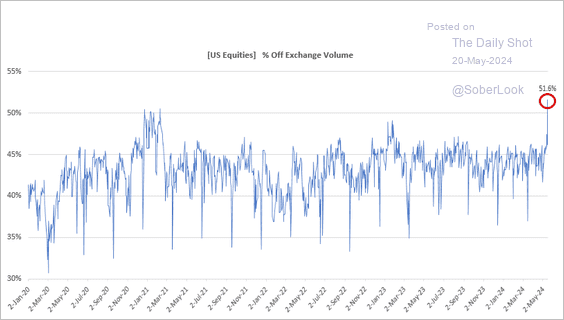

Clearly. Look at $MMTLP 506 days later.. 0 transparency
STILL unbalanced in a private company. Corruption. Corruption. Corruption! @DevinNunes
#NakedShorting #offexchange #U3Halt #Spoofing #transparency
@cvpayne @denniskneale @RepEliCrane @RepDonaldsPress @Jim_Jordan @BernieSanders @realDonaldTrump @DonaldJTrumpJr @unusual_whales @FinancialCmte @FSCDems @joerogan @elonmusk @mcuban @kevinolearytv anyone..
👀🔦😤🆘🚨
$MMTLP $mmat $DJT
System is beyond broken.
HF&MM < retail 🫠💯
They will continue to borrow what they don’t own, and keep creating fake shares because they never get held accountable. No late fees. No jail time. Nothing but hard working investors being punished for following the rules! This is our U.S market for you.. 🙄😤🤬

DEVELOPING🚨 Devin Nunes States That The SEC Is “Really, Really Corrupt” And Claimed That Gary Gensler Targeted Donald Trump
Now we can see why Devin Nunes didn’t write a letter to the SEC, or FINRA regarding the naked shorts in $DJT (Fox Business 2023)
$MMAT 04/24/24 10:17am
68.53% off exchange
@FSCDems @FinancialCmte @RepEliCrane @RepDonaldsPress @Jim_Jordan @RepRalphNorman @denniskneale @joerogan @DevinNunes @elonmusk @realDonaldTrump @cvpayne $MMTLP $DJT 👀🔦🧐🆘🚨⏳
#NakedShorting #Offexchange #pfof #U3 #corruption

@FinancialCmte @FSCDems @RepRalphNorman @RepEliCrane @RepDonaldsPress @Jim_Jordan @BernieSanders @joerogan @realDonaldTrump @kevinolearytv @mcuban @GrantCardone @DonaldJTrumpJr @elonmusk
🆘🚨👀🫠🔦⏳
$MMTLP $MMAT
0 transparency 500+Days
#NakedShorting #Darkpool #Offexchange #Transparency #Corruption $DJT $amc $gme
This is market transparency?
75+ Congressional letter
No share count from a delisted placeholder that was halted 2 days early for “extra ordinary” 0k.
#U3 $trch $mmat $mmtlp
@Metamaterialtec 🦋
@TRCHEnergy
@nbhydrocarbons 🛢️🧐
BREAKING🚨 MMTLP Was Officially Halted 500 Days Ago
Since then, there hasn’t been a resolution to MMTLP shareholders despite the 75+ Congressional Letter, Lawsuits, Petitions, Advocacy, and much more.
Shareholders are NOW asking for a Congressional Hearing & Share Count ☑️ RT
@realDonaldTrump @DonaldJTrumpJr
460+Days U3 Halt $MMTLP
VERY LITTLE market transparency given thus far. #NakedShorting #Offexchange $trch $mmat $mmtlp
I ask that you start looking into this ongoing market manipulation. Prolly will still be going on when you’re back in office.. everyday we see more, and more how retail investors don’t matter. Our financial markets are corrupt, and broken. @FSCDems @FinancialCmte @BernieSanders @RepEliCrane @RepDonaldsPress @elonmusk @joerogan @RepRalphNorman @RepJamesComer
🙏🏻👀🔦🆘🚨🔒😔

Still Waiting 449+Days Later..
$MMTLP $MMAT
Sayers & Doer’s!
#NakedShorting #Offexchange #U3 #Corruption #Private #UNBalanced #3S1s #FairMarket #Transparency
@R@RepRalphNorman @PeteSessions
@BernieSanders @RepEliCrane @RepDonaldsPress @Jim_Jordan
@realDonaldTrump @joerogan @pulte @cvpayne @elonmusk 🙏🏻👀🆘🚨

Still not worth a Subpoena after 400+Days? $MMAT $mmtlp
Take a 👀 at this! 🔒🚨🆘🙄
#NakedShorting #Darkpool #Offexchange #Corruption
0 Transparency.
No sharecount for a delisted ticker why? $mmtlp #U3Halt
@RepJamesComer @RepEliCrane @RepDonaldsPress @RepRalphNorman @FSCDems @FinancialCmte @cvpayne @joerogan @elonmusk @Jim_Jordan @BernieSanders @denniskneale
$MMTLP $MMAT
Million Dollar Question,
Who should retail investors goto for help, when regulators, and Congress don’t care?#offexchange #Nakedshorting #U3 #Days430+
@RepRalphNorman @RepJamesComer @Jim_Jordan @FSCDems @FinancialCmte @RepDonaldsPress @RepDanCrenshaw @elonmusk @joerogan

Michael Shaulov, CEO of Fireblocks, recently spoke to the Australian @FinancialReview about how Fireblocks is working with consumer brands incl @Heineken to revolutionize loyalty & marketing initiatives, the launch of #OffExchange and Non Custodial Wallets, and more.
https://t.co/flNywrT9Hm

Last Seen Hashtags on Sotwe
anxiouspanda() *** ((())) filter:videos
omegle video*
Seen from Pakistan
chapinas de corte
Seen from Guatemala
مشتهية
minichat() +filter:native_video
Seen from France
杭州ts
Seen from Singapore
femboytwitter
Seen from United States
Anxiouspanda
Seen from Greece
rockCR
Seen from United States
keerthysureshhot
Trends for you
Most Popular Users

Elon Musk 
@elonmusk
241.5M followers

Barack Obama
@barackobama
118.8M followers

Cristiano Ronaldo
@cristiano
114.6M followers

Donald J. Trump
@realdonaldtrump
111.8M followers

Narendra Modi
@narendramodi
107.1M followers

Rihanna
@rihanna
98.7M followers

NASA
@nasa
92.3M followers

Justin Bieber
@justinbieber
91.8M followers

KATY PERRY
@katyperry
90.1M followers

Taylor Swift
@taylorswift13
84M followers

Lady Gaga
@ladygaga
75.5M followers

Virat Kohli
@imvkohli
73.5M followers

Kim Kardashian
@kimkardashian
70.9M followers

YouTube
@youtube
68.8M followers

Neymar Jr
@neymarjr
66.5M followers

Bill Gates
@billgates
65.3M followers

Selena Gomez
@selenagomez
63.1M followers

The Ellen Show
@theellenshow
62.2M followers

CNN
@cnn
61.7M followers

X
@x
60.7M followers