Apple wants to buy cheap Chinese memory chips and the everyone thinks it's bad news for Micron but it's not (Save this).
CXMT is China's largest DRAM manufacturer, headquartered in Hefei and it was essentially irrelevant three years ago but today it holds 8% of the global DRAM market, up from just 3% a year ago.
The company makes commodity DRAM, DDR4, DDR5, and LPDDR chips primarily for phones, PCs, and consumer devices.
It is heavily subsidized by the Chinese government, operates at costs well below market rates, and has been placed on the Pentagon's Chinese Military Company blacklist due to alleged ties to the People's Liberation Army.
Apple raised MacBook Pro prices by 15% this week and is now desperate to find cheaper memory.
Tim Cook told the Wall Street Journal that everything needs to be on the table when it comes to memory sourcing, and Apple is lobbying the Trump administration for a license to buy CXMT chips technically possible, but complicated by the Pentagon blacklist.
This spooked some memory investors but it shouldn't have.
Here are the five reasons why this barely moves the needle for Micron.
First, Micron essentially already walked away from this market.
Samsung, SK Hynix, and Micron have all shifted more than 70% of their DRAM capacity toward High Bandwidth Memory (HBM) for AI, the premium product running inside every Nvidia GPU and every major AI data center.
CXMT is filling a hole that Micron chose to vacate because HBM generates 3–5x more revenue per wafer.
Second, CXMT cannot make HBM, its most ambitious stated goal is to begin certifying HBM3 for mass production by end of year, a full generation behind where SK Hynix and Micron already are in HBM3E production today.
The AI memory market, which is the entire bull thesis, is simply not accessible to CXMT at any meaningful scale.
Third, the dollar opportunity is in a completely different product.
The $280–530 billion memory opportunity Micron is selling into over the next two years is almost entirely HBM for data centers, automotive systems, and humanoid robots, none of which CXMT competes in today or realistically can in the near future.
Fourth, Apple is a consumer device customer, not an AI customer.
The memory that goes into a MacBook Air is commodity LPDDR while the memory that goes into an Nvidia GB200 AI cluster is HBM3E.
These products share a name and almost nothing else.
Losing Apple to CXMT on consumer DRAM is the equivalent of a luxury steakhouse losing a lunch sandwich order.
Fifth, the regulatory outcome is far from certain.
The Trump administration has been tightening, not loosening, export controls on Chinese semiconductor companies and even if Apple gets a narrow license, it would likely come with restrictions that limit scale, product type, and duration.
Bears will try to scare you but do not fall for it, long Micron.
Follow me @MelvinInvests for more AI, semis and the next big market themes.
You can't get more bullish on $MU than Elon Musk's comment below. Pretty incredible!
And to put things in context, "higher production" is not coming online until 2027 and beyond...and who knows if that will be enough.
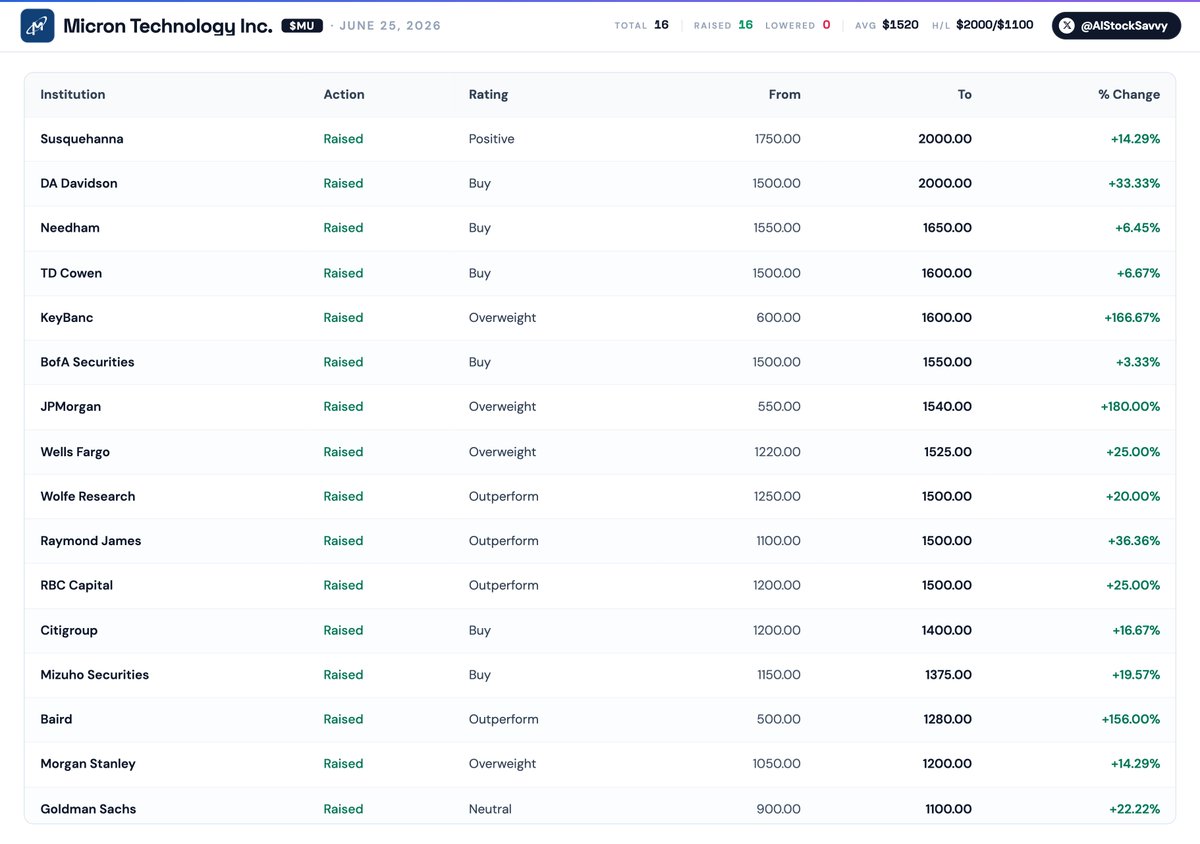
$MU PT raised to $2,000 from $1,175 at Barclays
$MU PT raised to $2,200 from $1,100 at Melius
$MU PT raised to $1,540 from $550 at JPMorgan
$MU PT raised to $1,600 from $600 at KeyBanc
$MU PT raised to $1,525 from $1,220 at Wells Fargo
$MU PT raised to $1,280 from $550 at Baird
$MU PT raised to $1,100 from $900 at Goldman Sachs
$MU PT raised to $1,500 from $1,200 at Rosenblatt
$MU PT raised to $1,600 from $1,500 at TD Cowen