🧵 Day 20/30 — #SystemDesign
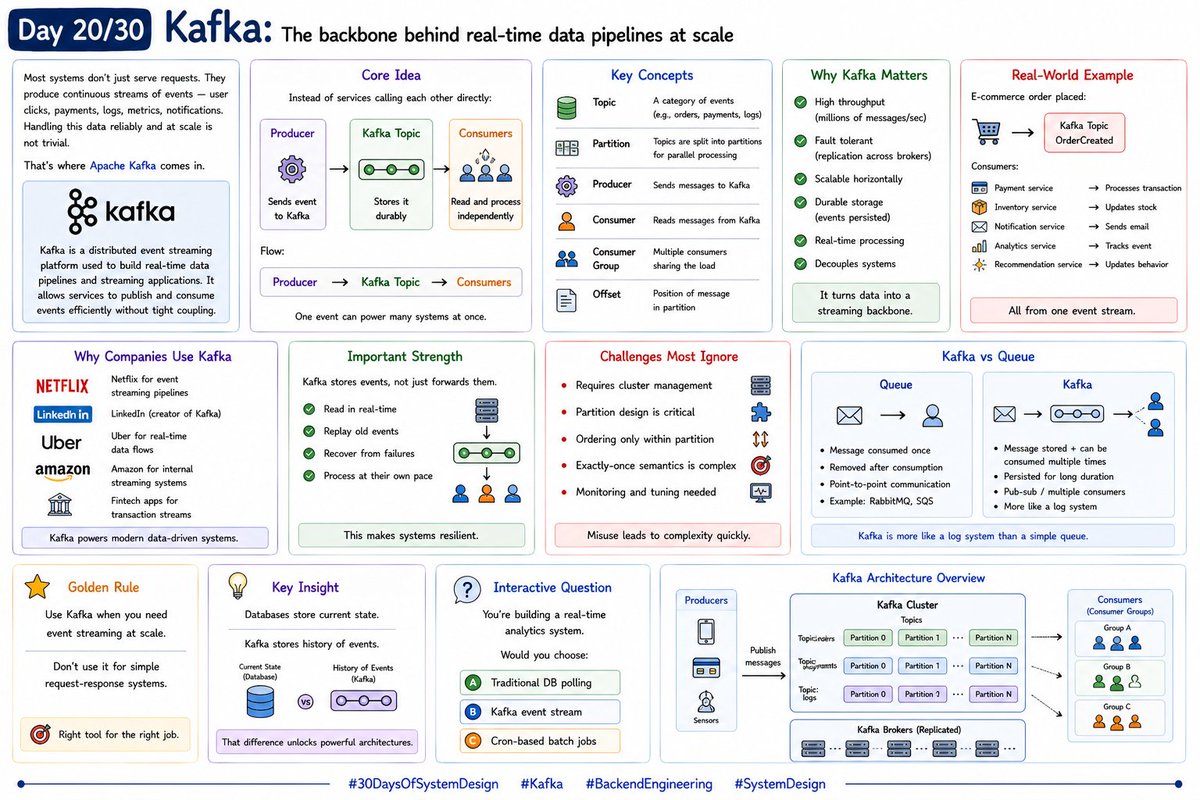
Kafka: The backbone behind real-time data pipelines at scale
Most systems don’t just serve requests. They produce continuous streams of events — user clicks, payments, logs, metrics, notifications. Handling this data reliably and at scale is not trivial.
That’s where Apache Kafka comes in.
Kafka is a distributed event streaming platform used to build real-time data pipelines and streaming applications. It allows services to publish and consume events efficiently without tight coupling.
----------------------
Core Idea !!
Instead of services calling each other directly:
→ Producer sends event to Kafka
→ Kafka stores it durably
→ Multiple consumers read and process independently
Flow:
Producer → Kafka Topic → Consumers
One event can power many systems at once.
---------------------
Key Concepts
1. Topic
A category of events (e.g., orders, payments, logs)
2. Partition
Topics are split into partitions for parallel processing
3. Producer
Sends messages to Kafka
4. Consumer
Reads messages from Kafka
5. Consumer Group
Multiple consumers sharing load
6. Offset
Position of message in partition
These concepts define Kafka’s power.
------------------------
Why Kafka Matters
→ High throughput (millions of messages/sec)
→ Fault tolerant (replication across brokers)
→ Scalable horizontally
→ Durable storage (events persisted)
→ Real-time processing
→ Decouples systems
It turns data into a streaming backbone.
---------------------------
Real-World Example
E-commerce order placed:
→ Event sent to Kafka (OrderCreated)
Consumers:
→ Payment service processes transaction
→ Inventory updates stock
→ Notification sends email
→ Analytics tracks event
→ Recommendation system updates behavior
All from one event stream.
--------------------------------
Why Companies Use Kafka
→ Netflix for event streaming pipelines
→ LinkedIn (creator of Kafka)
→ Uber for real-time data flows
→ Amazon for internal streaming systems
→ Fintech apps for transaction streams
Kafka powers modern data-driven systems.
--------------------------------
Important Strength :
Kafka stores events, not just forwards them.
Consumers can:
→ Read in real-time
→ Replay old events
→ Recover from failures
→ Process at their own pace
This makes systems resilient.
----------------------------
Challenges Most Ignore
Kafka is powerful, but not simple:
→ Requires cluster management
→ Partition design is critical
→ Ordering only within partition
→ Exactly-once semantics is complex
→ Monitoring and tuning needed
Misuse leads to complexity quickly.
---------------
Kafka vs Queue
Queue:
→ Message consumed once
Kafka:
→ Message stored + can be consumed multiple times
Kafka is more like a log system than a simple queue.
Don’t use it for simple request-response systems.
#30DaysOfSystemDesign #Kafka #BackendEngineering
🧵 Day 13/30 — #SystemDesign
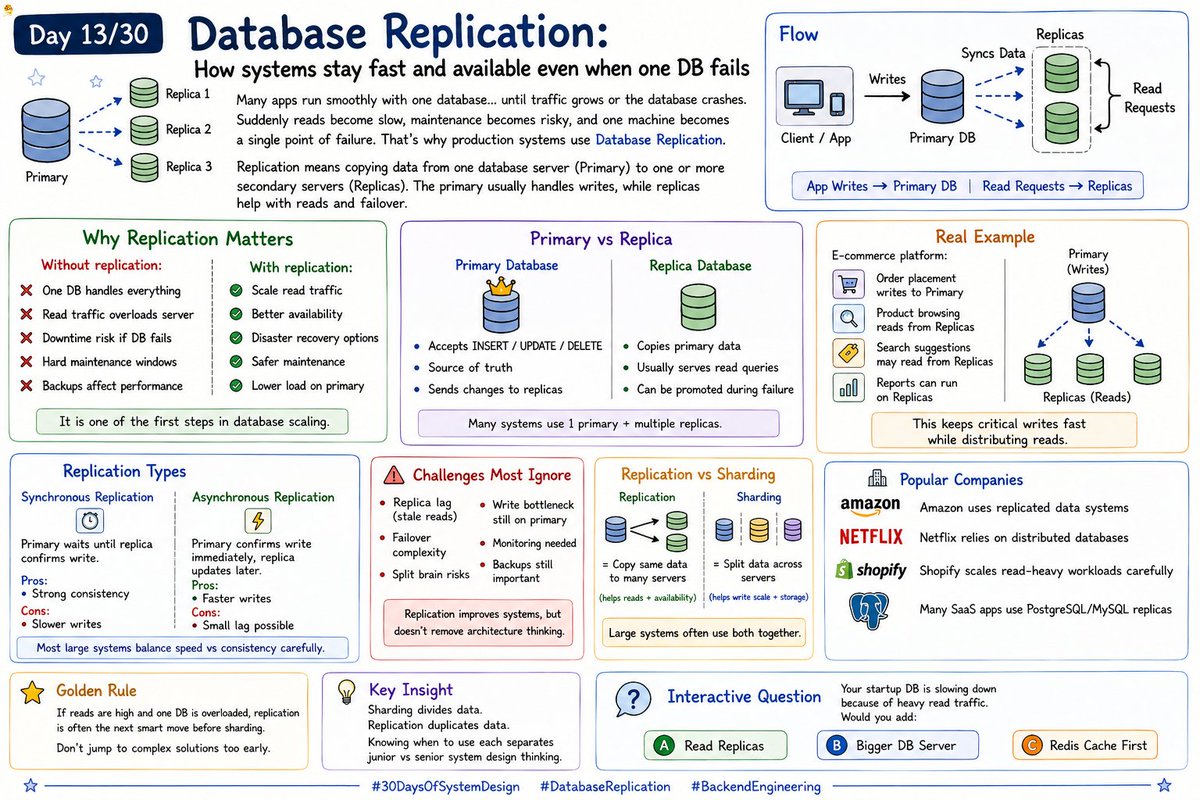
Database Replication: How systems stay fast and available even when one DB fails
Many apps run smoothly with one database… until traffic grows or the database crashes. Suddenly reads become slow, maintenance becomes risky, and one machine becomes a single point of failure.
That’s why production systems use Database Replication.
Replication means copying data from one database server (Primary) to one or more secondary servers (Replicas). The primary usually handles writes, while replicas help with reads and failover.
Flow:
App Writes → Primary DB
Primary Syncs Data → Replicas
Read Requests → Replicas
This improves performance and reliability.
-----------------
Why Replication Matters
Without replication:
→ One DB handles everything
→ Read traffic overloads server
→ Downtime risk if DB fails
→ Hard maintenance windows
→ Backups affect performance
With replication:
→ Scale read traffic
→ Better availability
→ Disaster recovery options
→ Safer maintenance
→ Lower load on primary
It is one of the first steps in database scaling.
-------------------
Primary vs Replica
Primary Database
→ Accepts INSERT / UPDATE / DELETE
→ Source of truth
→ Sends changes to replicas
Replica Database
→ Copies primary data
→ Usually serves read queries
→ Can be promoted during failure
Many systems use 1 primary + multiple replicas.
-------------------
Real Example
E-commerce platform:
→ Order placement writes to Primary
→ Product browsing reads from Replicas
→ Search suggestions may read from Replicas
→ Reports can run on Replicas
This keeps critical writes fast while distributing reads.
-------------------
Replication Types
1. Synchronous Replication
Primary waits until replica confirms write.
Pros:
→ Strong consistency
Cons:
→ Slower writes
2. Asynchronous Replication
Primary confirms write immediately, replica updates later.
Pros:
→ Faster writes
Cons:
→ Small lag possible
Most large systems balance speed vs consistency carefully.
---------------------
Challenges Most Ignore
Replication helps a lot, but adds tradeoffs:
→ Replica lag (stale reads)
→ Failover complexity
→ Split brain risks
→ Write bottleneck still on primary
→ Monitoring needed
→ Backups still important
Replication improves systems, but doesn’t remove architecture thinking.
🧵 Day 5/30 — #SystemDesign
Your system may survive traffic…
but can it survive millions of background tasks?
That’s where Message Queues come in.
They decouple services, smooth traffic spikes, and power async systems at scale.
What is a Message Queue?
A message queue is a buffer between producers and consumers.
Producer = service sending tasks
Consumer = worker processing tasks
Flow:
User Action → API → Queue → Worker → Result
Instead of doing everything instantly, tasks wait safely in queue.
Kubernetes — In Plain English ☸️
Pod → Smallest unit where your app runs
Deployment → Manages replicas & updates
StatefulSet → Stable identity + persistent storage
DaemonSet → One Pod on every node
Service → Stable internal access
Ingress → External HTTP/HTTPS access
ConfigMap → Non-sensitive configuration
Secret → Sensitive data
Node → Machine that runs Pods
Control Plane → Brain of the cluster
RBAC → Controls permissions
Namespace → Logical isolation
Understand the building blocks → Kubernetes becomes simple.
Confused between Dockerfile and Docker Compose?
This is for you.
Although they are complementary, they serve different purposes in your containerized environment.
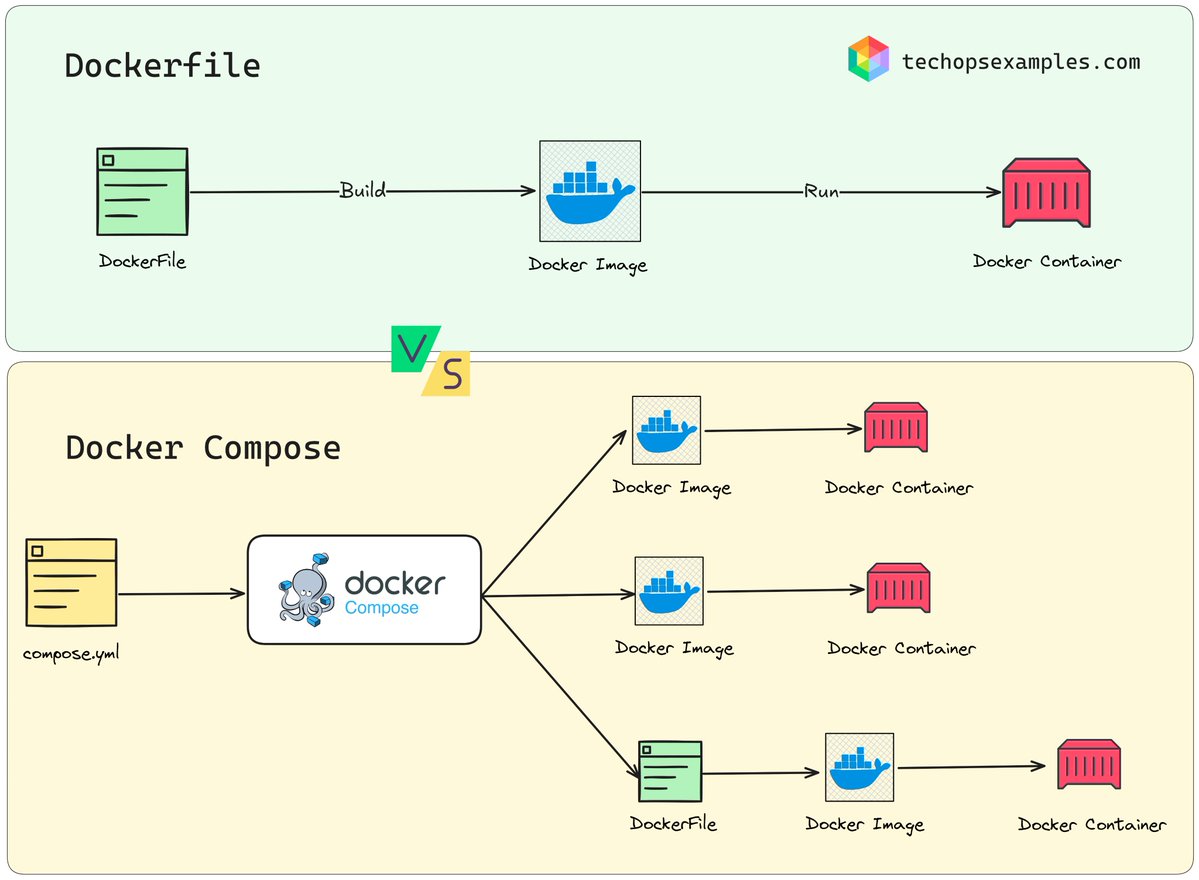
𝗗𝗼𝗰𝗸𝗲𝗿𝗳𝗶𝗹𝗲: Used to create and build Docker images.
𝗗𝗼𝗰𝗸𝗲𝗿 𝗖𝗼𝗺𝗽𝗼𝘀𝗲: Used to run Docker containers as part of a multi-container setup or with specific runtime configurations.
Note: From version 1.28.6, Docker Compose defaults to compose.yaml or compose.yml, with backward compatibility for docker-compose.yaml/yml. If both exist, compose.yaml is preferred.
Here, I've created a simple illustration to help you better understand.
58K+ read my DevOps and Cloud newsletter: https://t.co/wwkI6UOSo4
What do we cover:
DevOps, Cloud, Kubernetes, FinOps, IaC, GitOps, MLOps
🔁 Consider a repost if this is helpful.
Want to get better at Kubernetes?
Here are the free guides to help you actually understand Kubernetes 👇
📌 From architecture to Argo CD
📌 From EKS to Vault
📌 From init containers to Ingress
This list covers it all:
✅ Setup & Cluster Design
✅ Real-world Deployment Practices
✅ Security, Logging, and more
Here are some must-reads:
- Kubernetes Architecture: https://t.co/5vcTukRwol
- High Availability: https://t.co/uknyAnEQ4r
- DaemonSet: https://t.co/gHhnmKUKMs
- Init Containers: https://t.co/gmd94dcFGy
- Pod Lifecycle: https://t.co/issRvZHhK7
- Ingress Basics: https://t.co/l20C5DhEEX
- Kubernetes gateway API: https://t.co/O5zhFunC74
- Istio Guide: https://t.co/SoRJSUOgWs
🧵 𝗛𝗲𝗿𝗲 𝗶𝘀 𝘁𝗵𝗲 𝗳𝘂𝗹𝗹 𝗹𝗶𝘀𝘁 𝗼𝗳 𝗴𝘂𝗶𝗱𝗲𝘀: https://t.co/lJ5FDopddI
✅ Bookmark this
♻️ Repost if it helps others
#DevOps #Kubernetes #LearningResources
Here is why you should lint your Dockerfile 👇
For those who may not be aware,
Linting is the process of checking code for errors, bad practices, or inconsistencies using a linter utility.
By linting Dockerfiles,
You can catch errors early, improve security, and keep everyone on the team consistent.
Especially for beginners, linting can be educational. It can teach best practices and how to avoid common mistakes.
So how to lint Dockerfiles?
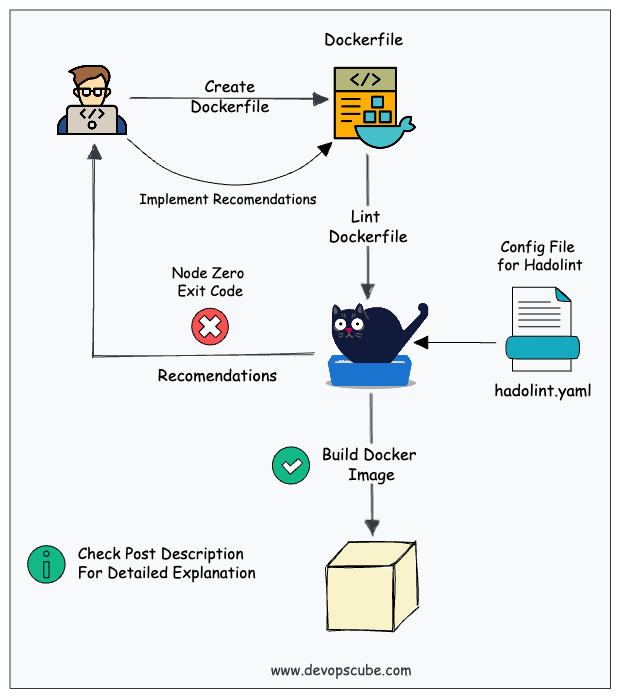
There is a utility called 𝗛𝗮𝗱𝗼𝗹𝗶𝗻𝘁.
It is an open-source command-line Dockerfile linter tool built using Haskell that helps you write error-free Dockersfiles.
Hadolint checks your Dockerfile for possible errors, security vulnerabilities, and performance problems. It will even check the shell scripts that are part of the Dockerfile.
It has over 9k starts on GitHub
Here is how it works,
- Hadolint looks at the Dockerfile.
- It breaks down the Dockerfile into an AST (Abstract Syntax Tree) to understand each command and its details.
- Next, it compares each command to a set of guidelines that focus on security, how well the code is written, and how efficient it is. These guidelines are built into Hadolint.
- Finally, Hadolint points out any issues it finds, giving you feedback on what needs to be fixed.
I've written a comprehensive, hands-on blog about Hadolint, covering most aspects.
𝗗𝗲𝘁𝗮𝗶𝗹𝗲𝗱 𝗕𝗹𝗼𝗴: https://t.co/tH3vDRpNzE
You can also use Hadolint in VScode.
Usually linting would be part of the Docker image build pipeline. I am working on an entire pipeline guide and will soon publish it.
P.S. ♻ Repost if you found this helpful. 🙌
Got any tips? comment below.
#docker #devops #devopsengineer
Today I completed "Deploy to Azure with IaC and GitHub Actions - Azure DevOps | Microsoft Learn"! I'm so proud to be celebrating this achievement and hope this inspires you to start your own @MicrosoftLearn journey! https://t.co/Lb3nudGsug
#AESinfo | #BurkinaFaso 🇧🇫
🔴 Piège à mouches : Un individu arrêté après avoir tenté de corrompre les FDS pour déstabiliser le pouvoir
Les autorités burkinabè ont annoncé avoir déjoué une tentative de déstabilisation du pays. Un individu a été arrêté après avoir proposé une somme d'argent colossale de 5 milliards de francs CFA aux Forces de défense et de sécurité (FDS) en échange de leur soutien pour renverser le pouvoir en place.
Dans une opération d'infiltration minutieusement orchestrée, les FDS ont feint d'accepter la proposition de cet individu, lui permettant ainsi de remettre la somme d'argent. Aussitôt l'argent réceptionné, l'individu a été interpellé par les forces de sécurité.