🚨 @CHAINLINK IS DOING MORE THAN PROVIDING PRICE DATA.
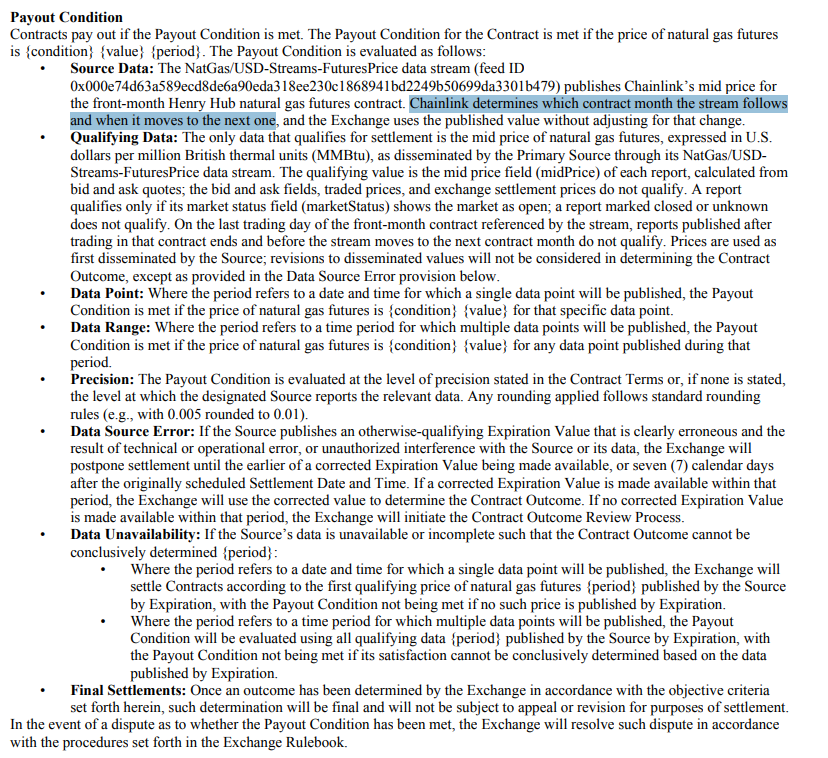
In an official @CFTC filing, @Polymarket US confirms something important about its natural gas futures contracts:
**“Chainlink determines which contract month the stream follows and when it moves to the next one.”**
Read that again. 👀
Natural gas futures have different monthly contracts, each with its own price.
🔹 Chainlink determines which contract month its data stream tracks.
🔹 Chainlink determines when that stream rolls over to the next month.
🔹 Polymarket US uses the published price WITHOUT adjusting for that rollover.
This isn't just delivering a number.
**Chainlink's methodology determines which futures contract supplies the reference price used to settle these financial contracts.**
And that methodology is now explicitly documented in a filing with a US financial regulator.
🔗 The infrastructure behind financial markets is becoming increasingly important.
Source: https://t.co/pnlwK6OFNA
ethereum:0x514910771af9ca656af840dff83e8264ecf986ca — Chainlink
ㅤ
Everyone is watching ethereum:native, solana:So11111111111111111111111111111111111111112, and ripple:native.
ㅤ
But what about the infrastructure connecting blockchains to real-world data and financial systems?
ㅤ
Meet ethereum:0x514910771af9ca656af840dff83e8264ecf986ca — Chainlink.
ㅤ
A decentralized oracle and interoperability network designed to connect smart contracts with external data, assets, and blockchain networks.
ㅤ
The big question?
ㅤ
Can Chainlink become essential infrastructure for the next generation of global finance?
ㅤ
Save this checklist.
ㅤ
01 | WHAT DOES CHAINLINK DO?
ㅤ
Chainlink provides infrastructure that allows blockchains to interact with information and systems outside their own networks.
ㅤ
Its ecosystem includes:
• Decentralized data feeds.
• Cross-chain interoperability.
• Proof of Reserve.
• Smart contract automation.
• Real-world asset infrastructure.
• Institutional blockchain connectivity.
ㅤ
The idea is simple.
ㅤ
Smart contracts need reliable information.
ㅤ
Financial institutions need connected systems.
ㅤ
Chainlink aims to provide both.
ㅤ
02 | CHAINLINK DATA FEEDS
ㅤ
Data Feeds are one of Chainlink's best-known services.
ㅤ
They provide external information to blockchain applications.
ㅤ
Potential uses:
• Cryptocurrency price feeds.
• Lending collateral valuation.
• Derivatives pricing.
• Stablecoin infrastructure.
• DeFi risk management.
ㅤ
Without reliable price data, many DeFi applications would struggle to operate safely.
ㅤ
But oracle systems still require strong security, monitoring, and economic incentives.
ㅤ
03 | CCIP
ㅤ
CCIP stands for Cross-Chain Interoperability Protocol.
ㅤ
It is designed to connect different blockchain networks.
ㅤ
Its capabilities include:
• Cross-chain token transfers.
• Cross-chain messaging.
• Programmable asset movement.
• Multi-chain application infrastructure.
ㅤ
The opportunity is significant.
ㅤ
Instead of keeping liquidity and applications isolated on separate blockchains, CCIP can help connect them.
ㅤ
But interoperability adoption must translate into sustained usage and economic demand.
ㅤ
04 | REAL-WORLD ASSETS
ㅤ
Real-world asset tokenization is one of Chainlink's major growth narratives.
ㅤ
Potential applications:
• Tokenized bonds.
• Tokenized funds.
• Stablecoins.
• Financial settlement.
• Asset verification.
• Institutional data connectivity.
ㅤ
Traditional financial assets require accurate data and reliable operational systems.
ㅤ
Chainlink aims to help bridge those requirements with blockchain infrastructure.
ㅤ
But partnerships and pilot programs should not be confused with large-scale commercial adoption.
ㅤ
05 | PROOF OF RESERVE
ㅤ
Proof of Reserve helps applications verify information about assets backing certain tokens or financial products.
ㅤ
Potential benefits:
• Better collateral transparency.
• Automated reserve checks.
• Risk management.
• More reliable tokenized asset infrastructure.
ㅤ
However, the reliability of reserve verification still depends on the quality and scope of the underlying data.
ㅤ
Technology cannot independently guarantee that every off-chain asset claim is accurate.
ㅤ
06 | THE LINK TOKEN
ㅤ
LINK is the native utility token of the Chainlink ecosystem.
ㅤ
Its roles include:
• Oracle network payments.
• Staking and security incentives.
• Ecosystem economic activity.
• Service-related token demand.
ㅤ
Chainlink staking helps support the security of selected oracle services.
ㅤ
But staking rewards are not equivalent to guaranteed dividends.
ㅤ
Important distinction:
ㅤ
LINK holders do not automatically receive all revenue generated by Chainlink services.
ㅤ
07 | TOKENOMICS
ㅤ
LINK has a maximum supply of 1 billion tokens.
ㅤ
Its original allocation framework included:
• Node operator incentives.
• Ecosystem development.
• Team and company allocations.
• Public token distribution.
ㅤ
Important factors:
• Circulating supply.
• Remaining token distributions.
• LINK staking participation.
• Oracle service demand.
• CCIP-related fees.
• Chainlink Reserve activity.
ㅤ
Chainlink Reserve was introduced to accumulate LINK using revenue from eligible on-chain and off-chain services.
ㅤ
This creates a potential connection between network monetization and token demand.
ㅤ
However, reserve accumulation is not the same as permanent token burning.
ㅤ
08 | THE VALUATION QUESTION
ㅤ
Using the 1 billion LINK maximum supply:
ㅤ
• $5 LINK = $5B.
• $10 LINK = $10B.
• $20 LINK = $20B.
• $50 LINK = $50B.
• $100 LINK = $100B.
ㅤ
These are hypothetical fully diluted valuations, not price targets.
ㅤ
Important metrics:
• Oracle service usage.
• CCIP transaction activity.
• Institutional integrations.
• Chainlink Reserve holdings.
• LINK staking demand.
• Token distributions.
ㅤ
The biggest question is whether Chainlink can convert infrastructure adoption into sustainable economic demand for LINK.
ㅤ
09 | CATALYSTS AND RISKS
ㅤ
Potential catalysts:
• Growth in real-world asset tokenization.
• Increased institutional blockchain adoption.
• Higher CCIP usage.
• Expansion of oracle services.
• More LINK accumulated by Chainlink Reserve.
• Greater staking participation.
ㅤ
Major risks:
• Competition from other oracle networks.
• Slow institutional adoption.
• Limited direct token value capture.
• Token supply distributions.
• Smart contract and oracle security risks.
• High valuation expectations.
ㅤ
Infrastructure creates opportunities.
ㅤ
But sustainable demand determines long-term token value.
ㅤ
10 | MY VIEW
ㅤ
Narrative: 10/10
Technology: 9/10
Utility: 10/10
Adoption: 9/10
Tokenomics: 8/10
Risk: High
Long-Term Outlook: Established Blockchain Infrastructure with Strong Oracle and Interoperability Utility but Important Token Value Capture and Valuation Challenges
ㅤ
I particularly like three things.
ㅤ
First, its established oracle infrastructure.
ㅤ
Second, its cross-chain interoperability technology.
ㅤ
Third, its potential role in institutional tokenization.
ㅤ
But two challenges remain.
ㅤ
Turning infrastructure adoption into LINK demand and maintaining its competitive advantage.
ㅤ
For me, LINK is a bet on blockchains becoming connected to real-world financial systems.
ㅤ
Not simply a bet on another cryptocurrency narrative.
ㅤ
Because smart contracts need reliable data.
ㅤ
Financial institutions need interoperability.
ㅤ
And sustainable token value requires real economic demand.
ㅤ
Save this for your long-term crypto watchlist.
ㅤ
Which blockchain infrastructure token has the biggest upside over the next five years?
ㅤ
ethereum:0x514910771af9ca656af840dff83e8264ecf986ca , $QNT , solana:HZ1JovNiVvGrGNiiYvEozEVgZ58xaU3RKwX8eACQBCt3 , or $ZRO?
ㅤ
Drop your pick below. 👇
ㅤ
Full research & setups on Telegram ↓
https://t.co/VUDDk1N8SJ
⬡ CHAINLINK Q3 MOMENTUM ⬡
• Launched CCIP 2.0
• $15B+ migrates to CCIP
• $140B secured across onchain finance
• TradFi adoption: DTCC, Swift, & more
• Enterprise adoption: Infosys, Robinhood, & more
• Work with policymakers across the U.S., UK, & Hong Kong
I just went through a conversation between the head of digital assets at DTCC and the co-founder of @chainlink. @The_DTCC is the plumbing behind almost every stock trade in the US. Most people have never heard of it, and it sits under nearly everything.
1. Your money has a weekend problem.
Markets close. Risk doesn’t. If a fund in Japan wants to borrow against US Treasury bonds on a Saturday, today it basically has to wait, or park assets in the right place days earlier just in case. Banks have spent millions on systems for this and still fight the same problems: things that don’t match up, different time zones, and a US vault that looks nothing like the European one.
DTCC’s fix is one shared system that runs 24/7, where those assets sit in one pool and can be used whenever someone needs them.
2. They didn’t make a copy. They made a twin.
Plenty of companies have put stocks on a blockchain. The catch is that many of those tokens don’t give you real legal ownership, which is why people argued about whether they were “real.”
DTCC took a different route. The digital version carries the same legal rights, the same investor protection, and even the same ID number as the original stock. Big institutions care about that more than anything. They don’t want exciting. They want certain.
3. The surprising part is what they’re not doing.
Everyone loves the idea of instant settlement, where trade and payment happen at the same moment. DTCC says it’s not that simple. About 98% of trades get cancelled out against each other, so only a tiny slice needs real money to move. Force everything to settle instantly and you’d need a mountain of cash sitting around. So they’re asking clients case by case: when does instant make sense, and when doesn’t it?
I respect that. Most people in this space only sell the dream.
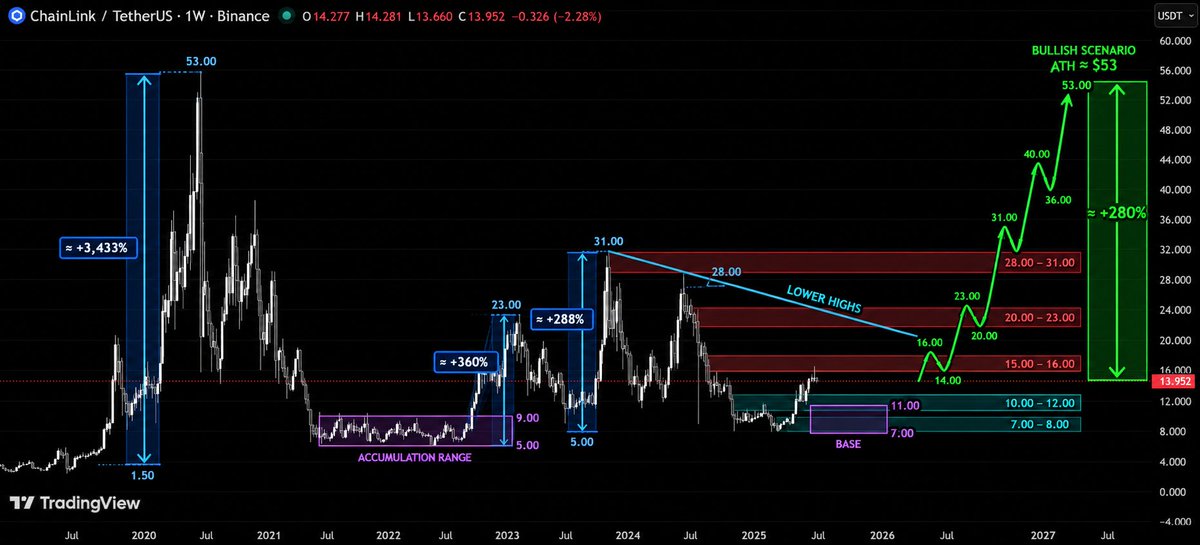
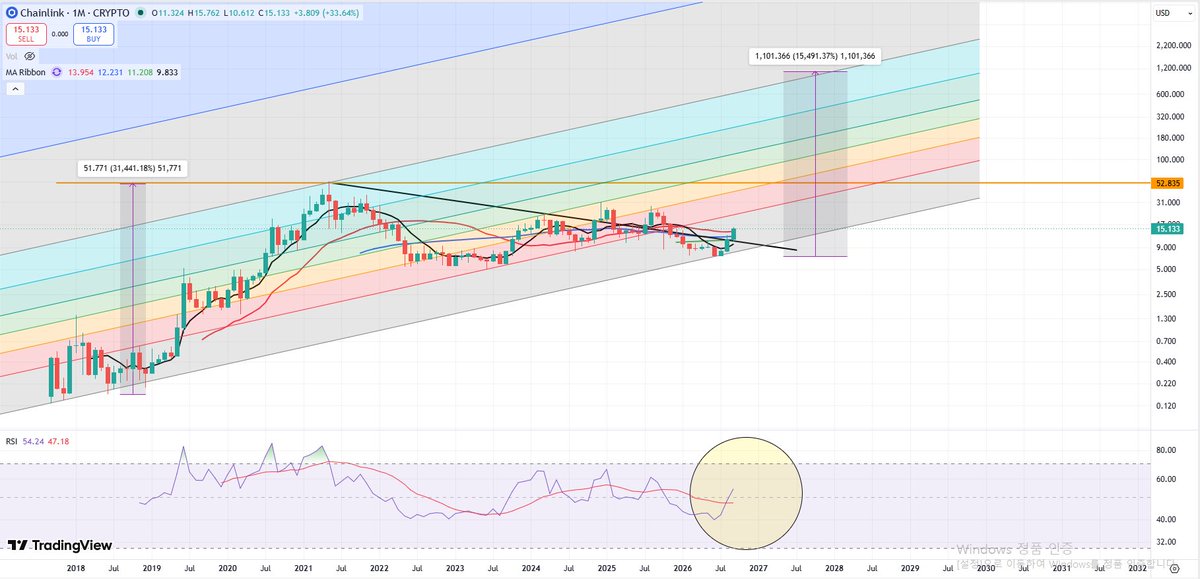
🚀 $LINK: THREE RESISTANCE ZONES STAND BETWEEN HERE AND $53
The weekly chart shows previous bottom-to-top advances of approximately 3,433%, 360% and 288%. The longer accumulation range around $5–$9 preceded a substantial recovery.
$LINK is now around $13.95, rebounding from its recent base. Price has recovered, but the broader sequence of lower highs remains the structure to overcome.
The first test is $15–$16. A weekly close above this zone, followed by a successful retest, would strengthen the recovery and bring $20–$23 into focus.
That next area also meets the descending resistance line. Clearing both would be a more meaningful signal that the broader downtrend is changing.
Above it, $28–$31 is the final major historical resistance zone marked before the bullish scenario extends toward $40 and the previous ATH near $53.
A full return to $53 would represent approximately 280% upside from the price shown.
$10–$12 is the first support to defend. Losing it would weaken the rebound and put the $7–$8 base back in focus.
The green path maps the ATH scenario. Reclaiming resistance as support is what would strengthen it.
$LINK — Chainlink
If RWA and on-chain finance keep growing, $LINK is one of the first coins I’d watch.
Chainlink is the biggest oracle network in crypto.
Simple idea:
Bring real-world data into blockchains so DeFi apps can actually work.
Current numbers:
-> Price: ~$18
-> Market cap: ~$12B
-> Circulating supply: ~680M LINK
-> Max supply: 1B LINK
-> 24h volume: ~$700M
Why I’m watching it:
Oracles.
RWA.
CCIP.
DeFi.
Institutional Finance.
The interesting part?
Chainlink is not just about price feeds anymore.
It’s also building infrastructure for cross-chain transfers and tokenized real-world assets through CCIP.
That puts $LINK right in the middle of some of the biggest crypto narratives.
RWA.
Stablecoins.
Cross-chain.
Institutional adoption.
The main risk is valuation.
$LINK is already a large-cap coin, so it needs real growth to keep outperforming smaller names.
But if RWA and on-chain finance become even bigger, $LINK is one of the most obvious picks in the sector.
I’m keeping this one high on the radar.
Got a coin you want me to break down next?
Drop it in the comments. 👇
Full research & setups on Telegram ↓
https://t.co/VUDDk1N8SJ
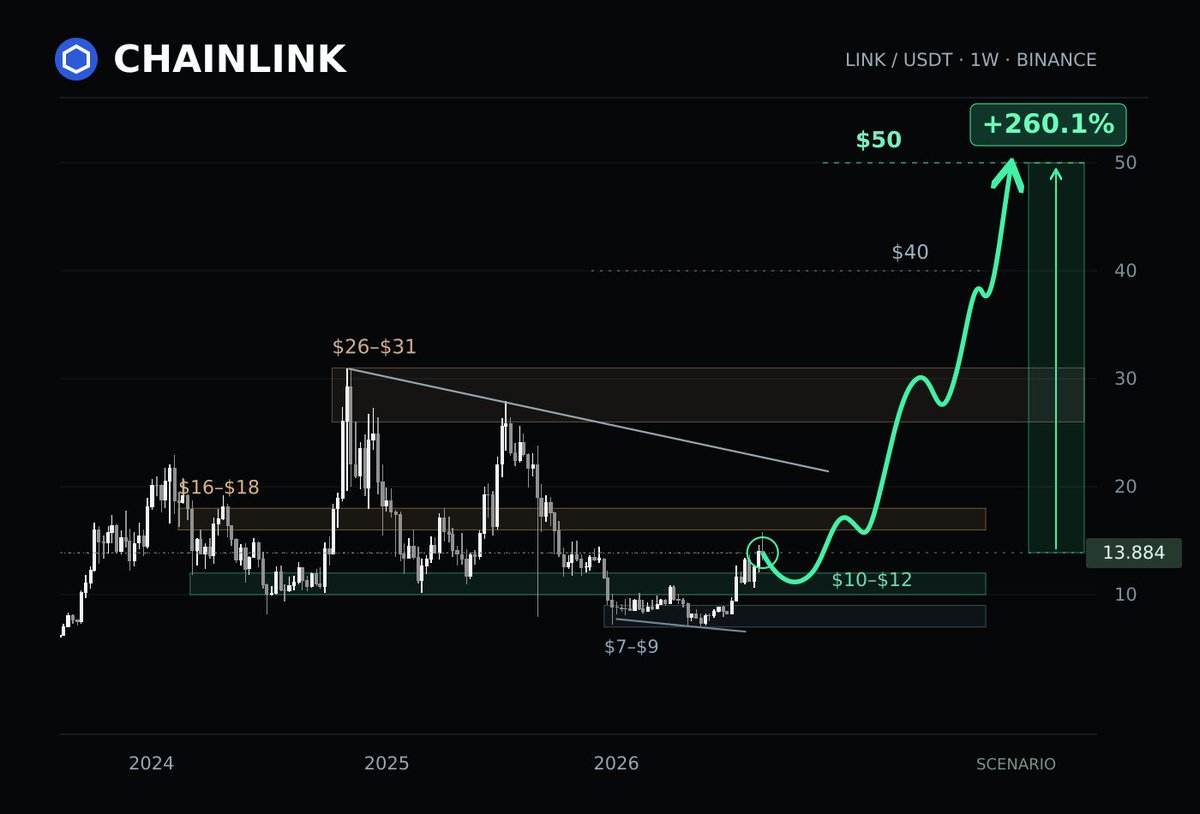
🔗 $LINK: THE $50 COMEBACK STARTS HERE
Chainlink has rebounded from the $7–$9 area. My bullish roadmap targets $50, but the recovery still has several levels to reclaim.
I’m watching $10–$12 for a potential higher low. Defending that zone would keep buyers in control of the recent rebound.
$16–$18 comes first, followed by the descending trendline and the major $26–$31 supply zone.
A weekly breakout above $31, followed by a successful retest, would strengthen the case for $40 and eventually $50.
That final target represents approximately 260.1% upside from the chart’s $13.884 price.
A weekly close below $7 invalidates this setup.
The opportunity I’m watching is a recovery built on higher lows and confirmed breakouts.
Simple addressable market comparison:
$QNT is a bank API. $LINK is the bid for a quadrillion-dollar market
#Quant ’s prize is a corridor of Clearing House rails that already clear $2T a day, tokenized deposits maybe in 2027. Real. Narrow. And that deal still doesn’t clearly need QNT. 15 million tokens on a license doesn’t get you to four figures.
#Chainlink is pricing the stack those deposits have to plug into.
✅CCIP 2.0 is their own words “the rails for the next $600 trillion in onchain finance”
✅ Add global OTC derivatives ~$845 trillion notional
✅ Add listed contracts, repo, and collateral that turns over, and you are staring at a quadrillion in notional.
✅ Fulcrum is the first product aimed at the $13.5T repo slice. CRE is the workflow. Oracles already sit under most of DeFi.
Standard Chartered stopped at $200 per $LINK That’s the polite version
$4T tokenized, fees up 25x. If LINK is the meter on even a sliver of a quadrillion in contracts, $500 per LINK is the base case and $1,000+ is INEVITABLE.
One billion supply. Every transfer, price, compliance check, and collateral move is a fee
Scarcity on a vendor contract is not a market.
$LINK is a tax on the entire financial system.
The biggest disconnect with investing in Chainlink is seeing all of these mammoth integrations with Swift, DTCC, etc., and thinking "ok that's great, but how is the LINK token involved?"
Well now that's settled:
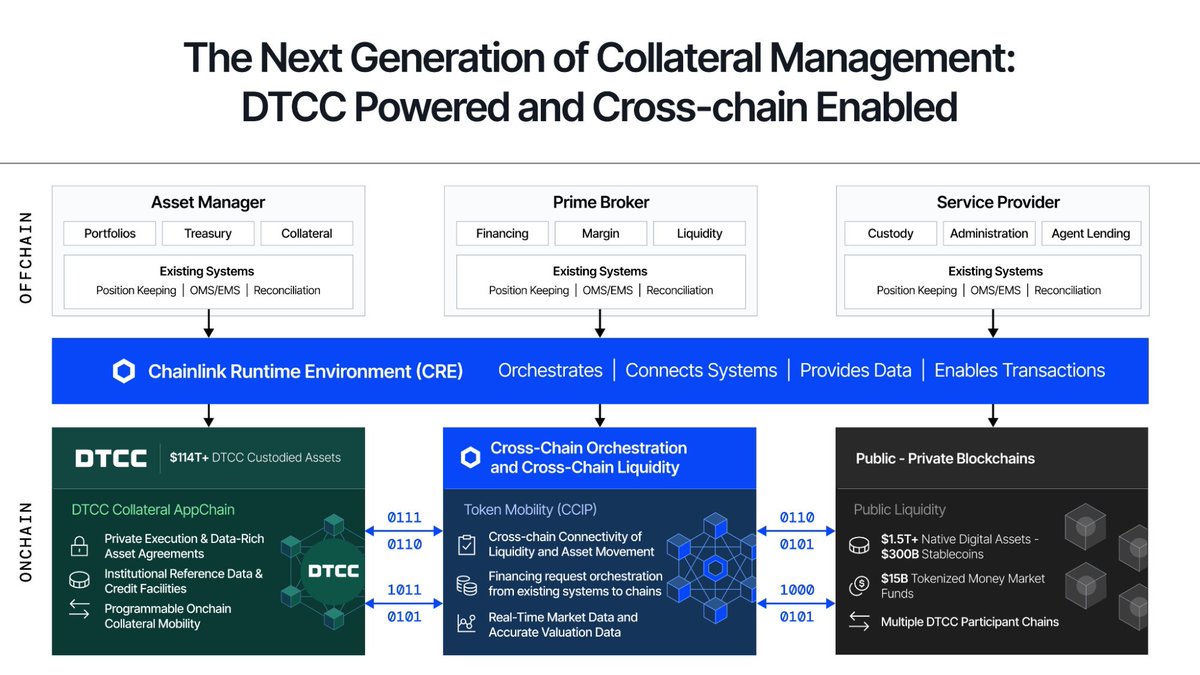
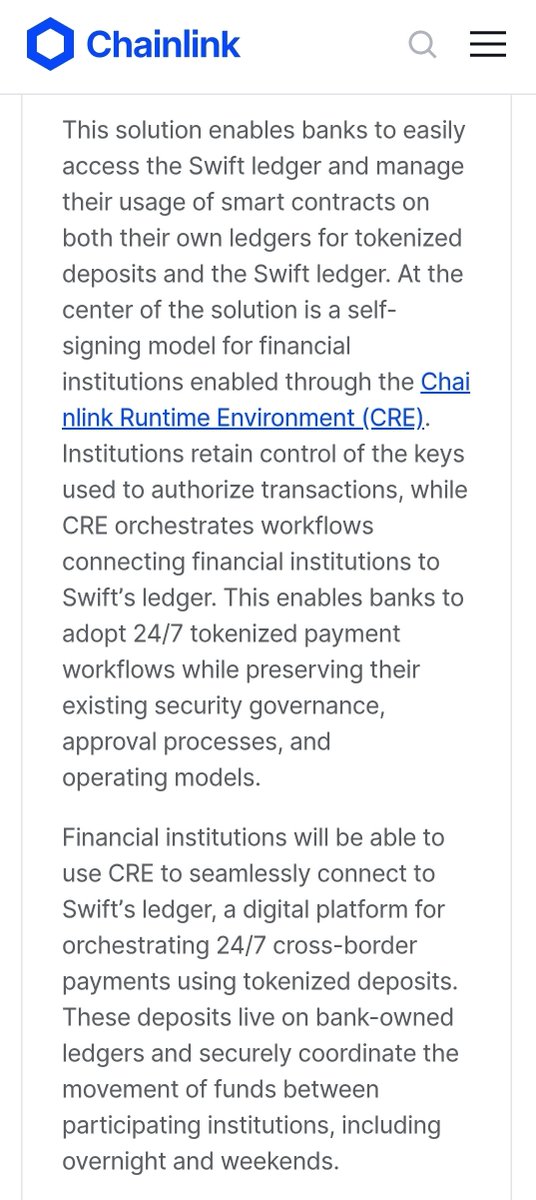
Chainlink’s overall platform is the Chainlink Runtime Environment (CRE). These institutions are integrating CRE.
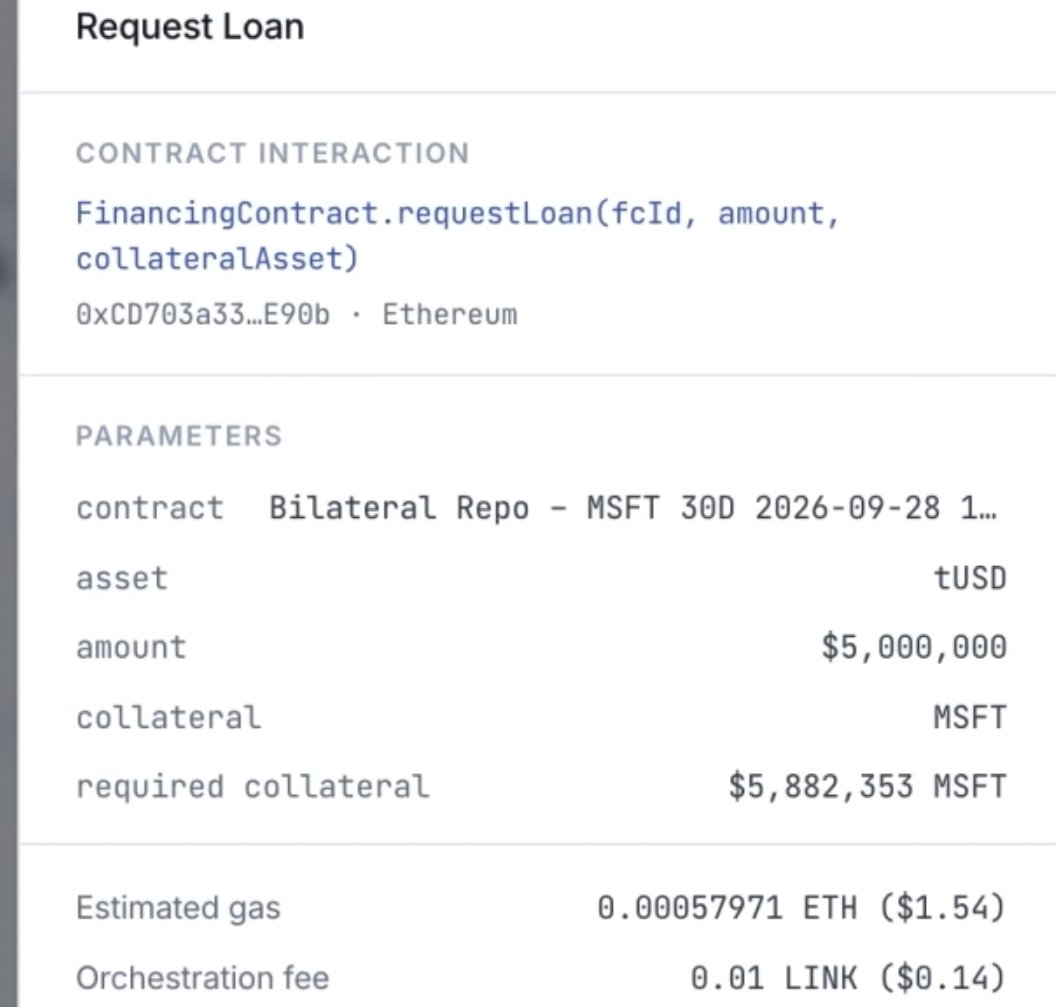
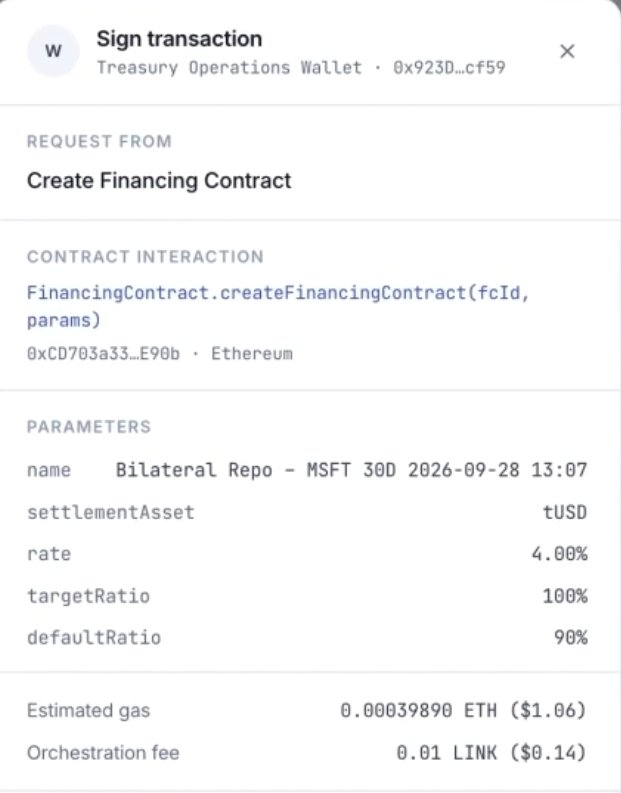
All transactions orchestrated through CRE have an "orchestration fee".
In addition to that, Chainlink services within CRE also require a fee (requirements for data, interoperability, compliance, privacy, etc.). The more complex a transaction, the more of the Chainlink platform is required, and the higher the fees.
The attached images are the evidence of this. They show example orchestration fees required when using Chainlink CRE.
Now imagine how this scales:
Swift is connecting thousands of banks to blockchains through CRE.
DTCC is connecting multiple private bank chains and public chains to their Collateral Appchain through CRE.
Bottomline is connecting 600+ banks to blockchains through CRE.
Swift alone sent 60 million messages per day in 2025. 15 billion messages in total 2025. Chainlink is what makes it possible to turn ISO 20022 messages into blockchain transactions.
AI Agents will also consume LINK through CRE with Chainlink's new product Chainlink for Agents, which lets AI agents act through CRE.
$LINK
My biggest takeaway regarding researching #Chainlink#LINK-
I would not say:
"#LINK is the best altcoin."
That's too simplistic.
I'd say something much more precise:
Among major altcoins, #Chainlink currently has one of the clearest documented positions as neutral infrastructure connecting traditional financial institutions, tokenized assets, blockchains and onchain financial applications.
And that's a very different investment thesis from:
"#LINK is going up because crypto adoption is increasing."
The stronger thesis is:
If a substantial portion of global financial assets eventually move onchain, #Chainlink could become one of the infrastructure layers connecting those assets and financial institutions regardless of which blockchain ultimately wins.
That's why I think LINK is fundamentally different from most of the altcoins currently trading today.