Based on everything explored in the source code, here's the full technical recipe behind Claude Code's memory architecture:
[shared by claude code]
Claude Code’s memory system is actually insanely well-designed. It isn't like “store everything” but constrained, structured and self-healing memory.
The architecture is doing a few very non-obvious things:
> Memory = index, not storage
+ MEMORY.md is always loaded, but it’s just pointers (~150 chars/line)
+ actual knowledge lives outside, fetched only when needed
> 3-layer design (bandwidth aware)
+ index (always)
+ topic files (on-demand)
+ transcripts (never read, only grep’d)
> Strict write discipline
+ write to file → then update index
+ never dump content into the index
+ prevents entropy / context pollution
> Background “memory rewriting” (autoDream)
+ merges, dedupes, removes contradictions
+ converts vague → absolute
+ aggressively prunes
+ memory is continuously edited, not appended
> Staleness is first-class
+ if memory ≠ reality → memory is wrong
+ code-derived facts are never stored
+ index is forcibly truncated
> Isolation matters
+ consolidation runs in a forked subagent
+ limited tools → prevents corruption of main context
> Retrieval is skeptical, not blind
+ memory is a hint, not truth
+ model must verify before using
> What they don’t store is the real insight
+ no debugging logs, no code structure, no PR history
+ if it’s derivable, don’t persist it
The stark difference between 2016 and 2024 is that in 2016 the rate overrode the fair value. Here it didn’t. This whole thing is managed by sentiment not fundamentals and it’s going to blow up in our faces sooner than we might think.
Bittensor has been a rabbit hole that keeps drawing me deeper. Over the past few months, I’ve spent quite a bit of time researching and engaging in conversations with subnet miners, validators, and owners.
Given its complexity, Bittensor is often misunderstood. So here’s my attempt at summarizing what Bittensor is.
--
Bittensor continuously rewards new, better machine learning (ML) models across a variety of targeted use cases.
While several decentralized projects at the crypto-AI intersection focus on decentralizing specific machine learning stack components, such as training, inference, or data collection, Bittensor takes a different path. Bittensor boldly competes with full-stack AI giants like OpenAI, Google, and Anthropic, who engage in the entire AI lifecycle — from conceiving new algorithms and collecting data to training models and hosting them for inference.
Ultimately, Bittensor’s overarching vision is to create an ecosystem capable of generating the necessary resources required for the production of machine intelligence. To realize this, Bittensor has built a framework that simplifies the creation of digital commodity markets, known as subnets. These markets can be tailored to incentivize individuals to contribute their expertise, intellectual property (e.g., models), and digital resources, including compute, storage, and bandwidth, for a diverse range of AI and non-AI applications.
To grasp the concept of digital commodity markets, think of Bitcoin. Bitcoin operates as a commodity market for compute, where miners are incentivized to contribute compute power for SHA-256 hash calculations and are rewarded in proportion to their computational contributions.
Instead of commoditizing SHA-256 hash production, Bittensor commoditizes AI model creation and discovery. Within Bittensor, each subnet develops its own incentive mechanism tailored to a specific use case. These use cases include text and image generation, web scraping, data storage, and pre-trained model production. This approach enables Bittensor to effectively mine AI discovery and execution resources across many subdomains.
With subnets, Bittensor can address the long tail of AI models, catering to niche industries, specialized AI applications, and unique problem-solving scenarios often overlooked by mainstream AI solutions.
Architecturally, Bittensor evolves into a network comprising various self-contained economic markets, seamlessly united under a single token (TAO) ecosystem, all geared towards the goal of advancing machine intelligence.
Within this ecosystem, tokenholders shape the network's trajectory by determining the allocation of capital to each subnet. Their decisions regarding the proportion of network emissions directed to each subnet actively guides the direction of AI development within Bittensor.
(shouout to @saypien for helping articulate this)
Read the full @MessariCrypto report here: https://t.co/e60fvJnnSK
We have to be precise here, otherwise this conversation gets muddy
Speculative activity on Ethereum _IS_ sustainable. The puck just moves from one casino coin to the next. It's no different than the speculation which has existed in Silicon Valley for decades (albeit on steroids). Casinos aren't going anywhere and startups/financial investment is often times simply at a different place on the same spectrum
Bitcoin can certainly survive without tail emissions, the question is whether or not the security budget is large enough to meet the needs of the participants
Both PoW and PoS have different security assumptions, and the lack of tail emissions is assumed to make the asset more valuable, which means that the same amount of BTC in fees actually delivers more USD value to miners
Before Ordinals, honestly, I'd probably agree with you
But considering how the demand for block space on Bitcoin has changed dramatically in the past 12 months, to a historic level not seen in the past 10 years
A wise person would wait and see how this plays out, because among all the narratives of the last cycle, this one is at the top of the list for reevaluation
Feeling feisty today - here are 2 unpopular opinions:
- The 21m BTC cap will be removed and/or Bitcoin will become a PoS network
- The Bitcoin chain will be sunset and BTC the asset will survive as an ERC20 on Ethereum
These things may happen within the next 10-20 years
MUST WATCH
Full fireside chat with Congressman @RepRitchie (D) and @fredwilson at #Mainnet2023.
A refreshing, nuanced conversation on crypto's potential and the importance of passing commonsense regulation with bipartisan support.
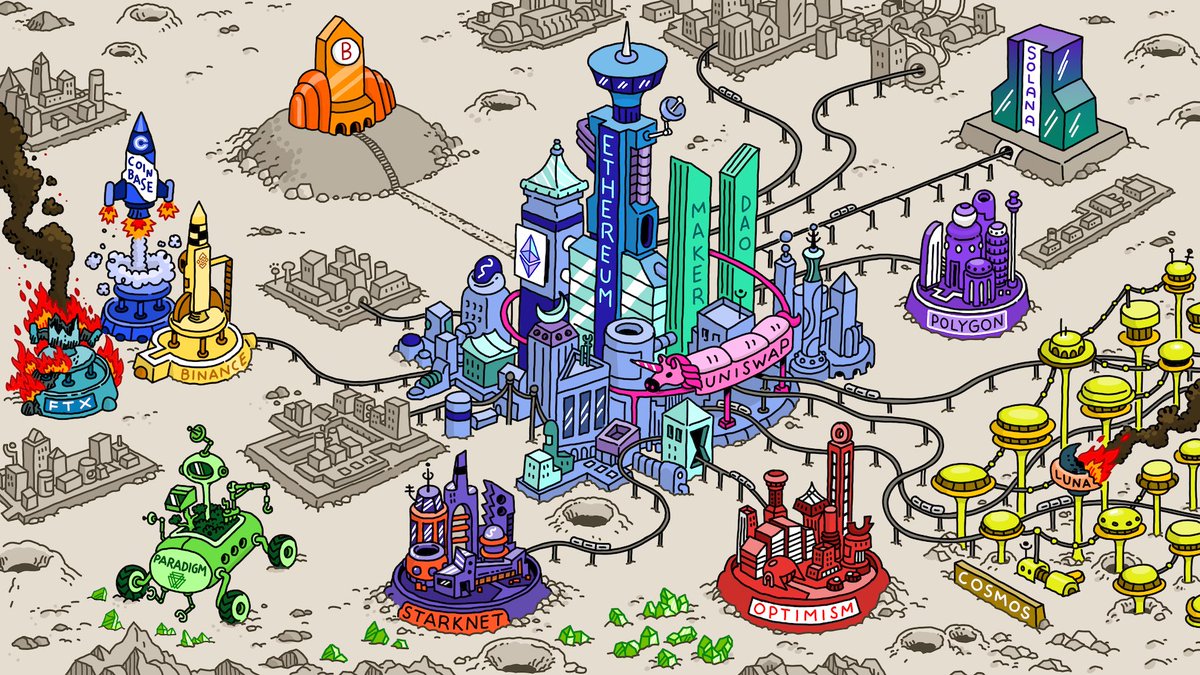
*The Casino on Mars*
It’s useful to think of crypto as a new planet that’s being settled.
Skeptics see a desolate planet without purpose. Or worse, a haven for an unsavory casino.
Optimists see the planet’s potential: a blank slate on which we can build an upgraded financial system and internet platform.
Early settlers are a mixed bunch. Explorers drawn to the frontier. Speculators, some rough and disreputable. Innovators and researchers, attracted to what’s newly possible. Ordinary people, especially those marginalized on Earth.
Governance remains ambiguous. Some Earthly jurisdictions prohibit their citizens from visiting. Others seek a foothold in the new world.
A history of speculation and hype cycles has cast a social taboo over the new planet, leaving many to wonder: what is its future?
Today’s casino-like speculation is part of a bootstrapping process. Much like the gold rush of 1849 transformed San Francisco from a quaint village into a major port (and ultimately the heart of tech innovation), today’s speculative frenzy in crypto is attracting the settlers and catalyzing the infrastructure necessary to turn a barren planet into a thriving crypto civilization.
7 Ways to Future Proof Your Developer Job in the Age of AI https://t.co/uGEzYyeVdo < I don't believe anyone can "future proof" themselves, but those with a growth mindset are going to be in much better shape in the years ahead!
How did @VMware's Enyinna Ochulor get started in the world of container runtimes while comparing K8s to K3s clusters?
🔎 Read more about his exploration and findings: https://t.co/6CQtXh2I0Q
we came to public blockchains because they are for the most part incorruptible
start layering in "on-chain" mechanisms & personalities which can be easily corrupted and you are just asking for trouble,
and you'll eventually violate the value proposition of the entire space
5/ Here's what I think happened:
- Alameda blew up in Q2 along with 3AC+ others.
- It ONLY survived because it was able to secure funding from FTX using as "collateral" the 172M FTT that was guaranteed to vest 4 months later.
Once vested, all tokens were sent back as repayment.
@Saudi_Airlines Saudia doesn't deserve their customer loyalty or their reputation, 8 phone calls and 5 support request during the week to change my booking date as website gives an errors without any support.
#Saudiairline_failure#Saudiairline_experience
Defaulting to a Jog
There are four speeds in life:
• Rest
• Walk
• Jog
• Sprint
Most people default to a jog—a staple of 9-5 work culture.
But you'll go much faster and further by defaulting to either rest/walk or sprint.
Rest, walk, sprint, repeat. There is no jog.
Falling Into Productivity Traps
Hustle culture lied to you.
Obsessively optimizing your time with new "productive" activities is actually counter-productive.
Free time is a call option on future interesting opportunities.
It provides the headspace to pursue high upside ideas.
What is the most efficient way to DYOR microcaps on Ethereum's L2 StarkNet?
Here is a mega-thread to avoid getting rugged and scammed.
Including analysis of github, whitepaper, socials, etherscan and smart contracts.
mega-thread🧵





![himanshustwts's tweet photo. Based on everything explored in the source code, here's the full technical recipe behind Claude Code's memory architecture:
[shared by claude code]
Claude Code’s memory system is actually insanely well-designed. It isn't like “store everything” but constrained, structured and self-healing memory.
The architecture is doing a few very non-obvious things:
> Memory = index, not storage
+ MEMORY.md is always loaded, but it’s just pointers (~150 chars/line)
+ actual knowledge lives outside, fetched only when needed
> 3-layer design (bandwidth aware)
+ index (always)
+ topic files (on-demand)
+ transcripts (never read, only grep’d)
> Strict write discipline
+ write to file → then update index
+ never dump content into the index
+ prevents entropy / context pollution
> Background “memory rewriting” (autoDream)
+ merges, dedupes, removes contradictions
+ converts vague → absolute
+ aggressively prunes
+ memory is continuously edited, not appended
> Staleness is first-class
+ if memory ≠ reality → memory is wrong
+ code-derived facts are never stored
+ index is forcibly truncated
> Isolation matters
+ consolidation runs in a forked subagent
+ limited tools → prevents corruption of main context
> Retrieval is skeptical, not blind
+ memory is a hint, not truth
+ model must verify before using
> What they don’t store is the real insight
+ no debugging logs, no code structure, no PR history
+ if it’s derivable, don’t persist it](https://pbs.twimg.com/media/HEu2icGbEAAvoFI.jpg)