In this stunning @ScienceMagazine video @zuckermanbrain Andrés Bendesky and team describe how they’ve combined genetics and neuroscience to understand what puts the fight in these fish, and possibly in humans, too.
Learn more about the neuroscience of aggression:
https://t.co/44tZmkT2D8
Excited to share our latest research on the hippocampal CA2 region's role in social aggression! 🧠🐭
In this pre-print, we provide a unified view of the two major roles previously ascribed to CA2: social memory and the promotion of aggression. Our findings reveal a neural mechanism for the long-standing observation in the literature that social novelty can enhance aggression.
📄: https://t.co/lauK0dvprd
Scientists @stefanofusi2 and Steven Siegelbaum have found a brain area in mice that may reveal how we can quickly discern a stranger from someone familiar. These new findings in @NeuroCellPress may shed light on disorders affecting #memory.
https://t.co/4MUY9RsTB5
Abstract disentangled low D representations are great for generalization but are not efficient for memory storage. The hippocampus seems to increase dimensionality to fix this problem. Published in Neuron, with a wonderful team @LaraBintheBrain, @LorenzoPosani, S. Siegelbaum
CA2 is critical for social but not nonsocial memory. We wondered what neural code could support such features and what the underlying sensory signals might be. Now published @NeuroCellPress. Thanks to everyone involved bringing this story to life!
https://t.co/4w9ErsfEIN
Hey #ScienceTwitter! Open to URM undergraduates/ recent graduates considering a Ph.D in Neuroscience: CAN is here to help you learn about life as a graduate student and how to get there!
Come join a fully funded 2-day event at Columbia University!
Applications due: February 25
Happy to share that our work on lateral entorhinal cortex’s role on CA2-dependent social recognition memory is now published @NeuroCellPress https://t.co/p8gy88gX4r
Thank you to all collaborators @desobrains@FelixFelxfel and members of the lab!
#keepCA2weird#dont4getCA2
It’s that time! Application is open for Columbia Access Neuroscience (CAN) ! This is an informative two-day event for students from underrepresented backgrounds who are interested in pursuing a Ph.D. in neuroscience! 🧠 Apps due Feb. 25th!
Please RT and share!
Are you passionate about retention & mentorship of underrepresented students in STEM grad school programs? 💜🚀✨
We need 3rd yr grad students (or above) to be mentors in our Grad Student Engagement & Community (GSEC) program!
More info & sign up here! https://t.co/48segv4AHE
🚨Please share and RT! Applications for Columbia Access Neuroscience (CAN) is OPEN! This event is for underrepresented students interested in learning about applying to neuroscience PhD programs. Applications due March 15th! 🚨
https://t.co/c4frELylO4
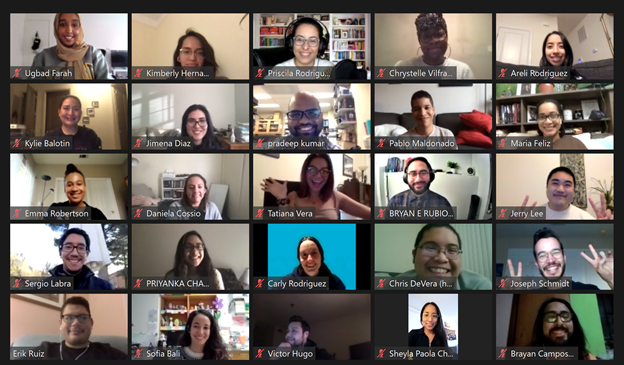
Just met the most amazing group of scientists (virtually) -- proud to be part of the inaugural @cientificolatin Graduate Student Engagement and Community (GSEC) program! Already inspired by my peers :')
@latinodeciencia Neuro at Columbia accepts undoc students not under DACA! Not 100% sure about the funding tho, dm if you’d like more info on who to ask