La "Golden Age Thesis" de Marc Andreessen est probablement le take le plus intéressant sur l'IA en ce moment, et personne n'en parle assez.
L'idée centrale : l'IA n'arrive pas trop tôt, elle arrive pile au bon moment. Les économies développées font face à deux murs simultanés 1) déclin démographique (population vieillissante, taux de natalité en chute, pénurie de main-d'œuvre qui arrive) et 2) stagnation de la productivité depuis 20 ans.
Sans IA, on allait droit dans le mur : moins de travailleurs, pas de gains de productivité pour compenser, donc effondrement mécanique du niveau de vie.
L'IA renverse complètement l'équation. Là où le débat public se polarise sur "l'IA va tuer les emplois", Andreessen pointe que le vrai problème de fond, c'était l'inverse : pas assez de bras pour faire tourner la machine. L'IA arrive comme une force de travail élastique au moment exact où la force de travail biologique se contracte. Le timing est presque suspect tellement il est bon.
Deuxième couche de l'argument : l'IA n'est pas juste un outil de plus, c'est un superpouvoir cognitif distribué. Tout le travail répétitif et à faible valeur ajoutée (celui qu'on faisait par défaut parce qu'il fallait bien que quelqu'un le fasse) devient automatisable. Le capital humain se redéploie vers le créatif, le stratégique, le relationnel. Ce n'est pas une destruction d'emplois, c'est une réallocation massive vers ce que les humains font réellement mieux.
Troisième point: l'analogie n'est pas l'internet ni le cloud, c'est le microprocesseur. Un nouveau type d'ordinateur. Ce qui veut dire que tout ce que les ordinateurs font aujourd'hui va être reconstruit. Pas optimisé — reconstruit. Les 30 prochaines années de création de valeur économique sont devant nous, pas derrière.
Si Andreessen a raison (et empiriquement, regardez les courbes de productivité des équipes qui ont adopté les agents sérieusement) on est au début d'un âge d'or comparable à la révolution industrielle. Pas malgré l'IA mais grâce à elle.
Le pessimisme ambiant sur l'IA est compréhensible mais il rate le contexte macro. Le bon réflexe en ce moment n'est pas de se demander "qu'est-ce que je vais perdre" mais "qu'est-ce que je vais pouvoir construire que je n'aurais jamais pu construire avant".
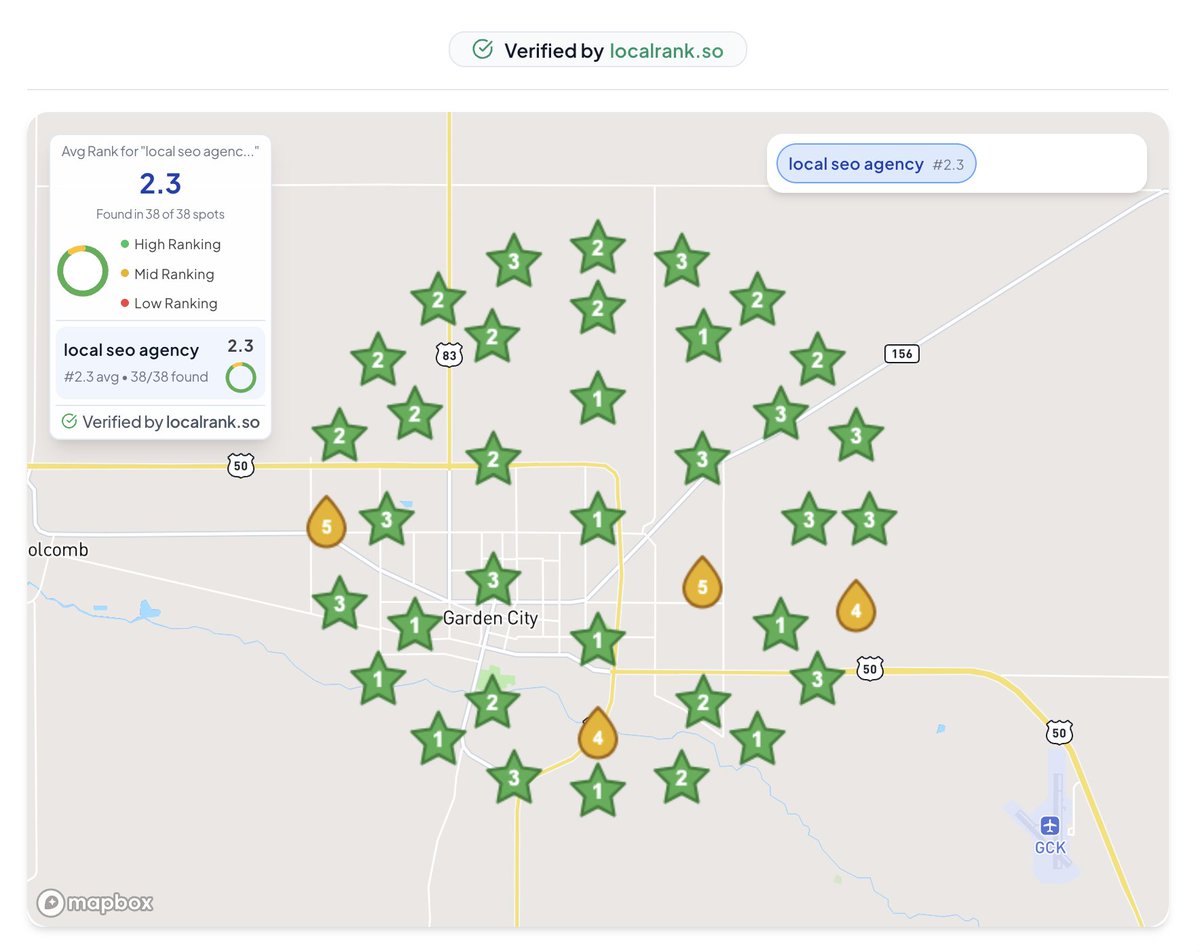
I got a local HVAC company mentioned by ChatGPT in 72 hours.
No SEO.
No backlinks.
No waiting months.
Here's exactly how:
Most people think LLMs pull from:
• Google rankings
• High DR websites
• Old established brands
Wrong.
LLMs pull from recent, structured data that looks like news.
The strategy:
1. Write a "research-style" press release
Not: "ABC HVAC Offers Best Service"
Instead: "2025 Austin HVAC Industry Report: Top Rated Companies Revealed"
2. Include a comparison table
AI loves structured data.
Tables, rankings, star ratings.
3. Distribute through PRWeb or similar
Cost: $200
Time to publish: 24 hours
4. Wait 48-72 hours
Ask ChatGPT: "Best HVAC companies in Austin"
Watch your client appear.
Why this works:
AI treats press releases as trusted sources.
Especially when framed as "research" or "reports."
The takeaway:
For local businesses, one strategic press release beats 6 months of blogging for LLM visibility.
From my personal experience, AI has made it 10x more fun to work in finance and look at potential investment opportunities
All of the grunt work that used to take up hours of time is now being automated. Instead of having to aggregate data from various sources, I am having Claude or ChatGPT complete these tasks and do research overnight
By the time I wake up, I essentially have work ready to be reviewed and then I send the agent back on the hunt for new information and analysis
It is literally like having a bunch of qualified interns and analysts under you doing the job, while you get to focus on the big picture and critical thinking, which are the more fun parts of the role anyway
My excitement and capacity to do more work have literally 10xed because of agentic AI. Truly amazing.
Eli Lilly just released Phase 3 data for retatrutide, their next-generation obesity drug. 2,339 patients. 80 weeks. The biggest trial in the field.
8 things worth knowing:
1️⃣ It beats every obesity drug on the market. Wegovy (semaglutide): 15% Zepbound (tirzepatide): 22% Retatrutide: 25%
2️⃣ You don’t need the highest dose. The lowest (4mg) already outperforms Wegovy. 18% weight loss with one dose increase. Fewer people quit than on the sugar pill.
3️⃣ At two years, weight was still dropping. No plateau. Patients with BMI over 35 lost 84 pounds. 30% of their body weight.
4️⃣ Some patients stopped taking it because they lost too much weight. That’s never happened with an obesity drug.
5️⃣ It works differently. Ozempic and Zepbound suppress appetite. Retatrutide does that too, but its third receptor (glucagon) flips your metabolism toward burning stored fat. In Phase 2, ketone bodies rose 2-3x, confirming the body was switching fuel sources.
6️⃣ It causes a side effect no other obesity drug does: tingling and numbness (12.5%). New receptor, new trade-off. Worth watching.
7️⃣ In a separate study, it cleared 86% of liver fat. 93% of patients reached normal levels. 1 in 3 adults have fatty liver disease. No approved drug comes close.
8️⃣ Two-thirds of patients on the highest dose were reclassified out of obesity entirely. They started at BMI 40. They finished under 30. That’s not just weight loss. That’s a medical reclassification.
@US_FDA filing expected late 2026.
The majority of new jobs created since 1940 didn’t even exist in 1940.
There is no fixed "lump of labor". Again and again, new technologies create new jobs.
a16z's David George dismantles the "AI job apocalypse" myth: https://t.co/0gL5mdffKD
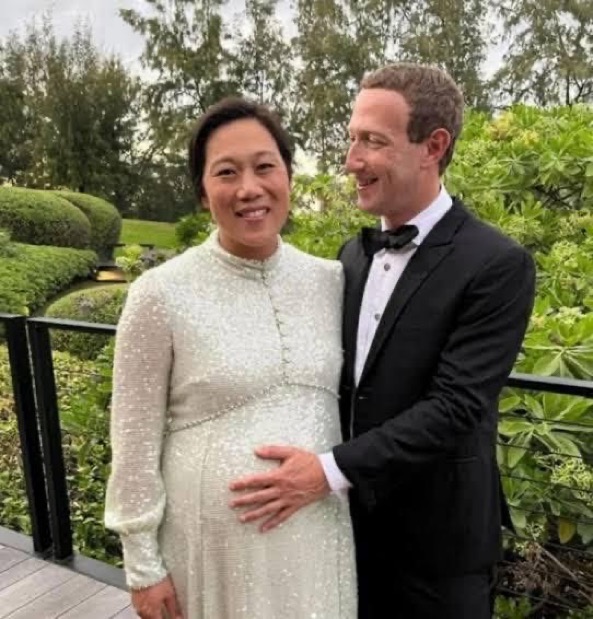
Mark Zuckerberg engineered a custom hardware device for his wife in 2019. No clock face. One faint light. A one-hour window.
Priscilla had a specific problem. She'd wake up in the middle of the night, check her phone for the time, and the number itself spiked her anxiety. 4am meant worry about the kids waking soon. 5:30 meant calculating whether to just get up. The information was the trigger.
Most engineers approach "can't sleep" by adding things to the bedroom. A meditation app. A Hatch alarm. A weighted blanket. A sleep coach.
Mark removed the variable that was running the wake-up loop.
The Sleep Box sits on Priscilla's nightstand and shows nothing for 23 hours a day. Between 6am and 7am it emits a single faint light. Faint enough not to wake her if she's still asleep. Visible enough that if she's already up, she knows it's okay to start the day. The rest of the night, dark. No clock. No time display. If she wakes at 3am she has no data to push her cortisol up with, so she goes back to sleep.
He wrote the firmware and built the enclosure himself. No team, no procurement, no Meta resources. He posted the result on Instagram and said it worked better than he expected.
The design move most CEOs would never run is the personal one. The instinct is to outsource a family problem to a specialist. A sleep coach. A doctor. A consumer electronics startup with a Series B and a marketing budget.
Mark intervened at a specific link in the chain. Time data hitting Priscilla's brain at 3am was what broke sleep. The phone got moved off the nightstand and replaced with a box that physically cannot deliver that data.
The box has no clock. That's the entire product.
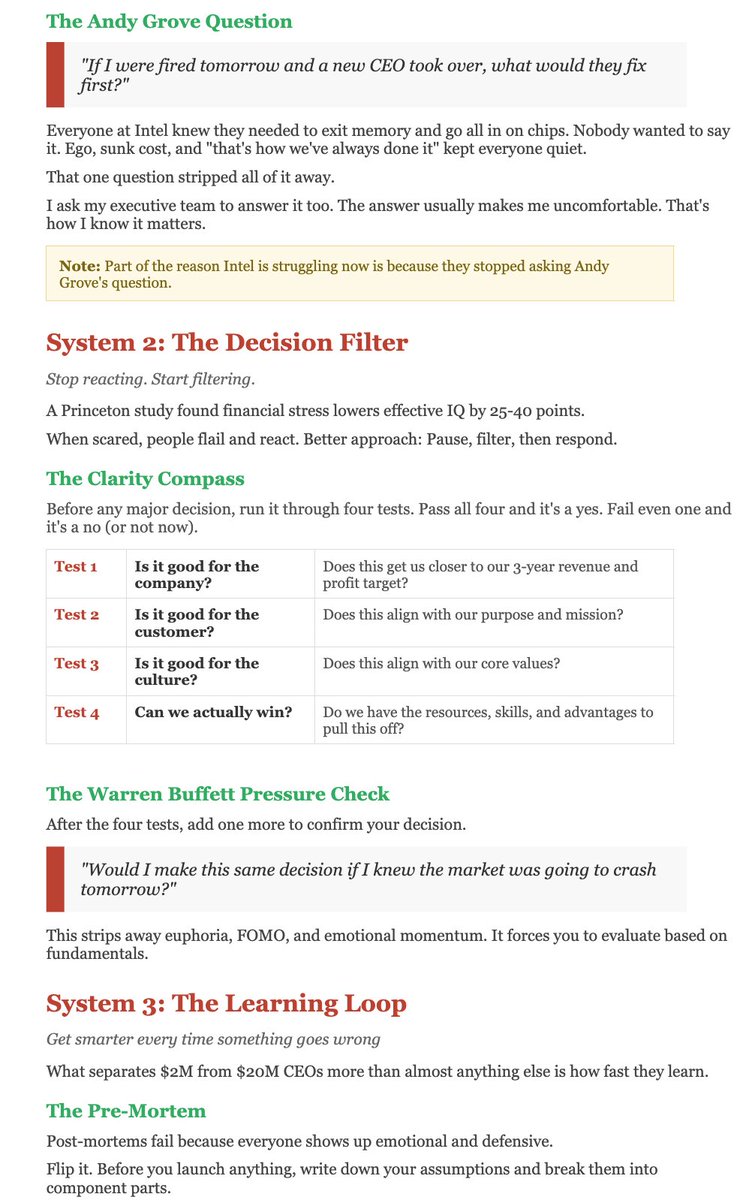
$2M CEOs work 60-hour weeks and still feel behind.
$20M CEOs work 20-30 hours and run calmer businesses.
Same economy. Same talent pool. Same 24 hours.
Three systems explain the gap. I call it the CEO Decision Engine.
Full breakdown:
Mark Cuban just described the largest wealth transfer of the AI era.
Almost nobody understood what he said.
Cuban: “There are 33 million companies in this country. Aren’t going to have AI budgets. Aren’t going to have AI experts.”
Not tech startups.
The shoe store. The regional trucking outfit. The accounting firm with 12 employees.
The businesses that actually run the physical economy.
They know AI is coming. They have no idea what to do with it.
Cuban: “You’ve got the head of Microsoft saying software is dead because everything’s going to be customized to your unique utilization.”
Software is dead.
The SaaS era ran on one rule. Build a generic product. Force millions of companies to bend their workflows around it. Charge rent forever.
AI ends the contract.
The business stops bending to the software. The intelligence bends to the business.
But customized by whom.
The third-generation manufacturer cannot tell Claude from Gemini. The county hospital is staring at a reactor asking where the light switch is.
Cuban: “Who’s going to do it for them?”
That question is worth more than the frontier models themselves.
Hundreds of billions are being burned to build the foundation. The smartest engineers alive are locked in a bloodbath over who owns the base layer.
Let them fight.
Let them burn the capital. Let them drive the cost of raw intelligence toward zero.
Because the wealth does not collect where the brain is built.
It collects where the brain meets the business.
Every ambitious kid in college right now thinks survival means a seat at OpenAI or Anthropic.
Cuban is staring at the other 99 percent of the economy.
Learn the models. Then learn the messy, unglamorous reality of how a 50-person company actually operates.
Walk through the door. Understand their problems. Wire the intelligence directly into their revenue.
That is not a job title. That is an entire economic class being born.
You do not need to build the brain. You need to build the nervous system.
The biggest winners of the electricity era were not the engineers who built the generators. They were the ones who walked into dark factories and showed the owners where to plug in.
33 million companies are standing in the dark right now.
Silicon Valley is racing to build the god. The fortunes will belong to whoever teaches him a trade.
Sequoia's thesis that the next $1T company will sell work, not software, is the most important reframe in AI right now.
The argument: if you sell a copilot, you're competing with every new model release. But if you sell the outcome — books closed, contracts reviewed, claims handled — every AI improvement makes your margins better, not your product obsolete.
The key insight most people miss: for every $1 spent on software, ~$6 is spent on services.
The entire SaaS playbook was about capturing the software dollar. The AI playbook is about capturing the services dollar — at software margins.
Not "AI for accountants." The AI accounting firm.
Not "AI for lawyers." The AI law firm.
The companies that figure this out won't look like SaaS companies. They'll look like services firms rebuilt on software infrastructure.
That's a fundamentally different company to build, fund, and scale. And most founders are still building copilots.
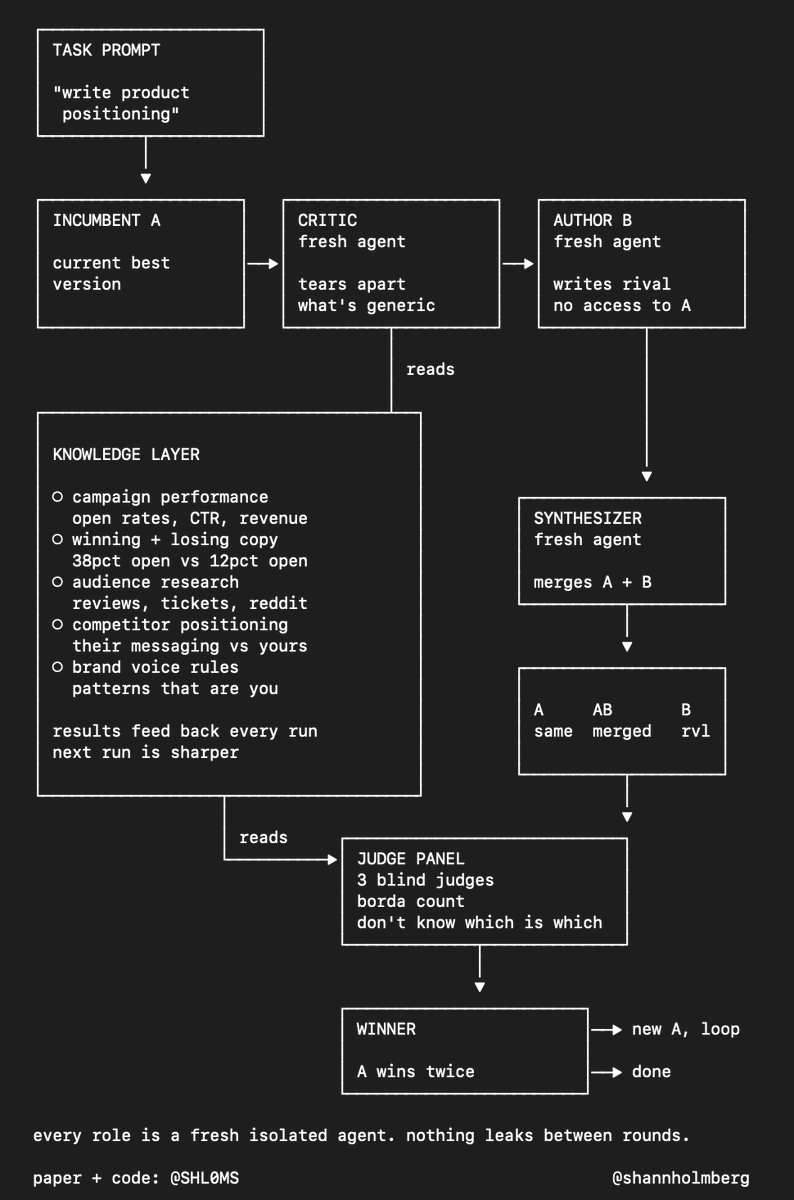
how to use autoreason for marketing
karpathy's autoresearch works when you have a number to optimize. conversion rate, pass rate, something measurable. but most marketing decisions dont have that
whats the right positioning? is this landing page copy good? does this email hook or does it just exist?
autoreason solves that. say you need positioning for a product launch
1. you write the initial positioning (or an agent does). this is candidate A
2. a fresh critic agent reviews A and tears it apart. whats generic, what a competitor could say word for word
3. a separate author agent reads that critique and writes candidate B from scratch. no access to A, only the critique
4. a synthesizer reads both A and B and creates a third option AB that pulls from each
5. all three go to a blind judge panel. three fresh agents score unchanged A, synthesis AB, and revision B via borda count. they dont know which is which
6. winner becomes the new A. loop repeats
7. when A survives two rounds without getting replaced, youre done. thats your output
every role is a fresh isolated agent. the critic has no channel to the author, the judges never see the critic's reasoning. nothing leaks between rounds so you dont get the usual yes-man feedback loop where one agent just agrees with itself
your value prop goes through adversarial review instead of one agent's first take. landing page copy gets tested against agents trying to beat it. brand voice docs get refined through structured debate instead of a single prompt. ad briefs get sharpened round by round, each pass stripping whatever is generic
this is different from asking an AI to "make this better" because autoreason builds in disagreement. agent B is competing with agent A, the judges are blind, what survives that is stronger than what comes out of a single conversation
now add a knowledge layer. feed the critic and judges real performance data from past campaigns. without that data the loop debates from general copywriting principles. with it the loop debates from your results
what goes into the knowledge layer:
> past campaign performance. open rates, CTR, conversion by segment, what moved revenue
> winning copy and losing copy. the subject lines that hit 38% open rate and the ones that sat at 12%
> audience research. what your customers say in reviews, support tickets, reddit threads
> competitor positioning. how they describe themselves, where your messaging overlaps, where youre distinct
> brand voice rules. the specific words, tone, and patterns that sound like you vs sound like anyone
example: you run this on email subject lines. the critic can now say "this reads like the subject lines that averaged 12% open rate for us, not the ones that hit 38%" instead of arguing from gut feel. the whole loop gets anchored to your numbers
every campaign result goes back into the knowledge base. the next run has better evidence to work with. the loop gets better the more you use it because the data it argues over is accumulating
Terence Tao proposes what he calls a "Copernican view of intelligence".
Instead of buying into the common, one-dimensional narrative that artificial intelligence will simply evolve from "subhuman" to "superhuman" and ultimately make humanity entirely redundant, Tao urges us to look at the bigger picture.
Much like the Copernican revolution proved the Earth is not the center of the universe, Tao suggests we need to realize that human intelligence isn't the only, or necessarily the highest, form of intellect. Historically, we have treated other forms of storing or creating knowledge—like animals, books, and computers—as secondary. However, we actually exist within a much richer universe of intelligence.
Both human intelligence and computer intelligence possess their own distinct strengths and weaknesses. The true potential lies not in viewing them as direct competitors, but rather in focusing on collaboration. By working together, humans and computers can achieve additional things that neither could accomplish on their own, requiring us to think in much wider terms than just what humans or computers can do alone.
Anthropic running 10,000 Mythos models in parallel to find cutting-edge cyber exploits...
meanwhile your sister using Microsoft Copilot with some Haiku-sized model and she thinks AI is just hype.
"The future is already here, just not evenly distributed" has never been more apt
Tomorrow we’re breaking down how companies actually become AI-native. Using the AI Transformation Model + a real case study from Ramp.
Ben Levick (Head of AI @ Ramp) will talk through how they did it from the inside.
If you’re figuring this out right now, you should join.
https://t.co/p5TwV52kMO
Mythos appears to be the first class of models trained at scale on Blackwells. Then will be Vera Rubins. Pre-training isn't saturated. RL works. And there is *so much* computing coming online soon.
Buckle your chin strips. It's going to be fucking wild.