@testwer@MarioNawfal The lawyers and the governments are the real winners. They are the ones who will fine (make the money) at the expense of customers.
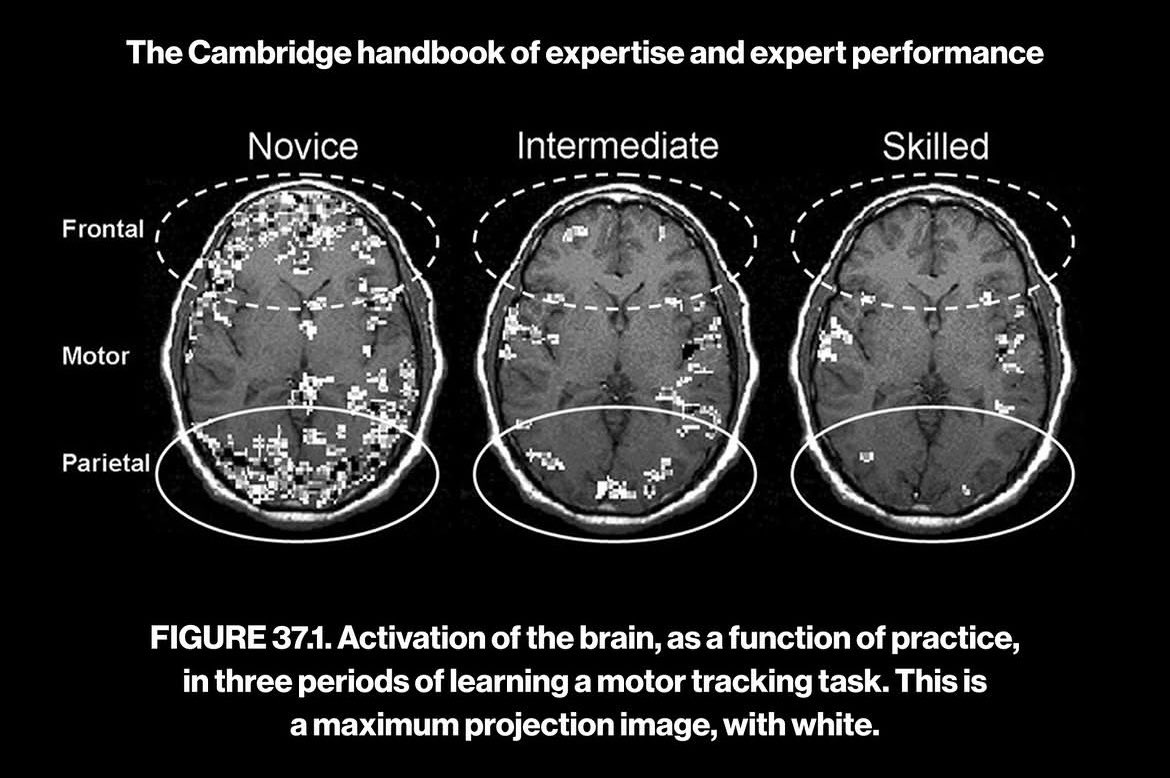
one of my favorite lessons from neuroscience: what feels like a struggle today becomes automatic tomorrow. the image below shows your brain working less hard at the same task as you get better, sometimes after just a single practice session.
the struggle is temporary. keep going.
Introducing Z1T:
Our first family of transformer-like models
made for sparse probabilistic hardware like Z1
Achieving up to 140x energy efficiency gains over GPUs
and revealing a new scaling law for sparse transformers
Read the blog:
https://t.co/zYLkLjrJLL
I had a panic attack last week. This was what I felt. I’ve only ever gotten one panic attack before. It came on so suddenly and unexpectedly because I got a text reminder of an upcoming bill. It’s so important to bite the bullet and ask for help or let someone know you’re not doing okay.
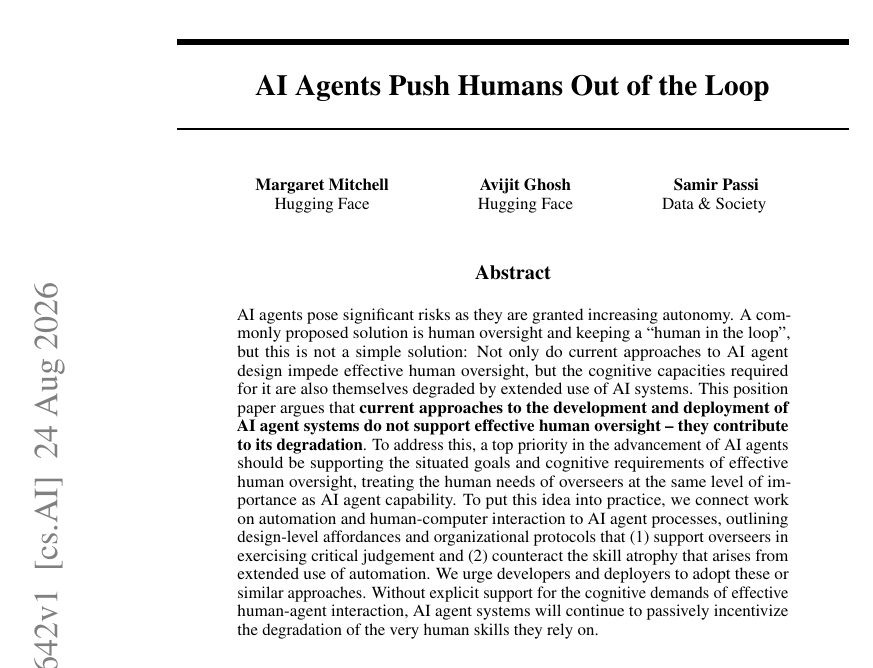
New HuggingFace paper argues that increasing agent autonomy can gradually make human oversight ineffective by causing approval fatigue, overreliance, loss of situational awareness, and skill degradation.
As agents do more, users are pushed into approval mode: skimming plans, granting permissions, and reconstructing what happened across steps.
Over time, automation bias, approval fatigue, weaker situational awareness, and skill atrophy can make those approvals less reliable.
Worse, weak approvals can become training or evaluation signals, rewarding systems for being easy to approve rather than easy to scrutinize.
Their answer is cognitive scaffolding at 2 levels: developers add strategic friction, better approval design, behavioral monitoring, and checks that force attention at consequential moments.
– arxiv. org/abs/2608.23642
Title: "AI Agents Push Humans Out of the Loop"