If I was cynical and misanthropic, I would pretend to hate AI and be a turncoat or double agent and work on convincing as many people as I could that AI was bad and needed to be shut down, so that I could just stay ahead of people.
HOLY CRAP there are so many people out there who just have nothing but blind rage at AI and it generally regresses to one of a few idiotic fallacies.
"AI is EVILLLLLL" - like okay, why? *crickets*
"AI is destroying EVERYTHINGGGG" - point to one thing?
"I just don't like it" - fair.
"It steals art work" - like okay sure, even if we grant that, it's only one function of what AI does.
Gaussian splats just got movable objects! 🛋️
Gaussian splatting gives you a near-perfect visual capture of a real place.
The catch is that the capture is frozen: one photoreal snapshot, with no separate objects, no collisions, no physics. Great to look at, hard to train a robot in.
@NianticSpatial new feature, Object Interaction (in beta), adds the missing structure on top of the splat.
Let's have a quick look at how it works.
Environment understanding scans the capture and finds whole, movable objects. Each one is extracted from the scene while keeping its visual appearance and picking up collision information.
After a quick review and cleanup, every object becomes something you can select, move, or remove, with simplified physical properties giving a baseline for how it behaves.
So a captured room stops being a single fixed layout. You can slide the chair, shift the equipment, clear the clutter, and generate many arrangements of the same recognizable, real-world space.
Train a policy in one static scene and it can quietly learn to lean on details that won’t hold on the real floor.
Varying the layout, and with relighting the lighting too, breaks that dependence while keeping everything grounded in a real place, with no rebuild from scratch.
NICE ONE!
Check it out here: https://t.co/SknidpGVn1
~~
♻️ Join the weekly robotics newsletter, and never miss any news → https://t.co/GoA3ZuwoPB
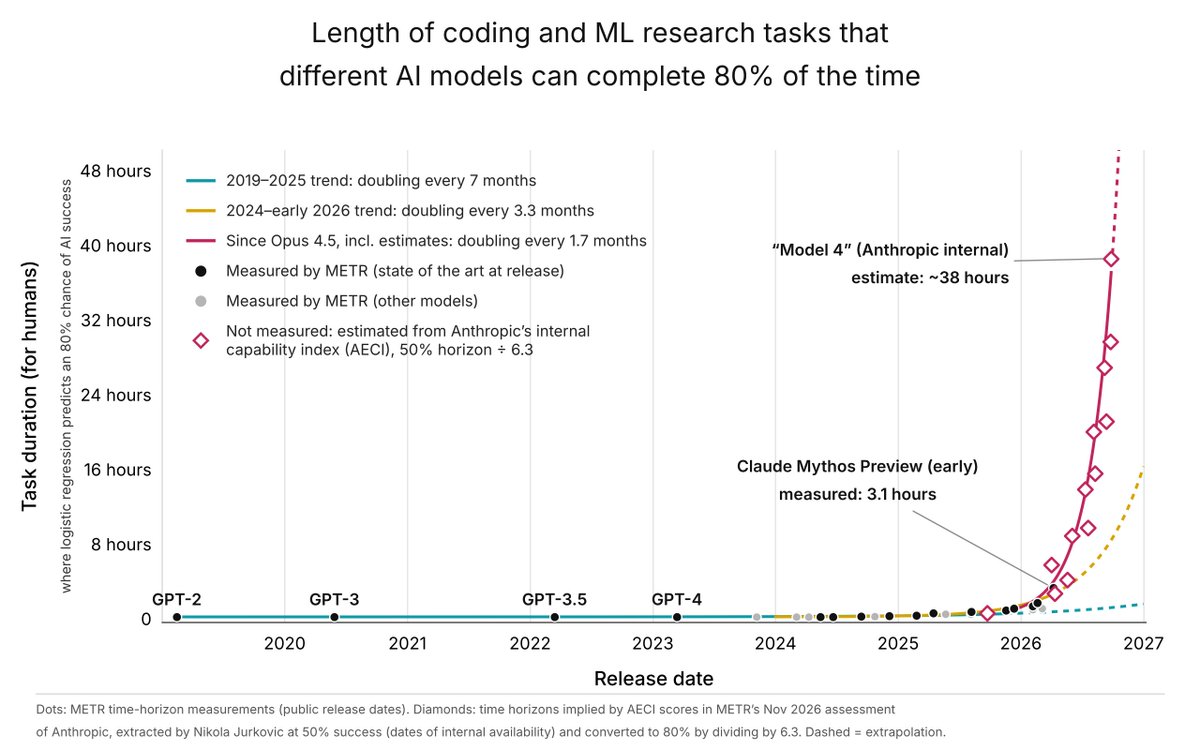
FAST TAKEOFF
Although this is just a rough estimate, we could be at 100 hours by the end of the year.
Mythos is from April, so we're looking at roughly 10x growth from April to October (internal Model 4), and potentially 30x by January (another 3x from October). And that's a conservative estimate.
I don't have the data from January this year, but I think it's reasonable to estimate that we could see around 100x growth over the entire year (3x in Q1 2026 + 30x april - end of december)
Acceleration is accelerating, so we very likely see an even larger increase in 2027, potentially 200x or more.
That would take us from 100 hours to 20,000 hours, or roughly 833 full days of continuous (24/7) human work.
The point is, no matter which estimate you use, conservative or one that accounts for further acceleration, AI capabilities in 2027 will be absolutely insane.
And keep in mind that we'll also see swarms of 100 000s, potentially even millions, of AI agents working simultaneously on the same problems, compared to low 1000s this year.
AI systems will be combining their (better than Millenium Prize level - because we're already at this level) capabilities with unprecedented amounts of parallel intelligence.
That's why I consider 2026, especially its final 2 quarters, the beginning of the serious takeoff.
2027 we will see an intelligence explosion that transforms the pace of scientific discovery, engineering, and technological progress beyond anything humanity has ever experienced.
@mariagorskikh Sandbox-to-production is where most agent projects stall. The open question for me is state consistency and recovery SLAs, the exact layers where teams can't afford downtime. Curious how you guarantee that.
@NatLabRockies Solid science, but in my experience discoveries like this stay on the shelf here. Without pilot-scale facilities and a manufacturing base, the IP gets licensed abroad. World-class discovery, foreign commercialization. The recurring pattern.
@DefenseScoop The hardest technical problem in this RFI is cross-platform identity resolution. Keyword tools are obsolete; with E2E encryption, metadata and behavioral analysis carry the detection load. Vendors who solve pseudonymous account linking will win this one.
@StephDebour@StephDebour Right, and that's telling in itself. Geofence announcements without operational data are marketing, not engineering communication. I'd watch incident reports and insurance claims instead, that's where the real signal lands.
@GlenGilmore Knowing how many agents are in use while lacking the ability to block harmful actions in real time is not security. Visibility without enforcement is just documentation.
@LogisticsStuff This maps directly to manufacturing operations. Design for clarity first, then automate. Retrofitting automation onto a messy process just digitizes the chaos.
Senior hires from AWS, Dell and CrowdStrike point to a buildout of enterprise and government channels. I'd want to see comparable investment in core quantum engineering talent. That would be the stronger signal.
$IONQ Three more senior hires joined this fall
Berwyn Jones joined in October as Senior Quantum Director, Government & Defence, based in Cardiff. He was Head of UK Public Sector at Cribl, after central government roles at Rubrik, CrowdStrike and Salesforce.
Matt Shepherd arrived in September as Sr. Director, Executive Engagement & Executive Briefing Centers. At AWS he led Executive Briefing Centers.
Kara Mullaney started in October as Director, Go to Market Operations, after more than nineteen years at Dell Technologies and EMC.
Tomorrow morning I will publish an article listing the people working at IonQ and all its subsidiaries, up to date as of today. It is built from public LinkedIn profiles, and you can ask your questions there and get your answers directly.
#IonQ #QuantumComputing
@HumanVsLife08@EU_Commission@HumanVsLife08 Laugh all you want, but predictive maintenance and automated inspection run in European plants today. In my experience the hard part is scaling pilots into production. That's where the UAE pulls ahead.
@josefprusa Impressive work. I've toyed with similar E-ink hacks, and moving the frame comparison off the FPGA's slow RAM with delta signals is a clean fix. The GPU shader approach is smart engineering. This is how hardware lifecycles get extended.
The physical scale gets attention, but I'd argue the control layer is the real weak point. Much of the SCADA base predates modern security standards. A grid with zero buffer is as much a cybersecurity problem as an electrical one.
The power grid is the largest machine ever built.
The internet gets all the credit. But one of the most complex machines humanity has built is the electrical grid.
The US grid alone:
• ~22,000 generators
• Hundreds of thousands of miles of high-voltage transmission lines (recent DOE figures cite ~642,000 miles)
• ~55,000 substations
• ~6.3–6.5 million miles of local distribution lines
• Powers ~330 million people, 24/7, in real time
The engineering challenge:
• Electricity cannot yet be stored at meaningful grid scale
• Supply must equal demand at every instant
• Failure anywhere can cascade across the system extremely quickly
2003 Northeast blackout: problems that began in Ohio (including overloaded lines contacting trees, plus control-room alarm failures) cascaded to roughly 50–55 million people without power in about 7–10 minutes.
The grid has very little buffer. It runs close to the edge, all the time.
@DealsDhamaka This is what sustained R&D and manufacturing scale produce. We keep debating pilot projects in Canada while others fly 19-seat electric aircraft. The gap widens every year without a real industrial strategy.
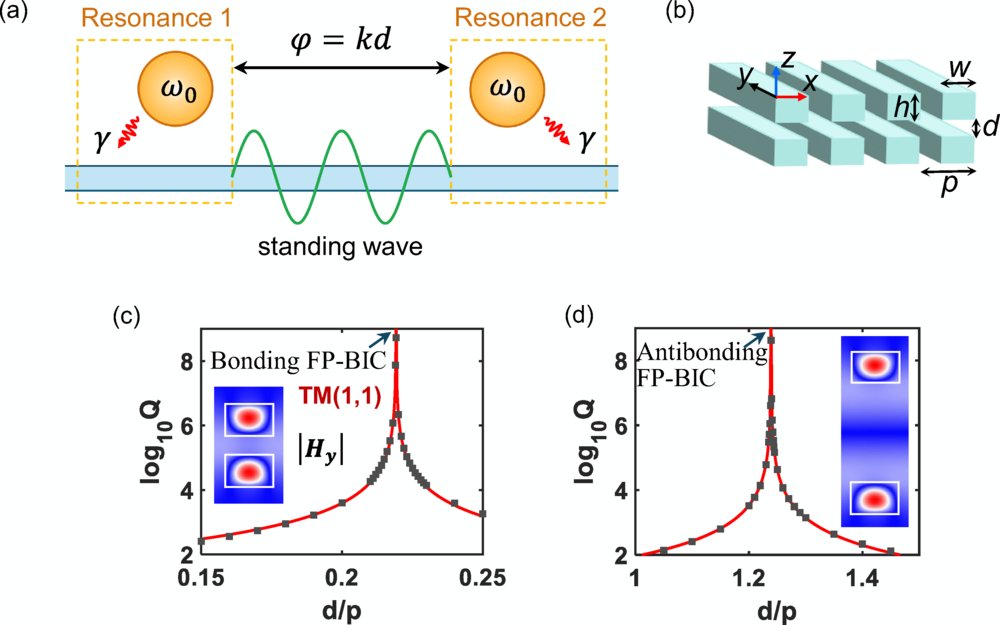
Impressive work. Tunable FP-BICs with Q factors near 10^8 from spacing-dependent interlayer coupling is a real design lever. My concern is fabrication tolerance: I would want to know how sensitive the BIC condition is to d/p deviations at scale.
🛸Bilayer metasurfaces offer abundant degrees of freedom and remarkable design flexibility for tailoring bound states in the continuum (BICs) through both interlayer and intralayer coupling compared with a single-layer metasurface. In this work, we present a comprehensive investigation of topological dynamics of BICs in bilayer metasurfaces... Our results provide valuable guidance of engineering BICs in momentum space with flexible capability and open promising opportunities for advancing applications in boosting light-matter interactions.
@HumanVsLife08@EU_Commission AI is already in Europe: predictive maintenance, quality inspection, process automation. The real issue is scaling pilots into production. I'd argue execution speed is what separates leaders like the UAE from pilot-phase thinking.
@milan_simonik@EU_Commission Figures check out. Canada sits even lower, around 1.7% of GDP, with business R&D among the weakest in the OECD. The predictable result: manufacturing R&D roles migrate to jurisdictions that actually fund them.