The Fairness Paradox
The Basic Problem
Here's what happens: When you try to be "fair" to political parties - give them equal time, equal representation, protect their positions - you're being fair to the system but unfair to the people.
A practical example:
Example 1: The Permanent Coalition Problem
Italy tried this. They said "let's be fair - small parties deserve representation!" So they got proportional representation where a party with 3% of votes gets 3% of seats. Sounds fair, right?
What actually happened: No party could govern alone. So they formed coalitions. But here's the trick - those tiny 3% parties became kingmakers. The big parties had to bribe them with cabinet positions to form a government.
Result? Italy had 69 governments in 73 years (1945-2018). The small parties stayed in power across most of them! They were supposed to be marginal - instead they became permanent fixtures. The voters couldn't throw them out because the big parties needed them.
That's unfair to voters - they can vote all they want, but these little parties keep coming back like a bad penny.
Example 2: The Equal Time Trap
In broadcasting, many countries have "fairness" rules: if you give one party 10 minutes, give all parties 10 minutes. Sounds reasonable!
But watch what happens: You've got a major party with 40% support proposing a serious healthcare reform. Then you've got the "Free Beer and Pizza Party" with 0.5% support whose platform is literally free beer and pizza. Both get 10 minutes.
Now the serious party has to spend their time responding to the Beer Party's nonsense, because it's been legitimized by equal airtime. The debate degrades. Serious policy analysis - which is hard and takes time to explain - gets crowded out by simple slogans.
The unfairness: Citizens trying to make informed decisions get noise instead of signal. The system is "fair" to parties but unfair to people trying to understand complex issues.
The Error-Correction Problem (This is the Big One)
Here's where it gets really interesting from a knowledge-creation perspective:
Democracy's superpower is error correction. Bad government? Vote them out. Bad policy? Change it. That's the whole point!
But "fairness" between parties creates friction in the error-correction mechanism.
Example 3: The German Stability Trap
Germany has a "constructive vote of no confidence" - you can't vote out a Chancellor unless you simultaneously vote in a replacement. This was designed to prevent the instability that killed the Weimar Republic. "Fair" to the governing coalition, right? They get stability!
The problem: Between 1949-2005, this made governments extremely hard to remove even when they were clearly failing. The 1966-1969 Grand Coalition between the two major parties meant there was effectively no opposition - 90% of Parliament was in government!
The unfairness: If almost everyone is in government, who represents the people who want change? The error-correction system jammed up. You had both major parties in power simultaneously - how do you vote out "the government" when the government IS everyone?
Example 4: The Bi-Partisan Commission Con
Here's one you'll recognize: "Let's be fair and create a bi-partisan commission to solve this problem!"
Sounds great. Both sides get equal representation. What could go wrong?
Everything. Because now you've created a body that can only act through compromise between parties, not responsiveness to reality.
The commission on Social Security reform can't say "this system is fundamentally broken" because half the commission's party defended that system for decades. So you get watered-down recommendations that offend nobody and solve nothing.
The unfairness: The people who need Social Security fixed get a commission that's structurally incapable of honest diagnosis because "fairness" means protecting each party's sacred cows.
The Hard-to-Reverse Part
Now here's the really nasty bit: these fairness systems are incredibly hard to undo.
Why? Because the people who benefit from them are the people who would have to vote to change them.
Example 5: The Electoral Commission Racket
Many democracies have "independent electoral commissions" with equal representation from major parties. Fair!
But these commissions draw electoral boundaries. And guess what? They tend to draw "safe seats" - districts where each party wins easily. This benefits incumbents from both parties at the expense of voters.
The lock-in: To change this, you need politicians to vote against their own job security. It doesn't happen.
Britain's boundary commissions operated for decades protecting incumbents from both parties. It took an outside crisis (hung parliament) to finally force reform.
The Unresponsiveness Problem
Here's the mechanism: "Fairness" between parties creates party-centered politics instead of issue-centered politics.
Example 6: The Grand Coalition Effect
When you force major parties into permanent coalition (Austria 1945-1966, Germany periodically), something weird happens:
They start to share patronage rather than compete on ideas. Austrian Grand Coalition divided up state industries, banks, government posts - "you get this ministry, we get that one."
Result? Neither party had incentive to propose radical reforms because both were complicit in the existing system. Voters had no way to express dissatisfaction because voting for either major party kept the same coalition in power.
The unfairness: Economic problems festered unaddressed for decades because the error-correction mechanism (electoral competition) had been replaced with a power-sharing cartel.
Why This Produces "Many Other Evils"
The unfairness to citizens is just the start. Here are the cascading effects:
Corruption: When small parties become permanent fixtures, they develop ownership mentality toward "their" ministries. (See Italian corruption scandals, Austrian nationalized industry scandals)
Extremism: When the major parties form a permanent centrist blob, voters with grievances have nowhere to go except to extreme parties. (See rise of Austrian Freedom Party, Italian Five Star Movement)
Incompetence: Removing bad ministers becomes nearly impossible because it might destabilize the coalition. (German coalition agreements literally specify which party gets which ministry for the full term)
Stagnation: Needed reforms get vetoed by junior coalition partners. (Netherlands' housing crisis worsened for years because small coalition partners blocked reform)
Legitimacy crisis: Eventually people notice the system doesn't respond to voting. (Record low turnout in many PR systems)
The Punchline
The beautiful irony is this: Unfairness to parties produces fairness to people.
When parties compete brutally and the loser gets kicked out, that seems "unfair" to politicians. They lose their jobs! The party apparatus gets dismantled! How mean!
But that's exactly what makes democracy work. The possibility of total defeat is what keeps parties honest and responsive.
Britain's first-past-the-post [FPTP] system seems brutally unfair to parties - third parties get millions of votes and handful of seats. But it produces clear governments that can be clearly blamed and clearly removed. The error-correction works fast.
"Fairness" to parties produces: permanent coalitions, patronage, stagnation, corruption, extremism, and voters who can't fix problems by voting.
Unfairness to parties produces: responsive government, clear accountability, effective error-correction, and actual representation of citizens.
The Deeper Point
This is a special case of a general principle: Systems optimized for fairness between agents often produce systemic unfairness.
Just like in evolution - "fairness" would mean every organism gets equal chance to reproduce. But that would prevent adaptation! The "unfairness" of selection is what creates the ability to solve problems.
In government, the "unfairness" of parties facing real consequences for failure is what creates governments that can actually solve problems.
New fastest shortest-path algorithm in 41 years!
Tsinghua researchers broke Dijkstra’s 1984 “sorting barrier,” achieving O(m log^(2/3) n) time. This means faster route planning, less traffic, cheaper deliveries, and more efficient networks - and a CS curriculum revamp =)
@tobi Well I agree that it's as much about the entire context as the latest prompt, but it's the word 'engineering' that I take issue with: what part of engineering are people doing? it's "prompt (or context) hacking" or "context manipulation" that is a better description IMHO.
Much more work is needed before this is really a robust result (paper forthcoming, hopefully by the end of the year), but the initial findings are clear:
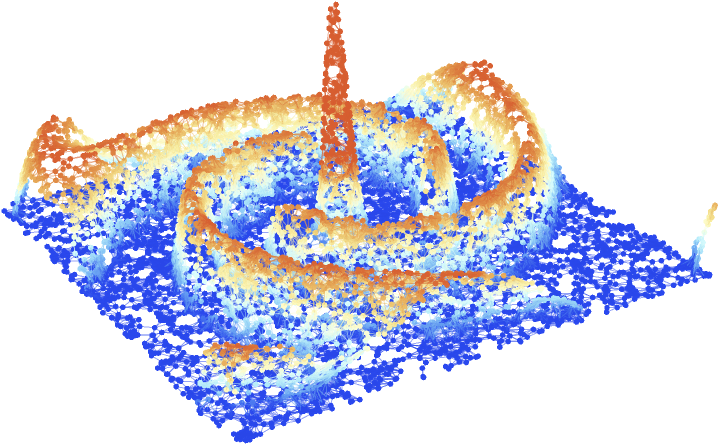
Spacetime discreteness may be observationally detectable in things like quasar luminosities. (1/6)
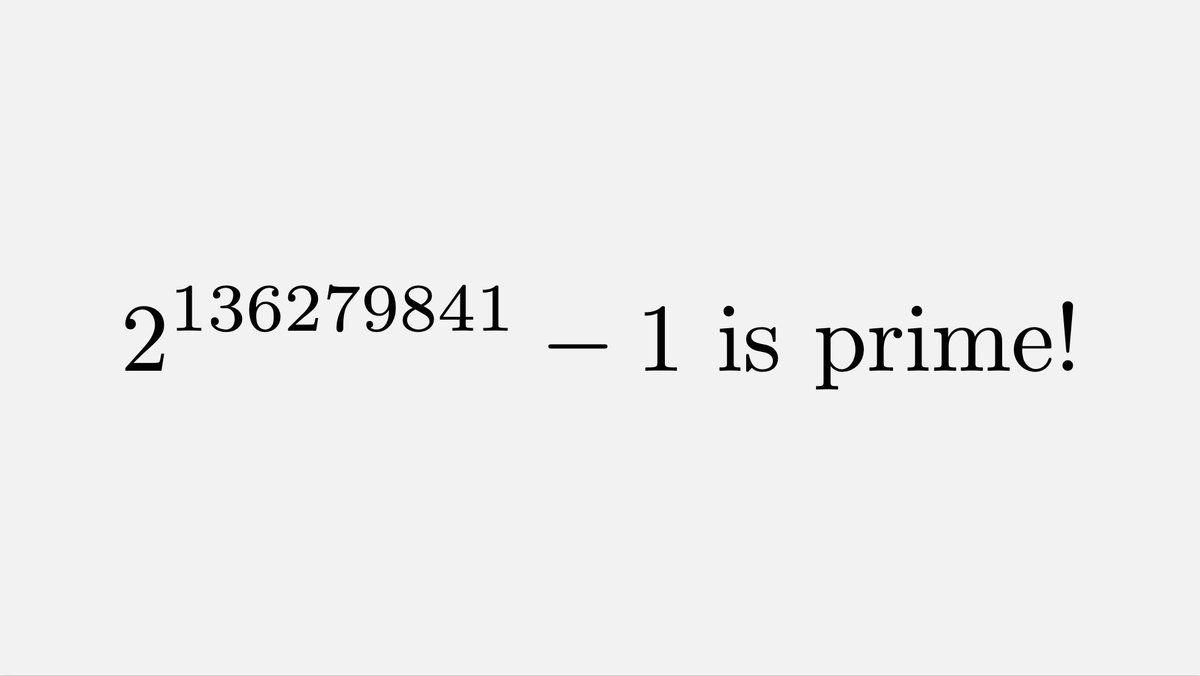
2¹³⁶²⁷⁹⁸⁴¹−1, discovered today, is the largest known prime. It's a Mersenne prime (2ᵖ-1), which are easier to find.
It took nearly 6 years for the GIMPS software to find it after the previous largest known prime. It was also the first Mersenne prime found using GPUs.
🚨Spruce Pine Update🚨
Some encouraging news from Sibelco.
- Says its plant has "only sustained minor damage..."
- "Our final product stock has not been impacted."
- However, still no power to the plant.
All told, this sounds pretty promising, in the circs.
Full statement here👇
How does Apple Intelligence get a high-quality LLM on device?
- The on-device model is ~3B parameters. Already pretty small (~6GB in 16-bit)
- Quantized with "accuracy recovering adapters". Quantize and freeze base model and train low-rank adapters for 10B tokens.
- LoRA adapters are fine-tuned from the accuracy recovering base adapters for different use cases. These are swapped in dynamically. Hence no additional cost for using accuracy recovering adapters.
- Mixed-precision quantization (some weights get ~2-bit, some weights ~4-bit, and tied input/output projection gets 8-bit).
- Mixed-precision quantization + accuracy recovering adapters gets you to 3.7 bits per weight at higher quality than e.g. vanilla Q4_0 (which is > 4 bits per weight).
- At 3.7 bits per weight the quantized model is about 1.4 GB with very little quality degradation from 16-bit 3B.
Details in Section 5.2 of the technical report: https://t.co/3mR9sqZmTg
I can't believe we're back to discussing LLMs' ability to reason. Where have you been these past two years? In a bunker? If you'd actually worked with LLMs during this time, you'd know by now that they're obviously pattern-matching machines. Try asking one to write incorrect code, and it will say, "Here's your wrong code," but the code will be correct. Or ask it to solve a popular riddle like the "man, goat, wolf, and cabbage," but with a slightly altered setting, and it will give you a solution that contradicts your setting. This is so obvious—why are we still talking about this?
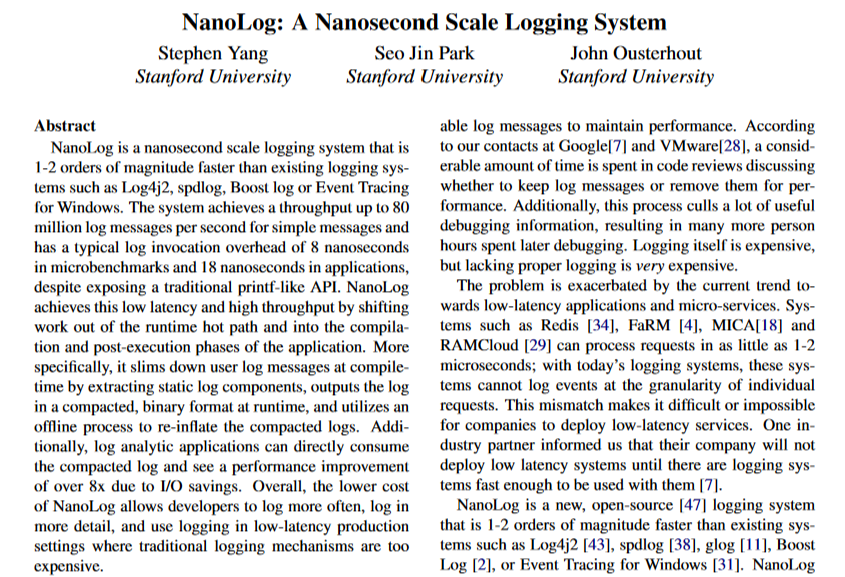
Want to write log statements in single-digit nanoseconds?
This cool paper from @JohnOusterhout's group shows how. I like it because it combines deep performance analysis with clever optimizations to make a system as fast as possible.
NanoLog is implemented as a more-or-less drop-in replacement for printf that's ~100x faster. The key observation is that the vast majority of log messages are never actually read. Thus, NanoLog tries to do as little work as possible at logging time, deferring work to a postprocessor that runs when someone actually reads a log entry.
When you log a message in NanoLog, it records only the dynamic part of the log message to an in-memory "staging buffer." To avoid overhead from synchronization or cache effects, these are single-consumer, single-producer per-thread circular buffers. Then, a background thread reads from each circular buffer, performs lightweight compression on each record, and writes it to disk. When you actually read a message, a postprocessor decompresses the records, interpolates them with the original static log message, and presents it to you just like a conventional logger.
The paper has a detailed evaluation section showing which optimizations actually work. The key takeaway is that the combination of 1) only logging dynamic content, not static strings and 2) performing lightweight compression before writing to disk were the most effective optimizations. I wish more papers would do analyses like this, it's good science!
Moths are attracted to lights because of the same mathematics that underlies twistor theory and compactification in theoretical physics: projective geometry.
It all starts from a simple observation: translations are just rotations whose center is located "at infinity". (1/11)
I am a physicist and I'm profoundly opposed to any idea of non-physical explanations that contradict physics. So that's a no-no and really doesn't make sense. However, there are ways in which both emergent properties such as minds and life and so on have an effect. And as you said, also abstractions. Now the fact that the theory of good explanations led to the idea that abstractions are real things was slightly surprising to me. I wasn't expecting the link, at least wasn't expecting it to be so strong as it is. But the thing is, if you think about how to explain events, physical events like a footprint on the moon, how do you explain how that happened? Well, it happened because of human ideas, of science. And human ideas, you could say in this reductionist sense that as you rightly say is the prevailing mode of explanation and the prevailing idea is to look down on other modes of explanation, that those ideas are nothing more than configurations of atoms. So some physicists, some rocket scientists put their brain into certain configurations of atoms and those atoms then acted on other atoms which then ended up making a footprint on the moon. Now what that misses is the explanation of why certain configurations of atoms put footprints on the moon while others, the overwhelming majority of configurations that human brains, even human brains have been put into in history, do not have that effect. And it's because there's a certain type of information. And this information can't in my view be reduced to statements about atoms because if you think about what that information does, it is in brains but the same information then gets transferred into, let's say, sound waves in air and then it gets transferred into ink on paper and then it gets transferred into magnetic domains inside a computer which then control a machine that instantiates those ideas in bits of steel and silicon and so on and so on. There's an immense chain of instantiations of the same information. And it's only special kinds of information that have this property that they are preserved and instantiated in successive physical modes. So what is being transmitted, what is having the causal effect is not the atoms but the fact that the atoms instantiate certain kinds of information and not other kinds. So therefore it is the information that is having the causal effect. If a particular instantiation of that information were damaged, then processes would come along to fix it, whether or not they could fix the physical instantiation. For example, if the computer goes wrong, then we don't use the corrupted information. We go back and rescue the information from a different computer and we throw away the atoms that at one point instantiated it. So the information causes itself to remain in existence. Now I think there's no way out of that mode of explanation. And if explanation is going to be the fundamental thing about our criterion, for example, about what is or isn't real, then we have to say that information and this particular kind which we call knowledge is real and really does cause things.
@DavidDeutschOxf
I don't know whether to be sad it's ending, or surprised that it's still been going all these years. The first assembly language I learned (and manually transcribed into Hex!!!) before I had a compiler... RIP #Z80 https://t.co/IFO6ZwQ4BZ
Ok, this is pretty crazy.
SQL has been the lingua franca of database querying since the dawn of time.
But for the first time in over three decades (!), ISO just published a NEW database query language called GQL -- the Graph Query Language!
Newly discovered vuln in Apple M-series chips lets attackers extract secret keys from Macs. "The flaw—a side channel allowing end-to-end key extractions when Apple chips run...widely used cryptographic protocols—can’t be patched" https://t.co/yjQTogcIzk
Newly discovered vuln in Apple M-series chips lets attackers extract secret keys from Macs. "The flaw—a side channel allowing end-to-end key extractions when Apple chips run...widely used cryptographic protocols—can’t be patched" https://t.co/yjQTogcIzk