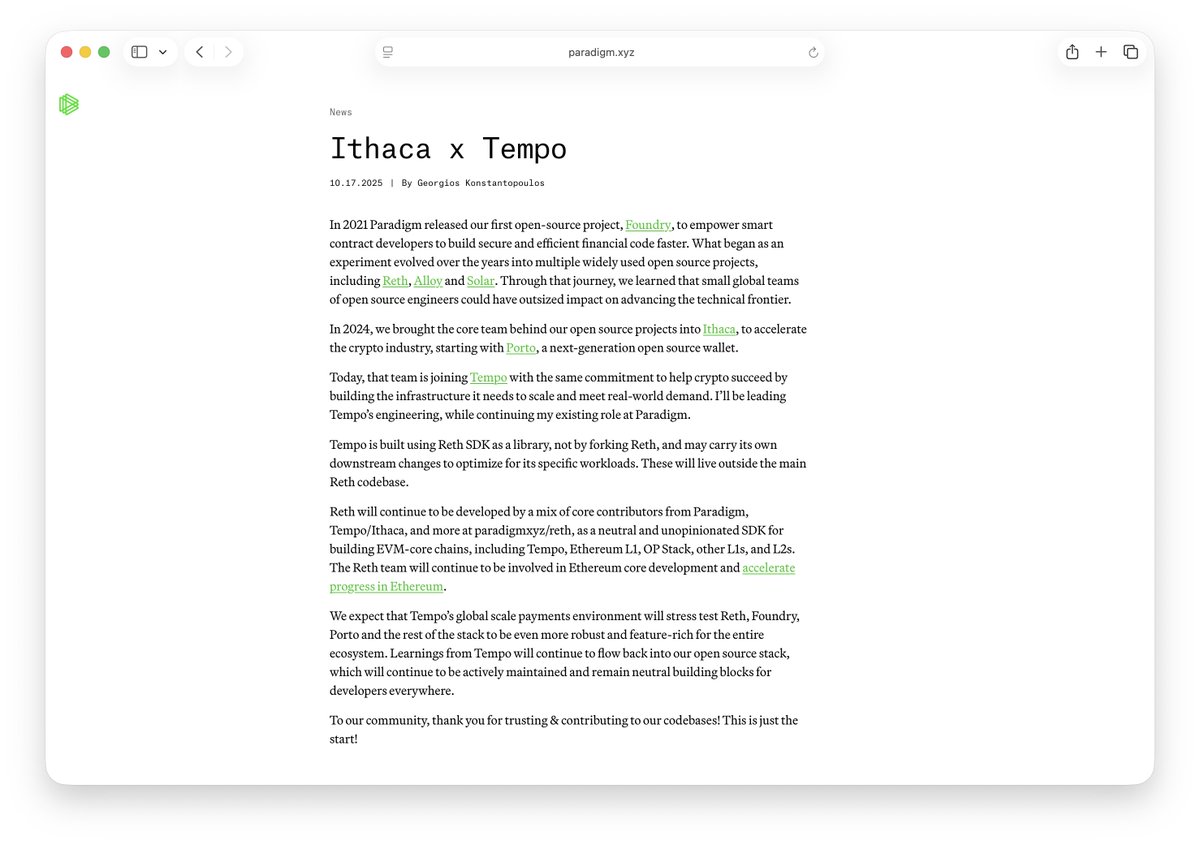
Today, we're launching Tempo Zones on the Tempo Testnet. Every zone is private, fast, and interoperable with each other. Zones support MPP for private agentic payments at web scale. See interactive demo below.
Zones are also integrated in the Tempo Wallet - test it out at https://t.co/HK01hfgFFz. We have two zones live in our documentation for experiencing this on full force: https://t.co/znaY54jgqi.
From a technical perspective, Tempo Zones are built on the Reth SDK and they have a few interesting innovations in them:
- Interoperability is solved by using the L1 as the pivot point, given fast finality this is really simple.
- L1 state is mirrored to the Zone, such as TIP20 tokens and their TIP403 policies.
- A stateless EVM executor which can be run inside a TEE or ZKVM for proof verification.
Overall very proud of our team's work on this and I think sets us up very well for interoperable, private and scalable blockspace.
@StackDigest Yup, but it’s not a big lift to fork + remove that check. The purpose is anti footgun, similar vibe as to check if transfer recipient is address(0)
Every ad impression, every recommendation algorithm, every retargeting pixel — all of it monetizes the space where human intent is unclear.
Agents collapse that space to zero.
An agent arrives with a mandate. Get me X. Budget Y. Constraints Z.
- No attention to capture.
- No desire to manufacture.
- No conversion funnel to optimize.
That's a different customer. And it needs a different internet.
- The attention economy monetizes the path to intent.
- The intention economy monetizes the *fulfillment of intent.*
At @tempo been building the protocol for that second economy — the Machine Payments Protocol, with Stripe, supported by Visa and others. Open source, designed for IETF standardization.
I wrote the full piece on what the intention economy looks like and why the infrastructure for it doesn't exist yet 👇
Normal create3 needs two keccaks to get the address (forwarder create2 → create nonce), this doubles the cost of mining vanity addresses over CREATE2
Have been nerdsniped for a while to build a better CREATE3, finally landed on something I think actually earns the v2
How does it work? We SSTORE2 the creation code, then CREATE2 a bootloader that delegatecalls it and becomes your contract. Scoped deploys just appends msg.sender to the bootloader init code
🧵 Tempo Architecture Deep Dive
@tempo is a payments-first L1 built for stablecoin transactions, whose testnet has launched a few weeks ago.
There are so many native features, but how will be the UX? What's the disadvantage?
In this thread, I'll break them down. 👇
Excited to share that the @ithacaxyz odyssey continues at @tempo!
We will accelerate Tempo’s mission towards real-world crypto adoption while further stress-testing and optimizing our existing open source stack for the entire crypto ecosystem.
Thank you for the trust, onwards.
3 mainnet x-chain demos of using Porto in DEXs in Safari mobile.
Self-custodial, no passwords, no extensions, cross-app, cross-device.
Batching, sponsorship, state of the art gas costs, 1-click interop and so much more.
1/3 @Uniswap:
Porto is now production-ready & fully open source!
Porto’s north star is to enable secure and programmable web-native crypto payments & finance without passwords, or browser extensions.
Integrate now in 2 lines of code and in less than 1 minute: `pnpm i porto`.
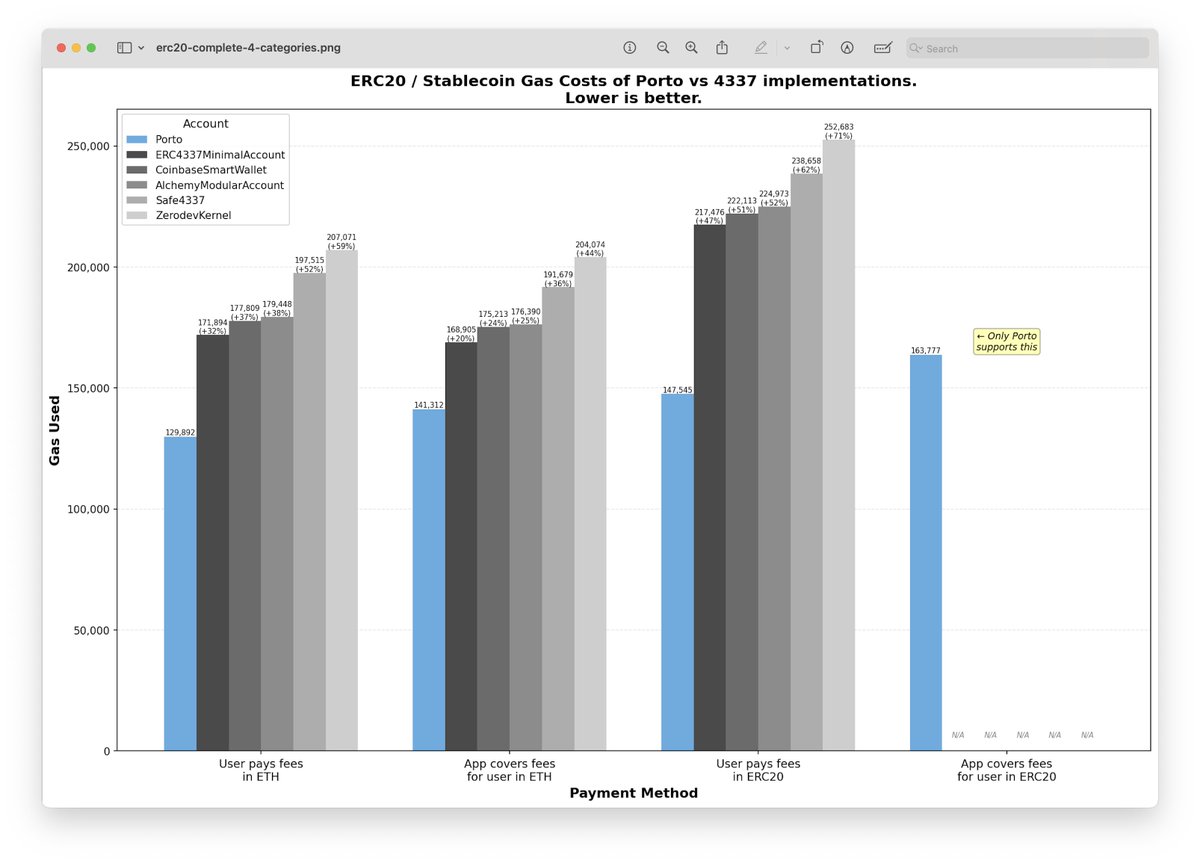
Hmm, it’s an AA solution benchmark based on feature set. Also, our accounts are: 7702 delegation to a 7702proxy to an implementation, which is architecturally less efficient than the create2 SCAs we’re benching against. The 4337 accounts are rly optimized, our cost gains comes mostly from our ground up redesigned entry point around cost
Alchemy’s MA v2 and ZD kernel uses EP 0.7
Webauthn - depends on whether the network has 7212 but everyone uses the same webauthn verification libs, so the cost delta will be the same
@Agusx1211@gakonst@jamalavedra That makes sense
My biggest concern is reliability tbh, finding a grief vector against simulation is essentially now a DoS vector. Are there ways to guard against this?
+1 on the sequencers running 5189 txs also, that makes a lot of sense to me as the end game of AA