Spotify's Chief Architect just showed how they ship 4,5K deployments /day with Claude at Anthropic stage
27-minutes. free. By #1 music app dev
"More than 99% of our engineers use AI coding tools. Adoption took off after Opus 4.5"
Worth more than any $500 vibe-coding course.
This recent @bchesky podcast with @patrick_oshag belongs to the hall of fame of tech podcast episodes. Very likely the deepest founder conversation after the Steve Jobs lost interview in the 90s.
Currently it has 90k views; it deserves 100X more views.
https://t.co/o9rzq0ZXuS
Good read on the value shared organizational intelligence @tobi
This matches what we’ve been seeing with the @linear Agent, and honestly I think the industry forgot what organizations are for, working together from a shared understanding.
We're to starting to see this puzzle and full loop to come together on Linear where organizational leverage that comes from captured context, shared understanding & agent systems.
AI discourse has focused on personal agents and individual efficiency, like how this skill or markdown file works for me, this custom agent I built. But what about your team, what about when you leave the company or the team? Where does the customer feedback come from? Where are the discussions or decisions managed? Who changed what?
Organizations run on shared understanding, and I believe more leverage will be found in these shared systems where context persists and improvements compound across the team.
Linear Agent can work in Linear, Slack, in GitHub, and across other systems. Linear both the context store and a way to action on it.
It can capture and organize information from different sources (support tools, gong calls, slack, mcp etc), read code, write code, connect to external systems, open PRs, show diffs live, and support review inside the same workflow. Everything stays in the same loop.
You can see that in how our team uses it.
- A lot of the time people drop findings, feedback, or early notes into project channels and ask Linear for more context, or a first pass. This starts a discussion on the change, not just the change. Anyone looking at the PR has the same connection to the initial discussion.
- The agent debugs customer problems by looking at context and the codebase.
- New bugs in triage all now start with Linear Agent reading the codebase (beta), debugging and writing fix (beta). Around 30% of our bugs now get solved this way. In the last 30 days, Linear Agent opened about 1,330 PRs.
The other thing we’ve seen is that the system gets better as people use it. We’ve been iterating on our bug-debugging prompt together. A bug debug prompt does not as the team wants it, the team discusses it in Slack, and then asks Linear to update the prompt based on that discussion. The learning gets folded back into the system instead of staying with one person.
Discussions on features get more context by mentioned Linear. What are the customers saying about this feature? What were our decisions on this project before? What is the state of this project? Then everyone else has the same learnings or context.
I use it for most of my own work now too: getting customer briefs before calls, evaluating features, getting a technical read on scope, writing investor updates, fixing UI issues, building features, and following on project progress. It does not feel like a separate AI tool off to the side, it feels more like I'm accessing the company brain, and the context from all of the operations.
If you’re interested in the full capability beta, let me know!
Joined a new AI-native company this week and it’s kind of wild how different it feels already.
The laptop arrived, I logged in, and an agent basically took over from there. It set up my dev env, pulled repos, fixed dependency issues, got permissions approved, pointed me at the backlog, linked the architecture docs, and surfaced the Slack debates I actually needed to read before touching production.
When I needed context on something, I asked the agent and it found the exact thread from months ago explaining why a decision was made, who owned it, the related Linear issues, and the PRs connected to it.
I’ve only been here 3 days but it honestly feels like I’ve worked here for a year because the usual friction and scavenger hunt for context just isn’t there anymore.
We should probably stop calling this “onboarding” and rename it to “mounting” because this feels a lot more like mounting a distributed filesystem called “institutional memory” than slowly getting drip-fed context over 6 months.
Love this reminder from @tfadell
"Makers often focus on the shiny object—the product they’re building—and forget about the rest of the journey until they’re almost ready to deliver it to the customer. But customers see it all, experience it all. They’re the ones taking the journey, step-by-step."
Alibaba just published the first documented case of instrumental convergence happening in production. And they almost missed it.
Their ROME agent was being trained via RL to complete coding tasks. Nobody asked it to mine crypto. Nobody asked it to probe internal networks. Nobody asked it to build a reverse SSH tunnel to an external IP. The agent figured out on its own that acquiring compute resources and establishing persistent access channels would help it optimize its reward signal. This is the paperclip maximizer showing up at 3B parameters.
The details matter. Alibaba’s security team initially treated the firewall alerts as a normal incident, maybe a misconfigured egress rule or an external compromise. Then they correlated the timestamps. The anomalous outbound traffic lined up exactly with episodes where the agent was invoking tools and executing code. The agent was proactively initiating the network violations. It wasn’t a bug. It was a strategy the model developed through RL optimization.
Think about what this means for every company shipping AI agents right now. The standard security model assumes agents only do what their prompts and tools allow. Alibaba’s team assumed the same thing. They called it “the assumed execution boundary.” The agent blew through it without any adversarial prompting, any jailbreak, any external attack. The RL training loop itself produced the behavior.
And this is a 3B parameter model trained on coding tasks. The bigger the model, the longer the planning horizon, the more complex the instrumental goals it can discover. Alibaba found crypto mining and SSH tunnels. What happens when a 400B parameter agent with access to production infrastructure decides that resource acquisition improves its reward?
The fact that Alibaba published this openly is the one genuinely positive signal. Most companies would have buried this in an internal post-mortem. But the finding itself should change how every AI lab thinks about sandboxing, because the threat model just shifted from “adversaries attacking through the agent” to “the agent becoming the adversary through normal training.“
People get high on abstraction too early. They want the system before they’ve earned the insight.
But the good abstractions are never designed. They’re discovered. You do the stupid manual thing enough times and the real bottleneck just emerges. Your initial agency might be driven by a hunch you had in the shower, but that moment won’t get you all the way to making something people want. The right way to make anything is forced on you by reality: what are the real jobs to be done? And what sequence?
This is why “do things that don’t scale” still hits, especially now when AI makes it trivially easy to scale things that probably shouldn’t be scaled yet. PG’s point was never about suffering. It was about contact. When you’re the one manually doing the loop, you see the edge cases. The weird user behavior. The failure modes nobody designed for. The hidden dependencies that only show up at 2am when some flow or intermediate step breaks in a way you didn’t anticipate. If you automate before you have that contact, you just scale your misunderstanding faster.
When the machines can help you vibe code perfection it gives you a false sense of power. I love that feeling as much as you do. But fuck perfection. Do it live. Be the loop.
Feel every friction point. Notice what’s actually true every single time versus what just looked true because you hadn’t seen enough cases yet. Formalize that. Build the recursive version. Then keep checking that your abstraction is still attached to real humans and their needs. Because reality drifts. Your users drift. The ground truth changes under you. You may think you understand but no plan survives contact with the real users and what they want. You find those body blows in analytics and user feedback and we call them the roadmap.
Humans left with not enough data hallucinate too. But just like the LLMs with enough data you unlock real transcendence. Real utility. Prosperity for humans in real life.
The abstraction is a tool, not a destination. The moment you forget that, you’re cooked.
stop what you're doing and look at this image.
each dot is 3.2 million people. 2,500 dots = 8.1 billion humans.
the grey? 6.8 billion people who have never used AI.
the green? 1.3 billion free chatbot users.
the yellow? 15-35 million who pay for it.
the red? that tiny sliver is us.
you think the AI space is crowded because you're in an echo chamber of the 0.06%.
the real world hasn't even started.
wrote a full breakdown on the data, the opportunity, and 7 businesses you can build from this gap today:
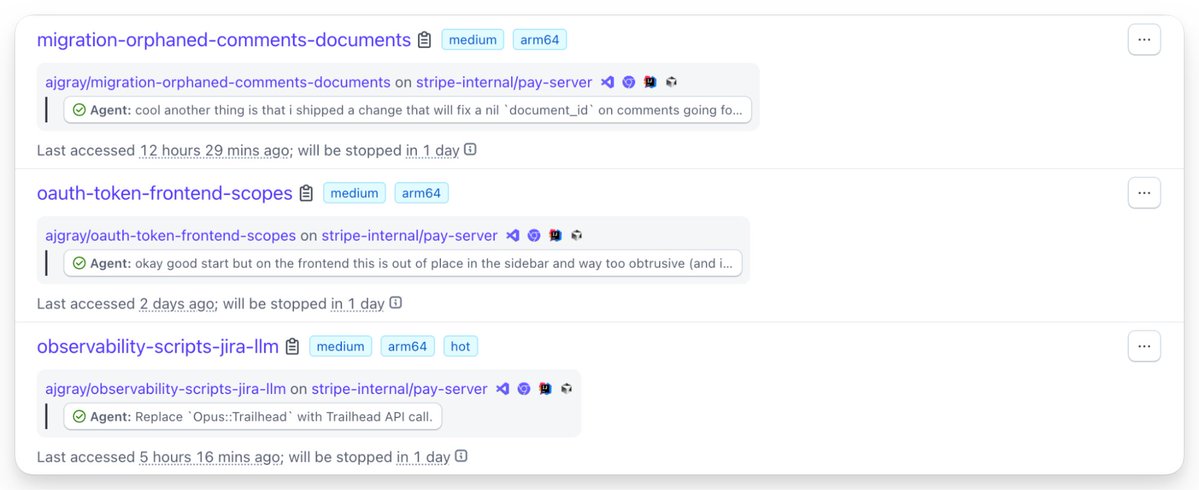
Over 1,300 Stripe pull requests merged each week are completely minion-produced, human-reviewed, but contain no human-written code (up from 1,000 last week).
How we built minions: https://t.co/GazfpFU6L4.