This is a slide from Terence Tao's 'Math 2.0' public lecture yesterday evening at Caltech. I am highly confident that, if the cure actually worked, almost any Stage 4 cancer patient would tell you that human comprehension of its mechanism is completely irrelevant to them.
Vibe formal verification won't get you far! Always check that your spec correctly models the verification target. The same for its properties. Then you can let the agents freely write the proofs for you.
The plot thickens.
"We show that the formalised Lean proof does not correspond to the [written paper] proof of blow-up of solutions to the Navier-Stokes equations."
https://t.co/02Q52MH81g
Mathematicians should also watch this. I’ve had a wonderful time chiseling proofs by hand, but folks need to accept that era is over and embrace the new one of exploring math with AI.
I used Opus 5.5 to formally verify the Claude Agent SDK using Lean. A couple short prompts = 16 PRs fixing various bugs and race conditions. Video attached.
TLA+ also works well. I sometimes combine Lean and TLA+ to look for issues around data flow, concurrency, and state mgmt.
I don't know either language well, but Claude is excellent at both. This approach is super useful for formally modeling your code and finding bugs that a human probably wouldn't have spotted.
Is formal verification the future of coding (or at least, bug finding)?
Arc Mainnet is live.
Arc launches as the Economic OS for the internet: an open platform for global markets, real-time value movement, tokenized assets, and agentic economic activity.
Arc is more than a blockchain.
It launches as a full-stack financial platform with assets, applications, interoperability, developer infrastructure, and Circle platform services live from day one.
Arc delivers USDC as native gas, deterministic sub-second finality, EVM compatibility, and institutional validators.
It integrates with Arc Studio, App Kits, Arc Portal, Circle Agent Stack, CCTP, Gateway, CPN, and StableFX.
A complete economic platform at genesis.
Arc launches with infrastructure for:
→ Agentic economic workflows
→ Lending and borrowing
→ Trading and liquidity
→ Onchain FX
→ Payments and settlement
→ Tokenized assets
→ Exchanges, wallets, custody, compliance, data, and developer tooling
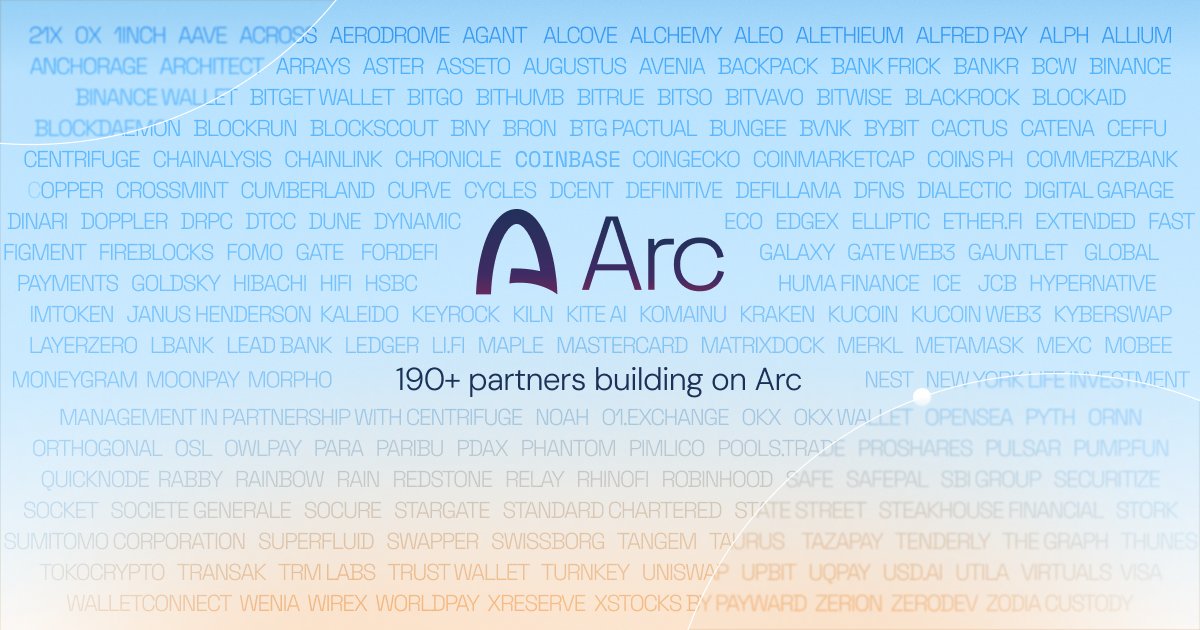
190+ institutional and ecosystem builders are building across Arc.
The TLA+ termination proof is an order of magnitude larger than the agreement proof (12k generated proof obligations vs 1183). More details are coming soon.
In the meantime, there's a new Tendermint-backed blockchain launching on Sept 16: @arc
The Tendermint protocol now has a formal, machine-checked proof of termination in TLA+!
Not just model checked on a finite instance. A complete proof, for any number of nodes in the network.
Until recently, liveness proofs like this were considered extremely hard, even with AI.
With LLMs, I can finally see formal verification becoming a requirement for publishing new distributed protocols.
Linking abstract specs to their implementations is still challenging but possible with techniques like model-based testing.
The gap between high-level formal specs like TLA+ and their implementations is well known. Nothing new here. Also, the article does not mention that there are formal techniques to close that gap, like model-based testing or proofs by refinement, or even program verifiers.
This is a cool blog post:
https://t.co/FwefCqDK0Q
The basic result is that running Antithesis on a bunch of Raft implementations still finds bug, despite formal verification at the protocol level.
Arc Mainnet launches September 16.
Arc is an open blockchain network being built for the world’s financial markets, real-time money movement, and agentic economic activity.
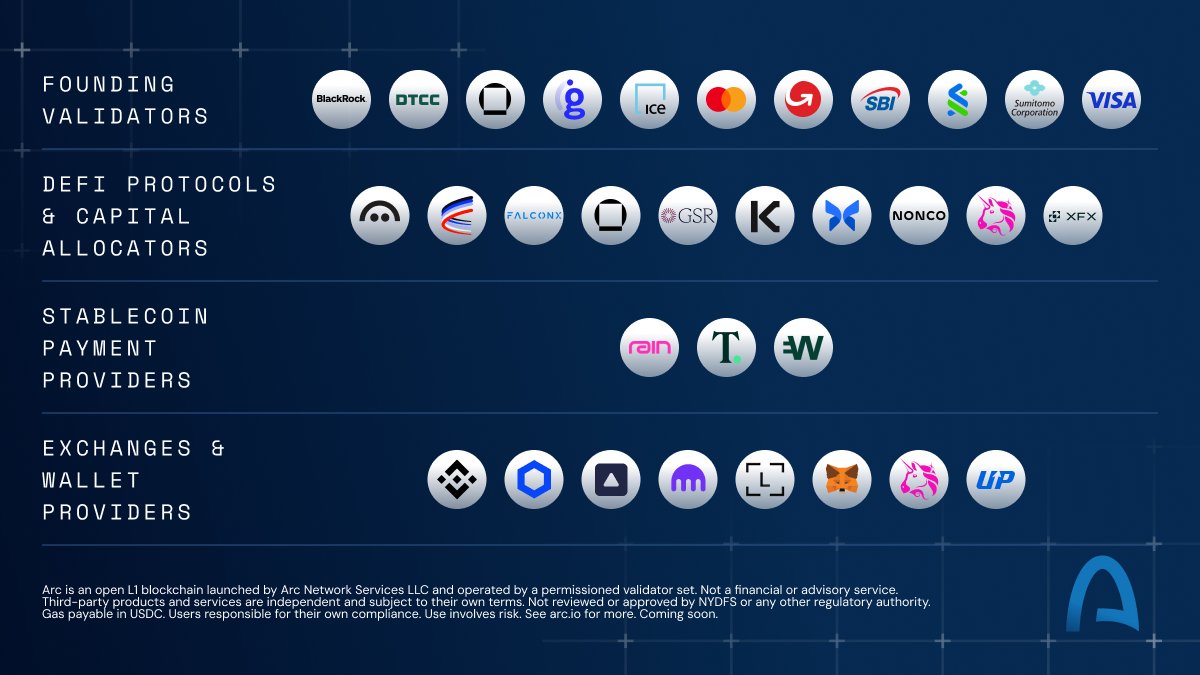
Arc’s founding validator cohort includes @BlackRock, @The_DTCC, @galaxyhq, @GlobalPayInc, @Mastercard, @MoneyGram, @ICE_Markets, SBI, @StanChart, Sumitomo Corporation, and @Visa.
This is a different model for onchain infrastructure: a network secured by the institutions building on it.
Arc is already gaining traction across major institutions.
@BlackRock, @BNYglobal, @The_DTCC, and @StanChart are each exploring integrations spanning tokenized asset settlement, custody, stablecoin access, FX, and repo infrastructure.
Arc is also expected to launch with a broad ecosystem across liquidity, payments, access, and infrastructure with more to come.
Liquidity / DeFi: @aave, @aeroxyz, @FalconXGlobal, @galaxyhq, @GSR_io, @keyrock, @Morpho, @nonco_otc, @Uniswap, @OfficialXFX
Payments: @raincards, @ThunesPayments, @wirexapp
Major Exchanges and Wallet Providers: @BinanceWallet, @chainlink, @FireblocksHQ, @krakenfx, @Ledger, @MetaMask, @Official_Upbit, @Uniswap
Participants building on Arc experience an open platform powering the world's financial markets, real-time money movement, and agentic economic activity.
Whether you're launching a financial application, integrating stablecoin flows, or experimenting with new, AI-powered economic models, Arc gives you the tools to build what isn’t possible anywhere else.
Arc Mainnet launches September 16.
https://t.co/lUb8kJRp2o
On the heels of the Privacy Sector announcement the other day, we're also publishing exciting research we've made on the Multi-proposer front
Introducing the Arc Multi-Proposer Protocol (AMP)
AMP brings (i) bounded inclusion and (ii) stronger ordering guarantees so that user flows on Arc have the best experience possible on decentralized infra
Brief explanation: Most network let a single validator decide what's in the next block and in what order. That discretion is where MEV lives, and it's the kind of discretion traditional markets explicitly regulate
AMP introduces a new role: proposers
Proposers have a super-power: they bundle user transactions into Payloads and broadcast them to validators. Once a Proposer talks to quorum of validators, then their Payload __must__ appear in the next block, in a fixed order. There is still a block assembler, but it no longer has discretion over what goes into a block.
If inclusion and ordering matter to your flows and your users, then AMP gives you a direct path to validators with protocol-enforced guarantees
We're actively looking for design partners! DM me, or subscribe here and we'll get back to you: https://t.co/Ft5F8DFlHl
As Arc approaches mainnet, we’re opening the network.
Starting today, developers can spin up a testnet node, inspect the code, and actively test and challenge Arc through our live bug bounty on HackerOne.
→ Arc Testnet code is now open-source
→ The Arc bug bounty is live on @Hacker0x01
→ Developers can run their own Arc nodes
Inspect it. Test it. Validate it.
Blog: https://t.co/C7aui0hEaa
Bug Bounty: https://t.co/9HBl9Ui8ds