AI Engineer | Building creative tools for creators/designers/artists |Learning in public | Open to AI Engineering roles | Psychology • Piano • Chess • Anime
In pursuit of greatness. No plan B.
> Self-directed AI/ML engineer,
> building in public,
> one system at a time
> until "founding engineer at a generative AI company" stops being a goal and starts being a fact.
✌️
I’m excited to finally announce the newest edition my Stanford course 𝗧𝗵𝗲 𝗠𝗼𝗱𝗲𝗿𝗻 𝗦𝗼𝗳𝘁𝘄𝗮𝗿𝗲 𝗗𝗲𝘃𝗲𝗹𝗼𝗽𝗲𝗿. It has been 9 months in the making.
Last November, with the release of Claude Opus 4.5, coding agents experienced a step function improvement in capability. We all felt it. The LLMs were more powerful, could reason for longer, solve harder tasks.
This year’s iteration of my course reflects the 2026 metamorphosis of software engineering.
My core belief is simple: AI-native developers of the LLM era are going to become the most important members of any software organization. I have designed my course to train this next generation of engineers.
𝗪𝗵𝗮𝘁’𝘀 𝗱𝗶𝗳𝗳𝗲𝗿𝗲𝗻𝘁 𝘁𝗵𝗶𝘀 𝘁𝗶𝗺𝗲 𝗮𝗿𝗼𝘂𝗻𝗱
First, 85% of my Fall 2025 class material is being thrown out. The Fall 2026 syllabus reflects the core capabilities AI-native engineers must have: agent skills, advanced context engineering, MCP portals, agent-ready codebase principles, agentic code review, security, parallelizing background agents, software factories, and more.
Second, I am going to teach my students how to have software taste. Every student will be required to ship pull requests to production-grade, real-world codebases. The course is collaborating with the top open-source AI repos who will offer support and mentorship to students on how to meaningfully contribute to their projects.
This has never been done before in any university course so I am incredibly grateful to our OSS Partners: @browserbase, @HeyGen, @CopilotKit, @semgrep, @OpenHandsDev, @milvusio, @marimo_io, Pi, @crewAIInc, @warpdotdev, @vercel, @cmux, @arizeai, @UnslothAI, and @anyscalecompute.
𝗪𝗵𝗮𝘁’𝘀 𝘀𝘁𝗮𝘆𝗶𝗻𝗴 𝘁𝗵𝗲 𝘀𝗮𝗺𝗲
I’m fortunate to again have AI software engineering leaders and founders as guest speakers to share their learnings from building top coding agent products. Thank you to @leerob from @cursor_ai, @bcherny of @claudeai code, @EnoReyes of @FactoryAI, @silasalberti of @cognition, @0xine of @semgrep, Rajesh Bhatia of @Cloudflare , @amasad of @Replit, and @eladgil.
All resources will be available online. All classes will be available to the public.
9/22 on Stanford campus. See you in class.
https://t.co/wTokHyUMsz
Interactive Linear Algebra — Chapter 1: Systems of Linear Equations & Vectors
Source: Interactive Linear Algebra (Margalit/Herman, Georgia Tech, Ximera)
1.1 What is linear algebra?
Linear → anything to do with lines.
Algebra → anything to do with solving for unknowns in equations.
1.2 Systems of linear equations
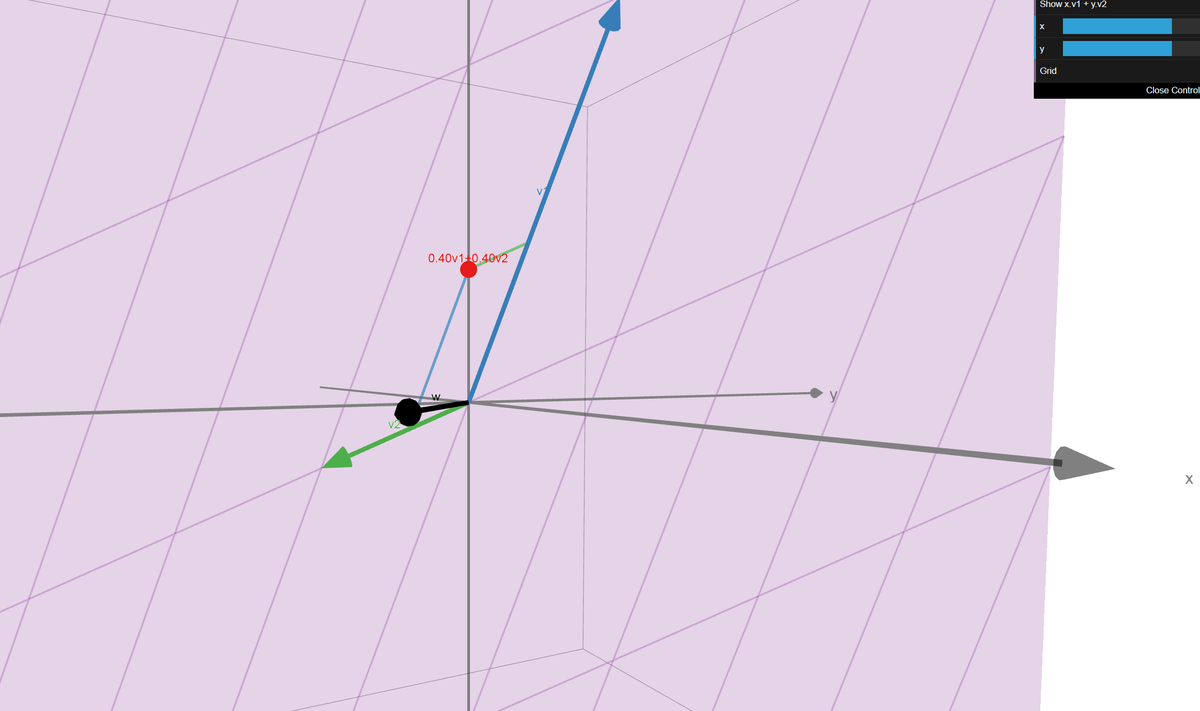
A linear equation in unknowns x, y, z, ... is a sum of constant multiples of those unknowns plus an optional constant, e.g.:
2x + 4y - z = 2
-x - z = 100
A system of linear equations is a collection of several linear equations considered together.
Solution — values of the unknowns that make every equation in the system true simultaneously.
Solution set — the collection of all solutions.
Solving — finding the solution set, usually expressed with some number of parameters.
A system does not need to have a solution. Example:
x + 2y = 3
x + 2y = -3
Here the solution set is empty.
Inconsistent system — no solutions.
Consistent system — at least one solution.
A solution to a system in n variables is a list of n numbers. E.g. (x, y, z) = (1, 2, 3) is a candidate solution to a 3-variable system.
1.3 Rⁿ: points, lines, planes, space
ℝ — the set of all real numbers (π, 3/4, -2.74, ...).
ℝⁿ — the set of all ordered n-tuples of real numbers (x₁, x₂, ..., xₙ). Such a tuple is called a point of ℝⁿ.
SpaceInterpretationℝ¹the number lineℝ²the xy-plane (Euclidean plane)ℝ³3D space
When a system has n unknowns, it's psychologically useful to view a solution as a single point in ℝⁿ.
1.4 Picturing solution sets
Line — a ray that is straight and infinite in both directions.
Plane — a flat sheet, infinite in all directions.
A single linear equation in n variables defines an (n − 1)-dimensional "plane" in n-space. E.g. x + y + z + w = 1 defines a 3-plane inside 4-space.
Two equations, two unknowns — three cases
Lines intersect at one point → unique solution (the intersection point makes both equations true at once).
Lines are parallel → no solution. E.g. x + 2y = 5 and x + 2y = -5.
Lines coincide (one equation is a scalar multiple of the other) → infinitely many solutions. E.g. x + 2y = 5 and 2x + 10y = 10 — both true at (0, 5), (1, 2), (5, 0), etc.
Free variables
For a system with more unknowns than independent equations:
number of unknowns − number of independent equations = number of free variables
1.5 Parametric description of solution sets
Solving "with parameters" means expressing the solution set using free parameters rather than a single fixed answer.
Example: x + y = 1 is the implicit equation of a line. Rewritten in parametric form:
(x, y) = (t, 1 - t), for any t ∈ ℝ
Here t is a parameter — it parameterizes each point on the line.
1.6 Row reduction
Two standard approaches to solving systems:
The elimination method
Augmented matrices + row operations
Three legal row operations:
Swap two rows
Scale a row
Row replacement (add a multiple of one row to another)
Row echelon form (REF)
A matrix is in row echelon form if:
All zero rows are pushed to the bottom.
The first nonzero entry in each row is strictly to the right of the first nonzero entry in the row above.
Every entry below a pivot is zero.
Theorem: every matrix is row-equivalent to exactly one matrix in reduced row echelon form (RREF) — provided the three legal row operations are used correctly.
RREF algorithm
1a. Swap row 1 with a lower row so the leftmost nonzero entry is in row 1 (if needed).
1b. Scale row 1 so its leading entry is 1.
1c. Use row replacement to zero out every entry below this 1.
2a. Repeat for row 2, using the leftmost nonzero entry in row 2 or below.
2b. Scale row 2 so its leading entry is 1.
2c. Zero out every entry below this 1.
... continue for each row ...
Last step: Use row replacement to clear every entry ABOVE each pivot,
working from the last pivot backward.
This is the forward pass (clear below pivots) followed by the backward pass (clear above pivots) — RREF requires both.
Pivot positions and pivot columns
A pivot position is an entry that is a pivot in some row echelon form of the matrix.
A pivot column is a column that contains a pivot position.
An augmented matrix corresponds to an inconsistent system if and only if the last column is a pivot column.
Two illustrative cases:
Pivot in every non-augmented column → unique solution.
Pivot in the last (augmented) column → no solution.
1.7 Parametric form — the recipe
For a consistent system in variables x₁, ..., xₙ:
xᵢ is a free variable if its column in the row-echelon form is not a pivot column.
Recipe:
Write the system's augmented matrix.
Row reduce to RREF.
Write out the corresponding solved system of equations.
Move all free variables to the right-hand side.
1.8 Implicit vs. parametric equations
Given the implicit system:
2x + y + 12z = 1
x + 2y + 9z = -1
The parametric form is:
x = 1 - 5z
y = -1 - 2z
(x, y, z) = (1 - 5z, -1 - 2z, z), z ∈ ℝ
This expresses every point on the line in terms of a single parameter z.
1.9 Number of solutions — three possibilities
For the RREF of an augmented matrix:
Last column is a pivot column → inconsistent (no solution).
Every column except the last is a pivot column → unique solution.
Last column is not a pivot column, and at least one other column also isn't → infinitely many solutions (free variable(s) present).
How have software engineering fundamentals changed with agentic coding? Here is our AI Engineering Skills map for software engineering fundamentals. https://t.co/cnRLj43DLs
🌻niji's Summer 2026 Begins🌻
We are holding a summer-themed image and video contest using niji·journey only!
Express a scene that evokes the feeling of summer through niji·journey, such as summer festivals, fireworks, wind chimes, sunflowers, towering summer clouds, evening coolness, verandas, seaside scenery, and more.
Submission Period:
Saturday, August 15, 2026 – Sunday, August 30, 2026, 23:59 JST
Judging Period:
Monday, August 31, 2026 – Sunday, September 6, 2026
Results Announcement:
Planned for around Friday, September 11, 2026
※ Please check the replies to this post for details on how to enter, the rules, and more!
#nijiSummer2026
Linear algebra note summary:
row echelon form → RREF → pivots.
The thing that clicked hardest: pivot positions are fixed properties of a matrix — but pivot values aren't. You can row-reduce the same system two different valid ways and land on different numbers in the pivot spots, yet the structure (rank, free variables, solution shape) never moves.
That structure is what actually matters. A matrix isn't really "a grid of numbers" — it's a compressed description of how many independent directions a system of equations actually has.
Second thing: free parameters in a solution set = unknowns − rank. Every parametric solution I wrote out this week was just that formula wearing different clothes.
None of this is decoration. This is the same object — a linear system's solution space — that shows up later as the null space of a neural net's weight matrix, and eventually as the structure diffusion models walk backward through when they denoise an image. Different domain, same skeleton.
current resource
3blue1brown, Math Academy method, Interactive Linear Algebra (Georgia Tech/Ximera) as primary text, Khan Academy running underneath as a gap-check.
Gate for this phase: derive gradient descent by hand and build linear regression with no libraries, no tutorial.
This is what "in public" looks like before there's anything flashy to show.
#buildinpublic #MachineLearning #LinearAlgebra
Yo
I'm inside of Imperium Academy
goal is to solve an actual problem for a client
depending on which problem I pick, it's likely along character consistency in image and video generation
Happy to get started
A 10 year-old boy from Japan discovered that butterflies can remember their time as caterpillars.
Jo Nagai noticed his caterpillars still loved him after turning into butterflies, and the affection he had for them led to a genuine scientific discovery.