Today the "circular financing" fear in AI dragged crypto down with it.
Not all of crypto is a funding loop, though.
I've held $BORG for years because SwissBorg is a real business: 1M users, $1.3B in assets, and it cleared Europe's MiCA bar while weaker tokens got locked out.
CONTEXT MANAGEMENT CAN KEEP AGENT LOOPS ON TASK BY RETAINING THE FILES, ERRORS, AND DECISIONS THAT MATTER NEXT
Prompt engineering is usually a human loop:
you ask, inspect the output, tweak the prompt, and send it again.
Loop engineering moves that repetition into the system.
Give an agent a goal, let it call tools, check the result, and decide whether the next action gets it closer to done.
Take a small bug fix:
run the test, read the failure, change the code, run the test again.
That sounds simple until the loop has no stop condition.
Then an agent can keep trying, keep consuming tokens, and keep increasing the bill without making progress.
Three parts make the difference:
1. A stop condition
Set limits for iterations, cost, time, or repeated failures.
2. Context management
Summarize old logs and retain only the files, errors, and decisions needed for the next step. A full context window makes agents drift.
3. Error recovery
A failed command should become structured feedback, not the end of the run.
LangGraph is one option for defining these states and transitions.
The work is no longer finding one perfect prompt.
It is designing a loop that knows when to act, what to remember, and when to stop.
Bookmark this before you need the workflow. Follow for the next breakdown worth keeping.
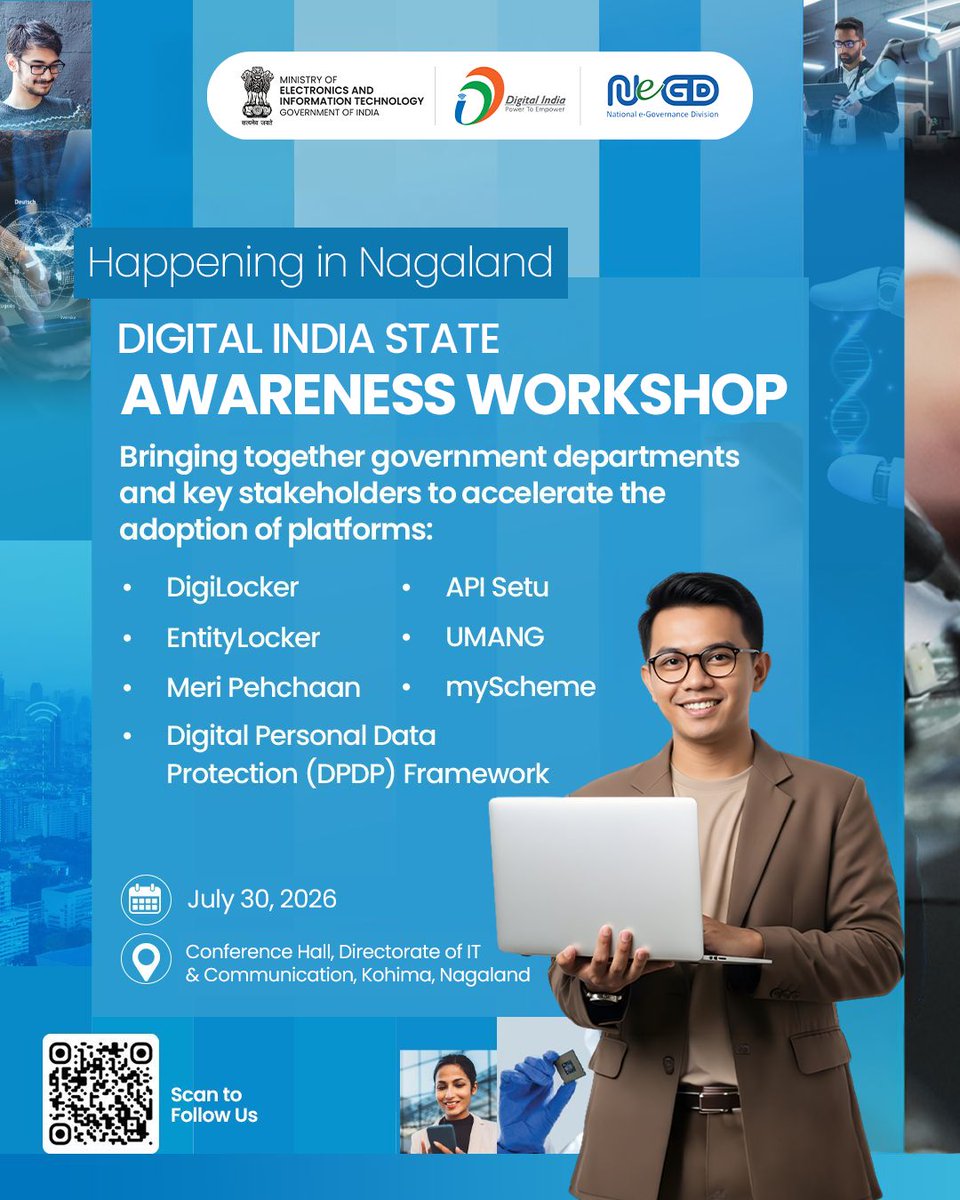
📢 Happening in Nagaland! Be part of the Digital India State Awareness Workshop on 30 July 2026 at the Conference Hall, Directorate of IT & Communication, Kohima. Learn about DigiLocker, UMANG, API Setu, Meri Pehchaan, myScheme, EntityLocker, and the DPDP Framework
#DigitalIndia
UPDATE: it's getting even worse.
It wasn't just chats.
Every app, dashboard, document, and tool people published as a Claude Artifact has also been getting indexed and surfaced publicly.
People have already found:
• Internal company dashboards
• Client project plans
• Clinical trial summaries
• Financial spreadsheets
• Employee payroll files
• Customer databases
• Contracts and legal drafts
• Personal health trackers
• Tax and banking documents
And here's the scary part...
Think about what developers actually put inside Artifacts while building things.
API keys.
Environment variables.
Internal documentation.
Product roadmaps.
Revenue models.
Private datasets.
Most people saw "Anyone with the link" and assumed it worked like an unlisted page.
They never expected search engines—and now third-party archive sites—to make those files discoverable.
If you've ever published a Claude Artifact, it's worth reviewing your published artifacts and unpublishing anything you don't want publicly accessible.
"Unlisted" and "not indexed" have never meant the same thing.
Bernard Arnault and Jensen Huang both joined X this week.
One is the richest person in Europe. The other runs the most valuable chip company on earth. Neither of them had X accounts before.
Arnault used his first post to respond to a 6-month Le Monde investigation into his family empire. No press release but a 1,500-word letter, signed, posted directly.
Jensen used his first post to publish an open letter on AI policy, co-signed by 24 companies including Microsoft, Meta, and IBM. He crossed 941,000 followers in 3 days.
This is the pattern now. Leaders who once controlled access through journalists and PR intermediaries are realizing that X gives them something traditional media never did: a direct line to the people who actually move markets, policy, and capital.
X has 550 million monthly active users as of March 2026, per the SpaceX S-1 filing. That number matters less than who those users are. The platform disproportionately holds the world's investors, founders, policymakers, and journalists. Influence here compounds differently than on any other platform.
Five years ago, a CEO joining Twitter was a brand exercise. Today it's a strategic decision about where power actually lives.
Sam Altman texts 300 to 400 people a day.
In a new interview with Ti Morse, he breaks down what actually runs OpenAI day to day. Operating in chaos. Learning to enjoy painful experiences on purpose. A small number of deep beliefs about the future instead of chasing every trend.
One line that stands out: “Google shouldn’t have let OpenAI survive.”
Another: “We are in the singularity.”
Full breakdown, timestamped, everything from how to start a startup to why he shut down Sora to focus entirely on Codex.
Follow @neil_xbt for more!
DEEPLEARNING. AI JUST RELEASED A FREE COURSE ON BUILDING AGENTIC KNOWLEDGE GRAPHS FROM SCRATCH.
Taught by Andreas Kollegger, Neo4j's Innovation Lead, published on Andrew Ng's platform.
Watch it today, then read the article below on how to become a graph engineer.
Save and bookmark this no matter what. It'll be the most productive thing you do this week.
[↓ Save this playbook before it disappears in your feed]
00:00 : What agentic knowledge graphs are and why agents need them
03:07 : How to construct your first agentic graph
14:00 : How multi-agent systems get architected on top of graphs
23:00 : How to build agentic graphs with Google's ADK
01:06:03 : Why graphs are the future of agentic AI
If you’re serious about building and automating with AI, watch this first.
this is one of the best Claude Cowork tutorials I’ve come across.
it is by Tina Huang ( ex-Meta data scientist).
she explains the entire workflow in under 25 minutes without overcomplicating anything.
definitely worth bookmarking.
#Crypto is showing clear signs of stress.
Centralized Exchanges are shutting down one by one.
❌ @BitMEX $BMEX
❌ @BitMart $BMX
Who's next?
@bitget $BGB, @Bybit_Official or @binance $BNB?
Or do you think they're strong enough to survive this cycle?
Drop your thoughts.
If you think your investment is underperforming...
Remember this:
🇮🇳 The Reserve Bank of India reportedly spent $6.2B in May 2026 trying to support the Rupee.
Yet, the Rupee is once again trading near its weakest level on record.
Sometimes even billions aren't enough to fight market forces.
Is AI Making Us Dumber? 🤪
💬 Research suggests offloading mental work to AI is like debt: an immediate payoff with long-term consequences. But collaborating with the technology may boost our work without eroding skills.
https://t.co/4wk7EIjG2G