Banning Anthropic's latest model would push everyone to adopt open-source models, which are lagging behind flagship proprietary models by only 3 months.
You can't rely on external models and risk your access revoked at a whim.
_
Sentiment is saying the bottom of this pullback is close if not in already. Again not a precise timing indicator but AAII bulls just dropped to the same level as when the Iran mess started!
I also noticed an uptick on some of the put/call measures I watch so it would seem the wall of worry is still firmly in place. None of this is consistent with a market that is going to melt down, let alone even top.
A toothpaste company has quietly killed the entire market research industry and nobody is talking about it.
Colgate published a paper showing you can predict real purchase intent at 90% accuracy by simply asking LLMs to roleplay customers.
And this is beyond insane.
If you ask an AI, "Rate this product from 1 to 5," it gives safe, middle-of-the-road garbage.
So researchers invented a method called Semantic Similarity Rating (SSR).
Instead of asking the AI for a number, they asked it to roleplay.
They gave the LLM a demographic profile. They showed it a product concept. And they asked it to write down its raw, unfiltered thoughts.
Then, they used a semantic model to translate those written thoughts into a numerical score.
The results are staggering.
Tested against 57 real corporate surveys and 9,300 actual human responses, the synthetic AI consumers matched real human buying behavior with 90% reliability.
They perfectly mirrored how different age brackets and income levels react to price changes.
And they provided detailed, qualitative feedback that was deeper and more critical than what actual humans wrote.
This destroys the economics of traditional market research.
You don't need to wait a month to see if a product will sell.
You can simulate 1,000 hyper-targeted customer interviews overnight.
You can A/B test pricing across every demographic instantly.
Kevin Warsh's view is clear: AI will eventually force interest rates lower because it will be highly deflationary.
"AI is going to make almost everything cost less. We're at the front end of a productivity boom."
The problem is that today's economy is telling a different story.
Inflation is at 4.2%, its highest level in three years.
Tensions with Iran continue to threaten oil supplies.
The labor market remains strong.
AI may be deflationary in the long run, but the Fed has to deal with today's inflation first.
I don't expect a single rate cut before the end of 2026.
Cost basis is so important.
Most leading stocks that made big moves over the past month pulled back 20–25% without breaking any key levels or major moving averages.
This is where cost basis matters when evaluating whether to sell.
If you have a major cost basis advantage, a 25% drawdown in a stock you’re still up 120% on doesn’t feel nearly as painful as it does for someone who chased and has no cushion.
A strong cost basis gives you the ability to sit through volatility.
A stock can go up 100% in six weeks, pull back 25%, and only return to where it was a week or two weeks earlier. Can feel dramatic but in the context of a powerful uptrend it can simply be normal digestion.
Fun fact of the day
This is not the 1970s!!
Wall Street economists still don’t get it.
Raising rates does nothing to fix the relative price shifts caused by a supply shock. Their fear that second- and third-order effects will trigger a 1970s-style inflation spiral is based on flawed economics.
Kevin Warsh understands this. Most of them don’t.
About 8 months ago, I warned that “Anthropic is running a sophisticated regulatory capture strategy based on fear-mongering.” This take was controversial at the time; now look how many people are saying it.
Our Anthropic bill is about to jump from $400K → $1.4M/yr.
Not because usage exploded, but because we're about to cross 150 seats.
Past 150 seats you're forced into Enterprise tier. Seats stop including any usage, every token bills at standard API rates. At our current run rate that's 3.5x overnight.
Unfiltered thoughts on AI spend:
1. We should spend tokens to grow as aggressively as possible. But most people (me included) aren't conscious of what they're spending.
2. Visibility comes first. People see their personal number and they're shocked. I accidentally spent $4,000 in 3 days in Claude Code.
3. For engineering the spend is clearly worth it. Pay for the best model, it saves more than it costs.
4. For a lot of other roles it's questionable. Apps nobody uses, skills someone already built. No ROI.
5. Spend limits are coming. We already require approval for more tokens on our support team.
The era of token-maxxing is coming to an end.
Here's the problem with SPCX, and no analysis can solve it.
There is no chart.
We have three rules for every IPO:
– Never buy on day one
– Wait for the "Good Chart" to form, enough price history to read trend, support, and the real level
– Ask whether you'd buy at this price if it were already listed
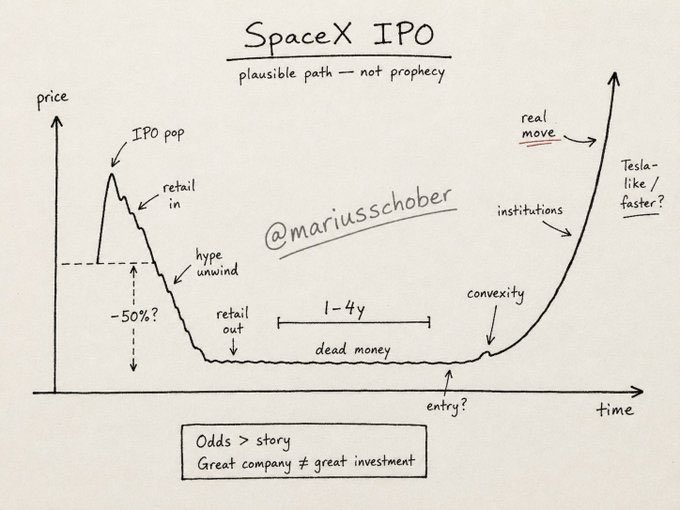
So look at how these stories usually trade. A pop as retail piles in. A long grinding melt as expectations meet reality, often down 50% or more. Then dead money, one to four years of nothing while the company grows into its valuation. And only then, the real move.
Amazon fell almost 90% after listing before it became Amazon. The class of 2021 was brutal: Robinhood -92%, Coinbase -92%, Rivian -95%, Oatly -97% from their day-one highs.
A great business and a great investment are not the same thing. The price you pay decides which one you get.
SpaceX may well be the most important company of the next fifty years.
Which is exactly why there's no rush to overpay on the first afternoon.
The rocket launches today.
The Good Chart launches later.
We'll wait for it.
Full breakdown in this week's Weekly by arvy.
Link via bio.
BREAKING: China bought +10 tonnes of gold in May, the largest monthly addition since January 2025.
This follows +8 tonnes acquired in April, marking their 3rd consecutive monthly net purchase.
China has now bought gold for 19 consecutive months, the longest streak since at least 2015, when its central bank began publishing more regular data on its gold reserves.
This brings China's official gold reserves to a record 2,331 tonnes, worth over 9% of their total FX reserves.
The country is also the 3rd-largest central bank buyer year-to-date, after Poland and Uzbekistan, with a total of +27 tonnes added.
China’s demand for gold is accelerating.
The assets the entire world buys to protect against war and inflation just did the exact opposite of what they were supposed to do.
Gold hit an all-time high of $5,600 on January 29, up 31% in just 29 days, adding $9 trillion to its market cap.
Silver hit $121 the same month, up 68% in 29 days, adding $3.5 trillion to its market cap.
Every safe haven buyer was positioned perfectly.
Then the US-Iran war escalated in February, the Strait of Hormuz closed, oil hit $93, and inflation climbed to 3.8%. These are exactly the conditions gold and silver are supposed to thrive in.
Instead, gold has now crashed 23% from its peak, wiping out $8 trillion in market value.
Silver crashed 44%, wiping out $3.5 trillion. Both are now negative for 2026.
The Fed uncertainty made it worse.
Kevin Warsh takes his first policy meeting on June 16 with no clear direction, historically the exact environment where gold surges. It is still falling.
$11.5 trillion wiped out from the two assets the entire world holds specifically for moments like this.
Good take
My guess is
- demand for intelligence is near infinite
- but 80% of workloads will be running on 99% cheaper models within 12-18 months
- 20% of workloads will still run on latest gen models where IQ maxing is important (scientific breakthroughs, higher level ochestrator agents?)
- rough analogy might be what % of macbooks or gaming PCs sold have the maxed out specs for CPU/GPU, prices are falling much faster than Moore's law here though
- this leads me to think the limiting factor will be energy and compute, not better models
At Coinbase we're working hard on routing prompts to cheaper models where appropriate, and in some cases have been able to keep costs roughly flat, while token usage continues to grow exponentially.