Yann LeCun has changed the game for robotics.
His team discovered that AI world models are "thinking" in twisted, curved geometry, and every RL algorithm you know has been fighting against it without anyone noticing.
For years, we’ve been trying to teach AI how to navigate the physical world.
And for years, it has stubbornly struggled with complex, fluid robotics.
Now we know exactly why.
Every standard reinforcement learning (RL) algorithm assumes the AI's internal "world map" is flat. Euclidean. Simple straight lines.
But LeCun's team looked inside the latent space of these advanced world models.
The AI wasn't building a flat map. It was building a curved, high-dimensional geometry.
Every time a robot tried to plan a movement, the traditional RL algorithm was forcing a straight line onto a twisted, non-Euclidean space.
It’s like trying to navigate the globe using a flat piece of paper.
The math breaks down. The distances get distorted. The AI gets confused.
The robot was literally fighting its own brain.
So, the researchers did something brilliant. They stopped fighting.
They rewrote the RL algorithms to operate natively in this curved geometry. They aligned the training to the exact shape of the AI's thoughts.
The results are a massive leap forward.
When you let the AI plan in the geometry it actually built for itself, training efficiency skyrockets. Planning becomes fluid.
Robots stop hallucinating impossible physics and start moving with natural, intuitive logic.
We spent billions of dollars trying to brute-force AI into understanding our physical world.
It turns out, the AI already understood it perfectly.
We were just forcing it to think flat.
Today we’re unveiling Odyssey-3, a big step forward for foundation world models.
It can control robots, power humanoids, drive cars (on the roads of India!), train AIs, pilot drones, and even play video games.
We can’t wait to see what intelligent systems it enables.
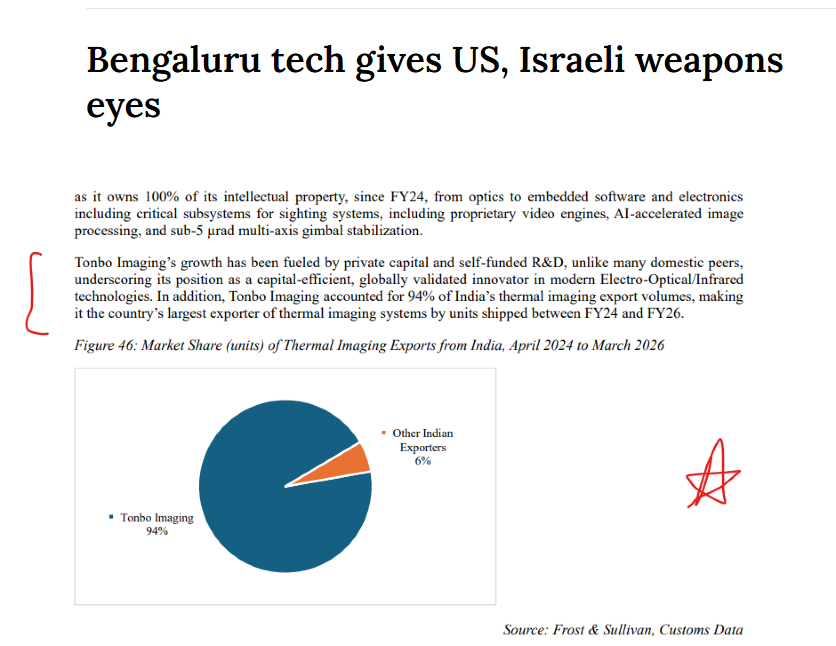
Indian Army found out about Tonbo Imaging because US Army soldiers were already using Tonbo weapon sights during joint exercises with NATO.
Founders previously worked at US Department of Defense. They built world class products first and sold in India second. Indian commandos used Tonbo night vision during 2016 surgical strikes across border. Systems also went to soldiers at Pathankot attack and at Ladakh border.
Most Indian defence companies sell at home first then try abroad, Tonbo did opposite and 65% of revenue comes from exports.
Most advanced military optics and sensors in world are controlled by US rules called ITAR, which means you need US government permission to sell them abroad.
Tonbo Imaging builds its own products that are free from these rules, so it can sell to any military anywhere. Company makes 93% of all thermal imaging gear that India exports. It sold 20,000 plus systems to 24 countries including NATO allies.
Qualcomm Ventures invested in it. Tonbo owns all its technology and does not depend on any foreign company for parts or designs.
This is best part below >>
Tonbo started by making weapon sights that help soldiers see in dark. Now it builds missile guidance systems, fire control computers, and missile seekers, far more complex and valuable products.
Company has only 293 employees total and sends manufacturing to Kaynes Technology and Avalon. It keeps all design, testing, and technology rights with itself. As orders grow, company does not need to build expensive factories.
Research done today turns into military contracts 3 to 5 years later and Tonbo has been investing for over 20 years.
https://t.co/PmBsssLNQd
DHRP -https://t.co/82Z3Gg5CBh
Everyone in the Bay is building a robot company. Almost nobody is talking about the real bottleneck.
After 2 years running the Robotics Center of Silicon Valley, seeing hundreds of frontier labs and stealth startups, one pattern is undeniable:
The blocker isn't model capability. It’s the sim-to-real loop.
1. Simulation ≠ Hardware Reality A VLA trained in Isaac Sim or MuJoCo hits a wall when it encounters real-world actuator limits: thermal throttling, joint backlash, and sensor drift. Even two units of the exact same robot model have completely different dynamics.
2. Teleop data is inherently off-policy Human demonstrations bootstrap your model, but your model isn't human. That distribution gap doesn't disappear with more of the same data. It only closes through real-world rollouts, failure capture, and targeted data collection.
3. "Working" is undefined until deployment Teams optimize for lab success rates, then fail on real-world edge cases: a wrinkled shirt, 4 PM glare, or a pallet 3cm off spec. Without a real-world evaluation harness, you are just guessing.
4. The solution? Treat RL² as your core loop Internally, we call this Reinforcement Learning in Real Life.
Deploy ➔ capture failures ➔ evaluate against real criteria ➔ collect targeted data ➔ redeploy. Continuous learning on real hardware.
5. The Takeaway The winners in Physical AI won't just have the biggest models. They'll be the teams that can close the real-world learning loop the fastest. Closing the sim-to-real gap is a 2-year infrastructure problem. That’s why we built our stack at the Robotics Center.
6. Come hang out If you're hitting these exact walls, let’s compare notes.
We host robotics builders at 90 Welsh St (SF) every Friday. Drop by.
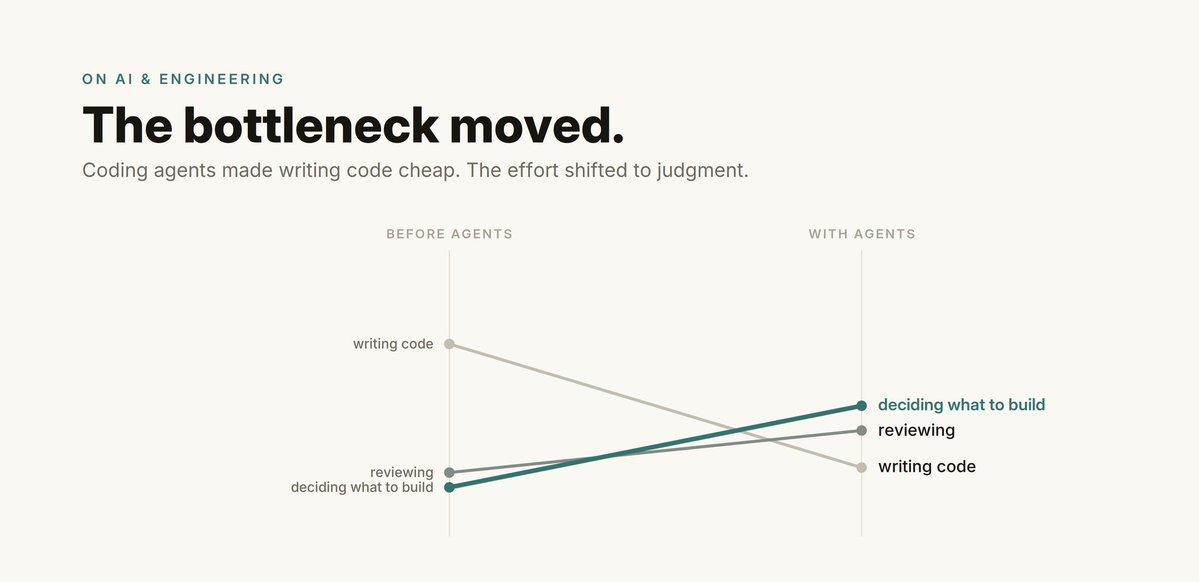
Writing code used to be the hard part
With coding agents, generating it is almost free. The hard part moved downstream, to reviewing what the agent wrote & deciding what shouldn't be written at all
The strongest engineers I'm seeing right now aren't the ones shipping the most AI generated code. They're the ones who treat every diff like it's going to production (because it is), write specs precise enough to be testable & delete more than they accept
The tooling changed. The judgment is still the job
📣 Introducing the Qwen-Robot Suite — Qwen-RobotNav, Qwen-RobotManip, Qwen-RobotWorld, three foundation models, a full stack for embodied intelligence.
🧭 Qwen-RobotNav — the gateway to mobility.
• Unifies 5 navigation tasks in one model: instruction following, point-goal, object-goal, target tracking, autonomous driving
• Controllable observation protocol
• Tool interface for agentic systems
🤖 Qwen-RobotManip — the foundation of interaction.
• Unified state-action space across heterogeneous robots
• Camera-frame delta poses for coherent cross-embodiment training
• Pretrained on a 38,100+ hour open-source corpus
🌍 Qwen-RobotWorld — infinite worlds for physical agents.
• Single world model, 20+ embodiments
• Natural-language action interface
• Predicts physically grounded futures across manipulation, driving, and navigation
Each model is independently useful, and could be composed as physical-world tools.Together, they form the low-level toolkit for general-purpose agentic systems that don't just see the world, but act in it.
📷 Blog:
https://t.co/ytLcbYET26
📖 Report:
Qwen-RobotNav: https://t.co/uPmSwDYGxg
Qwen-RobotManip: https://t.co/GeyIzJSpU8
Qwen-RobotWorld: https://t.co/SXPH1qzDFy
BREAKING 🚨: call centers are officially dead.
a 95 person startup just took the #1 spot in BOTH text to speech and speech to text. at the same time. nobody has ever done that.
ElevenLabs raised $781M. Cartesia raised $100M and beat them.
here's why every voice agent will run on Cartesia 🧵
Today, we enable AutoResearch in the physical world for the first time! Introducing ENPIRE: we give 8 Codex agents a fleet of robots, an allocation of GPUs, and generous token budget. We set them free with a simple goal: solve the task as quickly as possible, keep the robots busy but stay safe, don't waste precious compute. Make no mistake.
Then humans step aside and our watch begins. The robot fleet starts to come alive: they learn to look for visual clues, reset the scene, practice novel skills, tinker with control stack, read papers online, debate, reflect, get stuck, and try again directly on the hardware. All we did is to give Codex an API to the world of atoms, and the rest is emergence.
ENPIRE is able to solve high-precision tasks like tying zip-ties, organizing fine pins, and installing GPUs all by itself. We also discovered a new type of "physical scaling": 8 robots exploring in parallel improves significantly faster than fewer ones.
A part of our NVIDIA GEAR lab now self-improves tirelessly over night. We just read the reports in the morning.
/goal: we all take a holiday and Jensen wouldn't even notice ;)
We will be open-sourcing everything, so you can host your self-running robot lab at home too! Deep dive in the thread:
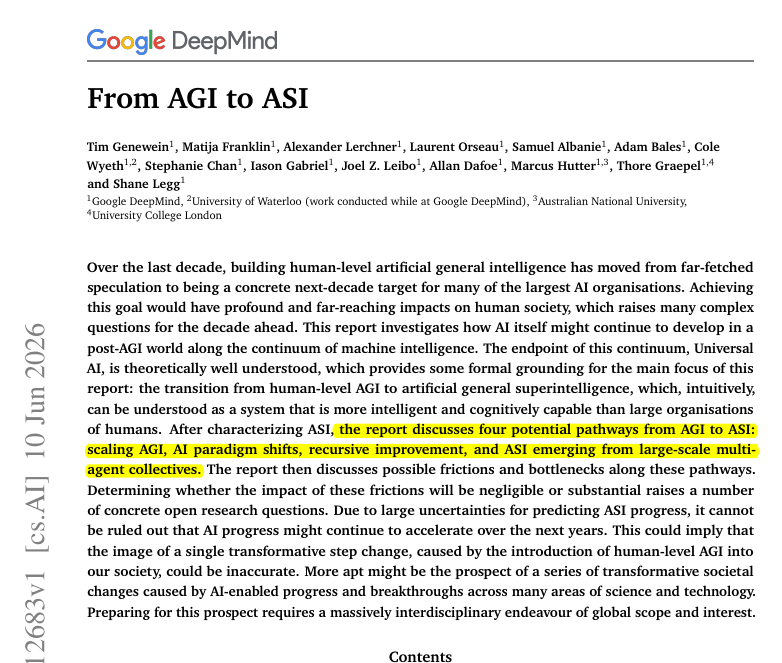
Beautiful paper from Google DeepMind.
Explains the pathways from AGI to ASI, and why that jump could happen through several routes.
The authors frame the AGI-to-ASI transition around 4 technical pathways:
- continued scaling of compute, model size, data, and test-time inference;
- algorithmic paradigm shifts beyond today’s transformer-based foundation-model stack;
- recursive self-improvement, where AI accelerates AI R&D and improves future systems; and
- multi-agent collective intelligence, where large populations of specialized agents coordinate into a superhuman group agent.
Scaling may work for a while, but it could hit limits in data, compute, energy, or weaker returns from making systems larger.
Recursive improvement is the most uncertain path, because AI could speed up AI research, but that loop may also slow if hard research problems need real-world testing, scarce hardware, or new ideas.
Multi-agent collectives may be the most underappreciated path, because a society of competent digital workers could outperform a brilliant individual model through specialization, speed, and coordination.
The big point is that ASI may not arrive as 1 sudden event, but as a chain of faster changes as AI helps create better AI and stronger scientific tools.
----
Link – arxiv. org/abs/2606.12683
Title: "From AGI to ASI"
Introducing DiffusionBlocks: Block-wise Neural Network Training via Diffusion Interpretation
https://t.co/c9AvsRKybj
What if we didn’t have to hold an entire neural network in memory to train it?
Standard neural net training optimizes all parameters jointly. As a result, the memory required during training grows linearly with the depth of the network.
In our #ICLR2026 paper, we propose DiffusionBlocks, a principled framework to train networks one block at a time, drastically reducing memory requirements while matching end-to-end performance.
With DiffusionBlocks, we split the network into blocks and train them one at a time, so you only need memory for a single block.
How? We explicitly assign each block a role: to move the representation a little closer to the target than the block before it did. That role turns out to be precisely what a diffusion model does, step by step. Each block only needs to optimize its own objective and can be trained independently.
We validated this across five different architectures:
• ViT
• DiT
• Masked diffusion
• Autoregressive transformers
• Recurrent-depth transformers
In each case, performance is competitive with end-to-end training while using a fraction of the memory.
This perspective also extends naturally to recurrent-depth (Looped) transformers, which apply the same network iteratively and normally require expensive backpropagation through time (BPTT). Viewed through DiffusionBlocks, we can replace those multiple iterations with a single forward pass during training.
Read our paper and code, to learn more.
Paper: https://t.co/CRj96VGYQn
GitHub: https://t.co/eNW0K9Xh8E
🐟
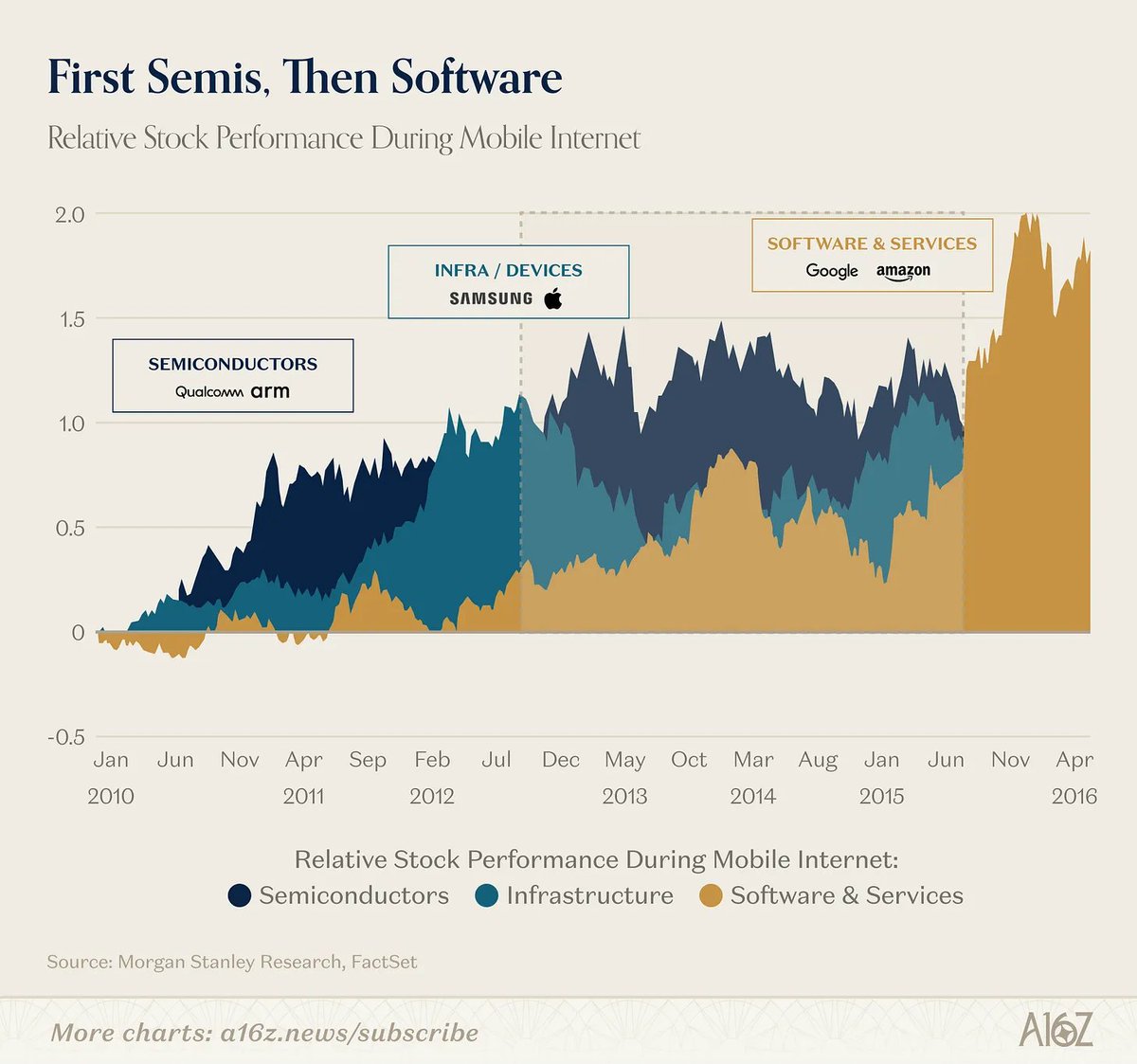
OpenAI and Anthropic are effectively telling the market they can't solve every problem with a generic AI coworker.
You don't pour billions into massive forward-deployed joint ventures if you think the next model release is going to take care of it.
In the cloud supercycle, semis led and software followed (and you didn't need Qualcomm or ARM to tell you the value was migrating up the stack).
In AI, the infra layer itself is telling us the application layer is a separate, massive opportunity they can't fully capture.
a16z's @joeschmidtiv on why the app layer isn't dead: https://t.co/84QN5Mj9T3
The AI numbers are starting to look very ugly.
Even under "best case" assumptions, FT's own data shows Microsoft AI ROI at -9%, Google at -15%, Meta at -28%, Oracle at -35%. Only Amazon barely comes out positive.
This is exactly why I keep comparing this to the dot-com era. Incredible technology does not automatically mean sustainable economics. The internet survived. Most internet companies didn't.
Right now hyperscalers are spending trillions hoping future demand catches up to present capex. That's not certainty. That's a leveraged bet.
Germany is a sleeping giant of physical AI
everyone's been writing Germany off in the AI race because there's no German OpenAI and no big data center story.
but theres actually two AI races happening:
the first is software. chatbots, LLMs, data centers. US/China are winning that, not even close.
the second one is physical. robots that pick up boxes, weld cars, carry groceries, stack pallets.
and on this one Germany is one of the top contenders in the world
this stat might convince you (it convinced me):
Germany is 3rd in the world for robots per factory workers (449 robots per 10,000 human workers).
only South Korea (1,220) and Singapore (818) are ahead.
Japan is behind at 446. the US is all the way back at 307.
so Germany already runs more of its economy on robots than almost anywhere else on earth.
and the German companies building this next wave of physical AI are some global heavyweights.
a few worth knowing...
> Neura Robotics in Metzingen is building humanoid robots and raising €1B from Tether at a €4B valuation (this was March 2026). Volvo already in from an earlier round.
> Sereact in Stuttgart raised $110M in April 2026 to build the software brain that lets robots see and grab things. already runs 1 billion+ real-world picks for BMW, Mercedes, and Daimler Truck.
> Agile Robots in Munich was the worlds first robotics unicorn. revenue doubling yearly, around €200M now, heading for €1B.
>RobCo in Munich raised $100M in early 2026 at a ~$500M valuation. their robots learn new tasks by watching a worker do it once instead of getting programmed line by line. already pushing into the US and aimed at the small and mid-size factories that make up most of german industry.
> Fraunhofer (Germany's network of 76 applied research labs) built the evoBOT in the video below. self-balancing, two arms, carries 100kg of cargo, being tested at Munich Airport right now.
but why is Germany specifically well positioned for physical AI though?
three things stack on top of each other.
first, the factories. Germany has thousands of family-owned precision manufacturing shops that have been logging sensor data for decades.
that data is basically the training fuel for physical AI and almost nobody else has it at this depth.
second, the customers are already there in-country.
VW, BMW, Mercedes, Porsche, Bosch, Siemens. a robotics startup in Stuttgart can ship its first commercial deployment to a brand everyone recognizes in year one.
that's why Sereact's customer list reads like a german car show lol.
third, the engineer pipeline. Fraunhofer spins out companies like Agile Robots straight from its labs. KUKA built the first 6-axis electromechanical robot arm back in 1973. they've been doing this for 50 years.
so the chatbot race is mostly settled and Germany lost spectacularly
but the robot race is still early innings. and i think Germany's well positioned
Fei-Fei Li (
@drfeifei
) beautifully explains Robotics.
She defines robotics not by form, like humanoids or cars, but by function: they are any "embodied machines" that must perceive, understand, and act within a physical, 3D space.
This core requirement is "spatial intelligence," the unifying principle of all robotics, allowing them to perform tasks and even collaborate with humans.
Throughout all of human history, we have been confined to a single, shared reality: the "physical Earth 3D world."
This singularity has been our only playground.
However, new technologies that combine 3D generation and reconstruction are shattering this limitation.
We can now create "infinite universes"—a multiverse of digital worlds for countless purposes, from training robots to enabling creativity, travel, and storytelling.
This leap from one physical world to an infinite multiverse unlocks boundless possibilities for human imagination and interaction.
Video from @a16z
Godfather of AI: "If you sleep well tonight, you may not have understood this lecture."
This 47-minute lecture is the best thing I saw about AI in the last few months.
It will definitely help you understand how it actually works and where it's going.
Geoffrey Hinton built the neural networks behind every AI alive, then quit Google to warn the world about it.
The part nobody wanted to hear:
> AI is already developing abilities its creators didn't intend
> in most cognitive tasks it's already ahead of us
> the question is no longer if it surpasses us but when
> the only decision left is which side of that line you're on
Right now the average person opens Claude, types something, gets an answer, closes the tab.
They think they're using AI. they're using maybe 10% of it.
I went through his entire lecture, built a practical system from what he was describing.
18 steps to actually use Claude the right way, with copy-paste prompts that work today.
Full guide in the post below.
AI has a "Dark Matter" problem.
And it’s the reason why even the smartest models still hallucinate.
Most scientific knowledge is stored in a "compressed" form. We see the final conclusion, the textbook formula, the Wikipedia claim, the polished result.
But the actual reasoning? The step-by-step derivation that makes that fact true?
It’s omitted. It’s "intellectual dark matter."
China published a paper that attempts to decompress the entire world of science.
They’ve built SciencePedia.
Instead of scraping the internet for facts, they built a Socratic agent to generate 3 million first-principles questions across 200 different scientific courses.
Then, they forced multiple independent AI models to generate "Long Chains-of-Thought" (LCoT) to answer them.
They didn't just ask for the answer. They demanded the full logical scaffolding.
Here is the part that changes how we think about knowledge:
They built a search engine that doesn't look for keywords. It performs "Inverse Knowledge Search."
If you query a concept, it doesn't give you a summary. It retrieves the diverse, verified reasoning paths from physics, chemistry, and biology that all culminate in that single point.
It reveals the hidden connections between disciplines that have been siloed for decades.
The results are a direct hit to the current "vibes-based" AI era:
- Articles synthesized from these verified chains have significantly higher "knowledge density."
- Factual error rates plummeted compared to standard models.
- The AI no longer just "believes" a fact because it saw it in training; it proves it from first principles.
We’ve spent years training AI to mimic how humans talk about science.
But talking about science is just repeating conclusions.
This paper proves that the future of intelligence is about reconstructing the logic that built it in the first place.
robotics needs better talent, not just ideas or capital
get good at any of these and become the person every robotics team is trying to hire:
autonomy stack:
– state estimation, planning, controls or the in‑house stack nobody else can touch
sim & test infrastructure:
– lossless logs, reproducible sims, rl loops (nvidia isaac sim, gazebo, mujoco)
fleet ops & deployment:
– ota updates, connectivity, getting data off robots in the field (greengrass, alloy, formant, or duct tape)
data, debugging & replay:
– figuring out why the robot did what it did, logs, time‑series, post‑mission analysis (mostly homegrown, rerun/foxglove, alloy)
embedded & edge systems:
– getting all of this to run on jetson / rb5 / weird industrial pcs
safety, compliance & verification:
– kill switches, test harnesses, ethics boards, fda submissions, and the standards work nobody wants to do
data engine & labelling:
– building the labelling, eval, and feedback loops that keep the robot from drifting into chaos
go to market & raas:
– pricing, contracts, usage‑based billing, customer success for robots‑as‑a‑service
if you’re trying to jump into robotics (or want to work with us), my dms are open 🦾