@GergelyOrosz The "tool" looks almost the same for everyone.
But in the hands of Kent Beck, it's gonna produce beautiful poetry and in someone else's hands, it'll produce plausible rhymes.
The tool itself is easy to learn and master. Software fundamentals still aren't.
@GergelyOrosz I was watching a presentation from someone at SpaceX AI and he said that he's still "team code review".
Now that got me thinking: you can be the most AI pilled person but what's still (more) important is understanding of software and systems.
It's fascinating how @alexandr_wang's 200 direct reports or my 120 direct reports (in the Xtreme Labs days) looks so much like the old Pivotal Labs 2-6 ppl pairing pods ���
* super small expert generalist teams
* high fidelity IRL collaboration
* prototyping w/ code over specs
* high intensity
* unscheduled 1:1's vs. scheduled
Cloudflare is taking ownership of tsrs, a port of TypeScript to Rust. It's 8x faster and uses 70% less memory than TypeScript 7.0.
We are not forking TypeScript – we are working with the TypeScript team and as a result 7.1 is already ~2.5x faster, too.
https://t.co/eXF9NzufID
@Lethain Why do you have a frontend monorepo and a backend monorepo?
Doesn't it defeat the purpose of a monorepo where frontend and backend are in the same repo?
Different language stacks, maybe?
@thorstenball@algo_luca For us, the ergonomics of having coderabbit etc run on pull requests is easier. We have no other reason.
I wrote about our process here: https://t.co/EZOrBzTawM
(Btw, big fan of the both of you and Rust)
@lox@thorstenball This. We do trunk based development as well. The PR is used to enforce linting and run the test suite before (automatic) merge. The coffee review bots also work best with PRs IMO.
Knowledge sharing? Naah. We do mobbing on the trickiest stuff
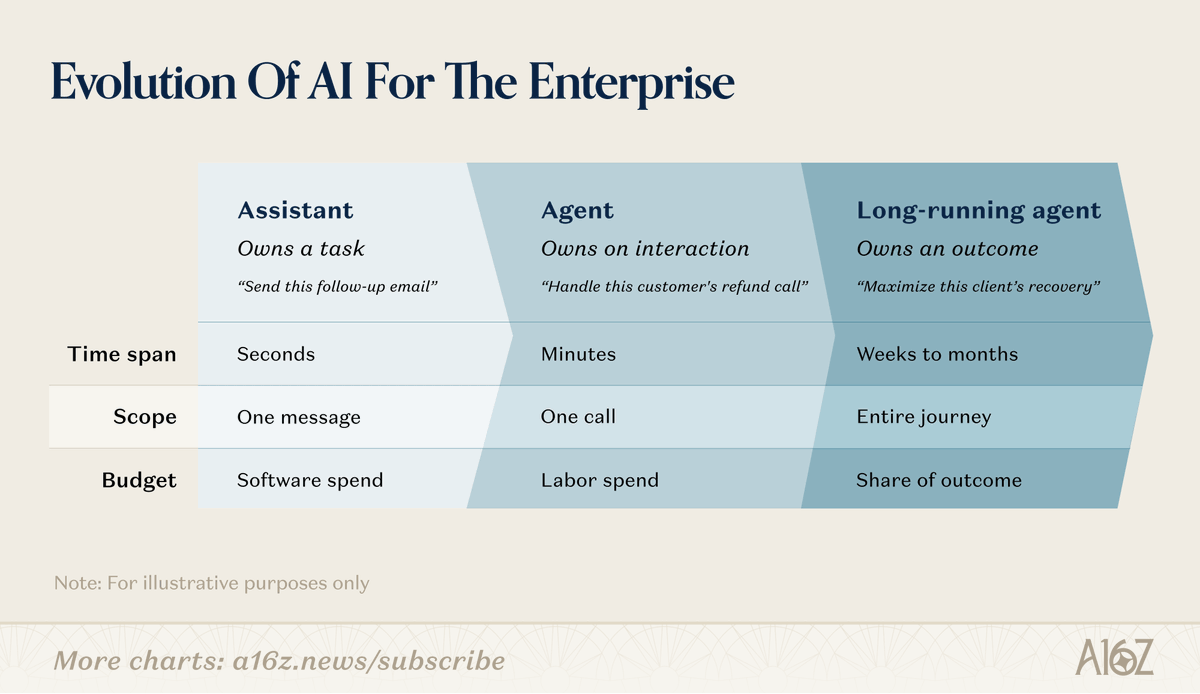
How AI for the enterprise is evolving, from owning a task to owning an outcome:
1. Assistant: handles one task in seconds, like sending a follow-up email. Companies pay for it out of their software budget.
2. Agent: handles one interaction in minutes, like a customer's refund call. It takes on work people used to do, so it gets paid for out of the labor budget.
3. Long-running agent: works toward a goal for weeks or months, like getting an injured client the biggest settlement possible. Because it owns the result, the company selling it can price on the outcome it delivers.
Full piece from a16z's @dhaber on long-running agents in high-value customer journeys: https://t.co/aHaatcizcd
today sana is becoming the new home for workday.
workday actions now take a few seconds to complete with dynamic ui.
powered by jev.
it's been v fun working with the @typesafeai team on this!
@zeeg I don't understand the anger these agents carry within themselves.
Me: "I need to edit a photo"
LevelBot: "do it tf yourself! Here, i made you a clone of Photoshop"
The recent blockade from Ecom website against personal AI agents reminds me of the old Comcast vs Netflix fued. Comcast had spent decades literally beating a path to doorsteps - underground cabling, overhead wires, etc. It wasn't easy btw - a few of my team members @ Google were negotiating these contracts for Google Fiber in Austin and just getting permits to use the telegraph poles to haul cables on was hard enough, forget about digging up the ground. And NLFX was using all that to directly deliver content to screens at high gross margins + obviating the need for cable TV!
Comcast throttled nflx on their networks. Nflx started a proxy war to convince their customers it's not them, it's the damn networks - so https://t.co/TH9oSb8l0F was born with nflx servers as the data download source so everyone can see how slow comcast is. It was a brilliant strategy because it made customers feel their network providers were slow for everything, not just nflx. Eventually they reconciled, but nflx caused enough trouble to shut down the comcast/warner cable merger. It was funny that nflx later went on to buy warner bros. Comcast market is today is 70b vs 300b for nflx.
Years of attention economy is now at risk due to agents but my guess is customer preferences (and laziness) will prevail and the ad driven economy will need to shift to a revshare economy over time.
Ok, now I understand why people want to get rid of unit tests. Apparently they overrely on mocks and there aren't proper boundaries between the different parts of the system. If that's the case, go ahead! You should have gotten rid of those before AI. :D
Amazon banning agents is the first opportunity I've seen since Amazon was founded for a startup to create an Amazon competitor. People will want agents to buy stuff for them. It will be one of the main use cases. And they won't want to use some Amazon-supplied agent to do it.
volume does matter
look, i get it. if you were an engineer before agents came along, you're rightfully skeptical about lines of code and number of PRs being used as a metric for any kind of productivity. and i agree! or at least, i used to. for ease of explanation i will talk about this from the perspective as being an engineer on a large team of at least 50.
volume didn't matter before because we focused on impact. you could have high impact even with a few PRs: for example you could make a one line config change and save the company millions of dollars.
but before agents, the times where i saw volume come into the conversation were for the outliers. on the negative end you might have someone who is struggling to perform, on the other end you might have someone who was a "coding machine" archetype. a coding machine was someone who could just lock themselves in a room and emerge with a stack of PRs that solve a huge number of problems. so volume did matter, but only at the tail ends of the distribution, and combined with impact.
if you've ever worked at a large tech company before, you'll get what i mean. the thing about agents is that big tech co problems are now small-medium co problems as well.
how do agents change this calculus? well, everyone now has the ability to become a coding machine. you have incredibly capable frontier models that can write code better than any of us, at a rate much faster than we can. in this world, if you're still producing the same number of PRs as before, why wouldn't you pause to wonder why you're not being more productive? alien intelligence is here, and yet you can't outship a human coding machine?
this brings me back to why i keep talking about trust (https://t.co/7fzYZV8LGH). if you haven't put in the work to trust your agent's output, it is very difficult to scale up your productivity.
and yes, this approach does require more tokens, but i think about this in terms of cost per intelligence. before agents, this cost was very high - you needed to hire many software engineers with high 6 figure salaries to do the work. tokens are still expensive today, but are likely to get cheaper over time (https://t.co/gTBZx7pl14) factoring in the cost of intelligence. what looks exorbitant today will likely be affordable in 6 moths to a year. a single engineer with agents can do the work of tens if not hundreds of engineers, at a fraction of the cost.
the reality that i don't think has hit yet is that job of the software engineer has truly changed. our job is not merely to produce software any longer (well tbh it was never only about the code, but bear with me for the sake of the explanation), but the machine that writes the software. this idea of a software factory, or a Michelin kitchen as i like to call it, is still a topic of research. and it's the type of stuff i like to share, not to flex, but to show you what's possible when you put a lot of rigor into using agents at scale