🧠 Why You Need a System and Process to Stay Invested
Markets test emotions. The biggest challenge in investing isn’t identifying what to buy — it’s staying invested through noise, volatility, and fear.
Investors often buy after rallies and sell after corrections. Over time, this erodes returns.
Study after study shows that the average investor underperforms the market by 3–4% per year — not because of fees, but because of bad timing driven by emotion. That’s why every successful investor needs a system: a repeatable, data-driven process that replaces emotion with rules.
At Systematic Edge™, we use two independent models to guide our weekly S&P 500 stance:
Risk & Flow model — tracks macro tone, fund flows, and sentiment.
Technical model — measures momentum, breadth, volatility, and yields.
The models don’t predict; they react. They’re designed to keep us disciplined — constructive when conditions are supportive, defensive when risk builds.
The Results (2015–2025)
We applied these models weekly, using SPX data from 2015 to 2025. The strategies are simple:
At-Least-One Buy = 100% long when either model is on Buy.
Average Signal = 50% long when only one model is on Buy.
Buy & Hold (SPX) = always long.
📈 Growth of $1 (2015–2025)
A rules-based framework compounds more consistently. When the process defines exposure, volatility matters less — and drawdowns become survivable.
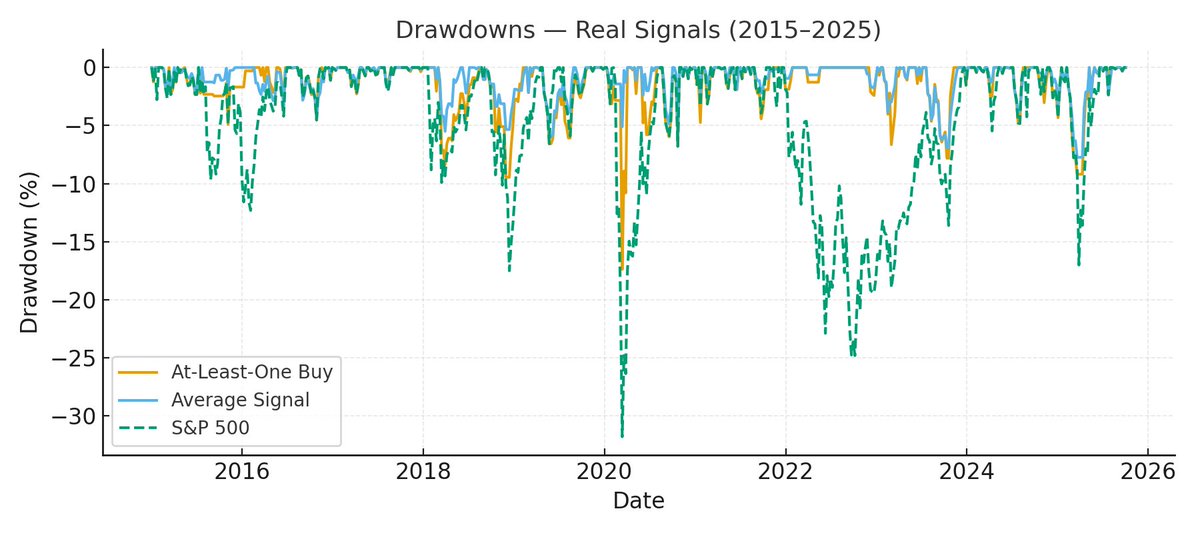
📉 Drawdowns (2015–2025)
Avoiding large losses is the foundation of compounding.
A –30% drawdown requires +43% to recover. A –10% drawdown needs only +11%. That’s the quiet math behind staying invested.
Process > Prediction
Markets will always fluctuate. But a system — anchored in data and rules — helps you navigate uncertainty with discipline, not emotion.
Our two models counterbalance each other, together, they enforce consistency — and consistency builds long-term edge.
The Takeaway
You don’t need to know the future. You just need a framework that keeps you rational when everyone else isn’t. Systems don’t have feelings. That’s why they win.
📬 Read more: https://t.co/xQUFx6lvJN
@liegeman Relatively speaking only. For example People vote for taxing rich normally are not rich themselves generally speaking. People vote to pause data Center or regulate AI normally don’t have much AI stocks, their 401k fund value prob also smaller.
🚨BOOM !!
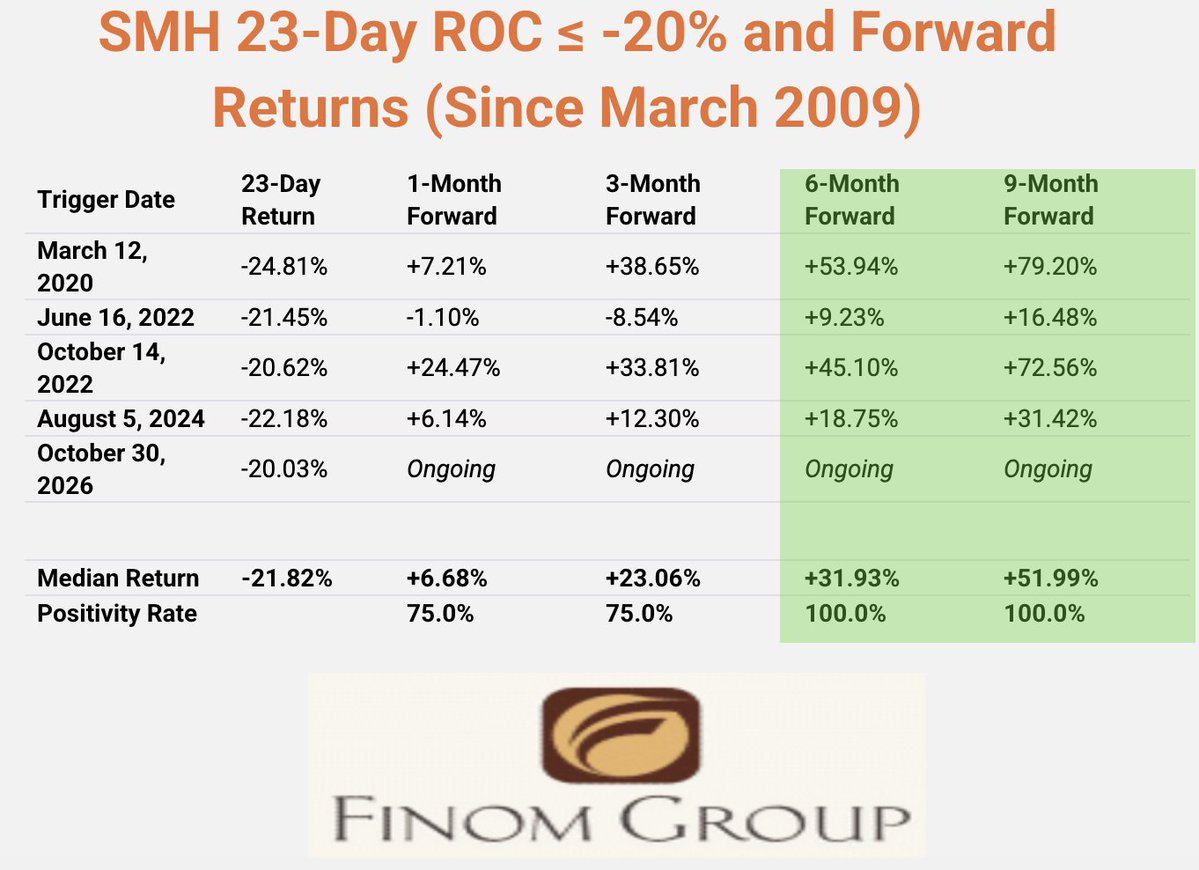
Since 2009, only 4 other times has 23-day ROC been this bad for Semiconductors, most recently in 2024.
When 1-month (23-day) ROC is -20% or greater, $SMH has been higher 6-months and 9-months later every time.
Median return = +32% and +52%, respectively🚀
$SOXX $QQQ $NVDA $ARM $MU $AMD $MRVL $IREN $SKHY $NDX $SPY $SPX $COMPQ
For the first time since 2006, Democrats won both the House and Senate in a midterm. Markets had already priced it in as evident by recent derisking.
Fearmongering aside, the S&P 500 $SPX was higher 3 months out in all cases with no 20%+ bear market in the next 6 months.
Gina Hinojosa may not be as bad for Texas data centers as it looks.
Her plan asks for: no subsidies, union labor, no NDAs, and proof household power and water bills won't rise.
Much of that is already underway:
Amazon, Google, Meta, Microsoft, OpenAI, Oracle and xAI pledged in March to bring their own power and pay for transmission
Microsoft pledged to pay full property taxes without seeking tax breaks
Nvidia is working with Vistra, NextEra and Constellation on data centers that cut power use when the grid is strained