The past couple months we may be witnessing what the Applied AI layer will look like at scale. Despite some of the initial critique that this would just be a thin layer on the LLM, it’s turning out that actually driving agentic workflows in an enterprise is far more complex. And anywhere there’s complexity you generally gain a moat and value over time.
Here are a few of the components that appear to make up the playbook based on the examples we’re collectively seeing in coding, legal, healthcare, customer support, financial services and other fields:
* Build the features that bridge the gap between the intelligence and the workflow. Some workflows can be automated by simply going to a general purpose interface, but others need tuned interfaces and features tied to the work they’re augmenting or automating. They need features that are specific to capturing the kind of data that’s needed as context for the agent. And they need a variety of bespoke tools for the agent to use, and unique interfaces for the human-in-the-loop UX. Going far deeper than just presenting the output tokens is clearly critical, and the more depth there is here definitionally the more sustaining value.
* Act as the model router balancing frontier intelligence with cheaper models. A natural advantage that any model neutral platform has is that it can naturally (in a business model-aligned way) leverage whatever level of intelligence is necessary for the workflows they’re automating to get done. There are plenty of scenarios where you need GPT-5.5 or Fable level capability, and also lots of workloads where a more efficient closed or open weights do the trick. Only the companies that have deep evals on specific tasks across all models, and the ability business model wise to leverage them, are in a great position.
* Drive the actual implementation and change management via FDE or equivalent. A big reason the applied layer works at scale is that most enterprises need some degree of help and support with change management in implementing agents for their workflows. Data has to be cleaned up and moved to modern systems, processes have to be re-engineered and documented, workflows have to be evaled, SLAs have to get achieved, and so on. All of this is going to be unique for every type of process that gets implemented, which means the companies that have expertise in a given domain and come with all the relevant best practices will be in a strong position.
* Implement domain specific GTM that creates expertise in that field. Beyond FDEs the companies that can build sales and GTM motions aligned to their domains also have a natural advantage. Most IT and line of business leaders have too many things to do in any given day; so if you’re not on their agenda, likely someone else is. Depending on the industry, there are entirely different sets of language you use, ways of working through security and compliance, regulatory controls you have to support, industry events that companies convene at, different system integrator and consulting partners you need to work with, and so on. The more generalized this gets the less you can speak the customers language, which is where the applied layer has a leg up.
A final note. There remains a view that a lot of this is all mitigated by model intelligence alone, and the bitter lesson solves all of this in the limit. That’s possibly true, but enterprises need help changing *today*. And many aspects of how to bring intelligence to real world work don’t only depend on the axis of the pure capability of the model, so most of what you’re doing now to win ends up being important no matter how good the models get.
The Agents SDK is now a runtime any agent framework can build on. Today we're opening up the Agents SDK primitives, with Flue as a first framework targeting Agents SDK, and rolling out agents in the dashboard.
https://t.co/93z3yeNJmp
At OpenAI, we're continuing to bet on Rust as the future of systems programming.
I'm proud to announce that we're making a $600,000 commitment to the Rust Foundation, which combines our Platinum membership with additional support for maintainer efforts across the Rust ecosystem.
The White House banning Anthropic’s most advanced models has much larger implications for the industry.
"Does this actually mean now that we have a de facto licensing regime for foreign employees working at AI companies?”
“And this is a huge issue because a massive amount of talent comes from China and other countries who are working domestically at these labs." — @leomschwartz, Tech and Politics Reporter
"AI will transform pharma, but not evenly and not all at once."
"Building an enduring company in the age of AI is hard precisely because advantages can dissipate rapidly as models improve."
"The companies that win will predict the uneven frontiers correctly, absorbing each model improvement as a tailwind rather than a headwind."
"Our view: discovered drugs are becoming abundant while clinical development remains the binding constraint — so the durable position is built around that bottleneck, not in the path of advancing discovery models."
Formation Bio CEO Benjamine Liu on how AI will transform biopharma, and why the sequence of change matters: https://t.co/2fQ0M0Dg9G
The future of coding is not one agent. It's a whole AI team.
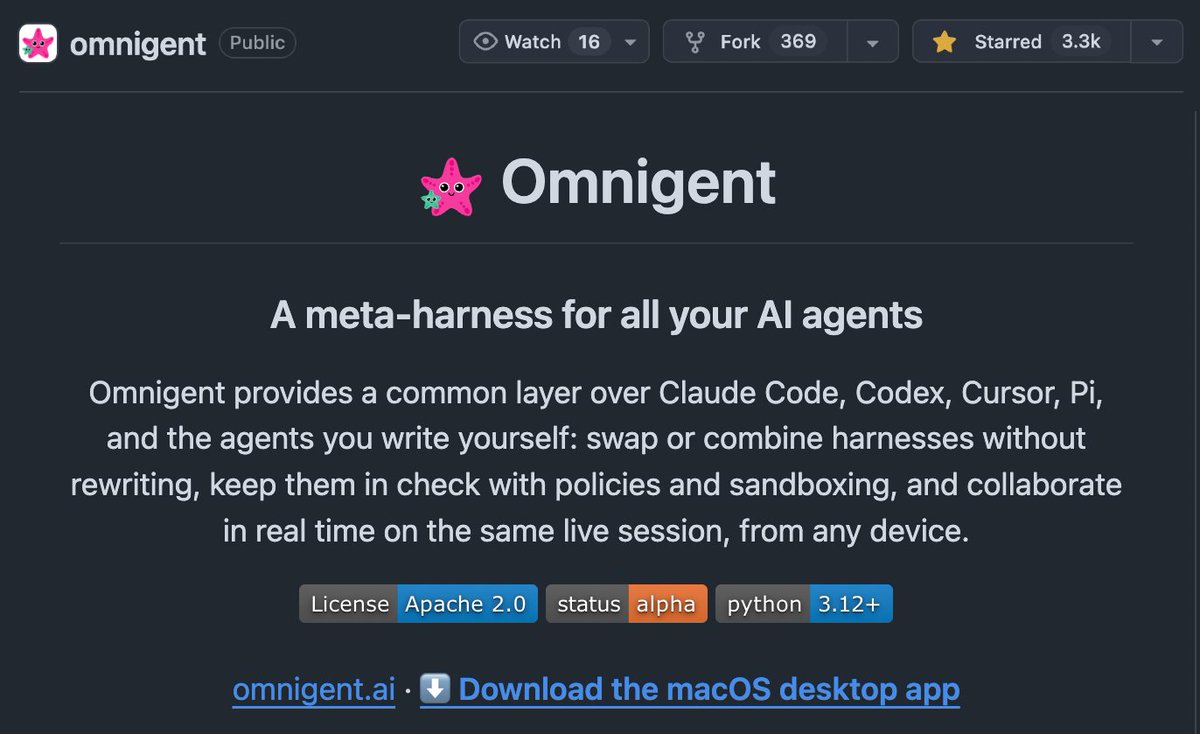
Omnigent lets you run a team of agents in one live session: Claude Code, Codex, Cursor, Pi, and your own agents.
It is a meta-harness for AI agents, built from our internal Databricks dev tools, and now open-sourced for everyone.
Built by the legendary @matei_zaharia and the Databricks AI team. And yes, Matei still writes a lot of code, even the frontend code for Omnigent and our products.
I wrote a little state of the union on the state of Interconnects, how I ended up with a loyal niche audience, and how I’m tweaking operations to ensure the long-term success here! Thanks for the support everyone. 💚
React → https://t.co/a4QDSs9wxd
Next.js → https://t.co/nDDXqUmgw5
@aisdk is more relevant than ever, given the intense model competition landscape. Just today, GLM 5.2, an open model, surpassed Opus 4.8 in our Next.js Evals (https://t.co/aporqgIfIh) 🤯
But the world needs a practical solution for how to build and deploy agents. Just like React needed Next.js to solve the task of building an actual web application. And that's eve.
☰╱☰
The framework for building agents
Build a company brain, personal assistant, or domain-specific agent
→ Data
→ Evals
→ Tools
→ Skills
→ Schedules
→ Subagents
→ Durable workflows
→ Sandboxed execution
→ Connections (services/MCP)
→ Channels (Slack/web/Discord)
Introducing Epic’s version control system: Lore! Built from scratch and open-sourced, we made scalability and performance core tenets from day one.
We’re releasing Lore as open source today.All source code, along with documentation of data formats and protocols are released under an MIT license and free to use. Help shape it into something even more powerful, together: https://t.co/zplVMjkRof
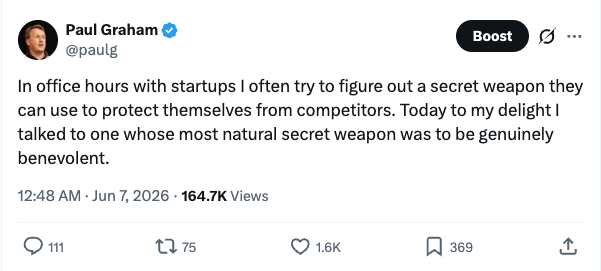
The hardest problems are rarely solved by adding more complexity to the solution -- they are solved by reframing the question until a simpler, clearer answer reveals itself.
Upcoming podcast guests
+ Jeff Dean, Chief Scientist at Google DeepMind
+ Andrew Ambrosino, Head of PM and Eng for Codex
+ Fiona Fung, Head of Eng for Claude Code/Cowork
+ Tara Seshan, Head of ChatGPT, Productivity at OpenAI
+ Dianne Penn, Head of Product, Research at Anthropic
+ Elizabeth Stone, CPTO at Netflix
"If the cryptography breaks, there is no reason to use a blockchain. You can go home."
@YuviLightman at QDay.
Google now estimates 1,200 logical qubits to break Bitcoin keys.
Standards bodies set their first deadlines for 2028.
There’s an Indian VC (based there, invests there) who I won’t name. Every term sheet he writes — even $1M checks — includes this: founders must return 5x, he keeps full anti-dilution AND his equity on top, and if they don’t hit it in 3 years, he gets to fire them. 😂😭
I told him, “dude, I can’t invest into this structure, it’s insane.” His response: “JJ! No no, you don’t understand — this is totally normal in India, man! We want you to invest!!”
LESSON: Any founder in India who’s been handed this — email me. I’ll personally make sure you get introduced to VCs who aren’t actively trying to fuck you over.
eve is an open-source agent framework for building and scaling agents.
▪︎ Durable execution
▪︎ Sandboxed compute
▪︎ Human-in-the-loop
▪︎ Subagents and evals
Available now in public preview ↓
https://t.co/XwmTeqm6Bg
This show with @AravSrinivas is one of the best we have done.
- The biggest problem today is power.
- We will see large resistance to data centre buildout continue.
- Micron will be worth more than Meta.
- Export controls have helped China.
- Monitoring token budgets is BS and only for losing companies.
How is that for spice? I have added my notes from the discussion below but such a special show to do with Aravind in London.
1. Are Agents the End of the Internet Advertising Model?
AI agents will disrupt industries built around objective transactions, but subjective spaces like travel, fashion, and shopping are more resilient. When intent is driven by vibes, exploration, and aesthetics rather than one correct answer, chat interfaces struggle to replace browsing, keeping much of the advertising model intact.
2. Biggest Takeaway From Elon Musk?
An elite entrepreneur can identify the single limiting bottleneck in a business and focus on it with unusual intensity. True concentration requires discipline: you must ignore even important issues when they distract from the immediate objective that matters most.
3. Did Export Controls Hurt or Help US Competition With China?
Export controls gave America a short-term edge by preserving a capability gap between open-source and frontier models. But they may have also forced China to become a stronger physical competitor by pushing its tech ecosystem toward memory-efficient architectures and deeper vertical integration.
4. How Will the Best Organizations Approach Token Budgeting?
Enterprises will stop manually tracking model capabilities or micromanaging token budgets across teams. As model optimization accelerates, the best companies will outsource this complexity to AI orchestrators that automatically route tasks to the right models at the right cost.
5. How Can America Retain Competitiveness in AI?
The West must build physical infrastructure aggressively, streamline power procurement, and counter alarmist narratives around data centers and job displacement. Leaders should explain the upside clearly: AI can let tiny teams build billion-dollar companies and drive major new GDP growth.
6. What Is the Single Most Important Metric in AI?
The key metric is token value per watt per user. Raw model building and fine-tuning are becoming commoditized. The real venture-scale value will accrue to orchestration layers and agent harnesses that deliver high-quality outputs while using minimal data center power.
7. Why Is Moving Fast the Ultimate Expression of Humility?
Founders often waste early cycles searching for a permanent moat, when speed is their only real defense. Moving fast is an act of humility because it forces constant contact with the market, repeated assumption testing, and a willingness to let reality overrule ego.
(links below)