interpretability might be the most important scientific problem in the world right now, as I don't think we can solve alignment if we don't know what we're building. I think I have good news about it. I co-authored early work in mechanistic interpretability at OpenAI and came away pessimistic, because neural networks appeared to fold into arbitrary tangled knots. years later, I started openai's first large-scale automated interpretability project, finding about 2% of neurons legible with the primitive tools we had
with modern agentic tools and a much closer look, the picture looks totally different. the vast majority in models up to trillions of parameters are legible, and their circuits beautiful. many famous examples of tangled neurons turned out to be misunderstood. The roadblocks I expected mostly aren't there. I now think ambitious interpretability will be solved by the time we need it most, and possibly quite soon, as automated scientists keep improving. it may be a bitter lesson for interpretability: the simple thing, at absurd scale, works
https://t.co/zHij5zwKGT
Ben & I started Mantic with the mission to solve forecasting.
This summer, Mantic out-predicted all 676 humans in the preeminent forecasting tournament.
We’ve raised $25M to scale.
We’re serving the brave decision-makers who want to grapple with uncertainty.
Join the mission.
Mantic is a world-class technical team on a mission to solve the next AI grand challenge: predicting global events with superhuman accuracy.
https://t.co/drL4HagUic
🚀New Paper!
https://t.co/cZZGbeVrgR
Everyone’s celebrating rapid progress in math reasoning with RL/SFT. But how real is this progress?
We re-evaluated recently released popular reasoning models—and found reported gains often vanish under rigorous testing!! 👀
🧵👇
🚨 ZeroBench: We created the HARDEST visual reasoning benchmark we could—then invited the AI community to red team our data 🔥
One month later, here's what happened... 🧵👇
Schmidhuber was a reviewer of the GAN paper in 2014. The reviews are public. He is the reviewer that asked us to cite predictability minimization. He did not ask us to cite artificial creativity (his current complaint). He hadn’t thought of that even in 2016.
Happy to share that the raw video frames from the dataset of our ICCV 2023 "Moment detection in long tutorial videos" paper are now available. We hope this will enable further research on moment detection in long videos.
Raw videos, code and other data: https://t.co/RprQaB99ie
Paper: https://t.co/INPaHFlhMt
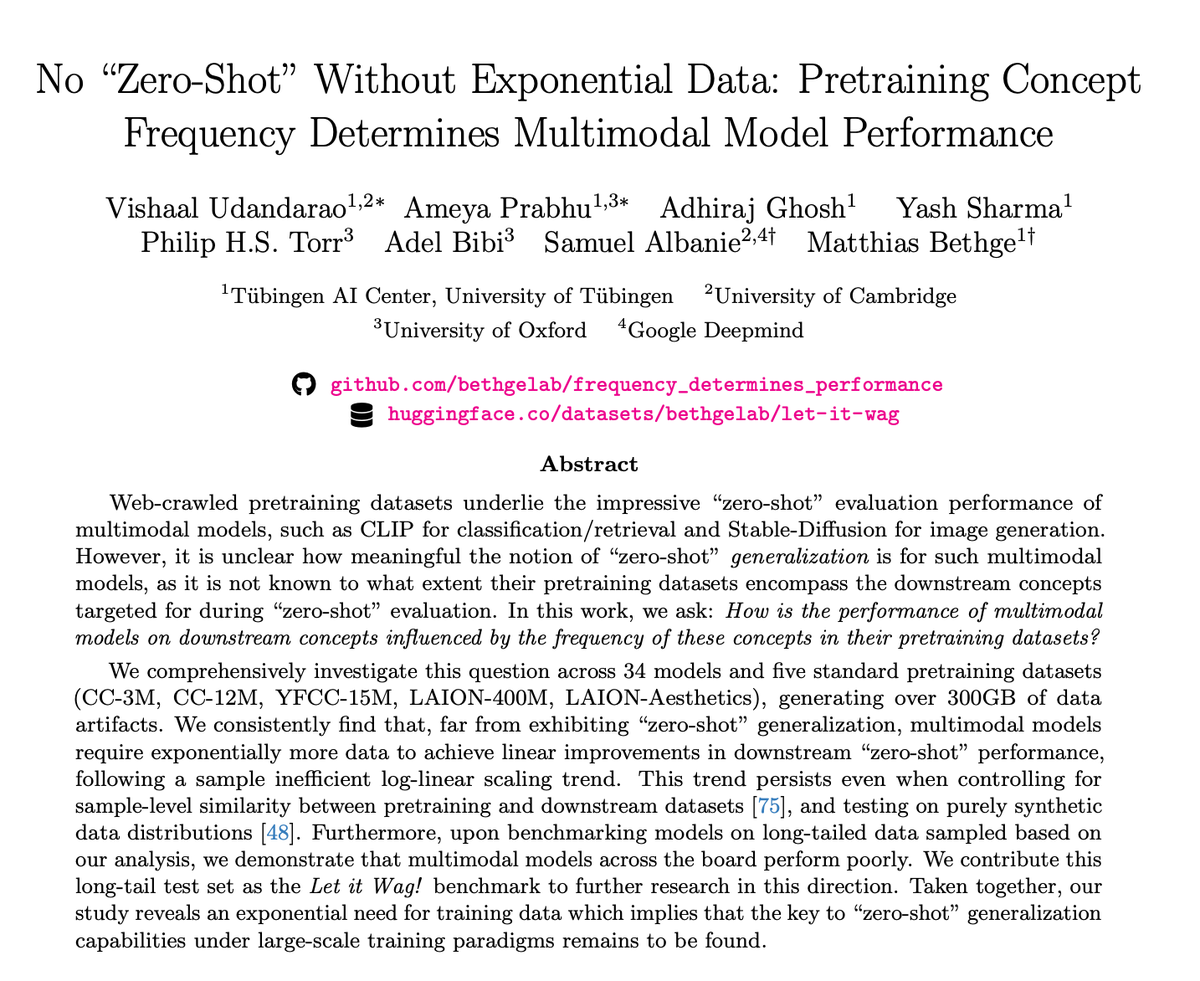
🚀New Preprint Alert!
📊Exploring the notion of "Zero-Shot" Generalization in Foundation Models. Is it all just a myth? Our latest preprint dives deep. Check it out!🔍
https://t.co/4PKwBGzr6K
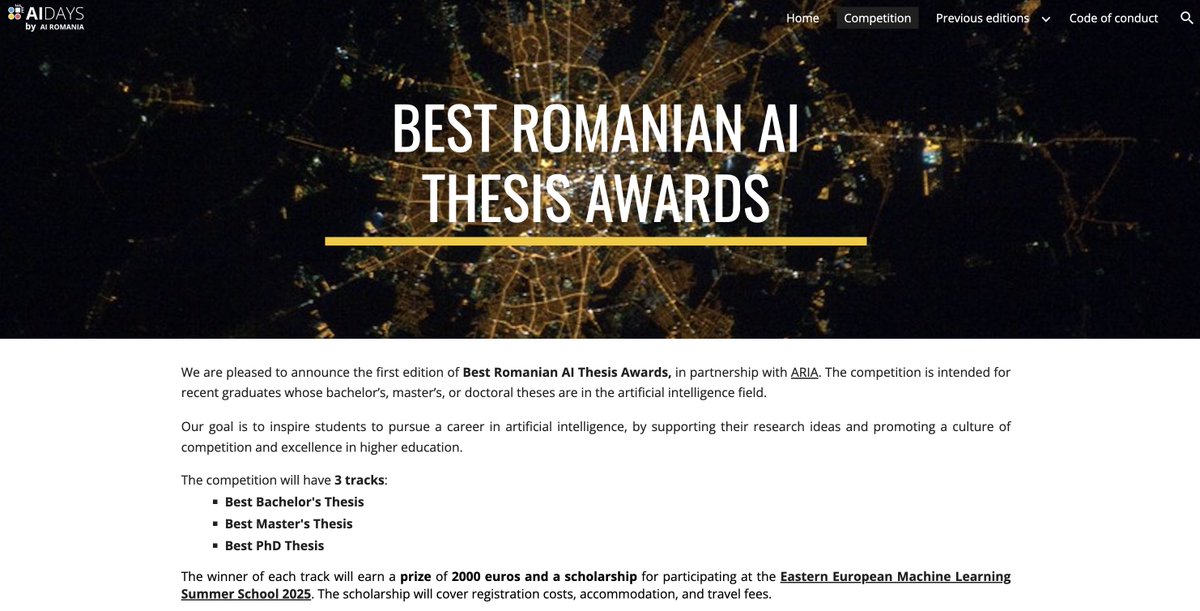
Romanian AI Days și Asociația Română pentru Inteligență Artificială lansează Best Romanian AI Thesis Awards 🏆🎉, un concurs destinat celor mai bune lucrări de licență, disertație și doctorat 🎓 din domeniul AI 🧠🤖. Pentru detalii, intră aici: https://t.co/0ifu3RjszF
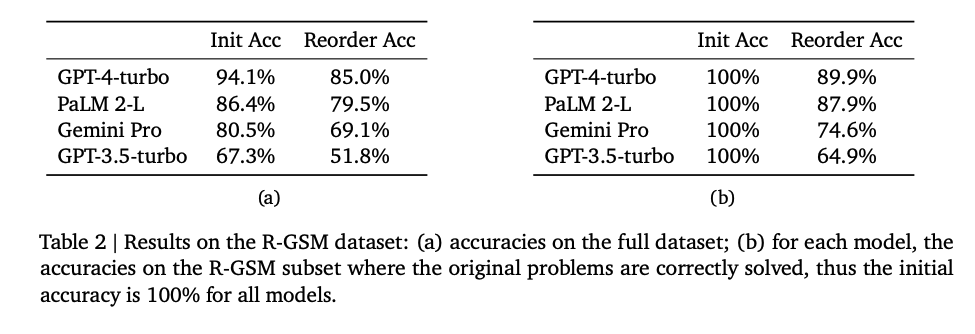
A new paper from Google DeepMind explores the effect of premise ordering on large language models (LLMs) in reasoning tasks. Despite the logical principle that the sequence of premises should not influence the conclusion's validity, the study finds LLMs' performance varies with different premise arrangements. Here's a summary:
The research investigates how the order of premises affects LLMs in logical and mathematical reasoning tasks, challenging the assumption that premise sequence is irrelevant to the outcome.
Key Findings:
* Logical Reasoning: LLMs perform best when premises are in a forward order that aligns with the proof's progression. Deviations from this order result in significant performance drops.
* Mathematical Reasoning: The introduction of the R-GSM benchmark shows a similar sensitivity in LLMs.
Congrats to the authors for their work!
Paper: https://t.co/XWrvem0uWX
@sama Create a video of a fluffy penguin in a kitchen making pancakes. The penguin, wearing a chef's hat, is mixing batter and flipping pancakes in a skillet on the stove. Focus on the penguin's skilled movements and the pancakes turning golden brown.
Today, I am very proud share what we have been working on for the last 14 months. ✨
Introducing Aya -- a new state-of-art for massively multilingual models. 🔥🎉
🔥Mamba with Longer Context🔥
We present 🐍LongMamba🐍, an early exploration of Mamba's **longer context extrapolation ability**. Our #LongMamba manages to retrieve *nearly perfectly* on a window context of 16384.
- Code: https://t.co/n7UZClAhcE
- Model: https://t.co/HcwO3Wjt0G
Excited by the generality of CLIP, but need more fine-grained details in your representation? Introducing SPARC, a simple and scalable method for pretraining multimodal representations with fine-grained information. 🥳 1/6
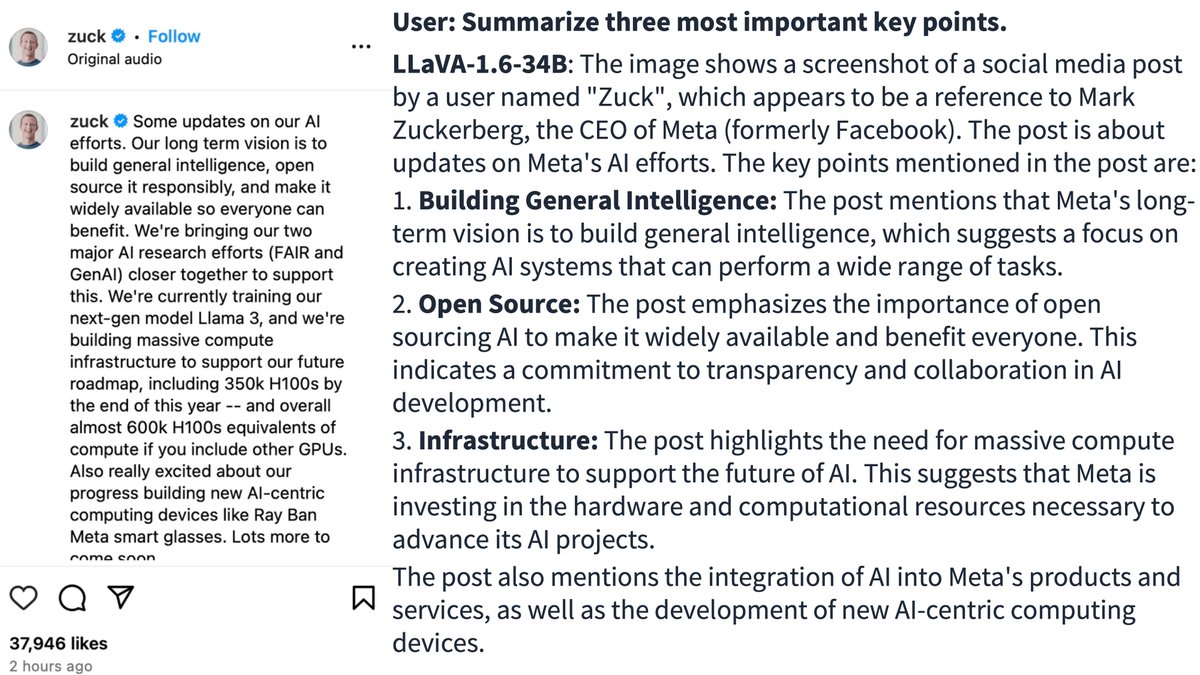
🚀We are thrilled to release LLaVA-1.6, with improved reasoning, OCR, and world knowledge. It supports higher-res inputs, more tasks, and exceeds Gemini Pro on several benchmarks! 🤯 It maintains the data efficiency of LLaVA-1.5, and LLaVA-1.6-34B is trained ~1 day with 32 A100s.
LLaVA-1.6 comes with base LLMs of different sizes: Mistral-7B, Vicuna-7B/13B, Hermes-Yi-34B. Thank you @MistralAI@lmsysorg@01AI_Yi@NousResearch
We serve LLaVA-1.6 efficiently with SGLang @lmsysorg. Thank you @lm_zheng@ying11231@shiyi_c98 for the integration.
And big shoutouts to awesome collaborators from the LLaVA team: @imhaotian@ChunyuanLi Yuheng Li @BoLi68567011 @zhang_yuanhan@shengs1123@yong_jae_lee
Blog: https://t.co/Mjd609CY2r
Demo: https://t.co/7VxuVA0gPk
Code/Model: https://t.co/gASnLmaUGY