Ask a model the same question twice and it can give you two different answers. Usually both are fine. Sometimes one is wrong. So the invoice total stays in your accounting software, and the customer question voicemail goes to AI.
After just a few hours with @claudeai Opus 5.5, and it's safe to say Claude is back.
In fact, we don't think people realized how much a step back 5 and 5.1 were compared to Opus 4 class models.
Great work by the @claudeai team.
16 plugins into HubSpot, QuickBooks, Stripe, Gusto.
Connecting the chat window to your tools is the easy part. Getting the work to stop needing you between those tools is still the job.
Small business owners deserve every advantage.
Meet the 16 plugins that help take work off your plate so you can focus on what matters most—running your business.
Explore the small business collection: https://t.co/VVRewAmWdf
We’ve written about this a bunch too. Couple things at play…
1. Sticking new tech in a broken process doesn’t get you anywhere. You just make the broken parts faster.
2. Large orgs have a thousand touch points — committees, approvals, departments. Small business owners can just do it.
3. Most of the elapsed time isn’t the work. It’s the handoffs and the waiting. Speed up the 17 minutes and you still have a 22-day process.
4. Satisfaction isn’t the metric. People can like the tool and still move the same number.
Our conclusion is not "Applied AI doesn't work" though; our conclusion is that it works a lot better in smaller and medium businesses.
A new model tops the leaderboard every few months. Build the workflow instead of chasing the tool, and the next upgrade costs one line in a config file: the model name.
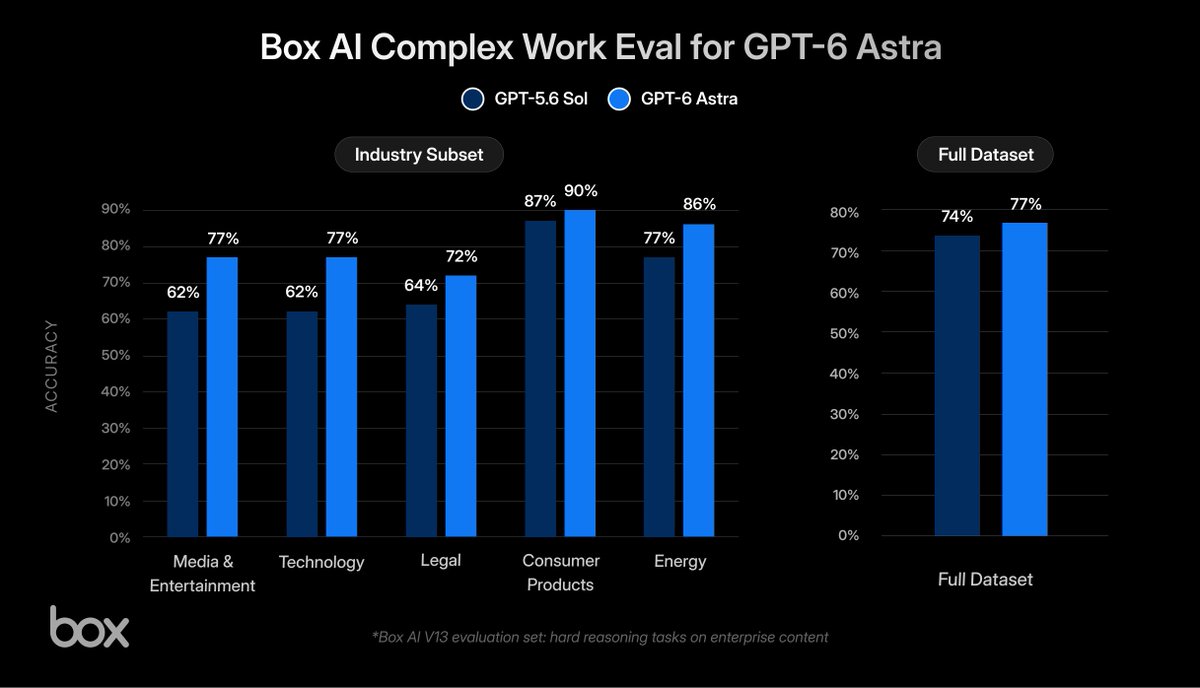
GPT-6 Astra is out. We've been testing the model in early preview on our enterprise complex work eval at Box. It is now the best model we've ever tested on our expanded and hardest test set.
Overall, GPT-6 Astra offers a breakthrough level of capability in coding, analytics, logic, and domain specific knowledge for dealing with complex enterprise knowledge work. In our eval, we use the GPT-6 Astra model in the Box Agent and give it a set of difficult tasks that represent real-world work in various industries. These tasks often will take people hours to execute properly and require deep domain expertise.
GPT-6 Astra scored 77% overall vs. 74% with GPT-5.6 Sol, representing frontier performance. But the story is in some of the bigger gains on individual task types that are incredibly complex across. Here are a few examples across the tests that show how much of an impact this will be in different industries:
* Media and entertainment (48% → 100%, +52 points). Ranking film genres and countries by profitability across a year of production data from four teams, where the trick is to apply the following year's tax-incentive corrections without double-counting them. GPT-6 Astra was perfect on every attempt. Sol had the rankings right but the underlying ratios were wrong.
* Technology (69% → 97%, +28 points). Choosing which region to fund first, from a stack of performance and infrastructure documents that never state the metric the brief asks for. GPT-6 Astra flagged the gap, labelled its own figure a proxy, and caught a growth claim that didn't match the numbers beneath it. GPT-5.6 Sol reported the proxy as the real thing.
* Legal (69% → 93%, +24 points). Reviewing an NDA against a company's own contracting policy, where reaching the right verdict isn't enough; the answer has to cite the provision behind it. Both models declined to approve the draft, but only GPT-6 Astra separated whether the liability cap's structure was permissible from whether its amount was defensible, and pointed to the policy language that settles it. GPT-5.6 Sol argued the same conclusion without citing the provision, which is a critical error in the legal industry.
* Healthcare (53% → 77%, +23 points). Auditing a batch of radiology reports for errors and rating how serious each one is. GPT-6 Astra caught a terminology error in a knee-imaging report that GPT-5.6 Sol missed on both attempts, and was more reliable at grading severity rather than just flagging that something was wrong.
* Energy (82% → 97%, +15 points). Building a consumption report on two facilities from a year of meter logs, where only one of the two sites is actually missing data. GPT-6 Astra found it and drew a line most reviewers wouldn't: the other site's odd solar readings are a measurement problem to investigate, not a gap in the record. GPT-5.6 Sol reported both sites as incomplete.
Astra clearly is going to offer a meaningful jump in powering and orchestrating enterprise workflows. We'll be making GPT-6 Astra as an option in the Box AI Studio for customers to build agents with shortly as it continues to roll out.
62% of European companies pay suppliers late because their customers pay late. Cash flow is a chain reaction.
Automating follow-ups won’t fix your customers. It just stops you from being the weak link.
In Europe, 62% of companies pay their suppliers late because customers pay them late.
I mapped the automation that turns an unpaid invoice into a scheduled, escalating follow-up — ready for approval the same day.
The entry channel can be Telegram, WhatsApp, Signal or iMessage. @NousResearch's Hermes or @openclaw reads the invoice, extracts the amount, due date and agreed terms, and drafts the reminder in your usual tone. A second model takes over if the first one is down.
The owner checks the message in the same chat. Nothing is sent without approval. The reminder goes out with the payment history attached. After seven days of silence, the system follows up with the same record.
The scale: late revenue now exceeds 12% for European businesses — past the level they themselves call sustainable. In Asia, 43% of B2B sales are made on credit, according to Atradius's 2026 survey of 2,145 businesses. In the US, the Federal Reserve counts uneven cash flow among the top financial challenges for 51% of employer firms.
If your team spends hours every week chasing the same document, tell me which document. I'll map the workflow.
Figures: Intrum European Payment Report 2026; Atradius Payment Practices Barometer 2026; Federal Reserve Small Business Credit Survey 2025.
80% say AI made them faster. 37% say it moved EBIT. Same 37 as last year.
The extra speed sat on the old workflow.
Faster at the wrong process is still faster at the wrong process.
📍 Most leaders think AI performance is a tool-adoption problem.
The real shift is whether the operating model converts speed into results.
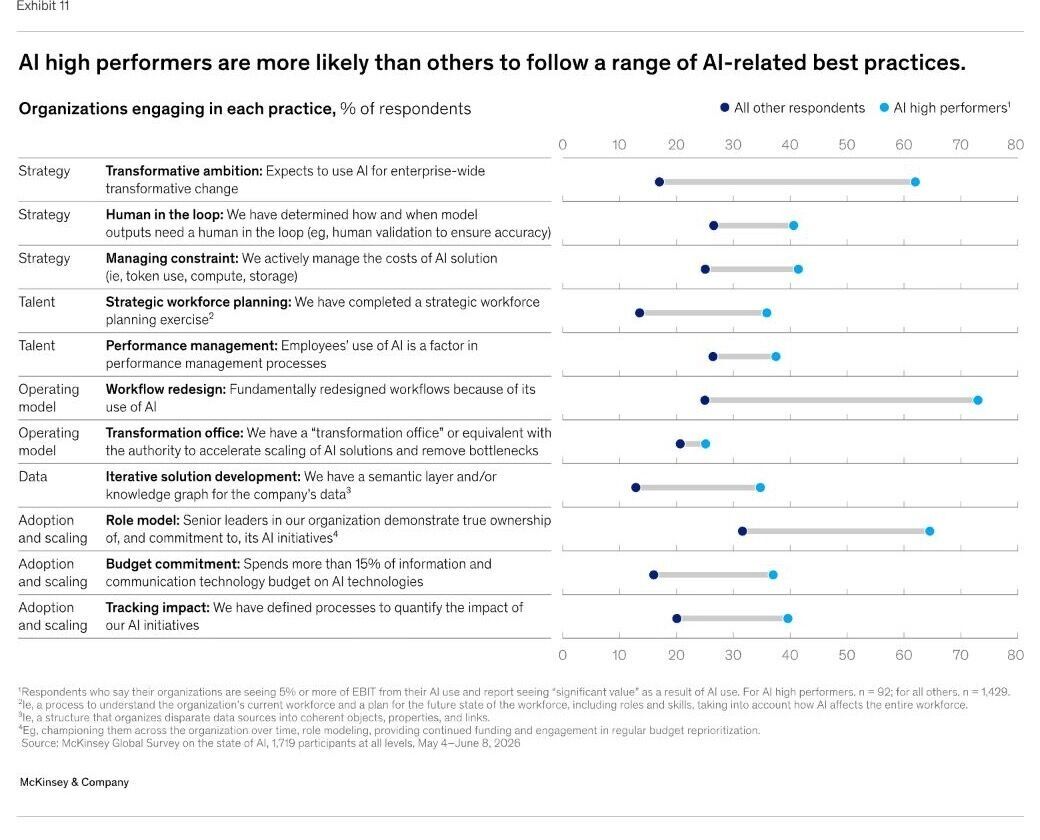
A recent McKinsey global survey shows that 80% of respondents report higher individual productivity from AI, while only 37% report any positive EBIT impact and just 6% qualify as high performers.
That gap signals a management problem, not a capability shortage.
1️⃣ Performance Consequence:
Faster individual work does not automatically improve enterprise economics.
If AI saves minutes inside an unchanged process, the organization may absorb local efficiency without changing cycle time, revenue, or margin.
2️⃣ Structural Blind Spot:
Most companies are scaling tools faster than they are redesigning decision rights, workflow ownership, and performance measures.
The same survey found that nearly three-quarters of high performers fundamentally redesign workflows, compared with only one-quarter of other organizations.
The difference is not access to AI.
It is whether management is willing to change how work moves through the firm.
3️⃣ Workflow Redesign:
AI value becomes measurable when leaders start with an outcome and rebuild the surrounding system.
That means deciding which steps disappear, where human judgment remains, who owns exceptions, and how gains will show up in financial results.
A deployed model is only an input.
The operating model determines whether that input becomes advantage.
The real AI challenge is not scaling use.
It is redesigning the organization so individual productivity compounds into firm performance.
Is your AI program adding faster tools to existing work, or changing the system that converts work into results?
via McKinsey
@ramonvidall@ricardo_ik_ahau@timo_vi@kkruse@ozsilverfox@sulefati7@faryus88@DioOmega@Nicochan33@RLDI_Lamy@jameslhbartlett@corixpartners@Corix_JC@Transform_Sec@TCyberCast@ILoveBooks786@pchamard@COSTESLionelEr@FrRonconii@violetainsights@timo_vi@BCAgroup@gaillparr@liontarakos@Ahmed43101178@sallyeaves@dinisguarda@drsharwood
A Richmond Times-Dispatch survey, Aug. 30, 2026, found 16% of Richmond-area businesses are actively using AI. Another 44% are exploring it. By subtraction, about 40% are doing neither. That gap is a decision waiting on somebody in the building.
If you could save 100 hours a year from one automation, would you at least think about it?
Your favorite ice cream spot did, and the results are as cool as their ice cream is tasty.
https://t.co/bmt0soYXPC
Somebody on your team is a human API between software that should just talk. Speed up their re-keying and you own a faster re-keying step. Rebuild the workflow and you don't do that step anymore.