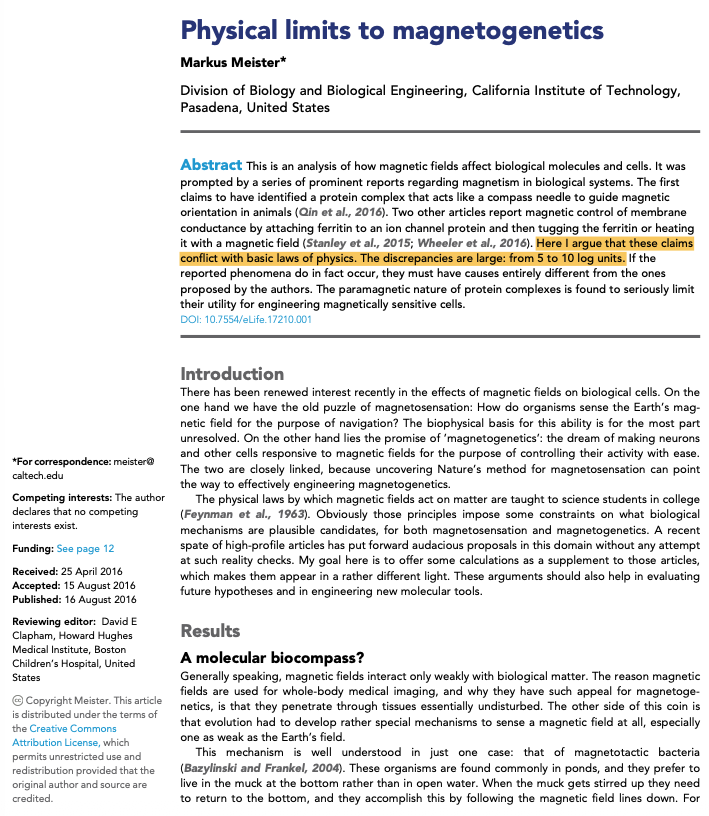
Finally some common sense! This article gets a rare "biophysics" stamp of approval. Good takes (though the writing style is too verbose...)
https://t.co/2OIKlhTSy0
No scientist ever said, "you know what I need? An AI agent to do molecular docking and protein structure prediction."
Why are we pretending this is progress?
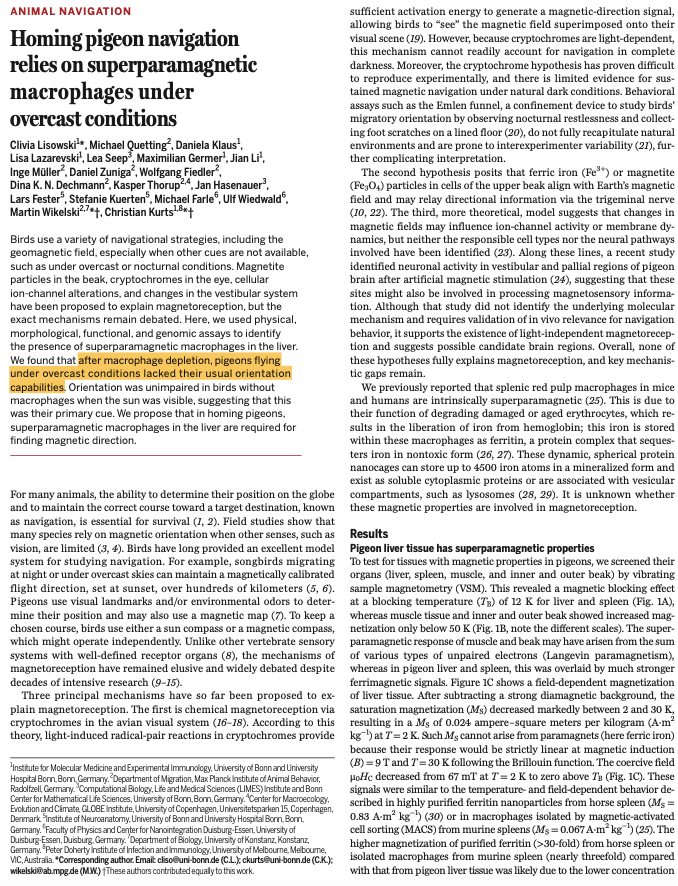
There is a new paper in Science proposing a mechanism for how homing pigeons navigate on cloudy days. (Hint: It's magnetic fields.)
As with many magnetobiology papers, though, I'm skeptical of their proposed mechanism.
These researchers, from Germany, found that pigeons have macrophages in their liver that accumulate lots of iron. They confirmed this with staining and other analyses. These macrophages also tend to cluster near nerve fibers in the liver (this is important for later).
Then they did a really interesting experiment:
- Train 34 pigeons to fly a particular 19-kilometer route. Ensure they all do this well.
- Split the pigeons into two groups: treatment and control.
- Inject the treatment group pigeons with liposomes loaded with clodronate. The macrophages eat these liposomes, and then clodronate kills the cells and scatters the iron.
- Release the pigeons, from both groups, on an overcast day (it's thought that pigeons use magnetic fields to navigate when there is no sun).
- All of the control pigeons reached their destination within 70 minutes, but the treated pigeons scattered in random directions.
- (Important control experiment: The treated pigeons, released on a sunny day, flew like normal and reached their destination.)
- This is taken as evidence that ??? macrophages --> iron --> navigation ??? via magnetic fields. But the mechanism is fuzzy.
This experiment is super interesting, and it's clear that the treated pigeons really are unable to home to their destination using a magnetic field. But I'm not entirely convinced by the mechanism these authors propose.
The main claim is that these iron-loaded macrophages "align" in a magnetic field, and that they shift according to the bird's orientation so that it can fix its direction. These macrophages (somehow) send signals to the nerve fibers in the liver, which then pass the messages to the brain, which allows the bird to navigate.
The news coverage for this story suggests how this might happen: "One idea is that as the bird shifts its position relative to Earth’s magnetic field lines, the ferritin changes orientation and tugs on the web of fibers within a macrophage, possibly triggering the release of signaling molecules." (All you need to do is read the 2016 Meister paper, from the images below, to understand why such a mechanism is physically dubious.)
The problem, though, is that the authors show (in their own study) that the iron in these pigeons' livers only act as a stable magnet at super low temperatures, below about 12 degrees Kelvin (or -260 degrees Celsius). At normal, physiological temperatures, the iron would be scrambled by the thermal motions of the tissue. Every measurement in the paper is taken at cryogenic temperatures, but a bird's body temperature is much higher, which means heat would likely destroy any magnetic alignment.
The authors claim that MILLIONS of iron particles in the liver are all acting together to escape this effect, but they don't demonstrate the mechanism convincingly at all. If this claim is true, why not take homing pigeons (control vs. macrophage-depleted) and then rotate a magnetic field around them? You could record their neurons to see if there is some kind of signal coming from the liver.
Yes, when you know your new discovery can't get published in a high-profile journal without 3 more years satisfying unnecessary reviewer demands.
If you discover a flying pig, reviewers will force you to sequence the genome and do scRNAseq to understand how the wings developed.
Researchers challenged longhorn crazy ants and humans with the same task: maneuvering a T-shaped object through two consecutive open doorways. Single humans always outperformed single ants, but ant groups could beat human groups. In PNAS: https://t.co/nV1ZXoFpSh
Some exciting results to share! The MagLOV and related proteins from @AndrewGYork and @Maria_Ingaramo are quantum. We measured 4% optically detected magnetic resonance contrast in living bacterial cells at room temperature. https://t.co/ys0GdvEX9H
BREAKING NEWS
The Royal Swedish Academy of Sciences has decided to award the 2024 #NobelPrize in Chemistry with one half to David Baker “for computational protein design” and the other half jointly to Demis Hassabis and John M. Jumper “for protein structure prediction.”
Check out our new preprint! https://t.co/YaYjLiPtYS
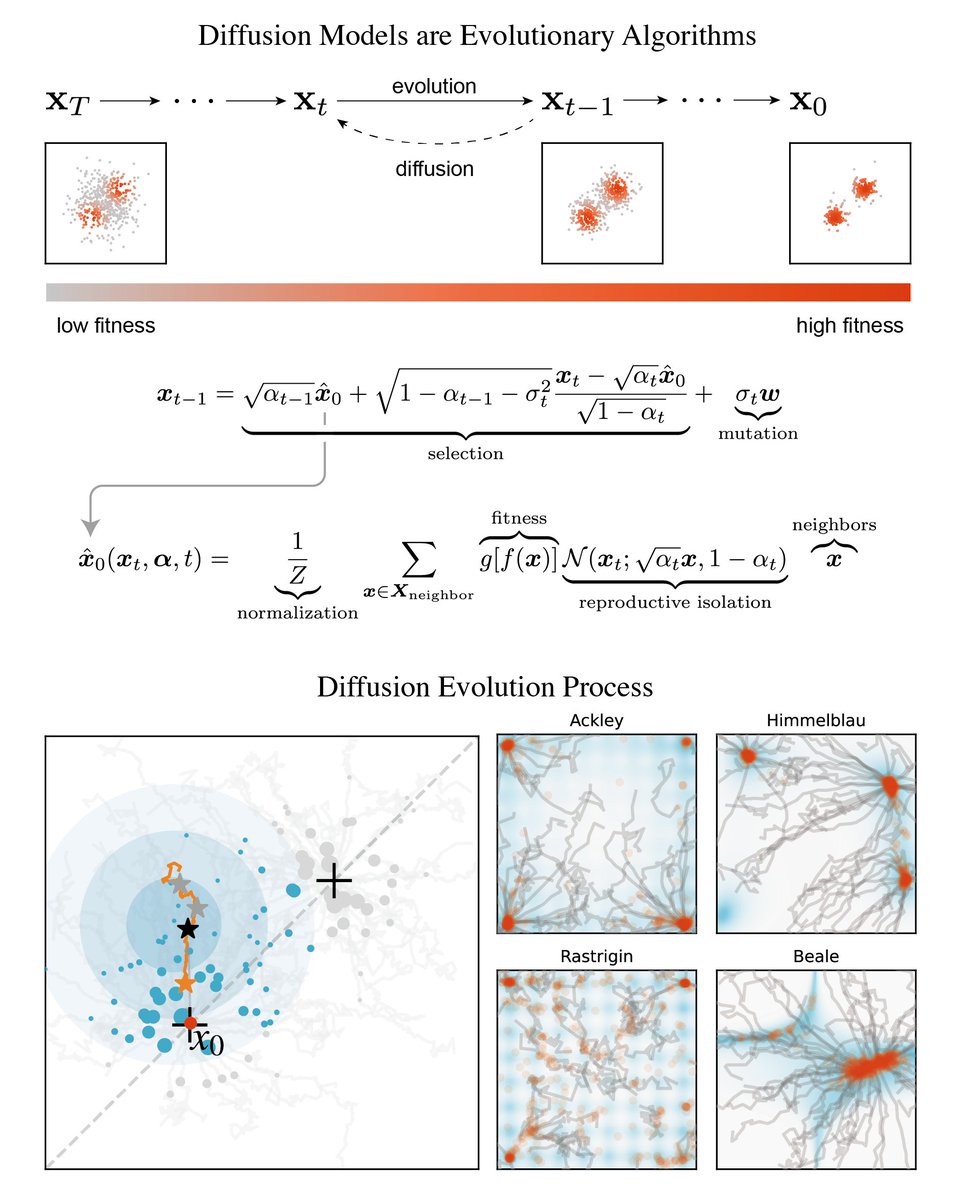
We find that Diffusion Models are Evolutionary Algorithms! By viewing evolution as denoising, we show they share the same mathematical foundation. We then propose Diffusion Evolution (1/n)
BREAKING NEWS
The Royal Swedish Academy of Sciences has decided to award the 2024 #NobelPrize in Physics to John J. Hopfield and Geoffrey E. Hinton “for foundational discoveries and inventions that enable machine learning with artificial neural networks.”