Formula for startup success: Find large highly fragmented industry w low NPS; vertically integrate a solution to simplify value product. - Keith Rabois
@harjtaggar The carnivore diet is a great elimination diet to gauge what your body deems inflammatory. The next thing you could try is Paleo to see if plants are causing any issues.
Lots of early-stage companies get stuck between servicing mass-market SMBs and larger Enterprise customers, and it causes them a lot of pain.
If you can sign Enterprise customers, there's a bunch of stuff you don't really ever need to automate. Onboarding and customer service can be super high-touch and manual because you're earning so much from each customer.
But if you have any volume of SMB customers, they are going to cause you a world of pain. You need to ruthlessly automate every customer interaction, otherwise you'll end up with thousands of people in customer service.
The counter-intuitive point is that smaller customers will often actually generate more customer service volume because they are less sophisticated. They ask loads of questions and don't have their shit together. Enterprise customers are often much more sophisticated.
Learn With Me
I’m often asked how I quickly synthesize information and form opinions. The value, to me, of doing this can be summarized as follows:
- Be more informed about technology, markets and the economy.
- Improve my situational awareness about trends and competitors.
- Have a clearer picture of how a company or sector is doing over another.
- Make better decisions.
I’ve now systematized this into a product that I can share with you, to the extent you are interested.
Read below for more details…
The world is complex and moves at a rapid pace. One day, climate change is all the news; the next day, it's how AI is on the verge of upending everything we know about everything; then we need to become experts in superconductors because some meaningful breakthrough may be at hand.
Meanwhile, the geopolitical chaos in Europe, the Middle East, and Asia seems to be omnipresent and is constantly challenging the existing world order. Finally, we want to know what all of this means for the economy and the companies we work at or are invested in.
It’s hard to make sense of all of this, especially as the incentives of the mainstream media have become increasingly difficult to understand. So how do I form opinions? How do I learn complex topics quickly, usefully, and then fold that into a usable framework?
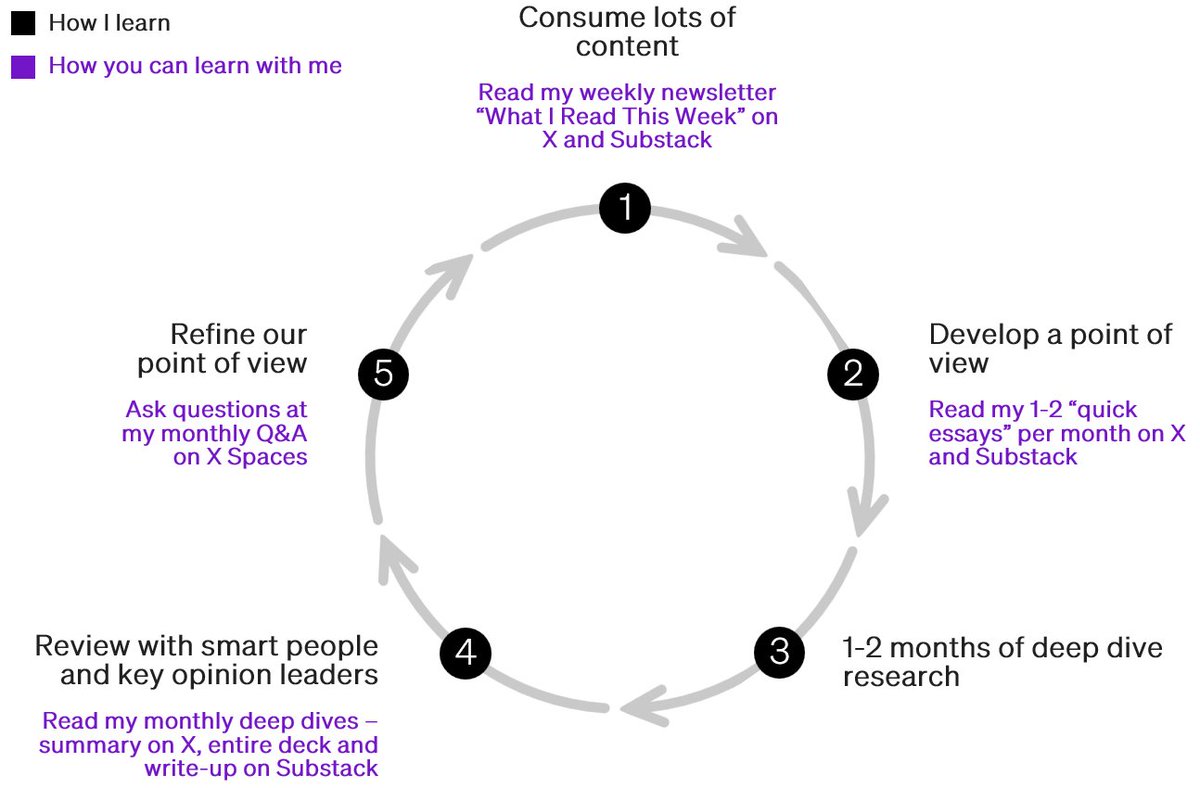
I start with consuming content. Everything from news articles to social media to scientific papers to institutional research to YouTube videos.
Most topics I skim and move onwards from, but for certain topics, where it makes sense, I write a quick 1-2 page essay because I feel it may be important. I do this so I can develop a quick point of view and understand the nuances a little bit better.
When something seems super interesting, I select it for a dive deep with my team, where we allocate at least a month or two to thoroughly understand the key drivers and opportunities, and produce a presentation that captures everything we’ve learned.
We then take our work and review it with a set of smart people and key opinion leaders to challenge and refine our views. Historically, these work products have been very educational to me. I suspect they could be educational to others as well.
So, to this point, I have decided to share more of the work that we do at Social Capital so that if you want to, you can learn along with us.
Here’s the plan:
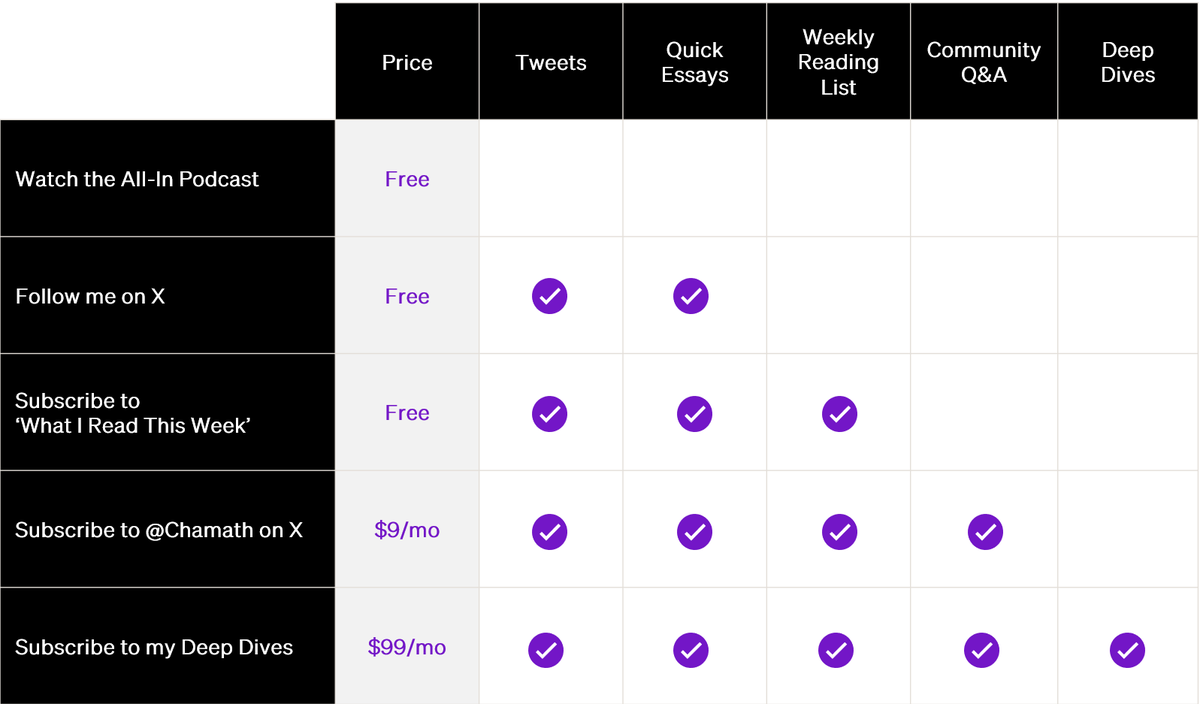
1. I’ll keep posting my daily thoughts and observations on X.
2. I’ll continue to share a summary of the best content that I consumed in the previous week through my weekly newsletter ‘What I Read This Week’.
3. I’ll publish 1-2 quick essays per month on X and on my weekly newsletter ‘What I Read This Week’.
4. Once per month, I’ll host a Spaces to talk about the content we’ve produced, thoughts on the “current thing”, talk to guests and include time for Q&A. This will be the key feature of my Subscription on X. You can subscribe to me on X, and my first Spaces will be in November.
5. Once per month, I will publish a deep dive. This will be a comprehensive slide deck on a topic with an accompanying write-up.
My Deep Dives:
I've structured my deep dives around five primary themes I believe are useful for understanding the world today. These themes will change over time, but it’s important to have a starting point.
1. Deep Tech: I think about “deep tech” as applying science to take things that are scarce and make them abundant, overcoming major scientific and engineering challenges. Such progress often results in significant leaps forward in our capabilities and lays the groundwork for new businesses. It's vital to track these developments to see the potential world in the next decade.
2. Energy Transition: The global energy transition will reallocate trillions in capital expenditure, reorganize U.S. industry, replumb global supply chains, and more. To understand the trajectory of the world and make informed decisions about where to invest your time and efforts, a grasp on energy transition is critical.
3. Healthcare & Life Sciences: Healthcare spending constitutes ~20% of U.S. GDP and shapes the primary demographic shifts influencing economic progress. For example, global GDP diminishes by ~15% due to premature deaths in the working-age population. With new technologies like MRNA and CRISPR, new drugs like GLP1s, and the challenges posed by aging, overweight or sick populations, understanding healthcare and life sciences is as important as it’s ever been.
4. Economic Analysis: In 2021, we saw nearly every business model receive funding. In 2023, capital markets have been much more constrained, and many companies are struggling. Understanding how and why companies receive funding and why certain businesses are valued more than others is important for understanding how technology can be implemented in an economically productive way.
5. Socio-Political Trends: This is the overlay that ties everything together, from the demographic trends that drive consumption habits, to political trends that can act as a headwind or tailwind to economic growth.
I’ll be publishing our first deep dive on December 1st for free, starting with a teardown of the global energy transition. The full content calendar for the next year is outlined below, however, subscribers will be able to comment on what they want to be covered in future months. I’ll make sure to announce next month’s topic in advance so you know exactly what’s coming up.
You should expect beautifully formatted, easy to understand presentations that assume no prior knowledge, with accompanying write-ups that will get you up to speed quickly on each of these topics.
If you are interested, subscribe to my Substack (link in bio) where I will be enabling paid subscriptions in the coming month.
Disclaimer: The views and opinions expressed above are current as of the date of this document and are subject to change without notice. Materials referenced above will be provided for educational purposes only. None of the above will include investment advice, a recommendation or an offer to sell, or a solicitation of an offer to buy, any securities or investment products.
@joshelman Exactly. They include phasing of releases that prove out business line first before scaling it. It’s a tedious process, but Amazon prefers to make these right decision earlier on. AWS, Prime, Prime Video all started from a PRFAQ.
@joshelman Hey Josh, I couldn’t agree more. At Amazon, we write product memos or PRFAQs that share why our business case will be a billion dollar business. I think a streamlined version would be perfect for startups.
Naval Ravikant: Hire high-agency people
“[Hire] people who just solve problems without even being asked to solve the problem—they identify the problem, they go solve it, they don’t even necessarily have to update you every step of the way, they’re not asking silly questions, and they’re just coming up with solutions. Because building a startup is an infinite set of problems that are being thrown at you.”
Source: @AngelList
A coming wave of disruptive companies will be built by layering domain expertise over GPT3. The best of these will:
- solve complex problems, not just automate simple tasks.
- be exceptionally nimble - evolving as fast as the underlying AI does.
- use usage as a metric, not number of users.
There will be a lot of noise. Few will survive.