Very happy to share the first preprint from our group:
https://t.co/epwUyrMSHo
In this work, we asked how oncogenic RAS signalling contributes to the cancer-associated glyco-code.
A thread 👇
Overall, our findings identify GALE as a metabolic control point linking oncogenic RAS signalling to glycoproteome remodelling and malignancy.
Huge thanks to everyone involved — especially Frauke Stoelting, our PhD candidate who led the study, and all collaborators.
Researchers alongside Dr. @vonKarstedtLab show that oncogenic KRAS activates a type I interferon program that sensitizes pancreatic cancer cells to necroptosis, revealing a therapeutic vulnerability in #PDAC.
Learn more here:
▶️ https://t.co/fMI70No4eO
Excited to share our latest study published in @ScienceAdvances. With the An & Zhang labs @UTHealthHouston, we show that monoclonal antibodies targeting PCDH7 inhibit tumor growth and enhance immune responses in multiple KRAS-mutant lung cancer models.
https://t.co/nL75KoAgGe
Bacteria move around using a molecular machine called the flagellar motor that rotates faster than the flywheel of a race car engine and switches directions in an instant. After 50 yrs, scientists have finally figured out how it works. “My lifelong quest is now fulfilled.” Link⤵️
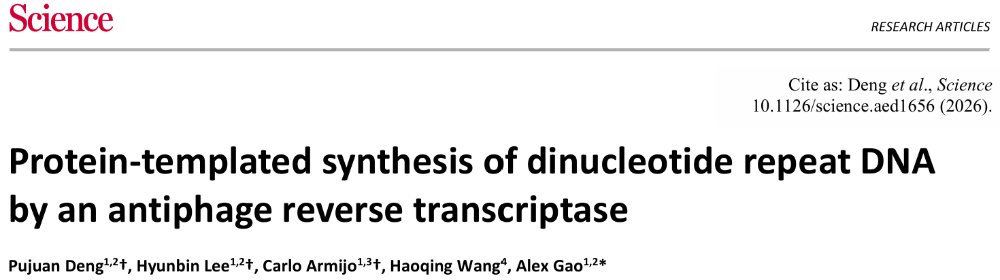
On April 16, 2026, the research group led by Alex Gao from Stanford University published a paper in Science entitled Protein-templated synthesis of dinucleotide repeat DNA by an anti-phage reverse transcriptase.
This study identified and characterized for the first time a bacterial reverse transcriptase named Drt3b, which does not require a nucleic acid template. Instead, it uses its own amino acid side chains as a "template" to precisely synthesize DNA of specific sequences.
This discovery represents another landmark breakthrough in the fundamental rules of biological information transfer since the discovery of reverse transcriptase by Nobel laureate David Baltimore and others in 1970. It not only fills a key gap in our understanding of biological information flow, but also opens a new dimension for deciphering the coding principles of life.
Congratulations to Team Gao on their outstanding work—this discovery is worthy of a Nobel Prize!
Wishing I had enough time to read all the reviews about cell death published in the last few weeks by people who actually know about cell death!
Cell death in cancer: Cell https://t.co/TFDfad0L5z
Years in the making: a detailed aging gene signature in mice and rats. >30 tissues, high Ns, multi-time points throughout the lifespan. >5000 samples in total. The data is accessible, so you check to see if your favorite gene is age-regulated.
https://t.co/5heN6ixvt1