It’s a miracle the Declaration survived 250 years. It was rolled through battlefields during the Revolutionary War, nearly destroyed when the British burned Washington in 1814, and spent decades being moved from city to city before becoming America’s most treasured national document.
Today's conversation with Michael Auslin, author of National Treasure: How the Declaration of Independence Made America," explores not only the remarkable survival story of the Declaration itself, but also the ongoing battle over what it actually means.
https://t.co/Jh6JTeTUu7
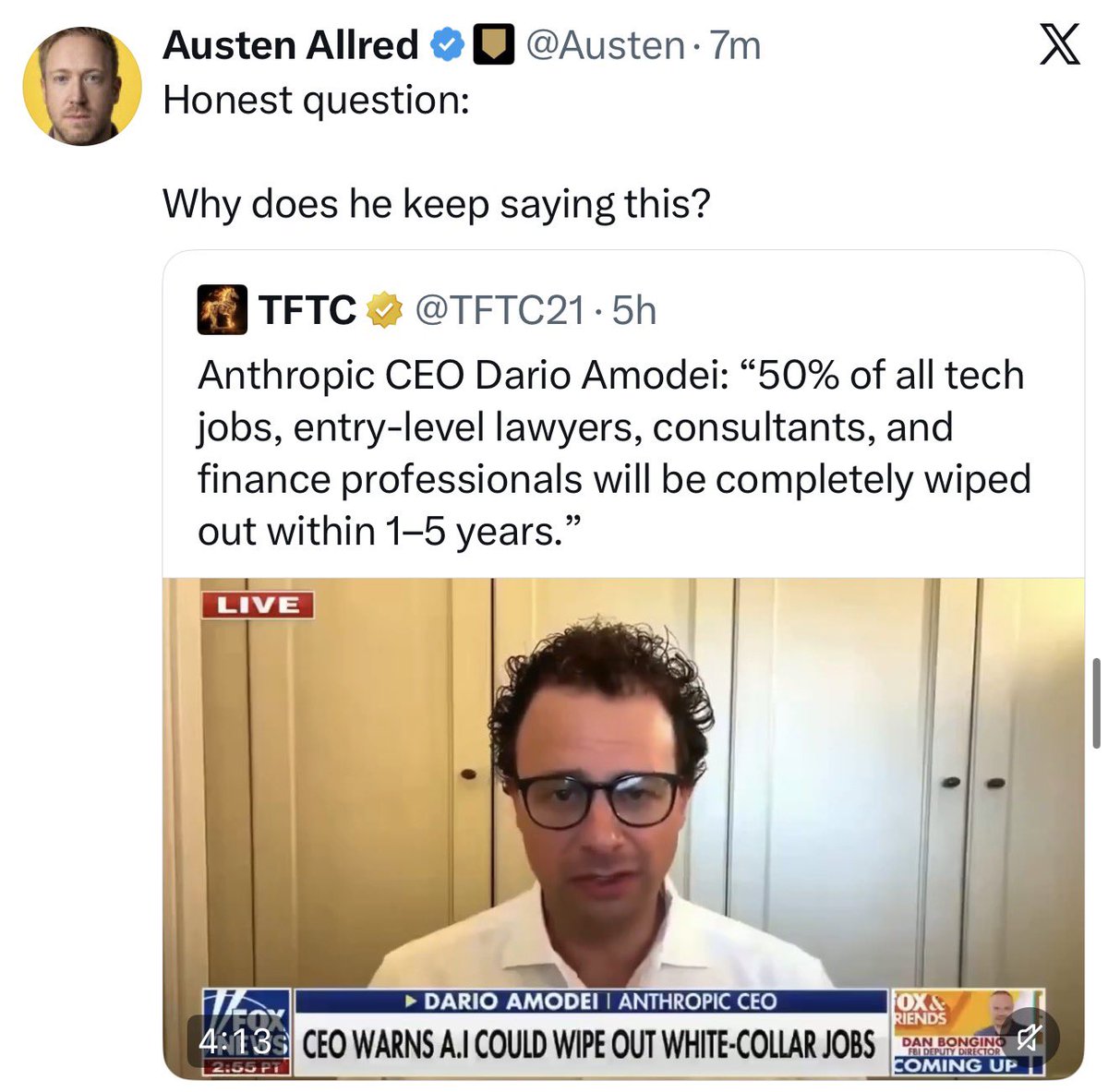
Anthropic’s CEO keeps talking about AI wiping out jobs because he’s trying to IPO this year.
If he positions Claude as armageddon for jobs, his TAM becomes “all white-collar human labor,” not just AI agents or SaaS.
It’s completely self-interested. All the concerns he’s expressing about job disruptions are fake.
It’s a marketing gambit to create hype and FOMO among the people he needs more than anyone else this year: institutional investors like BlackRock, Fidelity, pension funds, and sovereign wealth funds.
If these investors pay for tickets on the hype train—if he can make them believe that AI will eliminate half of white-collar jobs, with Anthropic, as the dominant leader in enterprise AI, positioned to capture the surplus margin—the IPO will be oversubscribed and Anthropic can raise more funds for the company at a higher valuation.
But Dario (or, at least, his bankers) knows that these investors are more fiscally disciplined than they used to be. A lot of them got burned during Covid SPAC-mania and don’t want to risk it again. They’re going to challenge Anthropic about whether it will ever get to sustainably high gross margins, or if its arms race with OpenAI will lead to kilowatt-hours permanently suppressing gross margins. They’re going to ask pointed questions about Anthropic’s massive capex and whether it will ever generate accretive ROIC.
And Dario might not have the answers they’re looking for.
So that’s why—to answer Austen’s smart question—you keep seeing Dario in the news and the podcast circuit, spreading doom and gloom about widespread job loss.
It’s not to make you afraid of losing your job. It’s to get Wall Street afraid of missing out on his IPO.
Incredibly moving from @elevenlabsio: Musician Patrick Darling, who lost his voice to ALS at 29, delivers the first-ever live performance using an AI singing voice clone trained on old phone recordings. Back on stage with his bandmates, singing his original song — the raw emotion when they hear him again after two years is unforgettable. AI restoring identity, creativity & connection. ElevenLabs Impact giving free voices to thousands. https://t.co/SQURhP7KJS
🚨 Neuralink patient #3 Brad (ALS) just got his REAL voice back, thanks to Neuralink + ElevenLabs cloning.
His family can finally hear him again! Warm, familiar, full of life.
No more robotic sound. Just him.
This is the most beautiful side of AI.
Jensen Huang just gutted the AI job panic with one profession.
Radiology.
The field AI was supposed to kill first.
Jensen Huang: “Computer vision was superhuman in 2019. And yet, the number of radiologists grew.”
Not competitive. Not close. Superhuman.
Every forecast said radiologists were finished.
Every forecast was wrong.
Not slightly wrong. Directionally wrong.
There are now fewer radiologists than the world needs. A global shortage. In the exact specialty AI was supposed to erase.
Why?
Because the task was never the job.
Huang: “The purpose of your job and the tasks and the tools that you use to do your job are related. Not the same.”
Reading a scan is a task.
Diagnosing disease is a purpose.
AI handled the task. The purpose didn’t shrink. It compounded.
Faster reads meant more patients seen. More patients seen meant more disease caught. More disease caught meant more demand for the people who decide what to do about it.
The tool did not kill the job. It fed it.
Then the fear did what the technology never could.
Huang: “The alarmist warning went too far and it scared people from doing this profession that is so important to society. It did harm.”
People heard radiologists were finished and walked away from the field.
Medicine bled talent it could not afford to lose.
Not because the work vanished. Because the panic said it would.
The prediction was wrong. The damage was real.
Huang: “The number of software engineers at Nvidia is going to grow, not decline.”
Not hold steady. Grow.
The company building the infrastructure that automates code is hiring more of the people who write it.
Huang: “I wanted my software engineers to solve problems. I didn’t care how many lines of code they wrote.”
Nobody ever hired an engineer to type. They hired them to think.
When the machine handles syntax, the engineer does not become obsolete. The bottleneck just moves upstream. To architecture. To edge cases. To the kind of reasoning no model handles alone.
The world was never short on unsolved problems.
It was short on people free to chase them.
That is the part the fear narrative misses every single time.
340,000 women once worked as telephone switchboard operators.
That job is gone. Nobody mourns it.
What replaced it created millions of roles that nobody in 1920 had the vocabulary to describe.
The losses are always visible. The gains are always invisible until they arrive.
That pattern has survived every technological shift in history.
It is surviving this one.
The people forecasting mass displacement are making the same mistake as the people who forecasted the end of radiology.
They can see the task being automated.
They cannot see the purpose expanding underneath it.
That blindness is not just wrong.
It is expensive.
Every person scared out of a career that AI will actually make more valuable is a cost the economy absorbs for nothing.
Not because of the technology.
Because of the story told about it.
It only takes five minutes to break the cycle.
Five minutes of exercise and you are back on the path. Five minutes of writing and the manuscript is moving forward again. Five minutes of conversation and the relationship is restored.
It doesn't take much to feel good again.
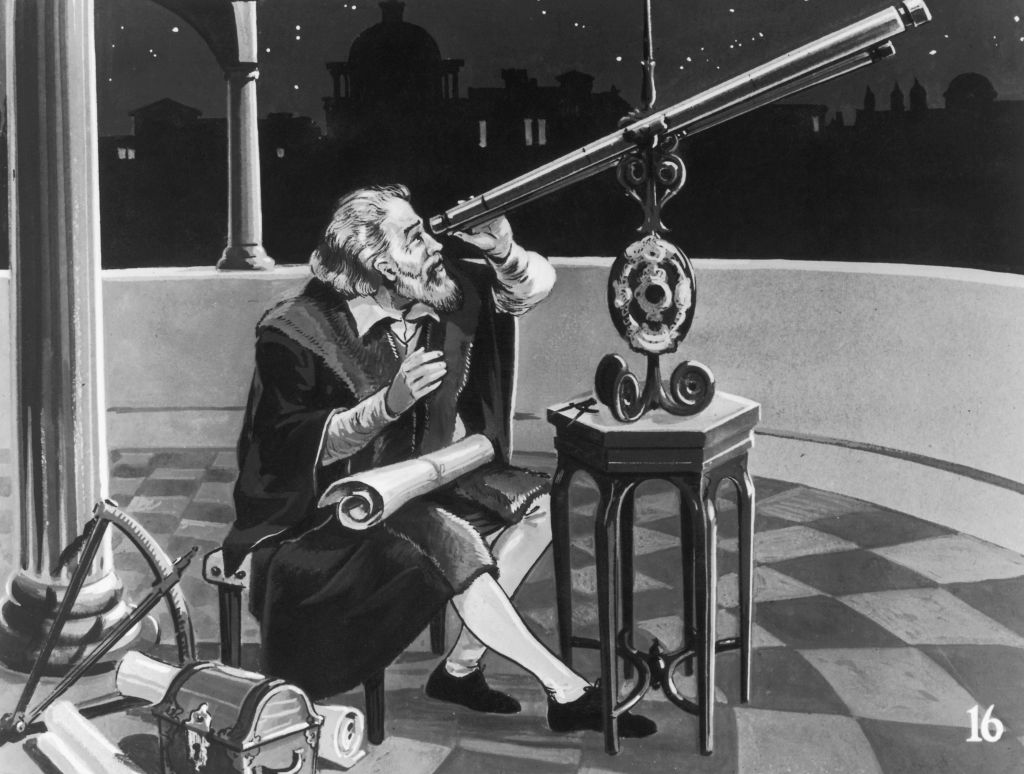
Happy Birthday to Galileo Galilei.✍️
Born on February 15, 1564, Galileo was a pioneering scientist whose observations transformed humanity’s understanding of the universe. Through his telescopic discoveries - including the moons of Jupiter and the phases of Venus - he provided powerful evidence that challenged long-held beliefs and supported the motion of the Earth.
Widely regarded as the Father of modern astronomy, his dedication to observation, evidence, and scientific inquiry laid the foundation for modern science.
This is one of the best speeches against communism and pro-Western Civilization that I’ve ever heard..,
Marco Rubio is incredible here.
I started to pull quotes from it, but there are too many.
This is a must watch.
This is a really good article. AI is going to wipe out millions of jobs. It’s happening now. Everything is changing. The avalanche is already here. Most of what we’re currently arguing about will be irrelevant very soon.
“Many of my daily preoccupations suggest that I belong more to the world than to God. A little criticism makes me angry, and a little rejection makes me depressed. A little praise raises my spirits, and a little success excites me…. Often I am like a small boat on the ocean, completely at the mercy of its waves. All the time and energy I spend in keeping some kind of balance and preventing myself from being tipped over and drowning shows that my life is mostly a struggle for survival: not a holy struggle, but an anxious struggle resulting from the mistaken idea that it is the world that defines me.”
Fr. Henri Nouwen
Return of the Prodigal Son
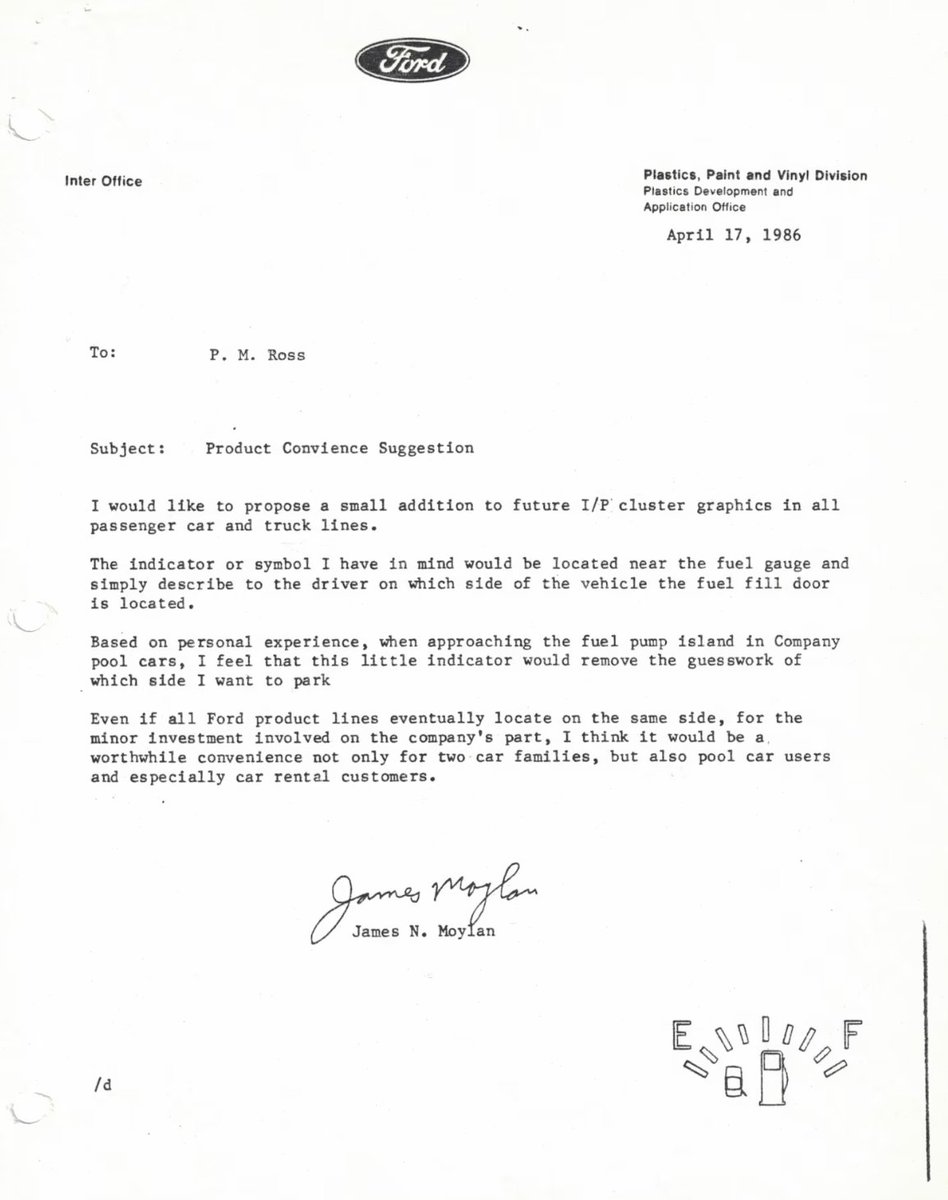
I think of Jim Moylan's invention every time I fill up my gas tank. Jim was a @Ford engineer who noticed an issue and was inspired to solve it to make our customers' daily lives easier. Nearly 40 years later and his innovative idea still helps millions of drivers every day!