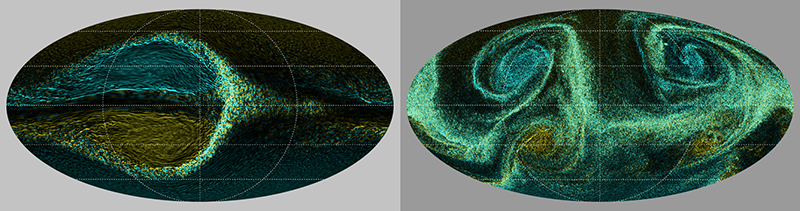
The @PhysRevLett cover is a frame from this movie that shows huge storms form, translate around the planet and vigorously mix its atmosphere.
This incredible amount of detail was revealed by high resolution simulations enabled by powerful supercomputers at @FlatironCCA.
Volume 131, Issue 23
https://t.co/16UdvtpCG9
Cover: Vorticity field of a spin-orbit synchronized exoplanet atmosphere with deep heating. Orange and blue colors correspond to positive and negative values of vorticity, respectively
https://t.co/UVur18W9tj
Sea levels around the world are rising as a result of human-caused global warming. Overall, global sea levels have risen about 10 centimeters from 1993 to 2023. #WorldOceansDay
https://t.co/qqRNzm91IA
Burning, churning weather on another world.
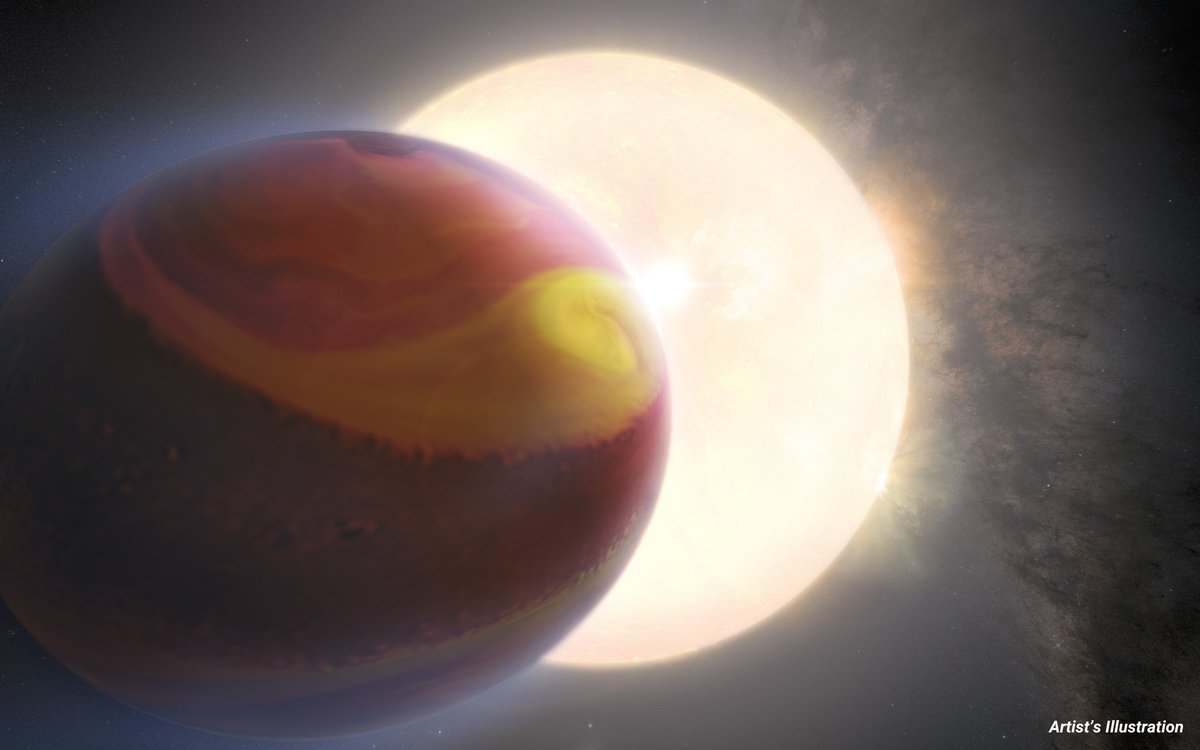
@NASAHubble saw massive weather fronts, storms, and fierce cyclones during three years of observing WASP-121 b. Temperatures hit 3,450° F (2,150 Kelvin) on this planet 880 light-years away. https://t.co/BYFfyWxtE4
Recent simulations reveal that some exoplanets may absorb heat deeper into their atmospheres than previously assumed, resulting in distinct weather patterns. 1/
👉 https://t.co/tTxUiMaGrj
Simulations show that exoplanets heated at deeper depths by their host stars display markedly different weather patterns @physrevlett https://t.co/CRZ3eAYnpC https://t.co/ke28teUkNP
Using Hubble, a team of astronomers have detected atmospheric variability on exoplanet WASP-121 b. The team analyzed Hubble's observations and used computer simulations to show weather patterns within the exoplanet's atmosphere.
By Martijn Luinstra ⬇️
https://t.co/Lu2AWncPdc
While WASP-121 b isn’t habitable, these results are an important early step in studying weather patterns on worlds beyond our solar system – maybe even finding potentially habitable ones: https://t.co/JyTCqrX2E5
This visualization shows the exoplanet's weather patterns.
Studies like this are just the beginning, we are looking forward to learning even more about the weather on these extreme planets with space telescopes like @NASAHubble , @NASAWebb and @ArielTelescope
Thank you for sharing our research!
We were very excited to discover that WASP-121b's atmosphere could be changing in time.
Our simulations show the planet’s extreme day/night temperature difference causes powerful storms to form that mix the planet's hot and cold regions.
Weather report from exoplanet WASP- 121b:
- Daytime temperature of 3,450 degrees Fahrenheit (2,150 degrees Kelvin)
- Massive cyclones
- Orbiting dangerously close to its host star!
For three years, Hubble studied changes in the atmosphere of this planet 880 light-years away ⬇️
Weather report from exoplanet WASP- 121b:
- Daytime temperature of 3,450 degrees Fahrenheit (2,150 degrees Kelvin)
- Massive cyclones
- Orbiting dangerously close to its host star!
For three years, Hubble studied changes in the atmosphere of this planet 880 light-years away ⬇️
Great to see our work featured on the cover of PRL!
Modeling flows on hot-exoplanets is a long-standing and complex problem in exoplanet science. We show that these planets can have multiple configurations of large-scale storms, depending on how they are heated by their stars.
Volume 131, Issue 23
https://t.co/16UdvtpCG9
Cover: Vorticity field of a spin-orbit synchronized exoplanet atmosphere with deep heating. Orange and blue colors correspond to positive and negative values of vorticity, respectively
https://t.co/UVur18W9tj
Supercomputer simulations of the weather on a hot Jupiter #exoplanet reveal a previously unseen storm pattern in which cyclones are repeatedly generated and destroyed https://t.co/RuVW8Euld8 #OpenAccess
Volume 131, Issue 23
https://t.co/16UdvtpCG9
Cover: Vorticity field of a spin-orbit synchronized exoplanet atmosphere with deep heating. Orange and blue colors correspond to positive and negative values of vorticity, respectively
https://t.co/UVur18W9tj
Supercomputer simulations by @jackatmos@Caltech and colleagues of the weather on a hot Jupiter reveal a previously unseen storm pattern in which cyclones are repeatedly generated and destroyed.
https://t.co/nfB9YT0UvP
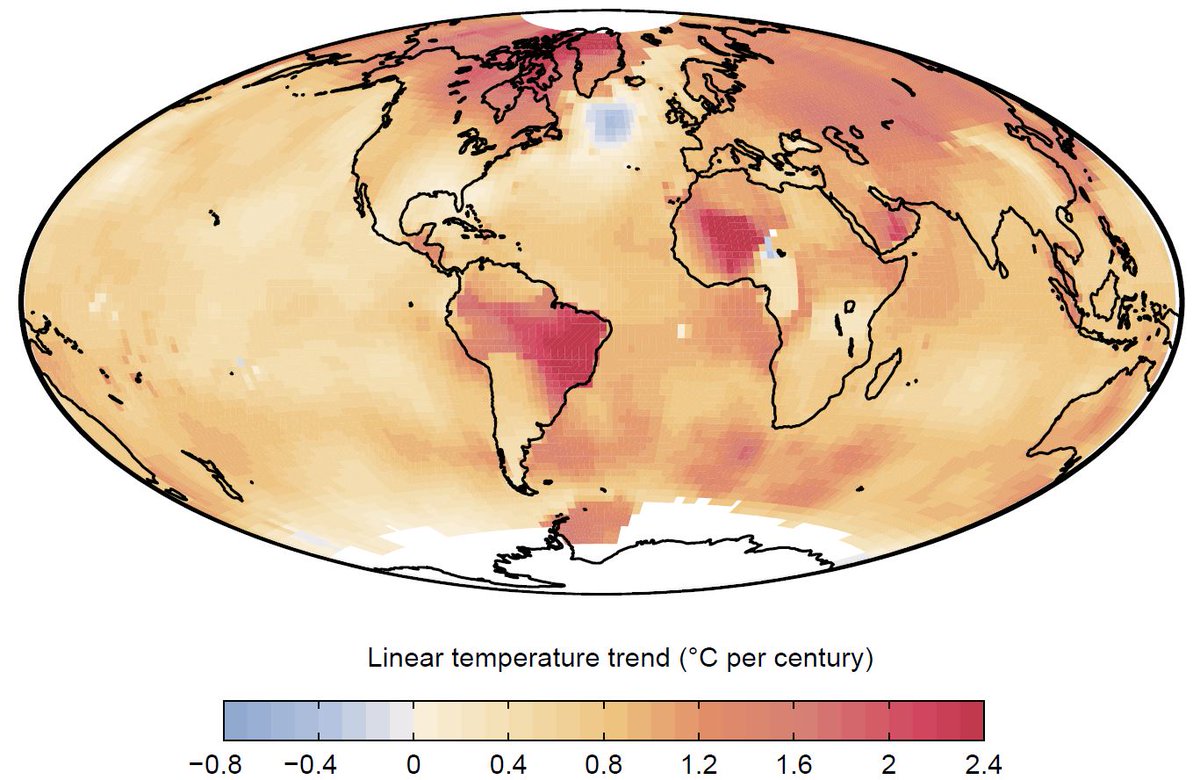
Here's a thread in pictures about the Atlantic overturning circulation #AMOC which is making headlines this week. I've studied this topic since 1991 and will show key data and models & some video.
Let's go: observed temperature trend since 1901 from https://t.co/jGHxmrjzLG 🧵1/x
Yesterday, Antarctic sea ice extent hit a new record statistical low of -6.65σ below the 1991-2020 mean. About a 1-in-70B chance w/o climate change.
This is not a graph of extent or anomaly. It is a graph of standard deviations -- a measure of how abnormal the year's data is.
Canada gets onboard @esa Ariel exoplanet mission! 🪐
We’ll be providing components known as cryoharnesses. This contribution will allow for Canadian science participation in the mission. @mcgillu
Learn more: https://t.co/cezGxxyb2N
📸 : ESA, CC BY-SA 3.0 IGO