🚨 JUST IN - The White House’s UAP Science Advisory Council members have been announced:
Dr. Avi Loeb — Harvard theoretical physicist, founder of the Galileo Project, former chair of Harvard's astronomy department, and bestselling author of Extraterrestrial, tapped to lead the new UAP Science Advisory Council appointed by the White House, AARO, and ODNI.
Dr. Regina Sarmiento — Galileo Project researcher whose work focuses on AI-assisted data analysis and management, joining the council to apply machine-learning techniques to UAP data.
Prof. Garry Nolan — Stanford pathology professor and molecular biologist, co-founder of the Sol Foundation, bringing expertise in molecular biology and materials science to anomaly investigations.
Dr. Tim Gallaudet — oceanographer and former Acting NOAA Administrator and Rear Admiral, contributing oceanographic expertise to the council's analysis of maritime UAP encounters.
Dr. Jennice Vilhauer — Los Angeles psychologist, developer of Future Directed Therapy and author of Think Forward to Thrive, joining to study the psychological impact of potential disclosure on the public.
Prof. Matthew Szydagis — physicist specializing in instrumentation and detector technology, appointed to lead instrumentation and data-collection methods for the council.
Dr. Devesh Nandal — researcher in numerical analysis and astrophysics, recruited to apply computational modeling techniques to UAP phenomena.
Prof. Peter Skafish — cultural anthropologist and co-founder of the Sol Foundation with a PhD from UC Berkeley, author of Rough Metaphysics, bringing an anthropological lens to how humans might interpret nonhuman intelligence.
Dr. Michael Shermer — founder and publisher of Skeptic magazine, longtime science communicator known for applying critical-thinking and anomaly-investigation methods, including a public wager with Loeb over alien-technology disclosure.
Dr. Richard Cloete — Galileo Project postdoctoral fellow trained at the University of Cambridge, specializing in AI-driven data analysis tools, appointed to the council to lead data analysis and AI methodology.
Dr. Omer (Eldadi) — specialist combining data management, AI, and human psychology, appointed to handle the council's data infrastructure and the human-factors side of UAP reporting.
A Brazilian couple visited the latest crop circle in Wiltshire and recorded a moving vortex.
There's no wind.
-------
#NEIOH - "This Is A Group Of Fairies That Have Come To The Location To Celebrate The Formation Of The Crop Circle.
This is Often Done But Few Have Captured This. As The Fairies Emit A Powerful Energy, The Formation Of The Vortex Is Seen.
The Fairies Will Linger Briefly And Then Completely Change Densities And Vanish Through A Portal Of Light."
Brilliant work from Thinking Machines. This interaction model framing is exactly where AI needs to go: less “prompt and wait”, more live collaboration between human judgement and background reasoning.
Strongly worth reading, and congratulations to the team.
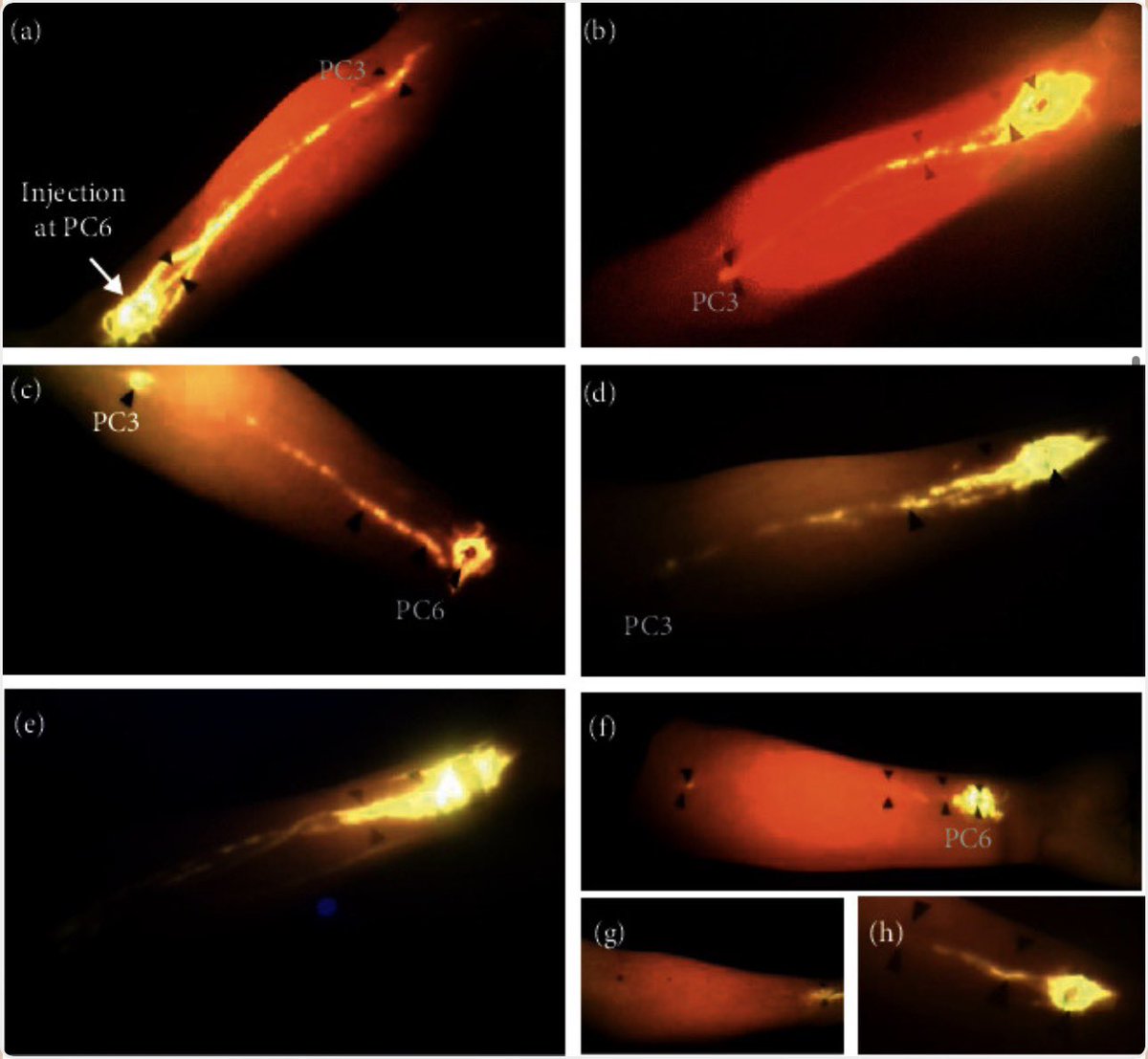
Boom! Scientists Discovered a Hidden Superhighway Inside You That Might Finally Explain Why Acupuncture Actually Works!
How tattooed skin biopsies proved something over 4,000 years old.
Buckle up…research just dropped a bombshell that is rewriting the human anatomy textbook and high fiving ancient healers at the same time!
Deep inside your body lies an enormous, previously overlooked network called the interstitium. It is a vast, fluid filled web that acts like a secret third circulatory system alongside your blood vessels and lymphatics. It is not just empty space between tissues.
It is a dynamic, interconnected superhighway made of collagen bundles suspended in a shimmering hyaluronic acid gel that soaks up water and lets fluids, cells, and molecules flow slowly but surely throughout your entire body, from skin to muscles to organs and back again.
For over a century, scientists saw these spaces as isolated little pockets. But groundbreaking work starting in 2018 by pathologists revealed the jaw dropping truth: it is one giant, continuous network.
When researchers examined tattooed skin biopsies, the ink particles had boldly marched from the skin deep into the fascia below, traveling through the interstitium in ways that made scientists say, That was not supposed to happen!
Here is where it gets truly electrifying.
This hidden highway might finally give Western medicine the biological proof it has been craving for acupuncture and Traditional Chinese Medicine.
For 4000 years, TCM has described chi flowing along 12 specific meridians. Acupuncture needles target precise points along those lines.
Skeptics have long asked for hard science. Now they have it.
Studies, including tracer injections and dye experiments in living volunteers, show that when you inject dye into an acupuncture point, it does not just sit there or race through veins.
It flows exactly along the traditional meridian pathways through the interstitial spaces between muscles, heading straight toward the heart. The dye follows the interstitium like a GPS guided river.
Rebecca Wells, one of the lead scientists, sums it up perfectly:
“I actually do think that the interstitium could be the link between Eastern and Western medicine”.
The implications are massive and mind blowing.
Cancer cells may hitch rides on this network to metastasize.
It could explain autoimmune flare ups where gut particles travel to distant organs.
It might even unlock better treatments for Type 2 diabetes by revealing how interstitial cells influence healthy fat production during weight gain.
This is not just a cool anatomy fact. It is a paradigm shift that could reshape pain management, chronic disease treatment, and how we think about the body as a whole.
Evolutionarily speaking, similar fluid systems appear in ancient creatures going back hundreds of millions of years.
The interstitium is not new. It has been with us since the dawn of multicellular life. We are only now catching up.
This discovery is pure science magic: ancient wisdom validated by cutting edge research, turning what looked like disconnected puzzle pieces into one breathtaking picture of how our bodies really work.
When reading this, be sure to send condolences to the “debunkers” that stole this 4,000 year old empirical science from your health. They were wrong.
Dive into the actual research papers:
The groundbreaking discovery of the interstitium: https://t.co/cqX5kzcVDZ
The study on continuity of interstitial spaces across the body: https://t.co/MeW2ZzPm3z
Research visualizing fluorescent dye migration along acupuncture meridians: https://t.co/C8juE92PA0
Your body just got a whole lot more awesome. The future of medicine is flowing through the interstitium right now, and it is going to be legendary!
In April, a website that has been sued, blocked, deplatformed, and chased across thirty-seven domains over fifteen years quietly launched its own AI.
Sci-Hub is the largest unauthorized library of scientific papers in human history. Ninety-five million academic papers. Tens of millions of books. Built and maintained by a single Kazakhstani neuroscientist named Alexandra Elbakyan since 2011, funded by donations, hosted on whatever country's registrar will tolerate it that year, mirrored across torrents and IPFS and Telegram bots.
Elsevier sued. Sci-Hub stayed up. The American Chemical Society sued. Sci-Hub stayed up. India sued. Sci-Hub stayed up. Swedish registrar Njalla cut the .se domain in January. Sci-Hub stayed up at .al, .ru, .ee, .box, and a half-dozen .onion addresses the registrars cannot reach.
Now the library has built its own intelligence.
Sci-Bot launched in alpha in April. You ask it a research question. It answers, and it cites real papers from inside the corpus, with links that actually open the actual papers.
The bot does not hallucinate citations. It cannot, because it only draws from papers it actually holds. The same property that the venture-funded labs have spent four years and forty billion dollars trying to engineer back into their products is a free side effect of training the model on a library that contains the books.
Anthropic, OpenAI, Google, and Meta have all been sued in the past eighteen months for training their models on the same shadow libraries that Sci-Hub assembled. Meanwhile the corpus those scripts were pointed at, the corpus those models were trained on, the corpus the entire generative AI industry is built on, sat right there the whole time, free, with a search box on top.
The pirates beat them to it.
Sci-Bot was built on a corpus that was already free, by a team that asked no permission, charging no one, with the explicit position that the right to read scientific research is older than the cartel that decided to charge for it.
The same arithmetic the medieval guilds used to keep the printing trade in approved hands. The same arithmetic Pope Paul IV used in 1559 to publish the Index Librorum Prohibitorum. The same arithmetic the Stationers' Company used in seventeenth-century London.
Knowledge has always had a fence around it. The fence has always been guarded by men who did not write the books.
The library answers. We never asked permission. We never had to.
Peekaboo 3.0 is live. Biggest release since 2.0.
⚡ Action-first macOS computer use
👁️ Unified screenshot + UI detection
🧩 Cleaner JSON across CLI + MCP
🛠️ Better snapshots
I started this last year, but the models just weren’t good enough. Now they are. https://t.co/0wvhR0NWOj
HTML is the new markdown.
I've stopped writing markdown files for almost everything and switched to using Claude Code to generate HTML for me. This is why.
@MatthewBerman Really like this idea Matthew. Detecting drift across OpenClaw prompts, skills, links, and support docs feels like one of the most useful practical unlocks for keeping an agent stack coherent over time. Very relevant to what I’m building with my Genie project. Cheers.
Judging by my tl there is a growing gap in understanding of AI capability.
The first issue I think is around recency and tier of use. I think a lot of people tried the free tier of ChatGPT somewhere last year and allowed it to inform their views on AI a little too much. This is a group of reactions laughing at various quirks of the models, hallucinations, etc. Yes I also saw the viral videos of OpenAI's Advanced Voice mode fumbling simple queries like "should I drive or walk to the carwash". The thing is that these free and old/deprecated models don't reflect the capability in the latest round of state of the art agentic models of this year, especially OpenAI Codex and Claude Code.
But that brings me to the second issue. Even if people paid $200/month to use the state of the art models, a lot of the capabilities are relatively "peaky" in highly technical areas. Typical queries around search, writing, advice, etc. are *not* the domain that has made the most noticeable and dramatic strides in capability. Partly, this is due to the technical details of reinforcement learning and its use of verifiable rewards. But partly, it's also because these use cases are not sufficiently prioritized by the companies in their hillclimbing because they don't lead to as much $$$ value. The goldmines are elsewhere, and the focus comes along.
So that brings me to the second group of people, who *both* 1) pay for and use the state of the art frontier agentic models (OpenAI Codex / Claude Code) and 2) do so professionally in technical domains like programming, math and research. This group of people is subject to the highest amount of "AI Psychosis" because the recent improvements in these domains as of this year have been nothing short of staggering. When you hand a computer terminal to one of these models, you can now watch them melt programming problems that you'd normally expect to take days/weeks of work. It's this second group of people that assigns a much greater gravity to the capabilities, their slope, and various cyber-related repercussions.
TLDR the people in these two groups are speaking past each other. It really is simultaneously the case that OpenAI's free and I think slightly orphaned (?) "Advanced Voice Mode" will fumble the dumbest questions in your Instagram's reels and *at the same time*, OpenAI's highest-tier and paid Codex model will go off for 1 hour to coherently restructure an entire code base, or find and exploit vulnerabilities in computer systems. This part really works and has made dramatic strides because 2 properties: 1) these domains offer explicit reward functions that are verifiable meaning they are easily amenable to reinforcement learning training (e.g. unit tests passed yes or no, in contrast to writing, which is much harder to explicitly judge), but also 2) they are a lot more valuable in b2b settings, meaning that the biggest fraction of the team is focused on improving them. So here we are.
i'm on vacation with my family. i read about mythos and couldn't relax the rest of the day. i am completely stunned. i already have a severe case of ai psychosis. i dont know what to call this now.
i'm up late right now (late for me). i can't stop reading about anthropic's new model that they can't even release publicly because it's so good. this feels different. words like "frightening" and "uneasy" and "scary" are being throw around by the anthropic team. i feel all of those things.
i knew this moment was coming. i didn't know it'd be so soon. i'm generally optimistic. i don't feel as optimistic today. i was shell-shocked most of the day. my mind was stuck on it.
i kept looking around at people enjoying their vacations with their families and...i just felt weird. like i had been told aliens are real, they're coming, and soon...and no one else knows. it's true though, practically no one knows what's happening in AI right now.
where does this go from here? how quickly? is software solved? is all software vulnerable now? am i even asking the right questions?
what about anthropic? this is an enormous amount of power for one company, one man (dario), to have. i've said this before but now it's more real than ever: can any company catch up to anthropic? opus likely helped build mythos, mythos will help build the next model after that.
recursive self improvement is here. the "intelligence explosion" as leopold aschenbrenner put it, is here.
i knew the frontier labs were racing towards ASI. i knew it. but i didn't fully grasp what it meant. the first company to reach it wins. period. full stop. nothing else matters. dario knew that and his bet on coding was right.
on the one hand, imaging all science, math, coding, climate problems being solved. imagine cancer being cured. imagine going to the stars.
on the other hand - imagine concentration of power, political and economic change happening so fast, society can't adapt.
how do we go on like things are the same?
@lexfridman Love you the way you are Lex. I’m a New Zealand professional genealogist and very open minded. We need people like you. Keep up the great work you do.