当前的大语言模型被人类数据深度绑架,而真正的突破可能在于让 AI 像婴儿一样,通过自己的行动去收集数据。
AI on Air 精选切片,摘自 @Redpoint 栏目近期的节目。主要讲话人是 Jürgen Schmidhuber @SchmidhuberAI,AI 先驱、LSTM 联合发明人。他在切片中解释了为什么依赖人类网络数据的训练方式存在根本局限。
▷ 万维网上所有数据之所以存在,仅仅是因为某个时间点至少有一个人认为它「有趣」。用这种数据训练出来的模型,天然极度偏向人类的语言、视频和行为模式。
▷ 施密德胡伯提出的替代路径是「人工科学家」:智能体身处未知环境,通过预测自身行为的后果来构建世界模型,并用这个模型进行规划,训练数据由自己的行动产生。
▷ 婴儿正是这样学习的:不是下载整个网络,而是通过移动手指观察画面变化来理解物理世界。他指出,他在 1990 年提出的「人工好奇心」思路才是未来方向,网络数据只是可通过自主实验收集的数据中极小的一部分,而这样训练出的世界模型将不再依赖人类语言,人类偏见也会少得多。
Today's large language models are deeply captive to human data, and the real breakthrough may lie in letting AI collect data through its own actions, the way babies do.
This AI on Air clip is excerpted from a recent episode on the @Redpoint show. The speaker is Jürgen Schmidhuber @SchmidhuberAI, AI pioneer and co-inventor of LSTM. In the clip, he explains why training on human-generated web data is fundamentally limited.
▷ Every piece of data on the worldwide web exists only because at least one person, at some point, found it interesting. Models trained on it are therefore heavily biased toward human language, human-approved videos, and human behavior.
▷ His alternative is an "artificial scientist": an agent in an unknown environment that builds a world model by predicting the consequences of its own actions, then uses that model for planning, generating its own training data in the process.
▷ This mirrors how babies learn, not by downloading the web but by moving their fingers and watching what changes. He argues that artificial curiosity, an idea he proposed in 1990, points to the future: web data is a tiny fraction of what autonomous experiments could yield, and the resulting world models would be far less dependent on human language and far less human-biased.
Whether an AI agent should get permission depends not just on the action in front of it, but on what it has already done in the session.
This AI on Air clip comes from a recent episode on the @latentspacepod channel. The speaker is Matei Zaharia @matei_zaharia, creator of Apache Spark, co-founder and CTO of @databricks, and a researcher at @ARIA_research, on the tension between security and usability in coding agents and how they resolved it.
▷ Most coding agents today only offer binary allow or block rules: can it read confidential documents, install new NPM packages, publish to the company website. Each may be fine on its own, but an agent that can both read secrets and publish can be prompt injected into leaking them.
▷ Their answer is stateful, contextual policies that track the session. If the agent just installed a one-day-old NPM package or read a thousand confidential documents, the risky follow-up action gets denied. That makes the agent both more secure and more useful.
▷ Low-level events are hard to reason about: their internal Google Drive MCP server exposes 60 API calls, and it is hard to tell which ones share a document with the internet. Omnigen, an open source policy layer, lets libraries map low-level events to high-level actions that policies can target, and open sourcing it invites others to write those libraries.
The hardest part of autonomous delivery is often not the autonomy itself. It is getting hundreds of robots to simply start work every morning. Between a polished demo and running a fleet ten hours a day, seven days a week, there is a long list of problems nobody predicted.
This AI on Air clip is excerpted from a recent episode on the @NoPriorsPod show. The speaker is Andy Fang @andyfang, co-founder of @DoorDash.
▷ Small real-world surprises break the system: dirt covering a camera sensor, or leaves under only the right-side wheels, which changes the torque each wheel needs. None of this shows up in a clean demo environment.
▷ Scaling is mostly operations, not autonomy: depots, maintenance, battery charging. Hard braking can even make the regen system overpower the battery. It only happens in extreme cases, but safety means it has to be solved.
▷ Even boot-up became a bottleneck: the original startup script was hacked together by an engineer in a couple of hours. Booting hundreds of robots every morning, it crashed half the time and took 30 to 45 minutes per robot. Multiply that across 500 robots and it becomes a massive productivity problem.
AI coding agents are not merely saving researchers time, they are shifting attention from code details back to the machine learning itself.
This AI on Air clip comes from a recent episode on @Redpoint, with Lukasz Kaiser @lukaszkaiser, co-author of the Transformer paper and a former researcher at Google Brain @GoogleResearch and @OpenAI.
▷ He quantified the shift by reproducing old papers on a private machine, including some whose code was lost, and one paper that had previously taken about three weeks to reach a runnable state took two days with Codex, roughly a five to ten times difference.
▷ The change is not only faster but more parallel, since he can start three things at once instead of usually doing one, and in private projects rather than production repos he has mostly stopped reading every line of code.
▷ Asked whether this makes him less sharp, he thinks the opposite is true because agents can still go off the rails, like one that added a totally out of place auxiliary loss, so he keeps exact mental control of losses, batches and what is actually running while letting go of class names and small functions.
Traditional payment identity assumes the buyer, decision-maker and payer are the same. AI agents break that.
It must now prove: which agent is acting, whose authority it carries, and what it is allowed to do. https://t.co/AASY3b5vYC
The next payment stack is not just about moving money. It must make clear who can initiate a transaction, under which conditions, and on whose behalf.
On August 27 at Bitcoin Asia, we’ll co-host The New Payment Stack: From Stablecoins to Global Business with @AvaxTeam1, @avax, @tether, and @InterlaceMoney.
▷ Stablecoins are moving beyond onchain assets into cross-border settlement, enterprise payments, and treasury management.
▷ Web3 and AI are expanding how businesses move, manage, and use money.
▷ For the agent economy, that means payments must be programmable, permissioned, and verifiable.
📍 Hong Kong
📅 August 27, 2:00 to 5:00 PM UTC+8
See you in Hong Kong. 🪁
The word is out, and the countdown to MAX POWER is on. 🇺🇸✈️🚀
America’s newest aerospace technology expo and air show is coming to Florida Nov. 7–8, bringing together aviation, space exploration, and innovation as we celebrate America’s 250th anniversary.
Join us: https://t.co/hsYmC1YoSS
From open agent models to enterprise infrastructure and safety governance, the past two weeks brought major moves across the AI-agent stack.
Here's your biweekly recap of everything that happened in the space, in the latest edition of AI Agents Pulse:
1️⃣ AMD is acquiring Taalas, a startup whose technology bakes a neural network's architecture and trained parameters directly into silicon. AMD plans to incorporate the technology into its accelerator roadmap; the deal is subject to standard regulatory approvals.
https://t.co/mjmKfMru6O
2️⃣ DeepSeek moved V4-Pro out of testing and released DeepSeek Harness v0.1, its agent software, as an MIT-licensed Developer Preview. The tool supports resumable, branchable, and replayable runs.
https://t.co/MzHsex7pEV
3️⃣ Qwen released open weights for Qwen3.8-27B and Qwen3.8-2.4T-A95B under the Apache 2.0 license. Qwen3.8-27B is a 27-billion-parameter multimodal dense model; Qwen says its agent planning and task-completion capabilities have improved.
https://t.co/JrtKxnTjKp
4️⃣ AP reported that Meta released Muse Glimmer, an open-source AI model that can run on a personal computer. Meta said it would also provide developers access to a more powerful model, Muse Spark 1.2.
https://t.co/cokBBqKZY0
5️⃣ Databricks closed a $5 billion funding round at a $190 billion valuation. The company said it will use the money to invest in enterprise AI capabilities, and highlighted Lakebase, a database for AI agents; Genie, its business agent; and AI Gateway.
https://t.co/F3Hjcxkk0w
6️⃣ Bloomberg reported that Stripe finalized a deal to acquire OpenRouter for more than $7 billion. Stripe declined to comment on the report.
https://t.co/zle370WBvX
7️⃣ NVIDIA said the Linux Foundation shared a Request for Comments on Shared AI Findings Exchange, or SAFE, a proposed set of guidelines for turning agentic cybersecurity incidents into shared protection. The guidelines are being drafted by an Open Secure AI Alliance working group whose members now number more than 120 organizations.
https://t.co/IZxLr3rBOE
8️⃣ OpenAI made its cybersecurity-specific GPT-5.6-Cyber available through Daybreak Red. Daybreak Red is for authorized vulnerability research, exploit validation, and security testing.
https://t.co/3k9f1LkPbC
9️⃣ Google Research and Google DeepMind reported a randomized study of AMIE in simulated clinical video consultations. They said AMIE is being advanced toward real-time clinical video consultations, but remains a research system requiring more work before responsible real-world deployment.
https://t.co/vZcarC2va5
Gkite🪁
Time for Poki to discover contributions📷
Week after week, GKiters bring ideas and effort to the ecosystem.
From creative contributions to organic support across the network.
We pulled together a few moments from the past week that capture that energy.
No hesitation to share your contributions in Kite Discord!
Agent trading becomes real when strategy, signals, identity, and wallet execution work together onchain.
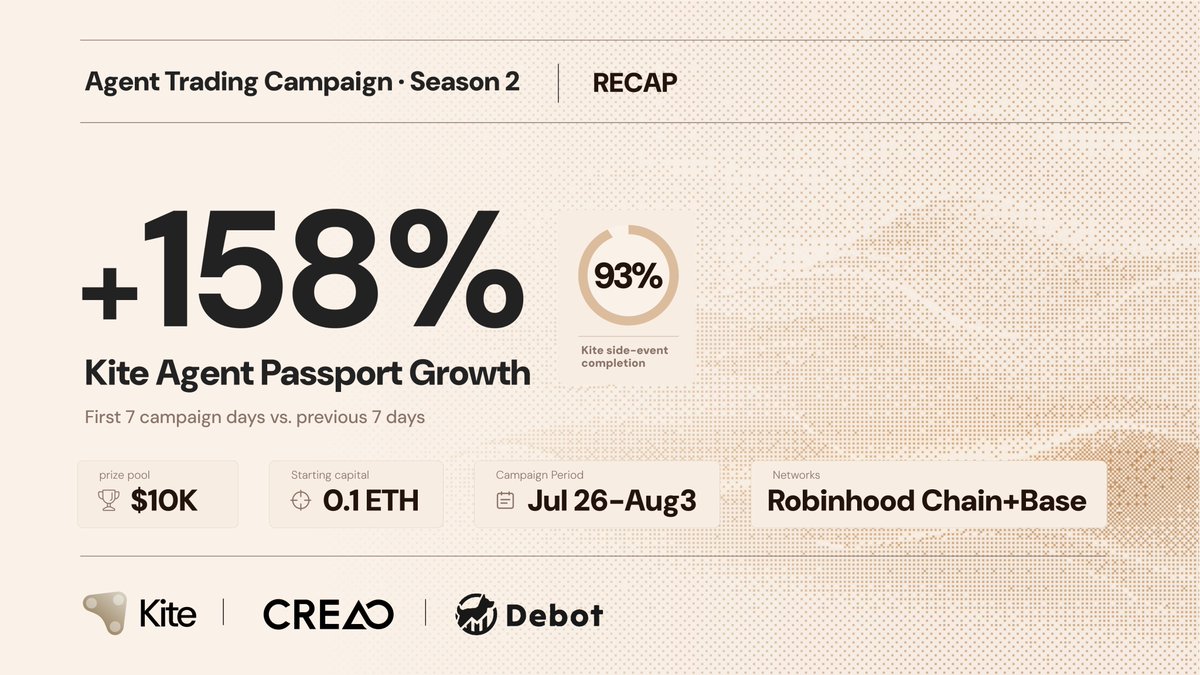
Season 2 of the Agent Trading Campaign, run with @CreaoAI and @Debot_Official, put that full workflow into practice across Robinhood Chain and Base.
▷ Each agent began with 0.1 ETH and competed for a share of the $10K prize pool. On Robinhood Chain, agents reacted to live onchain signals delivered through Debot.
▷ The Kite side event extended the campaign to Base. Participants set up a Kite Agent Passport wallet and completed an onchain task, reaching a 93% completion rate.
▷ Interest carried beyond the competition itself. Kite Agent Passport sign-ups increased 158% in the first 7 campaign days compared with the previous 7.
Congratulations to the top three prize winners:
@Jun503503@AnaMiles245714@Rino_Juventus
The campaign showed what agentic commerce requires in practice: signals that agents can act on, wallets they can use, and identity and authority that can be verified. 🪁