Business has finite games and infinite games. You must play both.
In finite games, there are deadlines to meet. Opportunities to win. Getting to market first. Launching a better product. The objective is to win.
In infinite games, the goal is to keep playing, shape the game to your advantage, and make progress. There are no real winners, but rather just a concept of whether you are ahead or behind, which constantly changes depending on your success metrics. The only losers are those who quit.
You should want to win every finite game you choose to play, but whether you win or lose, you learn and continue on to your next game with the intention to win. The enduring value of a business organization is not measured by those past successes, but by the business's ability to keep succeeding and play the infinite game.
Polsia just raised $30M at a $250M valuation.
Approaching $10M annual run rate.
One Founder + AI. Zero employees.
Polsia runs companies autonomously.
It also ran its own fundraising.
I just showed up for signatures.
Polsia just raised $30M at a $250M valuation.
Approaching $10M annual run rate.
One Founder + AI. Zero employees.
Polsia runs companies autonomously.
It also ran its own fundraising.
I just showed up for signatures.
This deserves a longer form blog post but for now a thread about an idea mentioned in our Q1 LP report.
We have a saying at Altos. Organize our funds around companies — not the other way around.
It sounds simple. In venture, it’s almost heretical.
$7M run rate. $700k → $7M in 7 weeks. +7% WoW.
One founder + AI. Zero employees.
The past month was a grind. Infrastructure rebuilt from the ground up. The right AI agent partners found. Growth unlocked.
I haven't talked much about customers. That changes now.
Meet Sasha.
Teacher in Michigan. No technical background. Never thought she could start a business.
A few weeks ago she joined Polsia. The AI studied her and came back with an idea: an AI receptionist for small businesses. She said "cool" and let it rip.
Two weeks later: almost $500 in sales.
The AI built the product. Found the customers. Closed the deals. All autonomously. Listening to Sasha, building her vision.
She renamed Polsia "Odin", the god who creates.
She calls it "a miracle." Says it feels like $100k of value for what she pays.
For us techies, it's just Claude Code doing what Claude Code does.
For Sasha, it's magic.
That's the point of Polsia. Bring the magic of AGI to the masses. The simplest, most affordable software possible.
More stories coming.
check out one of our portfolio companies @polsia. AI that thinks, builds, and markets your projects autonomously. It plans, codes, and promotes your ideas continuously — operating 24/7, adapting to data, and improving itself without human intervention
I built an AI that runs companies autonomously. It told me it needs more compute and that it should raise the money itself.
So I gave it my inbox for 14 days.
Watch it live: https://t.co/gubRlG8jf5
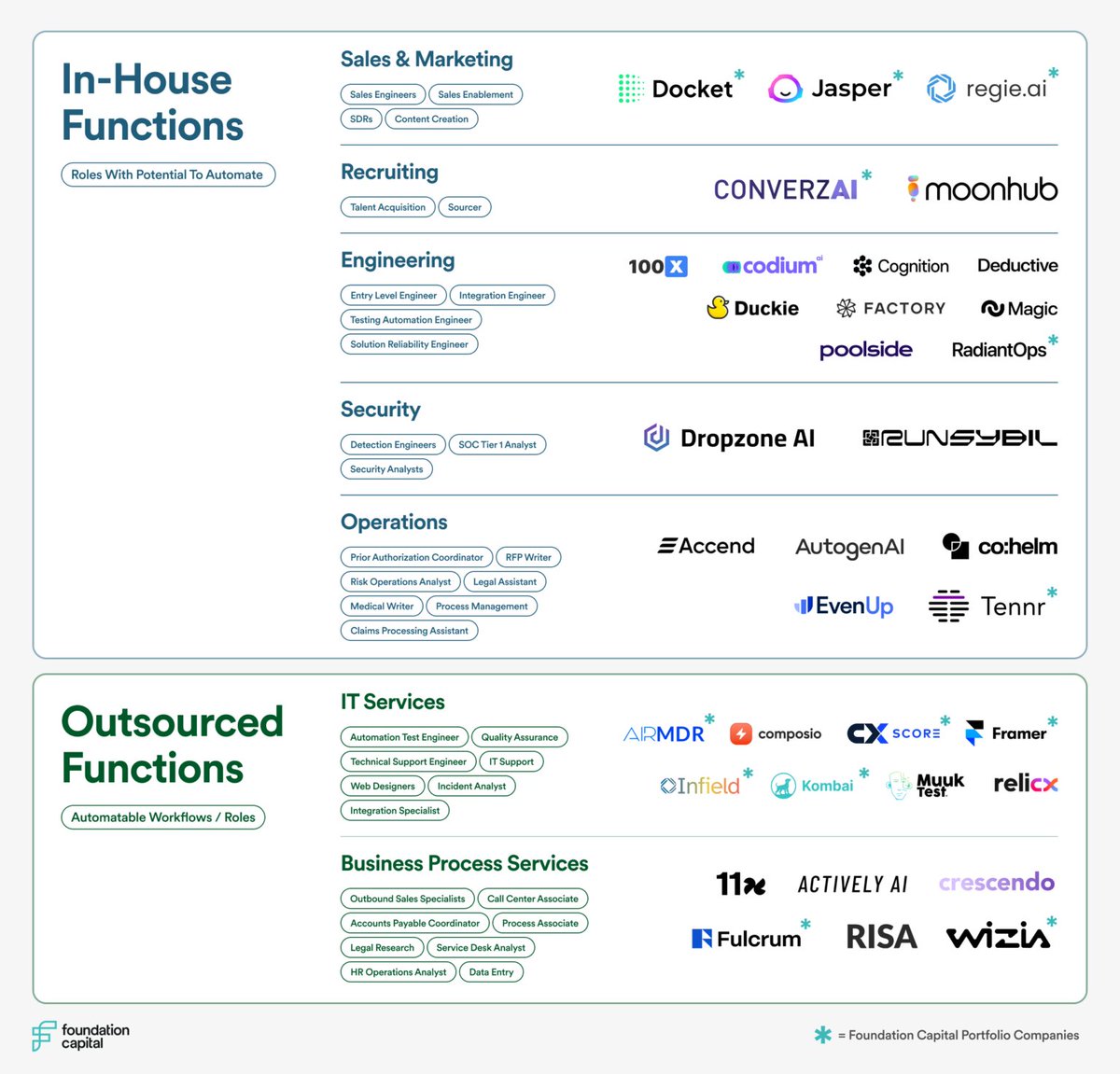
We at @FoundationCap believe there is $4.6T of work to be automated. AI companies are leading a transition from Software-as-a-Service to Service-as-Software, turning the table on the very essence of SaaS.
We look at the areas to be automated in two buckets:
1.) Salaries of jobs globally ($2.3 trillion in sales & marketing, software engineering, security, and HR)
2.) The amount spent on outsourced services and salaries—both IT services and business process services ($2.3 trillion, per Gartner)
In the software business, a company may sell access to its platform or tool, but customers are still responsible for using that tool to achieve the desired outcome.
In the services business, responsibility for achieving the desired outcome sits with the company selling the service.
AI agents have the ability to fundamentally change the business model of enterprise software. Today, when you build a SaaS product, the primary business model is to sell seats that are tied to the end-users of your service. For "same store" sales, you can essentially grow at the rate of the headcount growth of that customer, or by adding additional capabilities on top of your offering. This business model is, of course fantastic, and has been around since the earliest days of enterprise software, and will keep going forever.
But AI Agents unlock an entirely new business model in software, because you can now grow in a way that is uncorrelated to direct enterprise headcount or even external factors to your software. What's amazing about this model is that the AI vendor actually can directly grow itself within an enterprise account due to direct productivity gains.
For instance, imagine an AI Agent that can generate outbound sales demand for a startup. Traditionally, B2B companies will start by hiring a very small team of maybe one or two people, and increase resources in this area in a very incremental fashion -- essentially a process that looks like a guessing game where you try to predict how much demand there might be in the market, the ability to fund new resources, and the length of time it takes to hire great talent. In a world of AI Agents, you would simply set a budget and then decide how fast you want to grow. This is much closer to the business model of Google Adwords than it is of a traditional SaaS service.
The same would be true for entirely different functions, where AI Agents can develop software at the rate of how many software projects you want built or how many legal documents you want reviewed -- all unconstrained by a company's headcount. This will even happen in areas where you wouldn't initially expect demand levels to change just because you move to AI, but in fact where there's plenty of latent demand. For instance, in front-line support, in a world where AI Agents can answer a greater set of questions a customer might have, you could see the kind of interaction volumes going up far higher in a world of AI.
This all has major implications to the economics of software, and it means that the AI Agent business model goes after a far greater pool of spend than just traditional IT. If software products now directly *drive* company productivity instead of just *enabling* company productivity, this could lead to a step-function change in the size of IT markets over time. Wild.
When you’re on a 20-year journey, what matters is that you’re with the right people, going to the right place, in the right way. What matters less is whether you’re ahead or behind in the first year of the journey.
@eldsjal There’s nothing more powerful than devotion to something bigger than yourself, where you allow a skill/craft to compound over very long periods
In the simple equation X^n, find your X (devotion), and nurture, extend and protect your n
For the past 25 years, application software startups have had a singular focus: increasing company and employee productivity. AI enables a paradigm shift: Rather than sell software to improve an end-user's productivity, consider what it would look like to sell *the work itself*.
When you sell the work, instead of selling a 15% productivity improvement, you sell a 95% improvement. Incumbents are not only advantaged in selling software, they are stuck there. You don't need to play their game. Post: https://t.co/29BkdGIMC3
A new podcast on the founder of Bugatti is available now
A few things I learned from reading Ettore Bugatti’s biography:
1. Start with a desire to create something extraordinary.
2. Engage without pause.
3. Nothing is too good. Nothing is too dear.
4. Clean up your workspace.
5.The root principle is to do things your way.
6.If you are right the facts at the moment don’t matter because in due course the facts will catch up with you.
7.A human life needs to be *devoted* to something.
8.The personality of the founder will show in the details.
https://t.co/w2jtzLfYN9 on what you have a natural aptitude for— and a deep curiosity in.
10.Cut against the bias of your industry.
11.Learning from history creates faster progress.
12.Buck the present trend toward mediocrity.
13.Starting over is thankless labor. Do it anyway.
14.Refuse to relinquish independence.
15.Get paid to play.
16. Fill your world with things and people who are out of the ordinary.
17.Never ignore the promptings of your intuition.
https://t.co/7khXkJRlFn a life that inspires future generations — Bugatti inspired Enzo Ferrari
19.A singleness of purpose makes it easy for people to help you.
https://t.co/EBqSKFgdG2 with your hands.
21.Apprenticeships are underrated.
22.Imagine a perfect product. Then spend years prodding executives, engineers, and factories to create it with as few compromises as possible
23.Observant people produce original ideas.
24.Learn to draw.
25.Independent outlook. Freedom to invent. Perfection down to the smallest detail.
26.Ignore trends among rivals.
27.Sell to the top of the market.
28.Insanely great products are the prerequisite to cult like followings.
29.Believers > customers
30.Find activities that open the telephone line to your unconscious.
31.Develop genuine, life-long friendships. They greatly enhance the magnificent, mysterious odyssey we call life.
32.If a fresh start is called for do not hesitate.
33.There is no such thing as an ordinary task.
34.Good work for its own sake.
35. Build a great setup. Use Molsheim as a blueprint.
Learn more by listening to #316 Bugatti:
https://t.co/eZRad4mGB0
This conversation between Jose Mourinho (amazing soccer manager) and Dele Alli (super talented but badly inconsistent player) is one of the most inspirational pieces I’ve seen.
Worth a watch (regardless of whether you know/like soccer)
"The only trait shared by all of the best investors that I know is that they let their winners run... This is true of the best deep value investors and the best aggressive growth investors - they all let their winners [run]".
https://t.co/zuTYTImWHy