@arpitrage@Noahpinion Isn’t it because “knowledge” in economics and most other social sciences is ~continuous? Context-dependent. Very few “answers.”
Whereas math knowledge is more discrete. Answers/solutions. Basically applied logic.
Artists: but I don't want to lose my job. I love it.
Mathematicians: but I don't want to lose my job. I love it.
Economists: LONG HAVE I AWAITED THIS HOUR! DESTROY ME, EFFICIENCY, AND LET UTILIZATION-ADJUSTED TOTAL FACTOR PRODUCTIVITY RISE ON THE WIND OF MY ASHES!
Where in America can new homes get permitted and built fastest? And are we getting faster or slower over time?
In a new paper with @leonardo_damico and Audrey Wang, we show cities like Raleigh typically *finish* construction before cities like San Francisco even approve it.
Very happy to see our paper on TCJA’s corporate tax cuts out in the AER.
We ask:
1) How large are economic distortions from the corporate income tax?
2) Who bears in the incidence?
A short summary thread.
https://t.co/U5MA830LCM
This looks like a must-read!
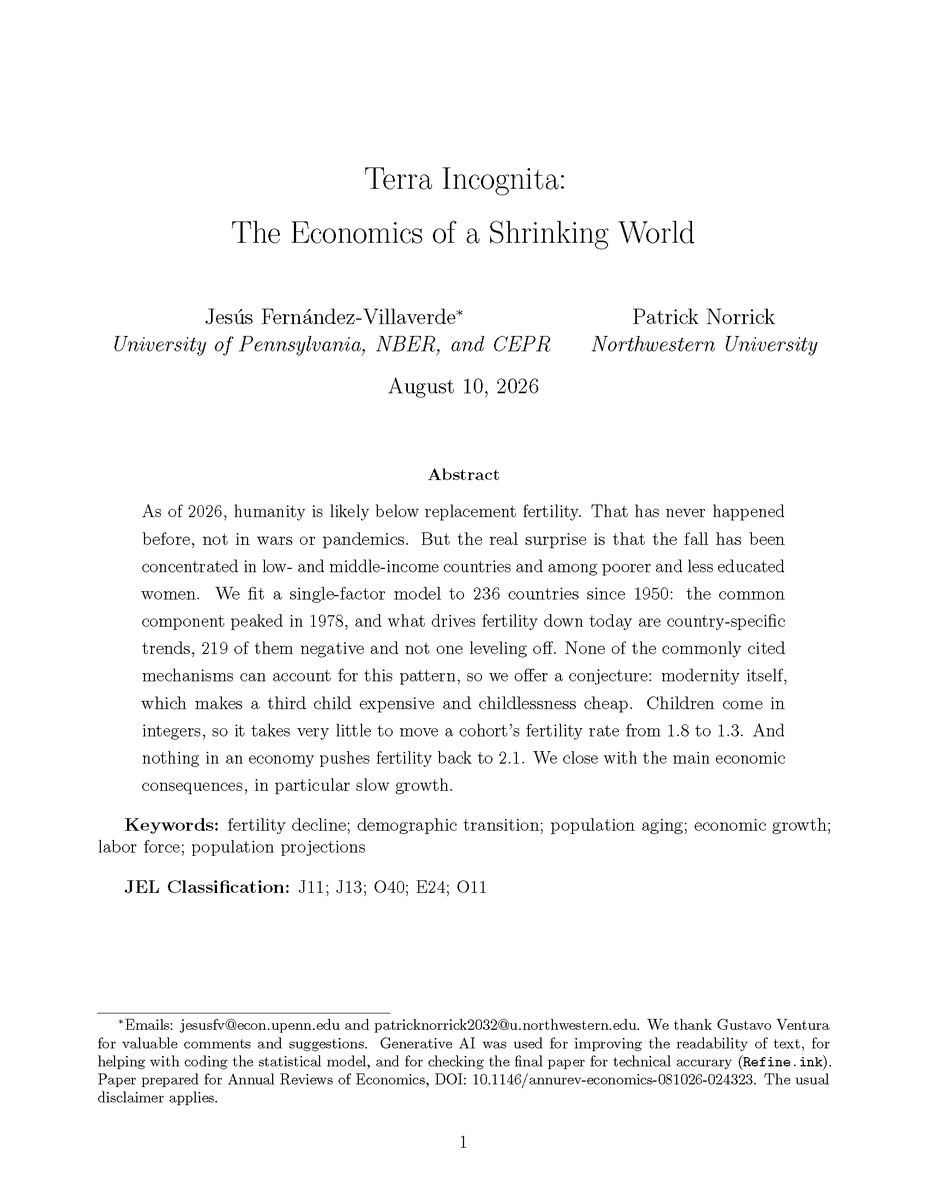
"Terra Incognita: The Economics of a Shrinking World" by Jesús Fernández-Villaverde and Patrick Norrick.
"As of 2026, humanity is likely below replacement fertility. That has never happened before, not in wars or pandemics. But the real surprise is that the fall has been concentrated in low- and middle-income countries and among poorer and less educated women. We fit a single-factor model to 236 countries since 1950: the common component peaked in 1978, and what drives fertility down today are country-specific trends, 219 of them negative and not one leveling off. None of the commonly cited mechanisms can account for this pattern, so we offer a conjecture: modernity itself, which makes a third child expensive and childlessness cheap. Children come in integers, so it takes very little to move a cohort’s fertility rate from 1.8 to 1.3. And nothing in an economy pushes fertility back to 2.1. We close with the main economic consequences, in particular slow growth."
https://t.co/W5lIk4v3tk
New work in the National Tax Journal
“The Paycheck Protection Program: Progressivity and Tax Effects”
By David Splinter, Michael Love, Eric Heiser, and Jacob Mortenson
@alz_zyd_ Also, I would assert that economists are not actually as influential as broadly claimed, especially in terms of policy, where lawyers dominate all.
There aren’t even economists leading the federal reserve. Last two have been lawyers.
@alz_zyd_ All fair
I guess my bias is that partisan motivated reasoning (initial bit on strawberries) is so much more toxic than intellectual/occupational motivated reasoning that the sins of the latter are minute compared to the former. So perhaps am too soft the latter rel to former
@alz_zyd_ It’s that, while imperfect, it’s a useful measure. And the groups measuring it continue to make improvements to their methods, and are transparent about them. Not at all irrational to not fully understand the definition or methods, but to still trust it.
@alz_zyd_ Hey, you consistently have good/interesting takes, but would encourage you to move on from this culture war / GDP stuff.
It’s not religion that causes most economists to say, “this thing that has been developed by subject matter experts and extensively vetted is flawed but ok.”