VALUE: After Hours (S08 E08): Derek Pilecki On Long/short Financials Investing, Regional Banks, Non-banks And Insurance
Here’s an excerpt from the episode:
https://t.co/UbSHzVRLVl
"You don't find entrepreneurs in chess clubs; you find entrepreneurs in casinos. They're playing poker; they're playing backgammon. They're playing games of chance with an occasional very high payoff, and a lot of life is exactly like that... The people who are running these organizations for the benefit of financial predictability are trying to make it chess. They're trying to turn it into a reductionist game where the most you can score is one for a win... Once you ensure that you’re not going to starve to death, die, etc., and you’ve looked after your children, 50% of your effort in life should be attempts to get lucky—in other words, as Nassim Taleb would say, I love this phrase, 'increasing your surface area exposure to positive upside optionality.' Finding opportunity."
- Rory Sutherland
Random musing - too many people try to maximize peak earnings vs lifetime risk adjusted earnings. So many hedge funders who had one or two good years and then are out of work forever or perpetually unhappy because they can’t get back to peak.
🚨 BREAKING: Anthropic just launched Claude for Education and it's not what you'd expect.
This version doesn’t just give answers—it asks better questions.
With Learning Mode and deep academic partnerships, it's built for critical thinking.
Here's everything you need to know:
Major update rolling out today at NotebookLM: a completely new adaptive design; interact with the Audio Overview hosts; and NotebookLM Plus--our premium version with expanded features.
Full features below 👇
New flexible "3-panel" interface lets you easily switch between asking questions, reading sources, and capturing your own ideas.
You can collaborate on writing tasks with a dual view of chat and notes, or ask followup questions via text while listening to an Audio Overview.
You can now “join” Audio Overviews with your voice and engage with the AI hosts to ask a question or steer the conversation. They'll adapt on the fly to (almost) everything you ask of them.
Expanded notes editor/viewer gives you more room to read and write
Auto-titled notebooks and notes
New NotebookLM Plus version, available through Google Workspace, Google Cloud, and (soon) Google One AI Premium. Plus features include:
300 sources per NotebookLM (up to 150 million words)—up from 50; raised limits for Audio Overviews, chat Q&A, and notebooks as well.
New sharing features optimized for using NotebookLM to create help centers or interactive guidebooks for your team or organization, with analytics to track usage
New "chat modes" that change NotebookLM's conversational style, including Guide (for help center/guidebook uses); Analyst (for strategic decision-making and planning); and a Custom setting that you can define.
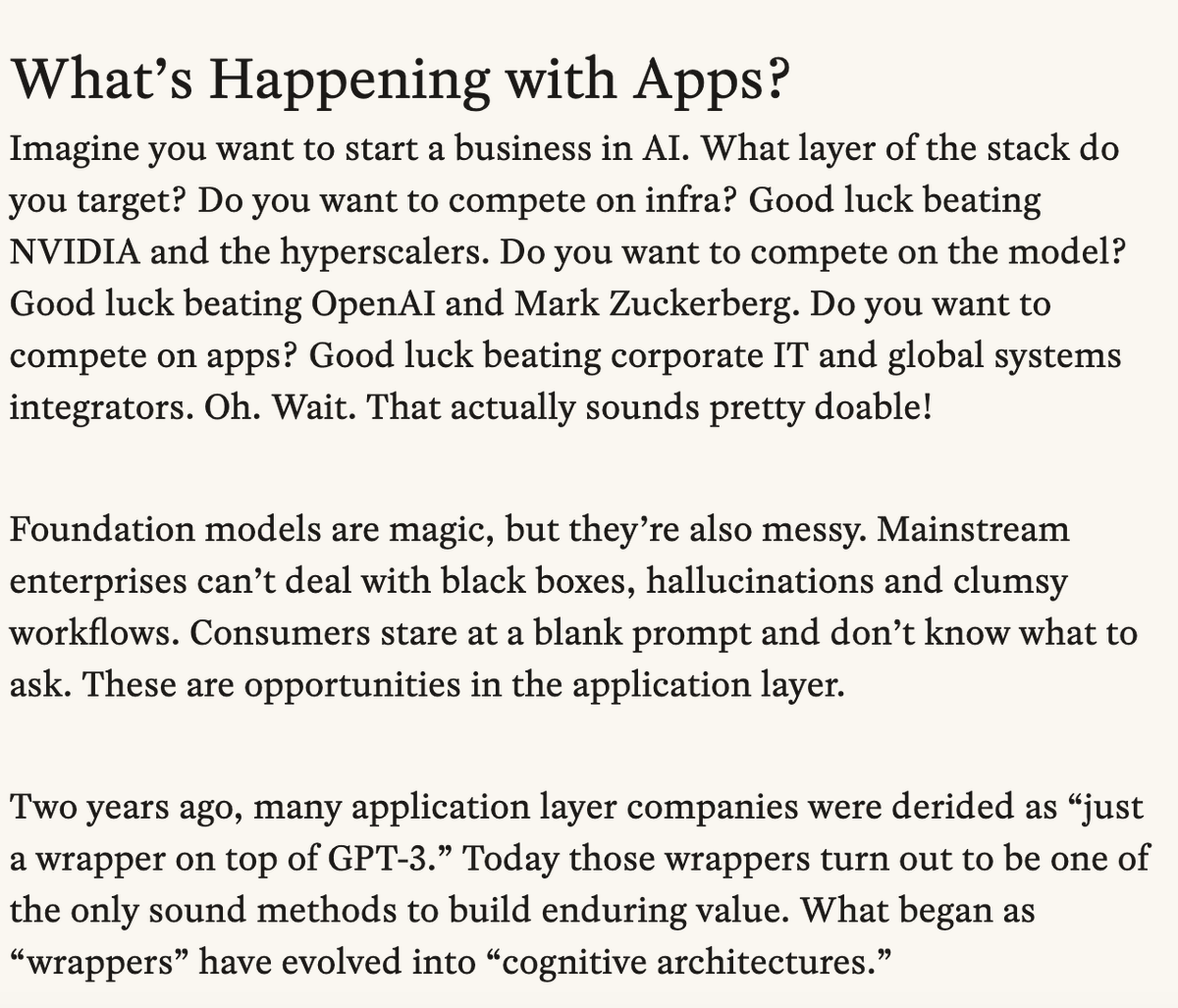
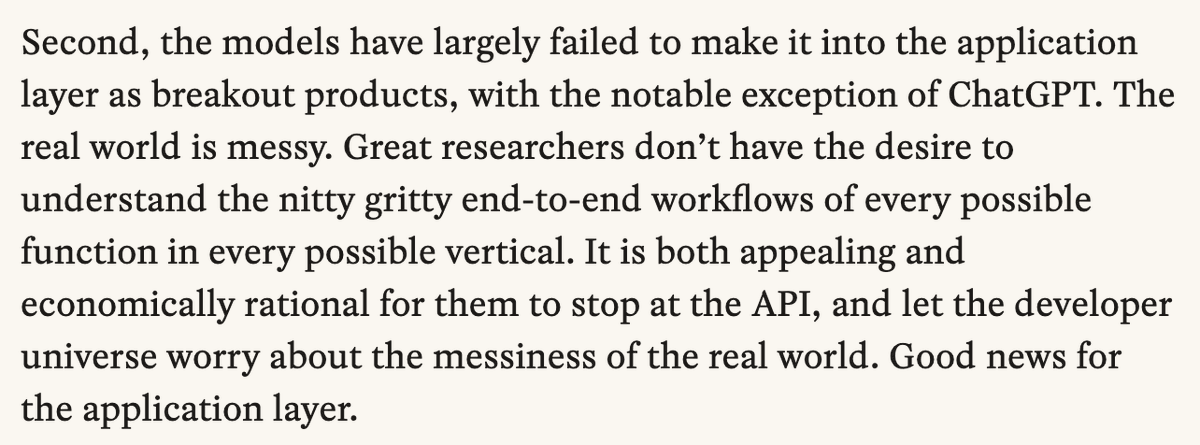
the new ai post from @sequoia is excellent. sharing best screenshots below
here's the tweet:
the opportunity lies at the application layer.
https://t.co/kQ1picTTNU
How to Prompt NotebookLM's Interests
One thing we hear constantly from users first experiencing Audio Overviews is how good the hosts are at uncovering the interesting bits from their sources.
You can elicit that same interest-driven summarization in text chat too. Here's how:
The Gemini models are amazingly deft at exploring large bodies of text and imagery to find specific sections that are high in surprise, high in unexpected information. You can call that just another incremental improvement on search and summarization if you want—to me it seems like a bigger deal than that—but either way, it lets you get answers to questions that no computer in the world could have produced just a year ago.
When I'm trying to get my bearings with a few new documents that I think I need to understand, I'll load them into Notebook and ask a variation on: What are the most surprising or interesting pieces of information or narratives in these sources? And I'll maybe give it a gentle steer: Please focus on the NASA astronauts of the 1960s, not the later ones. And I'll tell it to include key quotes. In 30 seconds or less I'll have an enormously useful text document highlighting the most interesting and compelling passages in my sources.
You can get most of this in NotebookLM right now, just by choosing to convert your sources into a Briefing Doc in the Notebook Guide panel. (And obviously, if you want to listen to this information in conversation form, Audio Overviews has you covered.) Both Briefing Doc and Audio Overviews are designed explicitly to surface interesting material. But you can get more clever and more personalized with it just by tweaking your prompts slightly.
Here's one one example. I uploaded something like 500K words of transcripts from the NASA oral history project, covering the entire span of NASA from Gemini (the other one) to Apollo and all the way to the Space Shuttle. And then I asked NotebookLM:
I'm interested in writing something about the Apollo 1 fire. What are the most surprising facts or ideas related to the fire discussed in these transcripts. Include key quotes.
Take a look at the answer that NotebookLM generated in 20 seconds or so. How long would it have taken me to assemble this document manually, sifting through effectively five books worth of transcripts? 10 hours? You can't command-F for "interesting things."
How to do school with NotebookLM:
1. Record audio from class on your phone
2. Keep laptop closed. Just jot down short phrases to describe most important points
3. Upload audio and PDF scan of notes to NotebookLM
4. Ask Notebook to expand your notes with details from recording
Bonus: at the end of the week, create an Audio Overview from all your class summaries to review the most important concepts in podcast format.
(As of this morning, NotebookLM now supports audio files--and YouTube videos--as sources. And we've added easy sharing tools for Audio Overviews.)
https://t.co/6hhNSzBKOZ
This is the final warning for those considering careers as physicians: AI is becoming so advanced that the demand for human doctors will significantly decrease, especially in roles involving standard diagnostics and routine treatments, which will be increasingly replaced by AI.
This is underscored by the massive performance leap of OpenAI’s o-1 model, also known as the “Strawberry” model, which was released as a preview yesterday. The model performs exceptionally well on a specialized medical dataset (AgentClinic-MedQA), greatly outperforming GPT-4o. The rapid advancements in AI’s ability to process complex medical information, deliver accurate diagnoses, provide medical advice, and recommend treatments will only accelerate.
Medical tasks like diagnosing illnesses, interpreting medical imaging, and formulating treatment plans will soon be handled by AI systems with greater speed and consistency than human practitioners. As the healthcare landscape evolves in the coming years, the number of doctors needed will drastically shrink, with more reliance on AI-assisted healthcare systems.
While human empathy, critical thinking, and decision-making will still play an important role in certain areas of medicine, even these may eventually be supplanted by future iterations of models like o-1.
Consequently, medicine is becoming a less appealing career path for the next generation of doctors—unless they specialize in intervention-focused areas (such as surgery, emergency medicine, and other interventional specialties), though these, too, may eventually be overtaken by robotic systems…maybe within a decade or so.
LONG POSITION SIZING: PART 2
Investors generally spend a disproportionate time and mental energy seeking to quantify position level up/down and financial projections, while often using little analytical rigor in position sizing, which also materially drives returns. This is the premise behind @alpha_theory. An (updated)🧵:
1. Summary
2. Background
3. Framework
4. Example
5. Conclusion
1. SUMMARY
At my prior fund, we historically sized positions based on a combination of our conviction and how much we thought we could lose if we were wrong. I copied this approach when I went out on my own, but layered in additional criteria adjust for factors that make a position inherently more risky or uncertain - examples include dinging sizing for companies that are burning cash, have substantial leverage, or where the margin for error in our assessment is likely to be wide.
After 1.5yrs of collecting data based on how I classified each investment at position inception and subsequent results, I believe I am able to refine my approach to sizing with a better appreciation for which factors were most correlated with good/bad outcomes, and in this way hope to improve sizing logic so we make more on our winners and less on our losers over time. While this approach isn’t perfect, I believe it’s better than sizing based purely on emotion, instinct, and memory, all of which are faulty and subject to cognitive biases. It’s also much harder to refine your approach to sizing if the inputs to that initial decison were all done in your head.
2. POSITION SIZING - BACKGROUND
I worked at 4 funds before starting my own. At 2, sizing was a block box - I either didn’t know our position sizes or never heard how the PM thought about sizing. At the two where sizing was discussed, at one it was based on a loose feeling of conviction, irr, and max position size. At the second, there was a concept of value at risk (not wanting to lose more than a certain amount) and conviction in sizing, but position sizes tended to cluster all at the same level, about 60% below max position size, and the conceptual discipline wasn’t always enforced in practice.
At all 4, the amount of time we spent thinking about how to size positions was a fraction of the time we spent on other activities. And while there was a loose framework with all of them, sizing ultimately came down to the pm and or analyst having a feeling this was a very good idea and should be sized close to max. I’m not sure this is necessarily a bad thing - there’s something to be said about intuition, especially where the PM has a history of having very good intuition for the best ideas (my prior fund). But intuition leaves no record of thought process to be improved upon, is hard to impart to analysts without decision making authority, and changes based on mood, recent experience and cognitive biases not founded in logic.
@Alpha_Theory is great software, but many of its basic principles can be copied without using it. At its core, the premise is that you can break down the elements of “judgment” and “intuition” into variables that you are forced to record at the time of your initial investment and change over time as the position matures. This has a few benefits over an intuitive approach:
1) it enforce a discipline around why you size things the way you do and is less prone to emotion based decision making.
2) It also allows analysts to - who are often closer to the work - to contribute more to sizing because they can help inform your variables. It’s hard for them to have influence when the PM hides behind just their “judgment”
3) it allows for a fact based assessment in retrospect around where mistakes in judgment or position sizing were made, that can be incorporated into future sizing decisions. If you have robust systems, you can also take this data and put it into a tool like Lightkeeper to see which variables were most associated with the best or worst outcomes.
Long post alert.
(Net) Revenue alone is not enough to estimate product strength of a consumer brand
When we first started looking at consumer brands in Blume in early ’22, thanks to @apurvavc who joined us to drive our focus on consumer brands / d2c, we used annualised revenues upwards of $500k / ₹3.5crs (25-30L+ monthly net revenue) as a criteria for diving deeper into a pitch. We saw revenues of 25L+ and CM2 +ve as some signals of early PMF and product strength / customer validation. We told brands that were lower than this number, to hit us up when they neared or reached this benchmark. Was it perfect? Oh no, but did it help us filter startups that were more appropriate for our stage? You bet.
That sieve for startup pitches soon turned out to be less finer than we thought. We started seeing more and more startups that were pitching us, at 50L+ monthly revenue and soon 100L+ monthly revenue. One reason was that Marketplaces like Amazon and Flipkart (and Myntra for apparel) were driving considerable revenue for consumer brands, far more than their own website did.
We then said we would now use $1m / ₹8crs annualised revenues as a criteria, and started using the sieve of ₹1cr / month as a revenue benchmark for early signs of PMF and product strength. Now even that sieve has proved ineffective, as startups riding on Quick Commerce’s growth and benefiting from access to Blinkit, Instamart, are coming to us with monthly revenues of ₹1.5-2crs+. Quite a few of these are not CM2 +ve as well.
What does increased revenue led by marketplaces / QCommerce indicate?
One challege is that I dont know if the increased revenue is an indicator of the product’s intrinsic strength, or early access to Quick Commerce / preferential access to Marketplaces. Is the revenue led more by distribution than PMF-led growth? Especially when the platform is not intrinsically native to your product genre - for instance, for a food brand, Blinkit is more native than an Amazon. For an electronics brand, Amazon may be more native than a Blinkit. So when I see an electronics brand where Blinkit is 50% of revenues, I worry. Clearly Blinkit is trying to drive up AOVs and is using the electronics brand to support this strategy. Tomorrow it may move to another category and drop it suddenly.
There is a parallel to this in Zynga and how it rode Facebook’s growth, until one day in 2012, Facebook decided to end the partnership. Now I dont necessarily see such a dramatic turn of play here, but at some point QCommerce and Marketplace platforms are going to a) suddenly change their strategy b) increase their commission to extract their pound of flesh c) use the data they have to build private labels etc.
3 signals that matter
So in this context of distribution access driving revenue growth, what signals matter to determine product strength and PMF? One could be own website revenue and offline growth, and seeing if that is increasing. That is insurance against any potential rugpull from the Marketplaces or QCommerce platforms. Second would be repeats, and seeing this manifest in CACs holding somewhat steady as a percentage of revenue (as the rising CAC for new users is balanced out by higher repeats and LTVs of the older cohorts). Finally margins, and if you are able to see sustained CM2 growth and are able to hold margins.
TLDR: Revenue alone isn’t enough to determine product strength and PMF. Yes, growing revenue is an important signal but it needs to seen along with own site revenue, repeats, stable or declining CACs and margins to arrive at a complete picture.
The older I get the more annoyed I get at investors that love to sound smart by teeing off on investors that are struggling that operate a strategy they don't agree with. Focus on your own game or the stock market will take aim at you next. It loves to destroy hubris.
AI TOOLS IN THE INVESTMENT PROCESS: 5 BARRIERS TO SCALE
One of the really cool (and unexpected) byproducts of what we are building at Fundamental Edge is that increasingly more financial software entrepreneurs are reaching out to us for guidance on their tools.
This is really cool, and I enjoy these conversations and the ability to see what is being built. On a personal level, I've gone from no AI use to a daily power user as the models have gotten much better & more reliable (lately, developing variable craps strategies for cold/hot shooters that get me as close to 0 house edge as possible).
There was a lot of discussion broadly about Sam Altman's argument there will be a 1-person $1bn company, and public market investors have extended that to our business - can there be a 1-person $1bn hedge fund?
If nothing else over the last 5 years, I've learned to keep an open mind. For for the AI entrepreneur who wants to serve the hedge fund / buy-side industry, or the aspiring 1-person $1bn hedge fund, or even for the existing 12 person hedge fund who wants to cut the team down to 4 using AI efficiencies, I wanted to offer some thoughts.
TO START: ROI on efficiency is a thing. When I started on the buy-side, one of my tasks as a junior analyst was to spread consensus. I literally had to request all 12-15+ sell-side models then re-cast them line by line to build detailed consensus. This took a lot of time. Tools like Zacks & FOA then ultimately Visible Alpha pretty much fully automated this task. Alt data & expert network transcripts have partially automated the field research dimensions of the job. These will be the easy wins for AI tools...management meeting prep, tone deviation monitors, etc. Though I wonder if specialized tools are needed for these tasks.
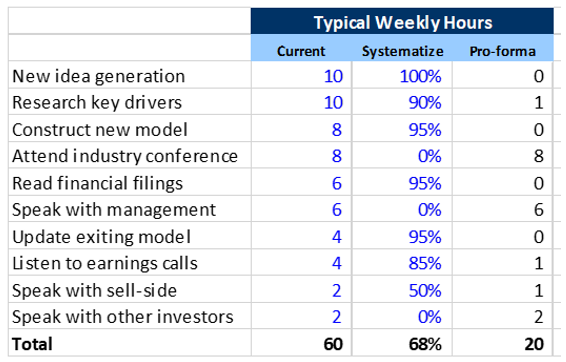
Here is one high level & illustrative cut of some of the key work streams of the fundamental investor and a guess on what can ultimately be systematized / AI-supported.
To truly make a dent in our industry staffing model, think "investment analyst AGI" here are six barriers that need to be overcome.
1) ANALYTICAL EDGE CASES. I've found a bit of naivety, respectfully, in some of the PhD engineers I have spoken with about data standards in this industry. We aren't working in food delivery, where if the data is bad your Chipotle goes to the wrong address. Edge cases abound, and analytical edge case mistakes are very, very unacceptable in this industry. We have a fiduciary duty as investors that we take as deathly serious.
Said differently, walk into your CIO's office or have a call with your biggest LP and try telling them the AI failed in an edge case and that's why you're blowing up. Just try it and let me know how that goes.
This is why, for example, despite Bloomberg & Factset's big data lead, they were never able to build a reliable "click to download" financial modeling service. It took a human team overlay at Canalyst to root out & solve these edge cases for a third party modeling service to gain any traction.
Thomas Li, founder of Daloopa, articulated this edge case dilemma on the @hedgineering podcast. Required listening for AI entrepreneurs in this space.
https://t.co/DikcozgQAw
2) CORPORATE ACCESS & FIELD RESEARCH. Yes, the game has shifted over time with the institution of Reg FD. Yet any serious institutional investor is spending meaningful time engaging with corporate management & individuals in the field. Access to management is seen as a critical contributor to alpha generation, generally.
How does the 1-person AI hedge fund solve this?
Managing that corporate relationship is an art unto itself and requires preparation & mastery of company fundamentals, emotional awareness, a certain maturity & gravitas, and a skillset around asking questions & eliciting information that is an incredibly human endeavor. Building a trusted set of industry contacts who like you and want to help you, who will reach out proactively with information on products & industry inflections - these are keys to alpha generation. I can't fathom how AI tools can replicate this.
3) EXPECTATIONS & POSITIONING. Successful market participants understand that good & bad are relative and that "good relative to expectations" and "bad relative to expectations" are the critical questions to ask. Assessing expectations is a messy, inexact science. Flows, sentiment, narrative, positioning, buy-side whisper & revisions tend to be deterministic in the timeframe with which most of the capital base is constrained (3-9 months). A complete picture of assessing expectations requires pipes into other investors, sell-side firms, trading flows and a keen & well-trained eye on interpreting price signals. If you aren't Warren Buffet, set ups matter!
Any tools that go beyond efficiency tools will have to crack this nut.
4) CREATIVITY & INTUITION. I like to break this job down into 1) process & 2) judgment. Vastly oversimplified, the analyst drives the process, the PM applies the judgment.
Reflecting on my career and on the observation of the many investors I have worked with, judgment is more of a right brained, intuitive process than I think many naive observers understand. Very rarely is an investment singularly made by a spreadsheet alone..."numbers look good, buy the stock". That is certainly a piece, but many intuitive elements ultimately drive stock selection, things like pattern recognition, "gut feeling", "trust & body language from management", "how the stock is acting", etc. These are often unnamed, and I think even some PMs don't fully comprehend how much they behave off of feel vs. solely analytics (or they don't want to admit it). That intuition comes on the backside of mastery, however - there is no shortcut to judgment. Stock selection is a creative business with many n of 1 situations and very loose "I feel like I've seen this story before" bets.
From a woo-woo perspective, tapping into this intuition is tapping into universal knowledge, quieting your mind, hearing "whispers from the muse" that lead you down the right path. Can machines ever hope to touch this level of creativity & guidance from the divine?
5) ADVOCACY, VISIBLITY & CONTRITION: DEALING WITH CIO'S & LP'S
Perhaps the biggest barrier on this list. Right now, clients I speak with are mostly dabbling with AI tools for small efficiency things. Exactly none have handed over any real thesis development tasks to AI.
Let's think about the structure of the buy-side. I'm an analyst. I advocate up to my PM. Generally, my PM and I will then advocate up to the CIO of a firm, often above a certain position size.
This CIO is generally a 20+ year experienced person who has received great rewards for rigorous, repeatable research & clear investment judgment. The CIO expects the Analyst & PM together to be the "smartest people" in the market on that name.
If the CIO says "is this a good business? Do we trust the management team", imagine instead of distilling your artisanal research down the key points, you simply say "well, this AI tool gave it a 9/10 business quality score and 8/10 management quality score, so...uh...yes?". I mean, good luck. We are in the advocacy business, our job is the own that expertise so that we can respond to any possible evolution in the story. Outsourcing that to an AI tool is hard, as the CIO will want to see your process & visibility into your thinking, just an output score.
Lastly, let's think about the structure of our entire industry. The largest pools of institutional capital are retirement, endowment or sovereign wealth oriented. The allocators/LPs have an extremely serious fiduciary duty to maintain & grow these pools of capital.
If I receive an allocation from a pension and my portfolio blows up based on a flaw in the AI tool - how cooked am I? Can I go to my LP and blame the AI tool? Yeah, I don't think so. Sure, a select few firms have earned the black box license from LPs, particularly quants with long track records, back tests, & impressive & skilled internal teams. But LPs generally want a lot of visibility into why the portfolio is performing, particularly when things go wrong. How a CIO handles communication around these drawdowns can be existential to that firm.
How does a 1-person, $1bn hedge fund handle this? An AI-generated investor letter after a blow-up? Yeah...good luck with that.
Just a few random Wednesday musings. Love any feedback on these ideas as the my ideas continue to evolve here!
Brett
The "Super Investors of Graham and Doddsville" underperformed about 1/3 of the time (when measured annually)
e.g. Buffett underperformed the S&P for 20 of the last 59 years
This process isn't for everybody
https://t.co/C3Ti2hSArC
Bryan Lawrence
@WilliamGreen72
https://t.co/th7RstVuPY