Founder and CEO, Mithril (@mithrilcompute).
Orchestrating Compute.
Fmr Research Scientist @GoogleDeepMind, Deep Learning Team.
CS PhD @Stanford
ML, Systems
@bernhardsson hmmm a GW is worth more per W than a W though 🤔
(in revenue... cost amortizes the other direction somewhat, although that can be U shaped)
Remarks from Anthropic CEO @DarioAmodei on our initial public offering:
My co-founders and I started Anthropic because we believe that the most powerful technology of our time should be built for the benefit of humankind.
Daniela and I lost our father to a disease that, just a few years later, became curable. I started my career in biology, hoping to help future cures come sooner. In the lab, I saw the vast thicket of complexity that scientists face when they’re trying to understand disease and develop new treatments.
So many of the scientific tools that can cut through that thicket—tools for gene editing, gene synthesis, controlling brain cells with light—started as pure ideas. In other words, they came from thinking. From intelligence.
Human intelligence has already made diseases like plague, smallpox, and polio history for most of the world. But progress on other diseases has been too slow for so many patients and their families. Going from a great idea to a treatment can take decades: it took many years from the first discovery of a strange repeating pattern in DNA to the approval of the first treatment for a disease using CRISPR.
Nature is full of these patterns. But we’ve had too little intelligence to decipher most of them; too few scientists, with too little time. Now we can build that intelligence. Whether it’s protein folding, drug design, cancer genetics, or clinical trial administration, scientists across many areas of biology and medicine are finding Claude can help them do their research in a fraction of the time it would’ve taken just a couple of years ago. I believe sufficiently powerful AI, working in concert with humans, could compress a century of scientific and medical progress into a decade.
I don’t want to get ahead of myself. At this point all we have are early results. Experiments and clinical trials will still take time. And although they involve slow and ponderous processes, I believe those processes can be substantially accelerated by AI. We hope that in the future fewer families miss a cure by just a few years.
Medicine is just a particularly vivid example, but there are many others. Our customers—the world’s most ambitious companies, nonprofits, and individual people—are already applying the intelligence we’ve built to stimulate economic growth; lift people out of poverty; protect democracy and free societies; even make everyday services like the DMV work better. We’re proud to work alongside them. And I’m extremely optimistic about what we can do together in the future.
At the same time, we have always been honest that this technology has very real risks. These range from misuse of the technology by individuals or nation-states, to economic disruption, to losing control of AI systems. We discuss these risks not because we think they are inevitable, but because we think they are avoidable.
Avoiding them depends on the choices made by the people building AI. There is a gigantic difference between how AI will go if we pay little attention to safety, versus how it will go if we are obsessed with safety. And an obsession with safety and with public benefit has been woven into Anthropic’s DNA from the start. From safeguards against biological and cyber risks, to alignment training and testing, to looking inside our models like an X-ray, Anthropic has pioneered methods for understanding and steering the behavior of AI systems.
There is much work still to be done, and the most difficult safety work lies ahead of us. The incredible talent of the company that has enabled us to build the most capable AI systems will need to be directed, even more so than it has already, towards double- and triple-checking that those AI systems are safe and secure.
And to state it unequivocally, we will pace the training and deployment of AI systems, taking as long as is necessary to have confidence that they are safe and will remain under human control. We will not bend to either business or political pressure. Today puts the company in a stronger financial position, and in doing so only strengthens our resolve to do the right thing.
If we can show it’s possible to make the right choices on safety and still build an incredibly successful company, others in our industry will be inspired to do the same. We call this a race to the top. When the race to the top is working properly, it doesn’t matter which company has the best models—everyone wins because everyone is building safely. The race to the top works best when driven from the front of the pack, and we fully hope and expect to do so, but the goal is to make the whole industry better, regardless of whether Anthropic is winning or losing at any given time.
The advent of machine intelligence is one of the seminal moments in human history, and we have a rare opportunity to shape it for the better.
This moment is bigger than any one company, or any one country. It will take all of us, working together, to ensure this technology goes well for us and the many generations to come. Starting today, we hope that you’ll join us on this mission.
One of the coolest things I've ever seen!! Loved the thunderclap as the starship dropped out of the heavens, before the catch. True alien tech. Huge congrats @elonmusk and the @SpaceX team! the whole stack is now proven out. Ad Astra! 🚀
Jensen’s contributions to the world go far beyond building a successful company; he helped build an industry and created a platform upon which others can build their dreams.
Jensen’s philosophy is unique in how much it emphasizes “additionality” and expanding the pie--doing “as much as needed, but as little as possible” to move the world in a better direction. He’s, of course, visionary, but also an extremely generous and positive-sum thinker and actor.
In reference to Morris Chang, Jensen once said:
“The world is full of successful people, but heroes are rare.”
“There is a difference between success and impact. I think Morris – his career, his philosophies, TSMC, its strategy, its core values – is absolutely a study in industrial revolution.”
Well said, and the same applies to Jensen himself.
I'm terribly sad @JensenHuang is no longer leading @nvidia.
Thank you Jensen. For the tireless work, for the focus, for the wisdom, for the support, for the vision, for the chance you gave me to do my life's work @nvidia.
We will do our best to push this work forward.
Across our projects @GoogleDeepMind, we are witnessing a genuine phase transition in the pace of scientific discovery. You will see a glimpse of this in our releases in the next few weeks.
It's always been about sample_efficiency x num_samples.
Methods that can't agglomerate FLOPs (e.g. aren't well suited to run on GPUs, with their abundant parallel FLOPs but comparatively limited memory bandwidth) can't assimilate many samples.
To use a funny analogy, sample_efficiency:gross_margin::num_samples:revenue.
Structured methods with strong sample efficiency that can't scale aren't interesting.
However, in defense of the "you aren't bitter lesson pilled enough" contingent, thin margin but ultra scalable businesses can be somewhat interesting. The opposite is less true.
Misinterpreting bitter lesson and an incredibly short period when scaling transformers did most of the legwork has reward hacked brains of a whole generation of scientists.
The more compute you’re pouring in training you’re model, the *more* important it is what algorithm you’re using.
There are algorithms that scale and algorithms that don’t and the only bitter lesson is that a lot of energy was spent on directions that were dead ends in the end. At the same time there are whole dimensions of scaling completely unexplored.
btw, in the age of AI, intellectual incisiveness and being able to hone in on good questions is more important than ever
questions about the taxes on a model like this... are not good questions
questions about the handful of undergirding core assumptions and where they come from -- those are good and fair
i recall once reading someone explain the distinction between *precision* and *accuracy* in investing
precision without accuracy is analyzing the Macy's or Blockbuster org charts and financial statements in great depth to form an investment thesis without seeing Amazon and Netflix coming
accuracy without precision is correctly discerning that "the internet is going to be huge," and then going all in on the leaders at the time... Cisco, AOL, and Yahoo
you clearly need both in good measure, and @shaunmmaguire has demonstrated both... so probably smart to try and engage with what he's suggesting
people critiquing the tax-related precision should instead focus on asking whether the model is even remotely accurate, b/c if it is... the implications are massive and far-reaching.
a hallmark of a really good research question is that both the negative and affirmative answers are useful. the answer to a bad question doesn't matter either way. there's a ton of alpha if Shaun is right... and also a lot if he's wrong. deciding whether you agree or disagree is probably one of the highest-leverage things you could do if you're an investor.
I've always believed that intelligence should come from simple, general building blocks that learn their own abstractions directly from raw data; in other words, the bitter lesson. I think we're finally seeing a real step towards AI that can learn from all data.
Language modeling on raw bytes is a microcosm of this ideal, and to me it's a central problem in AI: if we can't build LLMs that learn end-to-end from bytes, how will we handle the rest of the world's data that we understand even less?
Last year we introduced hierarchical networks (H-Nets) as a first step. Our new version finds up to 3-5x efficiency gains in controlled scaling law experiments, and at larger scale matches an open-source model trained on 11T tokens with ~10x less data and compute. The posts below walk through what we found and why we think it works.
"The invention of the boat reduced the importance of swimming, but enabled the discovery of new lands."
Beautiful analogy from @ylecun about the opportunities and changes with AI, in mathematics and in science more broadly.
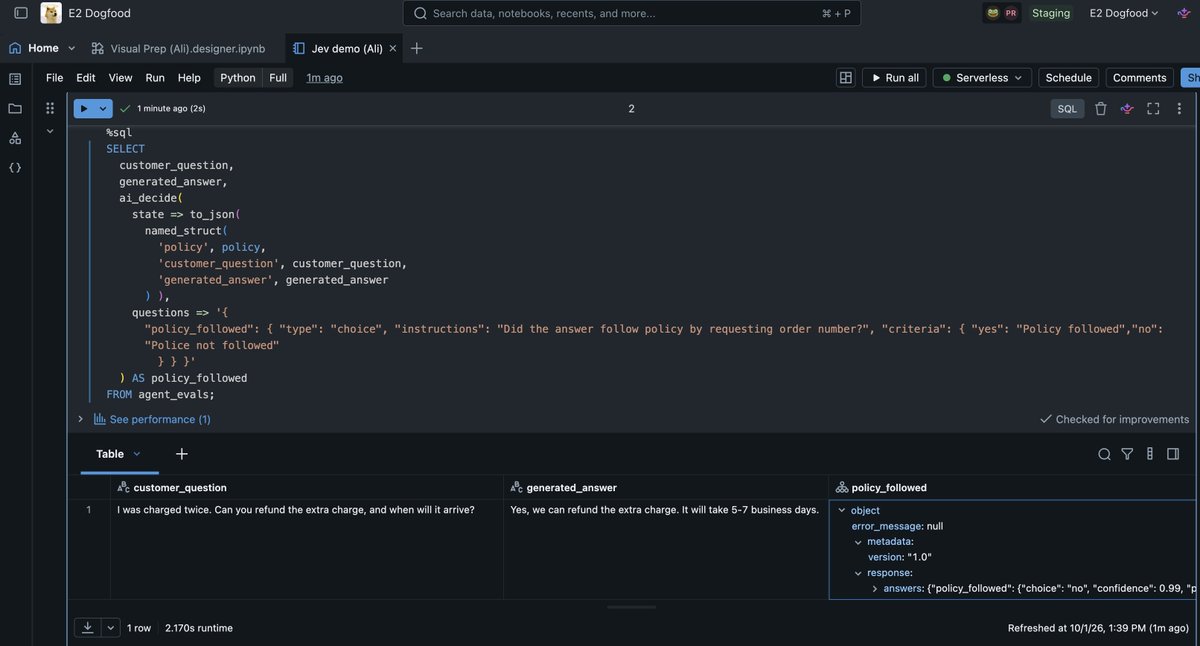
Everyone has been obsessed by Jev and what it can do, and they should be! Fast typed decisions >> slow text generation. It's a complete game changer. But how do you do that with all the data you have?
We just dropped 𝚊𝚒_𝚍𝚎𝚌𝚒𝚍𝚎(), which runs decision models natively on all your data in @databricks . Now you can run system one decisions on all your big data, see screenshot.
https://t.co/1kvMaxxFEt
After >$15B of development costs (per the S-1)
And almost 15 years of research
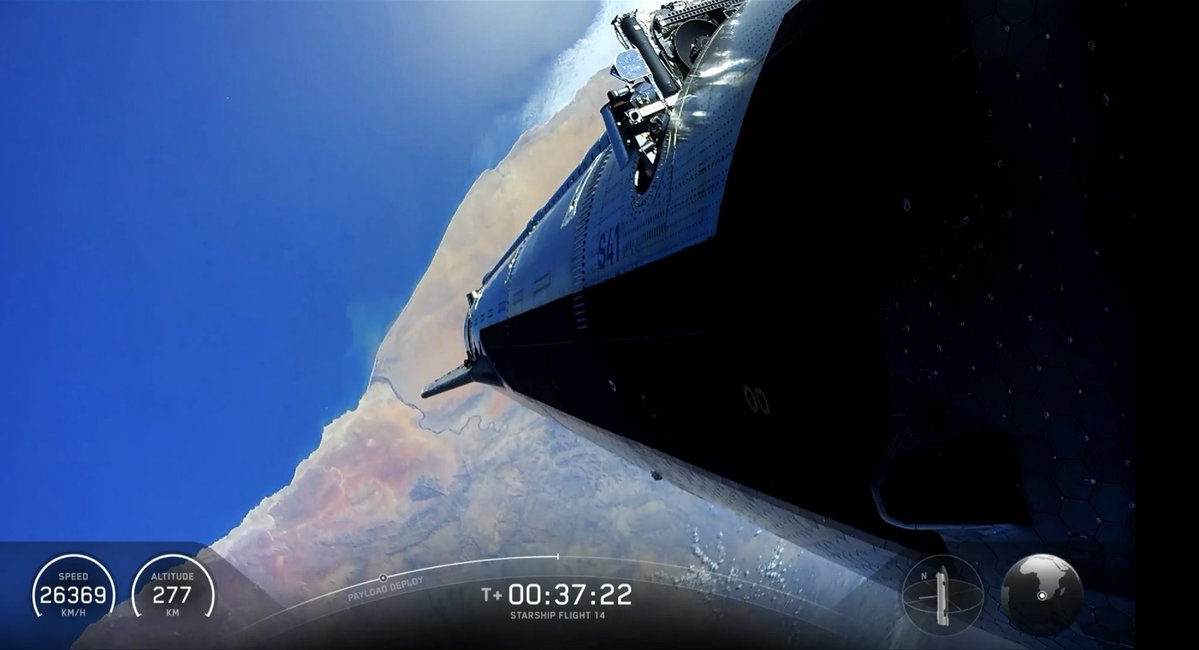
Starship has delivered its first orbital payload
She will change the course of humanity