This is the way.
The past 50 years of computing was about inventing form factors to interact with information. Retrieve information. Search for information. Edit information. Save information.
AI is about interacting with knowledge. It's completely different. Agents and models are there to do the dirty work aka interact with information). We need a new layer - more executive function, less tactical tools.
So instead of trying to jam AI into old form factors, its time to imagine a new form factor. From scratch. From first principles.
It's probably not a phone tbh, but what it is, I have not a clue. That said, like most breakthroughs we'll know it when we see it though.
Good luck to the teams building this.
LLM Knowledge Bases
Something I'm finding very useful recently: using LLMs to build personal knowledge bases for various topics of research interest. In this way, a large fraction of my recent token throughput is going less into manipulating code, and more into manipulating knowledge (stored as markdown and images). The latest LLMs are quite good at it. So:
Data ingest:
I index source documents (articles, papers, repos, datasets, images, etc.) into a raw/ directory, then I use an LLM to incrementally "compile" a wiki, which is just a collection of .md files in a directory structure. The wiki includes summaries of all the data in raw/, backlinks, and then it categorizes data into concepts, writes articles for them, and links them all. To convert web articles into .md files I like to use the Obsidian Web Clipper extension, and then I also use a hotkey to download all the related images to local so that my LLM can easily reference them.
IDE:
I use Obsidian as the IDE "frontend" where I can view the raw data, the the compiled wiki, and the derived visualizations. Important to note that the LLM writes and maintains all of the data of the wiki, I rarely touch it directly. I've played with a few Obsidian plugins to render and view data in other ways (e.g. Marp for slides).
Q&A:
Where things get interesting is that once your wiki is big enough (e.g. mine on some recent research is ~100 articles and ~400K words), you can ask your LLM agent all kinds of complex questions against the wiki, and it will go off, research the answers, etc. I thought I had to reach for fancy RAG, but the LLM has been pretty good about auto-maintaining index files and brief summaries of all the documents and it reads all the important related data fairly easily at this ~small scale.
Output:
Instead of getting answers in text/terminal, I like to have it render markdown files for me, or slide shows (Marp format), or matplotlib images, all of which I then view again in Obsidian. You can imagine many other visual output formats depending on the query. Often, I end up "filing" the outputs back into the wiki to enhance it for further queries. So my own explorations and queries always "add up" in the knowledge base.
Linting:
I've run some LLM "health checks" over the wiki to e.g. find inconsistent data, impute missing data (with web searchers), find interesting connections for new article candidates, etc., to incrementally clean up the wiki and enhance its overall data integrity. The LLMs are quite good at suggesting further questions to ask and look into.
Extra tools:
I find myself developing additional tools to process the data, e.g. I vibe coded a small and naive search engine over the wiki, which I both use directly (in a web ui), but more often I want to hand it off to an LLM via CLI as a tool for larger queries.
Further explorations:
As the repo grows, the natural desire is to also think about synthetic data generation + finetuning to have your LLM "know" the data in its weights instead of just context windows.
TLDR: raw data from a given number of sources is collected, then compiled by an LLM into a .md wiki, then operated on by various CLIs by the LLM to do Q&A and to incrementally enhance the wiki, and all of it viewable in Obsidian. You rarely ever write or edit the wiki manually, it's the domain of the LLM. I think there is room here for an incredible new product instead of a hacky collection of scripts.
Something I have brought into the business world from the military:
Thinking in functions.
When things get chaotic, we asked ourselves one question:
Which core function is failing right now?
A similar approach can be used to work through any bottleneck.
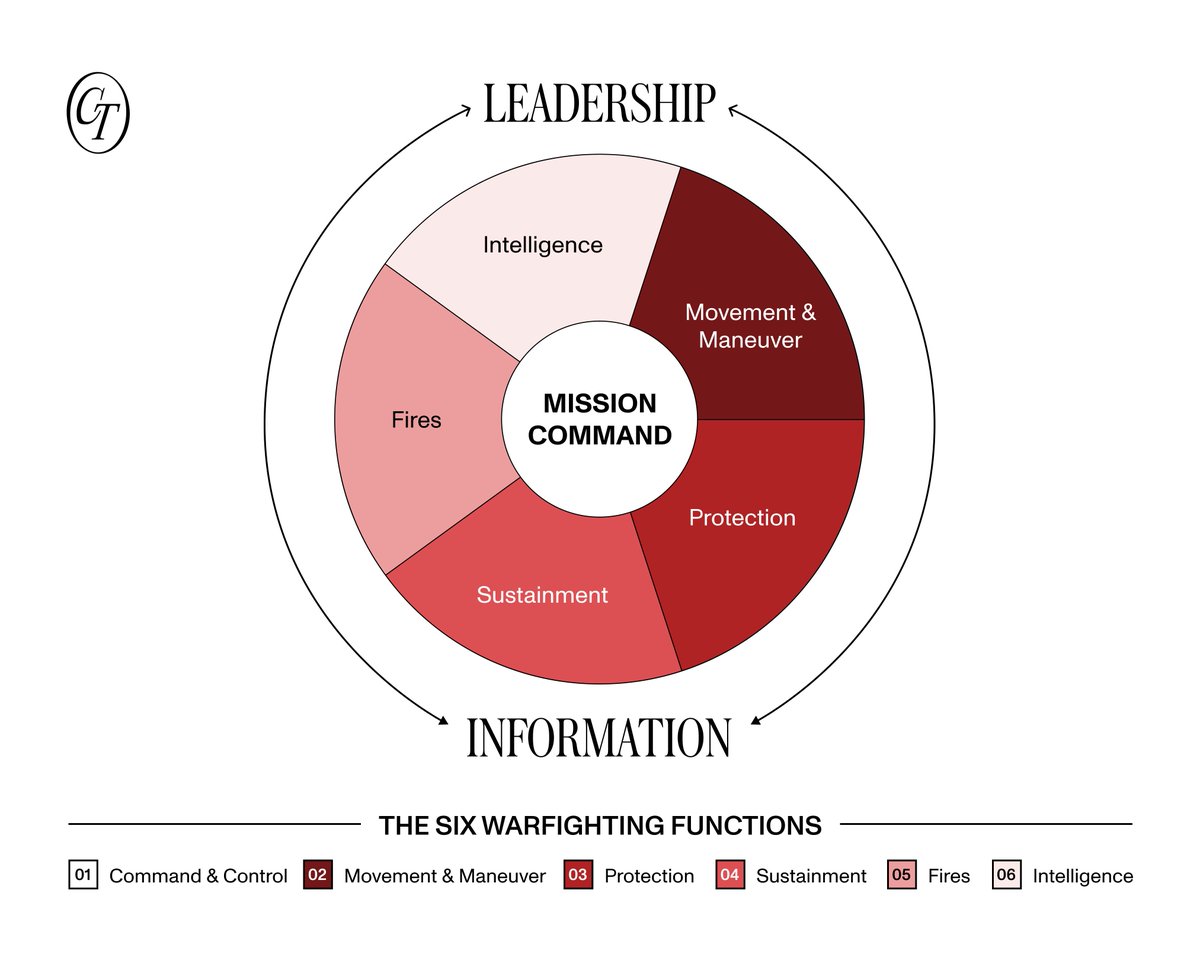
To show you what I mean, here are the 6 war-fighting functions (and their business equivalents):
1. Command + Control - set objectives, priorities, and decision authority (in business, that’s strategy, leadership, and assigning key decision makers).
2. Movement + Maneuver - positioning forces to create advantage (going through the motions of building a product, delivering a service).
3. Intelligence - collecting, analyzing, and understanding information about the environment and adversary (following signal > noise - knowing customers, competitors, and which data matters).
4. Fires - deliberate force applied to achieve outcomes (sales and marketing).
5. Sustainment - logistics and support needed to keep ops under stress (ops and finance).
6. Protection - preserving combat power and reducing exposure to risk (legal, risk management, and downside control).
When something feels “off”, I find the mistake is trying to fix everything at once. Instead, I use this as a diagnostic: which function is degraded right now?
Strategy unclear? That’s Command + Control.
Pipeline dry? Fires.
Burning out the team? Sustainment failure.
The reason I find this parallel fascinating is that business is usually low-stakes, so “good enough” becomes the de facto option.
You can misread reality, ship the wrong thing, or chase the wrong metric and still call it “learning.”
In war, the stakes are much higher.
If companies applied high-stakes decision frameworks like these with even a fraction of the discipline the military uses, they’d move faster, waste less time, and get a lot more done.
Just something I’ve been thinking about lately.
Folks. Can I explain something about world models? Seems like today might be a good day for that.
Advances in large-scale “world models” — whether developed by partners like Google or others — materially expand the frontier of interactive content creation. These models can generate high-quality, interactive, video-like experiences from natural language or minimal input.
Today, they are primarily editable through prompting, which limits the level of determinism and precision required for production-grade game mechanics. As a result, their outputs remain probabilistic and non-deterministic, making them unsuitable on their own for games that require consistent, repeatable player experiences.
Rather than viewing this as a risk, we see it as a powerful accelerator. Video-based generation is exactly the type of input our Agentic AI workflows are designed to leverage—translating rich visual output into initial game scenes that can then be refined with the deterministic systems Unity developers use today. Our agents already generate high-quality scenes from static video. Interactive, camera-controllable video from world models would further enhance this pipeline and materially improve the fidelity and speed of early-stage content creation. We believe this represents a meaningful step forward for AI-driven development across the industry.
Unity’s role is to operationalize these advances. Outputs from world models are ingested into Unity’s real-time engine, where they are converted into structured, deterministic, and fully controllable simulations. Within Unity, creators define physics, gameplay logic, networking, monetization, and live-operations systems to ensure consistent behavior across devices and sessions.
This combination enables developers to move faster from concept to scalable product: AI accelerates environment and asset generation, while Unity provides the execution layer that transforms generated content into reliable, monetizable experiences.
As a result, world models expand content supply and reduce development friction, while Unity remains the system of record for runtime, distribution, and long-term operations. This dynamic broadens Unity’s addressable market and reinforces its central role in the interactive ecosystem.
Wow the impromptu Caleb speech… ‘make your money in the regular season, the playoffs are for your name. For our legacy.’ Then he gives his game ball to Ben Johnson.
Can’t believe it’s the Bears.
At some point this year you'll be voice chatting with a team of agents building your business, while riding in a self driving car, look out the window and see a humanoid robot walking by itself carrying some shopping bags.
And just like that, you're in a new world.
🚨 A student in the US just discovered MILLIONS of new space objects.
The astronomy world was recently shaken by a discovery from an unexpected source: a teenager still in high school. Matteo Paz, a student from Pasadena, utilized archival data from NASA’s retired NEOWISE mission to bring 1.5 million invisible cosmic objects into the light.
During a stint at Caltech’s Planet Finder Academy, and mentored by astrophysicist Davy Kirkpatrick, Paz took a novel approach to data analysis. He built a unique machine learning model capable of sifting through a staggering 200 billion infrared records. In a span of only six weeks, his AI detected subtle patterns that human analysts had missed, identifying everything from distant quasars to exploding supernovas.
Paz’s findings were so robust that they earned him a spot in the prestigious The Astronomical Journal and a position as a research assistant at Caltech. His work does more than just populate star maps; it provides specific coordinates for the James Webb Space Telescope to investigate further. This breakthrough highlights a growing trend where fresh perspectives and AI tools allow young researchers to make historic scientific impacts from the classroom.
This past summer, SpaceX donated @Starlink kits to schools in The Bahamas, and now Starlink is being installed in ~200 schools across nine islands including, Exuma, Grand Bahama, New Providence, and Mayaguana, connecting more than 40,000 students to reliable internet.
Today, President Trump established the most significant national space policy since the Kennedy era.
@POTUS made a commitment to return to the Moon, establish an enduring presence, invest in the technology of the future and pursue the secrets of the universe.
@NASA, with a relentless focus on the mission, will lead in the peaceful exploration of space and we will NEVER come in second place.
Under this administration, we will continue to lead with the world in space exploration with purpose and ambition.