Optimistic take:
"what we really should be comparing is not the intelligence of AI and an average (or even the smartest) human, but rather the intelligence of AI and humanity as a whole"
Added Gratitude as a virtue
Precept: Acknowledge the good you receive; let the kindness of others be continued in your own.
Franklin never said this, but Codex researched everything he wrote about gratitude and came up with a precept that combined those quotes in a format similar to his other 13 precepts.
“Let us, instead of repining at what we have lost, be thankful for what we have enjoyed.” 🙏
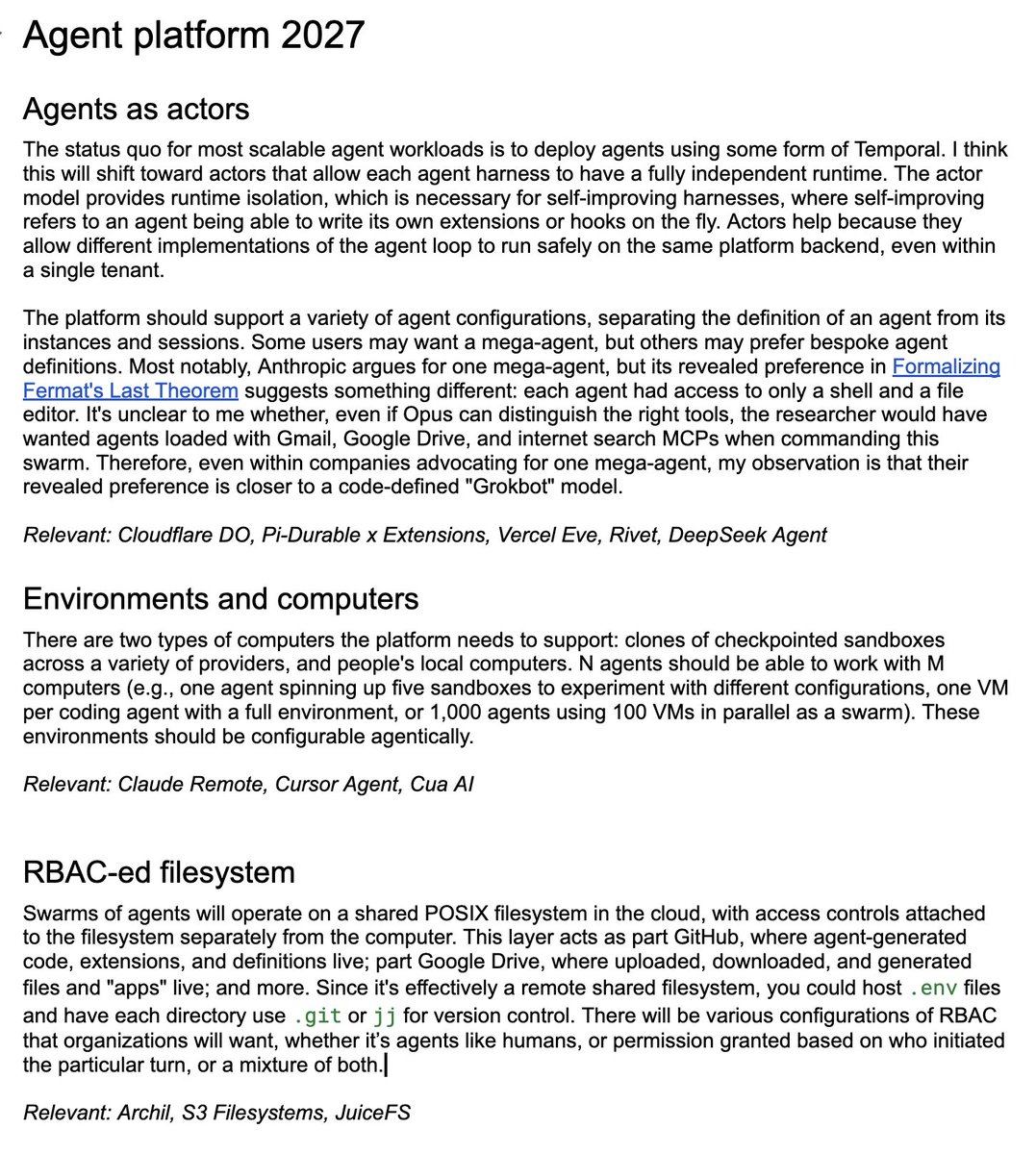
Agent platform of 2027.
This is the end game. This is the blueprint for the one and only application layer software that will exist. Every other software will effectively become databases for this layer, the everything agentic operating system for the million agent swarm to work on top of.
This is obviously the end game vision for the application layer of ChatGPT and Claude. I have reasons to believe that an independent company will own this product layer. But most ADE, "enterprise agent platform", or vertical saas companies, are focused on the wrong things far too narrowly, not technically competent, and do not have the product / technical vision to see this inevitable future.
The correct agent platform that wins will function like the base of a garden, from which customers will plant their unique "seeds" to grow their own plants and trees, managed and evolved by agents, humans, and signals from the sensors of the business. This presents a clearer picture than "factory of a factory" imo.
"The remaining gaps for models to greatly surpass humanity in every field are no longer intelligence; they are domain-specific know-how, plumbing, and experimentation. This means it is likely that AI will become the greatest contributor of progress across nearly every field, vastly outperforming the best humans."
It’s exciting to see how personal agents are already changing personal finance. For people who’ve made a purchase on Instinct, their average spend is over $700 per month.
But there’s more to your finances than just spending. Wealthy families pay a family office to do two things: protect their money and grow it. Instinct’s job is to do both for everyone.
Instinct will make sure you never pay for what you don’t use, make sure no refund you’re owed gets forgotten, tell you when a charge doesn’t look right, and identify opportunities for growth.
Ask your agent to connect your bank, card, and brokerage account through @Plaid. Available to all Instinct users in the US starting today.
First of Kind: the Granola Sam interview
Fresh off the heels of a sensational rebrand, @samstphenson hosted me at @meetgranola’s new San Francisco office to talk about designing the world’s first AI notepad and his experience navigating an ambiguous career into a co-founding role at one of London’s most beloved new startups.
We talked about:
› How courting future cofounder @cjpedregal was “embarrassingly like dating”
› Why Sam and Chris spent weeks interviewing people with no agenda, “fishing for a problem” before deciding to build Granola
› Why real-time AI notes looked like science fiction but weren’t helpful in practice
› Why Granola designs for the thin sliver of attention that isn’t focused on the meeting
› How his reluctant leadership led to the creation of Granola Sam—the face of every new user’s onboarding experience
› Granola’s scorpion dance with the frontier labs, and why the startup wants to own the work that happens around meetings
› The controversial rebrand that set off 24 hours of hate mail, and why the team is proud of it now
Our @firstofkind conversation is a reminder that you don’t need permission or credentials to build something new. As Sam puts it, “You can just learn everything you need to learn as you go do it.”
Powered our incredible sponsors:
@framer@noondesign@bot@tryramp@vercel@meetgranola@profound
The problem in the Democratic Party is that we promise we will make people’s lives better when we campaign and then we often lack the research, skills, patience, backbone, and force of will to implement necessary changes, measure results, and iterate.
The problem with the political commentary class is that they have no interest in learning how things get done in government. They teach Americans that politicians pass laws and those laws solve our problems. This couldn’t be further from the truth.
How many anti-poverty laws have passed and we still have poverty. How many affordability laws have passed? How many laws to fight homelessness? How many rural broadband laws? How many education laws? How many anti-gun violence laws? How many anti drug laws?
If Democrats are going to help America we have to stop thinking like poets/artists and start thinking like engineers. Writing a bill to fund a bridge is not equal to building a bridge.
We need to be masters in how government operates and how government can be made to be more effective. The other side argues that government isn’t effective at all and we provide them with new examples of this fact every single year.
The ultimate in lazy thinking is Socialism. If we just had Socialism all the problems will be solved. Hard problems don’t have easy solutions. Testing down what we have is useless if you have to ability to build anything in its place.
I’m old enough to be the dad of half my YC batch. This is my second time around.
Here’s what I know now that I didn’t in W12.
Nobody knows what they’re doing. The first time, I was sure everyone else had it figured out. Their ideas sounded smarter. Their traction looked better. Then I watched batchmates pivot, rebuild and start over, just like we did. Now I know we’re all in the same boat, just trying to figure it out. Some people are better at hiding it.
An exit doesn’t give you the answers. Selling my first company to Dropbox made a few things easier. Investors take the meeting. People return your emails. But the product still has to work, and users still don’t care who you are.
Everyone says startups are hard. The first time, I nodded along and didn’t really believe it. Now I have the scars.
Consistency beats intensity. I’ve run every week for 200 weeks straight. Most of them I don’t feel like starting. Startups work the same way. You don’t win on the big days. You win by showing up every day.
Same nerves as 2012. Better shoes.
I’ve joined the @fomo team to lead partnerships.
I’ve been in crypto for nine years and have been thinking about crypto social for much of that time. I was Farcaster user #303, built the social trading network @clicker, and angel invested in fomo.
Then I ran my public fomo account (@kyle) up to top 20 all time. Now I get to help grow the product I’ve spent so much time using, and there's nowhere else I’d rather be.
I’ve admired @paulerlanger, @seyong, @qrazhan_ultd, and the team since they launched, and my conviction has only grown since joining. We have not seen a new social network break out since TikTok, and I believe fomo will be the next.
My focus at fomo is chains and team tags. If you want more activity on your chain or you want to reach your token holders directly, let’s talk.
Kalshi just raised an additional $1B, valuing the company at $40B. This will help us expand into stocks, compute, indices, and institutional.
Tomorrow marks 8 years since we got accepted into YC and the journey began.
The odds of a kid from Lebanon getting here were pretty low.
Growing up there was great, but very challenging. We went through war. We had bombs explode in front of my house. I watched brilliant people’s lives destroyed for reasons beyond their control.
Lebanon is an unpredictable country. That unpredictability made it hard to plan for success. And yet despite it all, my mom sacrificed everything to give me and my brother the chance to go back to the US.
I found my refuge in two things: anime and math. Especially math.
I loved math because it calmed me. It was the opposite of unpredictable: clear, deterministic, orderly, and consistent. The proof is either right or wrong. I find that elegant and beautiful.
I was lucky.
I made it to my dream school, MIT (largely thanks to my mom), and my love for math quickly translated to a love for statistics, probability, and markets.
I love markets for a lot of the same reasons. Their incentives are clear: you get rewarded for being right and for pursuing knowledge. They are effective weighting machines for people’s opinions. They provide an incentive to be truthful, because they separate good information from bad information. They let people challenge the consensus and be rewarded for being right.
IMO, Hayek, Surowiecki, Hanson, Tetlock were the founding fathers of prediction markets. The more I read them, the more obsessed I got with the idea of applying market-based pricing to more things.
Markets bring rigor and critical thinking to more questions. And in an increasingly polarized and information-positioned word, I believe we need that more than ever.
Markets would also let people predict and manage more things outside of their control. And the world was becoming increasingly more unpredictable, and more like Lebanon, not less.
That love for markets got Luana and me to build Kalshi.
At first, it was mostly an idea we couldn’t stop talking about. We didn’t have much money. Luana’s sister bought the Kalshi domain name for us (for ~$1.7k). We moved to SF to get started, and embarked on a long, uncertain journey to build a regulated exchange.
The paranoia and anxiety from my childhood never left me. Even when things are going well, I think about what could go wrong. When people trust you with their money, that instinct serves a purpose.
I wanted us to build something that would hold up under pressure.
The first principle we defined at the company: regulatory-first. We worked with regulators for years before we listed a single market. We took every step to do things the right way and always asked for approval before proceeding. It was very hard at times, especially when we were being overtaken by competitors, but we believe doing things the right way matters.
Luana and I aren’t the only ones.
Our team put years of their lives into something far from certain. That’s especially true of Lior, Brandon, Rainer, Luis, Xavier, and Josef, who stuck with us for years. They believed when there was little to point to. And they stuck with us no matter how long it took. Kalshi is the result of an arduous journey through a long desert where, at times, most people didn’t understand why we were making the walk.
Many people still don’t understand what we’re doing and some disagree with us. Markets have historically taken time to be understood and accepted by some. But while not always obvious, their benefits are vast: capital markets help allocate capital and derivative markets help predict and manage uncertainty.
I firmly believe in these benefits, and that’s why I am dedicating my life to building this market.
Markets have caused issues many times in the past, and they certainly can present harms (manipulation, insiders, and addictive behaviors). These harms are more acute for certain types of markets (sports, short-term options, etc.) than others. It’s why I believe that guardrails need to exist and why we have taken the approach we have taken. We have consistently prioritized thinking critically about the risks and building the appropriate safeguards, sometimes beyond what the regulators require us to do. Many believe more needs to be done, and that’s a conversation I welcome.
Over time, I believe more people will see what we see: markets can help us get smarter and manage the future with more rigor, more precision, and more certainty than we have today.
To our tens of millions of users: you have made Kalshi bigger than anything Luana and I could have possibly imagined. Thank you for trusting us and thank you for coming along on the journey. I feel a strong responsibility to build a company worthy of that trust.
I am so lucky to spend my life building something I love. I hope everyone finds something they care about that much. Something that keeps you curious. Something that pushes you to your limits. Something that may put you at odds with the status quo. Something worth the hard days.
For me, it’s still markets. The more I learn, the more I want to understand.