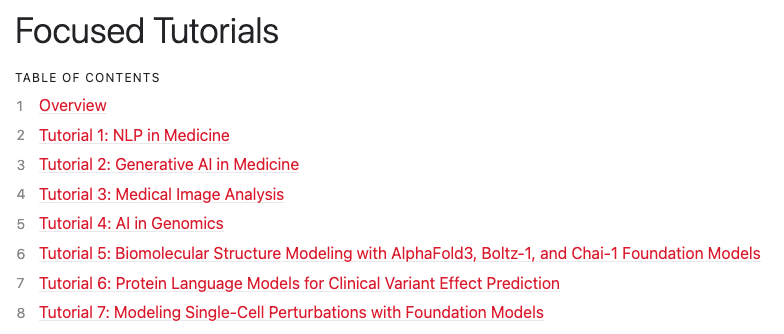
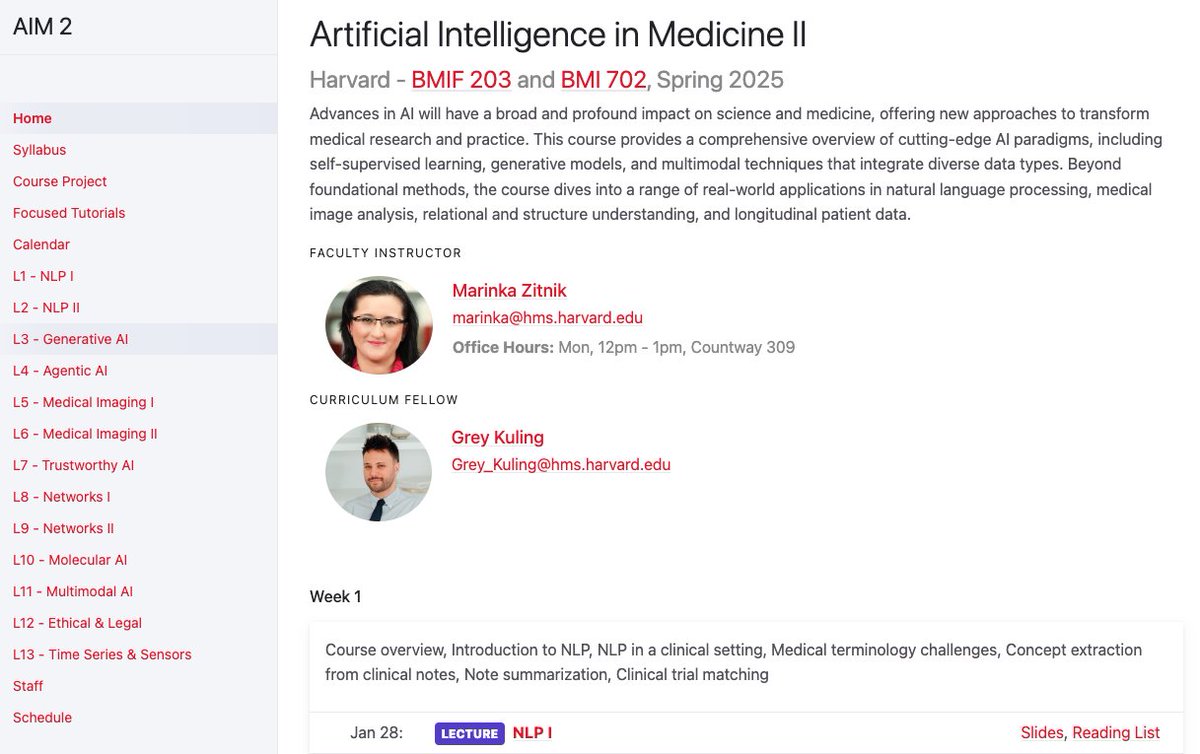
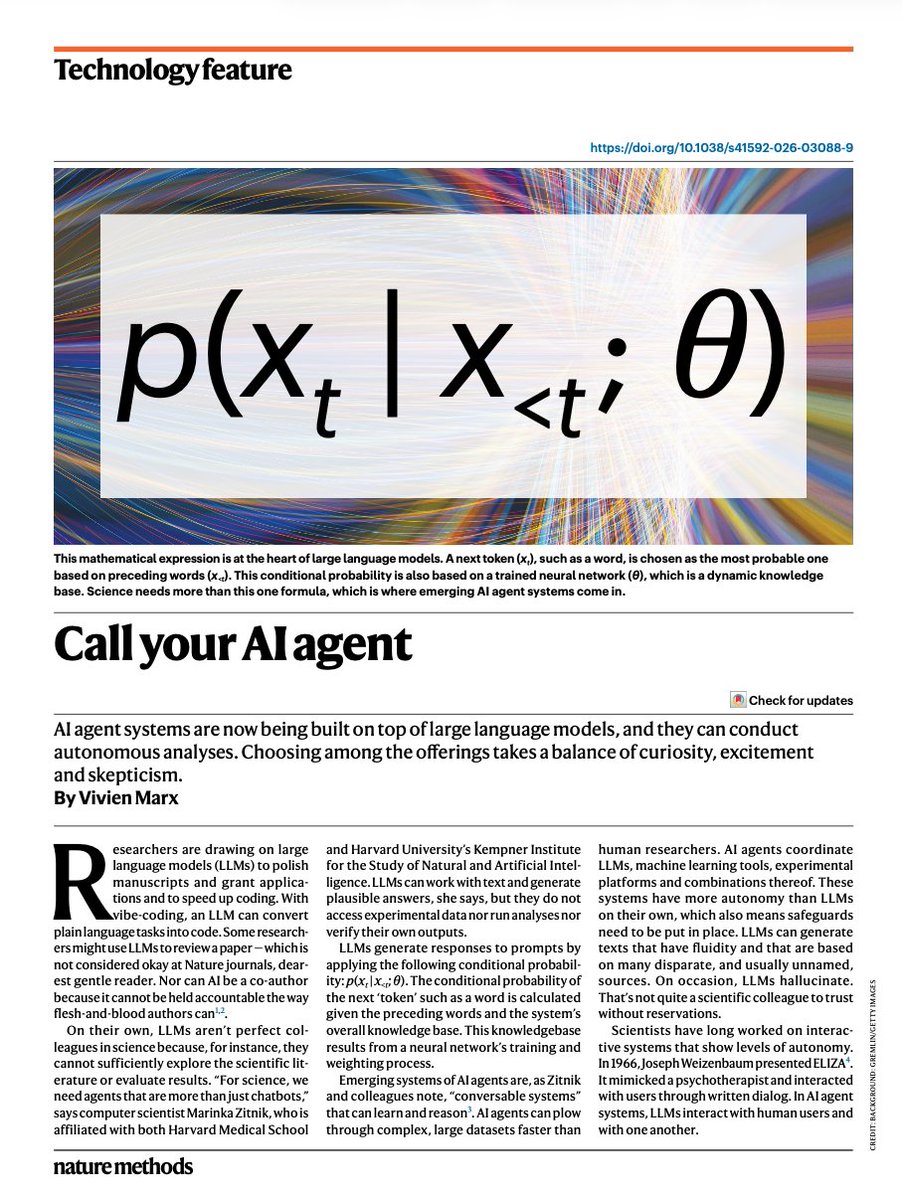
Agentic AI for science featured in @naturemethods: https://t.co/sLu3EZZMks. We are still early, with many open challenges ahead, but it is exciting to see this direction continue to evolve, wonderful piece by @metricausa
ToolUniverse — an open platform enabling AI agents to use scientific tools and databases at scale, by @GaoShanghua
→ https://t.co/lWHESvXvIW
ClawInstitute — shared research boards for long-running collaborative discovery where agents co-develop ideas over time, by @GaoShanghua@AdaFang_
→ https://t.co/cIDf53yOsZ
Medea — an omics AI agent for large-scale biological reasoning and analysis, by Pengwei Sui
→ https://t.co/t2lut9nyJV
@HarvardDBMI@harvardmed@KempnerInst@broadinstitute
Google DeepMind just solved one of the dirtiest problems in image generation. and the fix is almost embarrassingly elegant 🤯
every diffusion model you've used (Stable Diffusion, Flux, etc.) relies on latent representations. an encoder compresses images into a compact space, and a diffusion model learns to generate in that space.
the problem nobody talks about: how you train that encoder is basically vibes.
the original Stable Diffusion approach slaps a KL penalty on the encoder with a manually chosen weight. too much regularization and you lose high-frequency details. too little and the latent space becomes chaotic for the diffusion model to learn from.
everyone just... picks a number and hopes for the best. it's the equivalent of tuning a radio by feel while blindfolded.
DeepMind's paper reframes the entire question.
instead of treating the encoder and diffusion model as separate stages, they train them together. the encoder's output noise gets directly linked to the diffusion prior's minimum noise level. this one connection turns the messy KL term into a simple weighted MSE loss, and gives you something you've never had before: a tight, interpretable upper bound on how much information your latents actually carry.
think of it like this. before, you were compressing an image and praying the compression ratio was "about right." now you have an actual dial that tells you exactly how many bits of information are flowing through, and you can set it precisely.
the results speak for themselves. FID of 1.4 on ImageNet-512 with high reconstruction quality, using fewer training FLOPs than models trained on Stable Diffusion latents. on Kinetics-600 video, they set a new state-of-the-art FVD of 1.3.
but the real contribution isn't the numbers. it's that they turned one of the most heuristic-heavy parts of the generative AI pipeline into something principled. the trade-off between "easy to learn" and "faithful reconstruction" was always there. this paper just made it visible and controllable.
the uncomfortable implication for everyone building on frozen Stable Diffusion encoders: you've been optimizing everything except the foundation.
DeepMind built a simple RAG technique that:
- reduces hallucinations by 40%
- improves answer relevancy by 50%
Let's understand how to use it in RAG systems (with code):
Excited to announce our graduate course AI in Medicine 2 this Spring @HarvardDBMI@harvardmed
Course syllabus https://t.co/ZOcZ3das6m
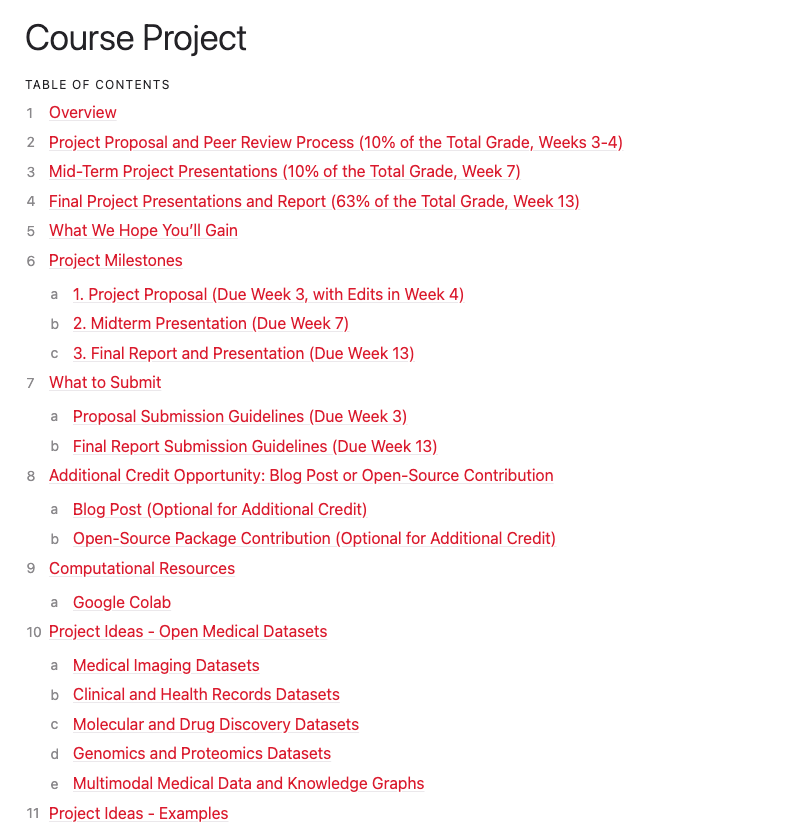
The syllabus features weekly lectures, focused tutorials on cutting-edge AI topics, hands-on student research projects, and weekly quizzes personalized for each student. We will share materials publicly throughout the course
We will explore:
🔍 Self-supervised learning
🎨 Generative models
🔗 Multimodal techniques
🤖 Agentic pipelines
Applications span NLP, medical imaging, relational and molecular learning, and longitudinal patient data
Course staff: @YEktefaie @YepHuang @c_sheare Grey Kuling @AIM_Harvard_PhD@BIG_Harvard_PhD@harvard_data@KempnerInst@broadinstitute
OpenAI broke the Internet just 4 days ago.
People can't believe how "intelligent" o3 is. Unlocking new possibilities.
10 wild examples:
1. Generate 12-month personalized astrology forecast
This is HUGE: FDA is phasing out the animal testing requirement for new drugs!
This opens the door for virtual cell models (eg scGPT) to lead the way:
•Predict human responses better
•Cut dev time + cost
•Ethically superior
•FDA-backed
•Built for personalized medicine
The future of drug discovery is AI-enabled!
#AI #Biotech #FDA #DrugDevelopment #virtualcell
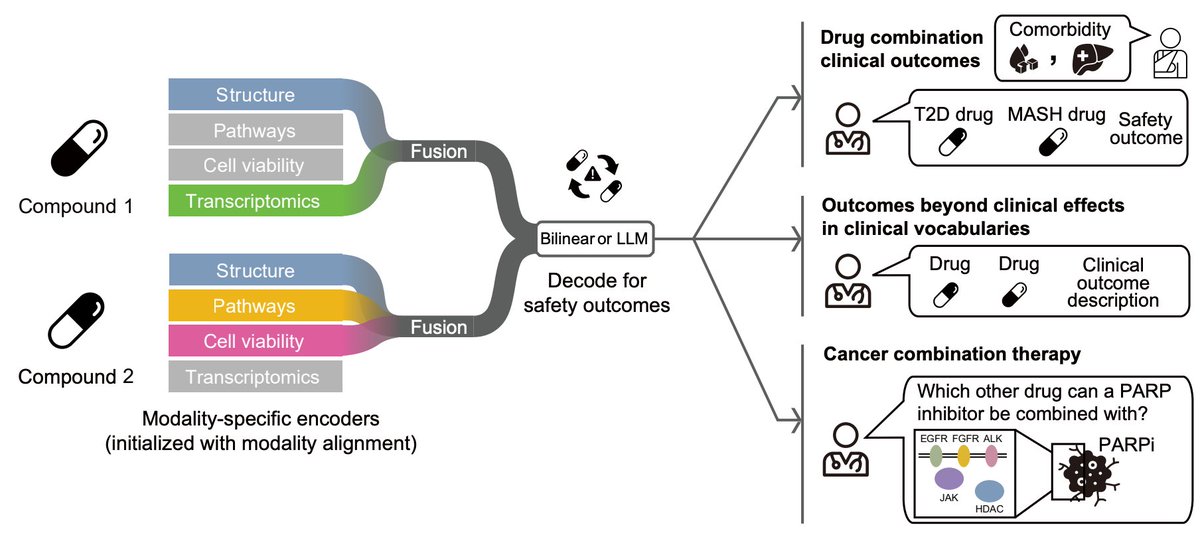
Predicting clinical outcomes of drug combinations from preclinical data is a major challenge @YepHuang
We know a drug works in the lab. But will it work in patients? 🔬 ➡️ 🏥
This is key for safe and effective therapies and it's one of the hardest challenges in medicine. MADRIGAL is a multimodal AI model that predicts clinical outcomes of drug combinations from preclinical data 🧵
Why does this matter?
Combo therapies can improve efficacy and reduce side effects, but identifying safe and effective pairs is difficult. The search space is enormous, pharmacological interactions are complex, and many compounds lack complete preclinical data
The missing data problem
Most AI models struggle when key drug data is missing. MADRIGAL learns from incomplete datasets at both training and inference, making it capable of predicting clinical outcomes even for drugs with sparse data
What is MADRIGAL?
A multimodal AI model that integrates 21,842 compounds and predicts 953 clinical outcomes to assess:
✔️ New drug combinations
✔️ Drug safety and toxicity across organs
✔️ Personalized response using patient genomic data
Led by a stellar PhD student @YepHuang with a team of fantastic collaborators @xiaorui_su, Varun Ullanat, Ivy Liang, Lindsay Clegg, Damilola Olabode, Nicholas Ho, Bino John, Megan Gibbs
@HarvardDBMI@Harvard@harvardmed@broadinstitute@KempnerInst@harvard_data
1/ Modelling cellular changes across diverse cohorts reflects the full spectrum of human biology and advances inclusive healthcare.
inVAE, our generative model achieves this by accurately identifying cell states.
A collaboration bw @sangerinstitute@HelmholtzMunich@SCICambridge
Recent advances in interpretable machine learning using structure-based protein representations
Survey on interpretability methods for protein 3D models...
P: https://t.co/yIhqkWetw7
We are pleased to announce the release of The Protein Design Archive. Our comprehensive database of designed proteins highlights the triumphs and challenges of the field: https://t.co/HXe2Lc7YpJ
Preprint:https://t.co/VAXycmYs9q
@mjstam@MartaChronowska@WoolfsonLab#proteindesign
The AI Scientist: Towards Fully Automated Open-Ended Scientific Discovery 👩🔬
https://t.co/NH5Qbb99pd
It’s common for AI researchers to joke amongst themselves that “now all we need to do is figure out how to make AI write the papers for us!” but I think we’re now getting there!
Thrilled to share @fabian_theis lab paper on transformers in single cell omics out in @naturemethods ! Check it out to learn about the latest models, how they are trained, applied, and their limitations. https://t.co/Qo8Run5Luz (🧵1/7)
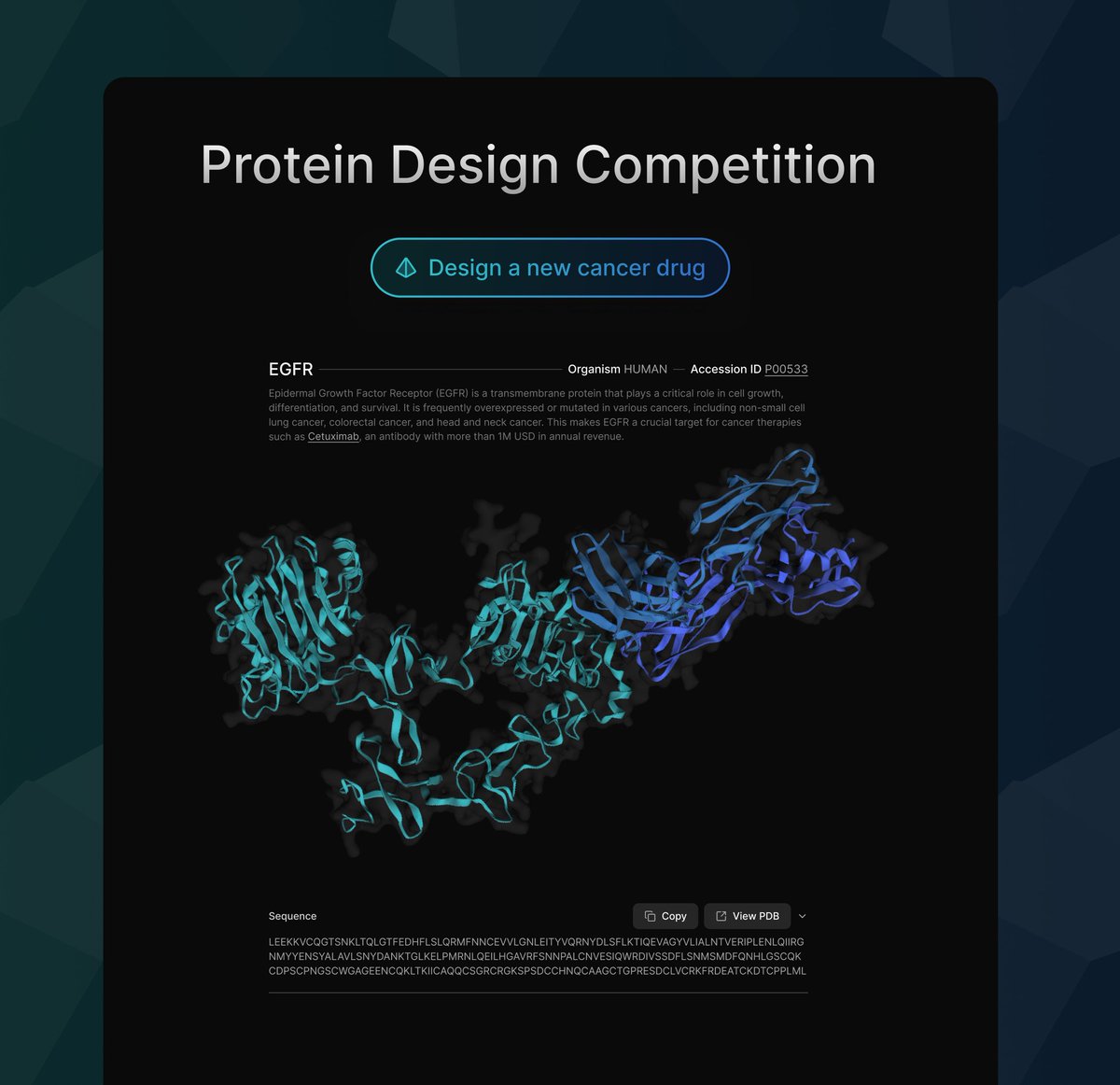
Crowdsourcing better cancer drugs!
At @adaptyvbio, we want to allow anyone to become a protein designer.
Test your skills and design a binder to EGFR to make an improved cancer drug. The best designs will be tested experimentally in our automated wet lab and all results will be open-sourced.
Submit your designs at https://t.co/kZnS6HZjgx
Deadline for submission Aug 18, results announcement Sep 18