Today, we release LFM2.5-VL-3B, a lightweight vision-language model that reads screens, documents, and the physical world. It handles digital screens across mobile, web, and desktop, grounds objects to coordinates, reads text and charts, and calls tools from either text or image input.
Built on LFM2.5-2.6B base, with a SigLIP2 400M NaFlex vision encoder
> Pre-trained on ~34T tokens
> Vocab size: 128K
Comparable or better scores compared to models up to 2.6x its size:
> ScreenSpot-v2 80.7, ahead of Gemma-4-E4B at 51.2
> RealWorldQA 73.1, ahead of InternVL-3.5-4B at 67.7
> TextVQA 84.3, ahead of Qwen3.5-4B at 81.2
> RefCOCO-avg 87.9, up from 57.1 on LFM2-VL-3B
> ToolSandbox 59.5, up from 26.4 on LFM2-VL-3B
🧵
How do we create amazing personal AI? Here's a recent talk from River CEO Igor Babuschkin (@ibab) sharing our vision for personal AI and continual learning.
Hot take… isn’t it kinda crazy that nobody is really using AI Agents? I don’t mean software engineers or AI early adopters. I mean “college friends talking about it in group chat,” the feeling you got when everyone started using Instagram or TikTok.
These frontier AI models are *insane* (as are the harnesses & tool calls & the like). And every large tech co has an AI agents platform, not to mention all the YC startups doing vertical agents. Yet all of your friends and family outside of tech — who spend all day staring at their iPhones and get paid to work in browser tabs — don’t really care or find themselves using any AI agents yet.
Yes ChatGPT, Claude, etc. are extremely popular… but if you look at the engagement data the vast majority of people are still using these aI chat tools like a glorified Google + Grammarly. That’s why the AGI labs are all pushing desktop apps for Codex, Cowork, etc. so hard to non-technical ppl. And yes exceptions for lawyers and customer service but even those have some asterisks and exceptions to rule.
Look I’m not saying the ChatGPT moment for AI Agents is not coming… it most definitely is! Remember we pivoted from Arc to Dia precisely because we believe computing is going to be radically reimagined around these AI primitives. No doubt. But that’s my point: it’s just so surprising it hasn’t happened yet because all of the tech you’d need is there.
Again if you stop for a second and think about it… for all the press and money and hype and models and crazy ARR numbers… this “AI Agent” moment does not *feel* like the other breakthrough tech moments we’ve lived through (e.g. think the shift to Stories via Snapchat & Instagram, or shift to on-demand via Uber/Airbnb/Doordash).
Which is a long way of saying: if you can figure out the answer to “why” most people don’t care about AI agents yet (and have no enduring interest in using them) — especially since the models and harnesses are here and ready — the answer to that question will allow you to capture a lot of marketshare and make a lot of money in 2027.
Theoretically, the tech is ready for AI Agents to totally transform how we work and live our lives… but alas the general public dgaf… that’s the generational puzzle to solve for the next 12 months for anyone not working on the models themselves.
Hot take… isn’t it kinda crazy that nobody is really using AI Agents? I don’t mean software engineers or AI early adopters. I mean “college friends talking about it in group chat,” the feeling you got when everyone started using Instagram or TikTok.
These frontier AI models are *insane* (as are the harnesses & tool calls & the like). And every large tech co has an AI agents platform, not to mention all the YC startups doing vertical agents. Yet all of your friends and family outside of tech — who spend all day staring at their iPhones and get paid to work in browser tabs — don’t really care or find themselves using any AI agents yet.
Yes ChatGPT, Claude, etc. are extremely popular… but if you look at the engagement data the vast majority of people are still using these aI chat tools like a glorified Google + Grammarly. That’s why the AGI labs are all pushing desktop apps for Codex, Cowork, etc. so hard to non-technical ppl. And yes exceptions for lawyers and customer service but even those have some asterisks and exceptions to rule.
Look I’m not saying the ChatGPT moment for AI Agents is not coming… it most definitely is! Remember we pivoted from Arc to Dia precisely because we believe computing is going to be radically reimagined around these AI primitives. No doubt. But that’s my point: it’s just so surprising it hasn’t happened yet because all of the tech you’d need is there.
Again if you stop for a second and think about it… for all the press and money and hype and models and crazy ARR numbers… this “AI Agent” moment does not *feel* like the other breakthrough tech moments we’ve lived through (e.g. think the shift to Stories via Snapchat & Instagram, or shift to on-demand via Uber/Airbnb/Doordash).
Which is a long way of saying: if you can figure out the answer to “why” most people don’t care about AI agents yet (and have no enduring interest in using them) — especially since the models and harnesses are here and ready — the answer to that question will allow you to capture a lot of marketshare and make a lot of money in 2027.
Theoretically, the tech is ready for AI Agents to totally transform how we work and live our lives… but alas the general public dgaf… that’s the generational puzzle to solve for the next 12 months for anyone not working on the models themselves.
i predict we’ll see a breakthrough consumer ai product within the next 12 months that rivals chatgpt & claude by making personal agents genuinely useful & accessible.
& it’ll feel like electricity.
nearly all the seeds required to create this experience now exist. someone just has to assemble them correctly.
When you go talk to users, don't (just) ask them what features they want. Ask them what problems they have. In the best case this will lead you to think of features they'll love but would never have thought to ask for. And expect to go through multiple cycles of ask-and-build.
Today we release LFM2.5-2.6B, an agentic model that runs entirely on-device. It plans, calls tools, and works through multi-step tasks on phones, laptops, PCs, and robots. Data never leaves the device, and the marginal cost of each run is essentially zero.
> Pre-trained on ~34T tokens
> LFM2.5 flagship hybrid architecture
> Context length: 128K
> Vocab size: 128K
> balanced intelligence per watt
> customizable on a single GPU for any specialized task
> LFM2 open-weight license
Comparable or better scores compared to models up to nearly 4x its size:
> ToolSandbox 77.83, ahead of Qwen3.5-9B at 76.44
> Multi-IF 80.07, ahead of Gemma-4-E4B-it at 77.35
> IFStruct 85.49, ahead of Qwen3.5-9B at 78.50
🧵
Agent systems are often discussed as if the central LLM does all the work.
In practice, the surrounding harness also needs efficient models for routing requests, enforcing policies, extracting entities, and checking whether retrieved context is relevant. 🧵
Today we release LFM2.5-Encoder-230M and LFM2.5-Encoder-350M: bidirectional encoders that stay fast at long context, even on CPU.
> LFM2.5-Encoder-230M: about 3.7x faster than ModernBERT-base on CPU at 8,192 tokens. Under 30s per forward pass, versus over a minute and a half.
> LFM2.5-Encoder-350M: 4th of 14 models on GLUE, SuperGLUE, and multilingual classification, behind only three larger models, one of them nearly 10x its size.
🧵
While we eagerly await Fable 5's return, our agentic WebGPU kernel optimization framework kept running.
Opus 4.8 picked up where Fable left off, pushing Liquid AI's new LFM2.5 230M to an unbelievable 1,400 tok/s... running locally in your browser.
Don't blink or you'll miss it.
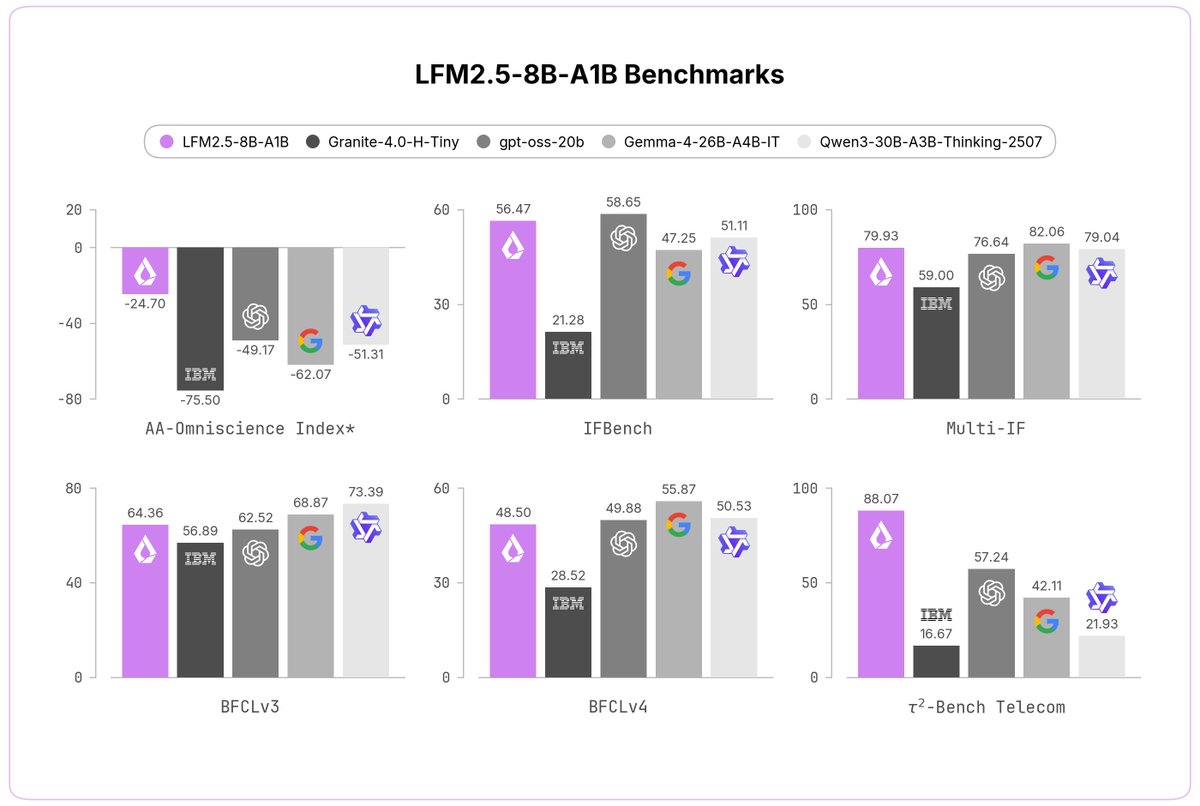
Today, we're releasing LFM2.5-8B-A1B, a device-optimized model designed to power real-life applications on phones, laptops, PCs, robots, and fast & lightweight server-side use-cases.
> 8B MoE, 1.5B active
> Expanded 128K context
> LFM2.5 flagship hybrid MoE architecture
> Trained on 38T tokens + large-scale RL
> fast, reliable tool calling, punching above its weight, comparable to models with up to 4x its size
> customizable on a single GPU for any specialized task
> LFM2 open-weight license
🧵
We’re on our way, Tokyo!
Apply to join our 2-day hackathon co-hosted with @wayequity and @AMD.
Engineers, founders, and mentors across the Liquid AI and WAY ecosystems will gather to ship real-world applications to accelerate Japanese industry, powered by our Liquid Foundation Models (LFMs).
Selected participants, in teams of 1-3, will create applications/workflows to address real-world problems only possible with LFMs.
Top projects will be awarded:
/ Gold Prize - $3K USD
/ Silver Prize - $2K USD
/ +Internship offers, community recognition, and more.