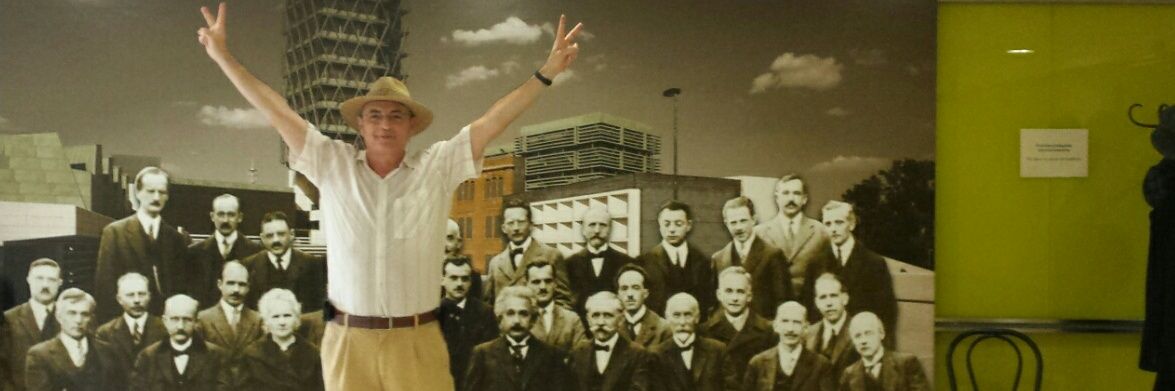
Einstein’s Theory of Relativity, Critical For GPS, Seen In Distant Stars
https://t.co/t5dsz6Sf1h
To deepen see this paper of mine:
https://t.co/Obqbu0wdAL
However the 3-body Newtonian problem was 'solved' by Sundman (1907) by means of a series solution in (1/3) powers of time of the differential equations.
Poincaré showed that it is impossible to solve it by reducing the dimension of the system with the help of constants of motion
The three-body problem broke Newton, broke Poincaré (who ended up inventing chaos theory trying), and was finally cracked open by Chenciner & Montgomery in 2000: the figure-8 in clip 4 is their proof.
Šuvakov & Dmitrašinović added 13 more families by 2013.
Every clip is a real numerical integration of F = G·m₁m₂/r² with equal masses, no fudging. Math from 1687 still has surprises in it.
[🎞️ extract: From Infinity with Love]
Gabriel's Horn, also known as Torricelli's Trumpet, is a geometric figure that has the paradoxical property of having infinite surface area but finite volume. It is formed by revolving the curve y = ¹⁄ₓ around the x-axis from x = 1 to infinity.
So many people today — and even professional scientists— seem to me like someone who has seen thousands of trees but has never seen a forest. A knowledge of the historic and philosophical background gives that kind of independence from prejudices of his generation from which most scientists are suffering. This independence created by philosophical insight is — in my opinion — the mark of distinction between a mere artisan or specialist and a real seeker after truth.
-- A. Einstein, as mentioned in a 1944 letter to Robert A. Thorton
Do we live in a 'small' Universe?
That would be the case if a non trivial topology of 'spatial' hypersurfaces, imprinted subtle signatures on the cosmic microwave background (CMB) and on the 3D distribution of matter, breaking the Cosmological Principle.
https://t.co/ZAD54zBb4V
Have you understand?
Exactly the same as before, 1 meter of string spliced, but now instead the Earth, consider the string around the Wilky Way.
Will a cat easily pass through the gap?
The answer is YES, an astrocat will pass through the gap, which will be aprox 16 cm in size.
A string wrapped around the Earth.
1 metre of string is spliced into the original string, so that it is at a uniform height above the equator, will a cat easily pass through the gap?
The answer is YES, a cat will pass through the gap, which will be approx 16 cm in size.
Los tiempos físico y psicológico.
El tiempo físico fluye siempre a la misma velocidad y no podemos detener los relojes. No podemos añadirle más años a la vida, pero expandiendo de forma lineal nuestra mente, sí podemos añadirle mucha más vida a los años.
¿Te acuerdas de los veranos de la infancia? Parecían eternos. En cambio, con los años, la Navidad llega antes, los meses parecen semanas y los años se evaporan. La física del tiempo no ha cambiado. Entonces, ¿por qué nuestra mente insiste en que el tiempo se acelera?
Pointillisme was an immersive installation created by Japanese architect and designer Taiju Yamashita. The work took inspiration from the painting technique of pointillism, where many tiny dots combine to create a larger image. Instead of paint, Yamashita used thousands of suspended transparent spheres to create a three-dimensional “drawing” made of light.
📹 odilov_m_u
@PhilosophyOfPhy To you:
"The greatest enemy of knowledge is not ignorance, it is the illusion of knowledge"
Nöther theorems do not say that you write.
@skdh Einstein's theory of Relativity is BASED on the hypothesis that there's a fundamental limit on speed and that is the light speed in vacuum measured in a (locally) inertial reference system.
AND Relativity has been "falsed" with many experiments and observations.
Bertrand Russell on what he'd tell future generations:
In a 1959 BBC interview, the philosopher Bertrand Russell was asked what he'd want to pass on to descendants watching the film "like a Dead Sea scroll in a thousand years time."
His answer came in two parts.
One intellectual, one moral.
On the intellectual side, Russell said:
"When you are studying any matter, or considering any philosophy, ask yourself only: 'What are the facts, and what is the truth that the facts bear out?' Never let yourself be diverted, either by what you wish to believe, or by what you think would have beneficial social effects, if it were believed. But look only and solely at: 'What are the facts?'"
The trap he's pointing to is subtle.
It's not just wishful thinking that distorts our view of reality. It's also the temptation to believe things because believing them would be useful.
Russell rejects both. The only question that matters is what's actually true.
On the moral side, his message was simpler:
"Love is wise, hatred is foolish. In this world, which is getting more and more closely interconnected, we have to learn to tolerate each other. We have to learn to put up with the fact, that some people say things that we don't like. We can only live together in that way."
He closes with a warning that lands harder with each passing decade:
"If we are to live together and not die together, we must learn a kind of charity and a kind of tolerance, which is absolutely vital to the continuation of human life on this planet."
Two disciplines, then, for anyone hoping to live well and leave the world intact:
Look at the facts as they are, not as you wish them to be.
And extend tolerance to people whose views offend you. Not because they're right, but because the alternative is that we don't survive each other.
A Galactic Year is the time it takes for the Solar System to complete one full orbit around the center of the Milky Way galaxy and it's ~ 250 million years.
[🎞️ thebrainmaze]