If you take Social Security at 62 and invest every check you don't need, that's $1,400/mo invested for 8 years at 7% grows to ~$180K by 70.
That pot can cover the $1,080/mo you'd have gained by waiting, almost forever, and whatever's left goes to your heirs, not back to the government.
I want control as early as possible.
🚨 Insiders are LOADING UP on Coherent $COHR
Director Stephen Pagliuca just purchased $15,000,000 worth of shares following a $1M buy from the CEO just 2 weeks ago
The stock is currently squeezing straight into its 200-week EMA 👀
Goldman Sachs now forecast over 2000% growth in humanoid robotics by 2035.
These 10 physical AI stocks could be next decade’s biggest investment theme.
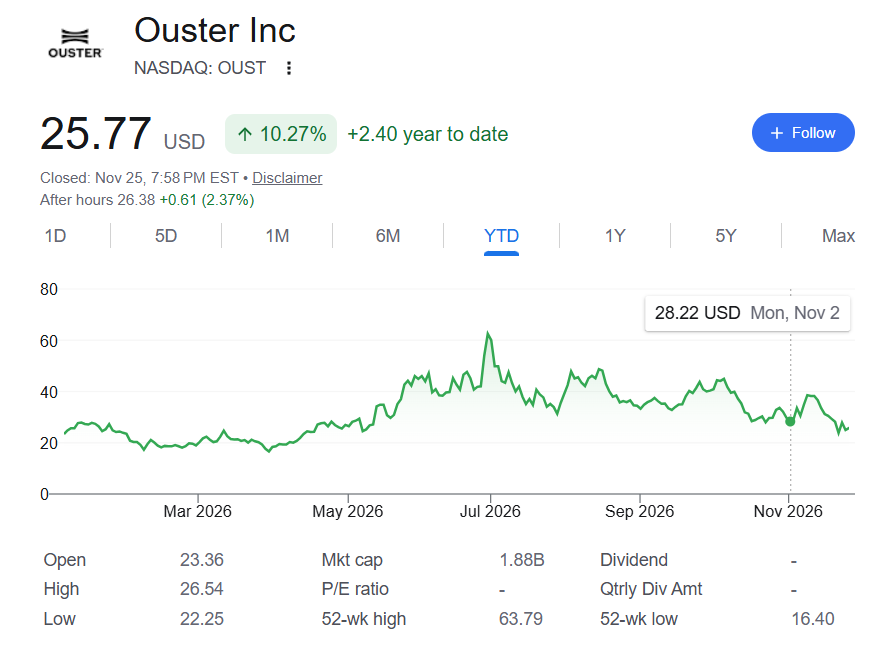
1. $OUST | Leading LiDAR technology company powering Physical AI and industrial robotics. Q3 2026 revenue surged 50% YoY to $59M.
Want to retire before 59½ and tap your IRA without the 10% penalty?
Most people don't know about 72(t).
It allows Substantially Equal Periodic Payments (SEPP) from an IRA, penalty-free, at any age.
The catch:
- Payments are set by an IRS-approved method
- You must continue them for 5 years or until 59½, whichever is longer
- Break the schedule and the 10% penalty can apply retroactively to every payment, plus interest
Start at 52? You're locked in until 59½.
Start at 57? You're locked in until 62.
It's powerful. It's also rigid.
Compare it first with the Rule of 55, a Roth conversion ladder, and a taxable brokerage bridge.
I am rotating some of my other networking exposure to get heavier into $COHR
This is not a recommendation at all for you to do the same of course.
We just don't see this kind of insider buying in most of these optical and networking names
Over the last couple weeks three insiders put ~$51.1m of real cash to work across 257,910 shares (all voluntary open market buys, no 10b5-1 plans and not counting the routine board RSU grants)
direct buy from CEO Jim Anderson on Nov 9 for 5,000 shares at $199.48 (~$997k)
direct buy from director Enrico Digirolomo on Nov 10 for 1,000 shares at $222.89 (~$223k)
huge buying from director Stephen Pagliuca (former Bain Capital co-chair) through his family LLC, taking 82,000 shares on Nov 20 at ~$185.59 (~$15.2m) right into a -13% flush and then coming back Nov 23 and 24 for another 169,910 shares at ~$203.95 (~$34.7m)
That's ~$49.9m from Pagliuca alone in three sessions
and it came right after the board authorized a $2b buyback on Nov 18 (~5% of the market cap)
The blended average across all four buys is ~$198/sh and $COHR closed today at $196.19 after reversing all the way back from $174.96 intraday
I'm not quite ready to add additional exposure to AI infra, but between the company position and these signs of conviction from inside folks is good enough for me to consolidate some exposure here into what I believe will be the (most?) durable companies in the trade
I have concerns about their ability to source enough high quality 6-in substrates to meaningfully ramp their margins over time. But I do think it's mostly a timing issue and seeing these buys gives me a bit more confidence that they aren't stressed about it
Everybody says max your 401k, Roth IRA and HSA
Super helpful
But nobody tells you where the next dollar goes
Here's the 4 places it should go (in order): 🧵
This is the most important post you'll ever see.
The biggest question I get is what happens if you bought the top of individual stocks that may never recover.
Here's how to recover, the professional way:
1. Tax Loss Harvesting (do this first)
This is the single most valuable move you can make right now. The IRS lets you use investment losses to offset gains and reduce your tax bill.
How it works:
- Sell your losing positions to realize the loss on paper
- Use those losses to offset any capital gains you had this year (from other trades, crypto, real estate, etc.)
- If your losses exceed your gains, you can deduct up to $3,000 per year against ordinary income
- Any remaining losses carry forward indefinitely to future tax years
The swap trick:
- For example, sell $NBIS at a 70% loss, book the loss
- Immediately buy a similar but not "substantially identical" stock (this avoids the wash sale rule)
- Example: sell one AI infrastructure name, buy another. Sell $SMCI, buy $DELL. Sell $NBIS, buy an AI ETF. You stay exposed to the same theme but you banked the tax loss.
- The wash sale rule says you cannot buy the same or substantially identical security within 30 days before or after the sale. Different companies in the same sector are fine.
The math:
- You put $50K into AI stocks, now worth $15K. That is a $35K realized loss if you sell.
- If you had $20K in gains elsewhere this year, that $35K loss wipes out the $20K in gains (saving you roughly $3,000 to $7,000 in taxes depending on your bracket)
- The remaining $15K loss carries forward. $3K offsets income this year, $3K next year, $3K the year after, and so on.
- You are literally getting paid by the government to reposition your portfolio.
Deadline: You must sell BEFORE December 31 to claim the loss for this tax year. Do not wait.
2. The Quality Audit
Pull up every position and sort them into three buckets:
Bucket A: Leaders with real earnings - $NVDA, $MSFT, $GOOGL, $META, $AMZN, $ORCL, $TSM
- These are down 30 to 50% but they print cash, have massive moats, and will recover
- Action: hold, or add slowly if you have capital
Bucket B: Promising but speculative- companies with real revenue growing fast but no sustained profitability yet
- Action: trim to a size where you can sleep at night. If it goes to zero tomorrow, it should not change your life.
Bucket C: Hopes and dreams - pre-revenue, story stocks, SPACs, names down 70%+ with no clear path to profitability
- Action: tax loss harvest these immediately. Sell, book the loss, move on. These are the ones that may never come back. Down 70% can easily become down 95%.
3. The Rebalancing Framework
You said you put "all your money" in AI stocks. That is the real problem, not the drawdown. Concentration killed you, not the thesis.
Target allocation going forward:
- 55% core holdings (strongest fundamental leaders or blue chip leaders)
- 30% high conviction sector bets (AI infrastructure, semis, cloud)
- 15% growth and speculative (the ones you believe in long term)
How to get there from here:
- Use the tax loss harvest proceeds to buy broad index exposure
- You are not "giving up" on AI. You are building a base that lets you survive the volatility without panicking.
4. The Dollar Cost Average Recovery
If you believe in AI long term (and you should, the capex cycle is real), set up a systematic plan:
- Take whatever new capital you can invest each month
- Split it: 60% into stronger fundamental names, 40% into your highest conviction AI name
- Do this every single month regardless of what the market does
- In 12 to 24 months, your average cost basis will be dramatically lower than your original buy
This is how you turn a bad entry into a good position over time. You are not "averaging down" emotionally. You are executing a plan.
5. The Covered Call Income Strategy
If you hold 100+ shares of any position, you can sell covered calls against them to generate income while you wait for recovery.
How it works:
- You own 100 shares of $NVDA at $140 (bought at $200)
- Sell a call option at $170 strike, 30 to 45 days out, collect $400 to $800 in premium
- If NVDA stays below $170, you keep the premium and your shares. Repeat monthly.
- If NVDA goes above $170, your shares get called away at $170 (you still made $30/share from your current price plus the premium)
The math over a year:
- Collecting $500/month in premium on a $14,000 position is roughly 40% annualized income
- This dramatically accelerates your breakeven timeline even if the stock goes sideways
6. The Roth Conversion Play
If your portfolio is down 70%, this is actually the best time to do a Roth conversion.
- Convert your beaten down AI stocks from a Traditional IRA to a Roth IRA
- You pay taxes on the current (low) value, not the original value
- When those stocks recover (and if they are quality names, they will), all the gains are tax free forever
- You are essentially converting $15K worth of stock that you originally paid $50K for. You pay tax on $15K now instead of $50K+ later.
7. The Mental Framework
Stop thinking about your entry price. It is irrelevant. The market does not know or care what you paid.
The only question that matters every single day: "If I had cash instead of this position right now, would I buy it
today at this price?"
- If yes, hold.
- If no, sell and redeploy into something you would buy.
- If maybe, trim to a smaller size.
Your portfolio should only contain positions you would actively choose to own today. Anything you are holding just because you are "waiting to get back to even" is a position you should probably exit.
The Action Plan (this week)
1. Today: List every position, current value, and loss amount
2. This week: Sort into Bucket A, B, and C
3. Before Dec 31: Tax loss harvest all Bucket C names. Swap into similar exposure or broad index.
4. January: Set up the monthly DCA plan. Start the covered call strategy on your largest positions.
5. Ongoing: Stop checking daily. Set a calendar reminder to review quarterly.
The people who built generational wealth in markets all have one thing in common: they survived their worst trade and kept going.
This is that moment. I got you.
$COHR is 55% below its June ATH ($425). IMO, it is one of the clearest candidates to reclaim it first.
Director Stephen Pagliuca (Bain Capital) just bought 82,000 shares at an average of ~$185.59, a $15.2M personal purchase on Nov 20. Days earlier the company authorized a $2B buyback.
Meanwhile the business is accelerating:
Last quarter revenue $2.37B (+50% YoY), guiding +60% pro forma growth in FY27, with $NVDA still a strategic partner on CPO/optics.
Insiders sell for a hundred reasons.
They only buy size for one.
When both the board and a director are stepping in with real capital this far below the ATH, the setup stands out.
PS: Credits to @CKCapitalxx for sharing the screenshot!
When you sign up for Medicare at 65 (or when you retire if you are on a company plan), you have to make 1 choice that can follow you for the rest of your life:
Traditional Medicare or Medicare Advantage.
Get it wrong, and once your health changes, you may not be able to undo it.
Here's the difference in plain English.
TRADITIONAL MEDICARE
Doctors: Any doctor or hospital in the U.S. that takes Medicare. Most do, but not all, so ask before you book.
Approvals: Generally none needed before you get care.
Your costs: 20% of most doctor and outpatient bills after a $292 deductible in 2027, with no yearly cap. Hospital stays have their own separate deductible.
Filling the gap: You can buy a Medigap supplement for a monthly premium. Plan G covers almost everything Medicare approves, including the hospital deductible, except that $292 Part B deductible. For prescriptions, you add a separate Part D drug plan.
Extras: No routine dental, vision or hearing.
MEDICARE ADVANTAGE
Doctors: Usually a network. Outside it, you may pay more or not be covered at all. Emergency and urgent care are covered anywhere in the U.S.
Approvals: Many services, especially expensive ones, need the plan's OK first.
Your costs: Copays and coinsurance as you go, with a yearly cap. In 2027 that cap can be as high as $9,850 in-network.
Premium: Most people in these plans pay nothing beyond the Part B premium, which everyone pays either way.
Extras: Often some dental, vision and hearing.
THE CATCH
Here's why Advantage looks cheaper. With traditional Medicare, if you add a Medigap plan and a Part D drug plan, you pay 3 premiums: Part B, Medigap and Part D. With Advantage, you pay Part B, and most plans charge nothing more. Everyone pays Part B either way, including any IRMAA surcharge.
In a healthy year, Advantage can cost less. The problem shows up when you get sick and the copays start adding up.
In a bad year, Advantage can cost you up to $9,850 in-network for medical care in 2027, and it can happen again the next year if you're still sick. With traditional Medicare and Plan G, your Medicare-covered medical bills come to the $292 deductible plus the supplement premium.
Advantage plans can also change every Jan. 1. A plan that charges $0 a month today can start charging a premium next year. Your copays, the out-of-pocket cap and the doctors in the network can change too. For 2027, many plans raised their caps and cut extras like dental. Some plans shut down altogether.
You can switch Advantage plans every year, so you're not stuck in 1 plan. What you can get stuck in is Medicare Advantage itself. When you first have Part B at 65 or older, you get 6 months to buy any Medigap plan with no health questions. If you join Medicare Advantage when you're first eligible, you get 12 months to change your mind. After that, in most states, a Medigap insurer can ask about your health and turn you down. There are a few exceptions, like if your Advantage plan shuts down or leaves your area. But the time you'd most want to switch is after you get sick.
Your Medigap premium can go up over time too. But what Medigap covers is set by law and doesn't change from year to year.
Open enrollment ends Dec. 7. Which one are you on, and why?
See pinned post and bio link for important disclosures
Is this going to KILL $LITE $COHR $AAOI?
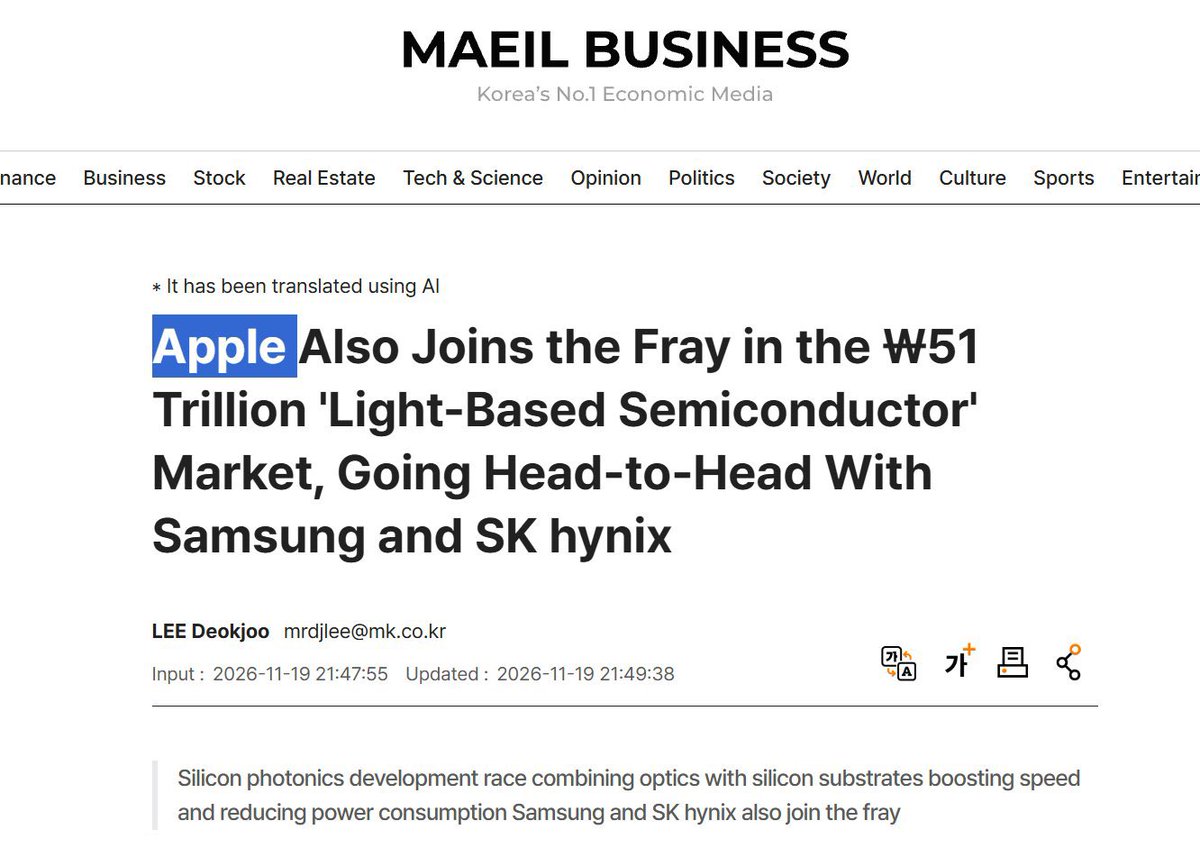
$AAPL hiring SiPh engineers is TAM validation.
CPO/NPO market: $100M to +$39B by 2030.
They need lasers, but they can’t build them next year.
Here’s the most important part:
Moving from pluggables to CPO doesn’t reduce laser content. It increases it. You need more high-power CW lasers per GPU once you co-package optics.
$AAPL accelerating CPO is laser demand expansion, not substitution!
$LITE and $COHR own the InP/CW laser bottleneck. $NVDA already paid billions. Capacity is sold out into 2029.
$AAOI is pure volume torque on the same 1.6T ramp!
So no. This isn’t a kill shot. It’s more demand hitting a constrained supply base.
IMO, this is net/net bullish for the optical stack!
PS: Thanks for sharing the news @PhotonCap.
Wells Fargo charged my seller $6,800 a year for a homeowners insurance policy that legally pays him $0 if his house burns to the ground
It covers $0 of his furniture, $0 of his liability, and $0 of his $110,000 in home equity
It only insures Wells Fargo
His normal policy used to cost $1,600 a year. In the spring, his insurance carrier bought aerial drone photos of his street, saw curling shingles on his 19 yr old roof, and mailed a 45 day non-renewal letter
Because he didn't have $10,500 sitting in checking to put on a new roof before the deadline, the policy expired
The day it lapsed, Wells Fargo put a "Force-Placed Hazard Insurance" policy on his house and billed $6,800 a year straight to his mortgage escrow, jumping his monthly house payment by $433 a month
On a force-placed policy, the mortgage bank is the only named insured. If a fire destroys a $235,000 house where you owe the bank $125,000, the policy pays Wells Fargo its $125,000 loan balance and walks away, wiping out every dime of your $110,000 in equity along with everything inside the house
If an insurance company drops you over an older roof, or you're buying a house with an insurance flag, use these 3 rules:
1. Use federal rule 12 CFR 1024.37(g) to force a 100% refund within 15 days.
When a mortgage servicer tacks a $6,800 force-placed policy onto your loan, you aren't stuck paying it for the year
Under federal RESPA rules (12 CFR 1024.37), within 15 days of receiving proof that you bound your own replacement coverage, the bank is legally required to cancel their policy and refund every dollar they charged you for overlapping days
2. Use an independent broker or state FAIR Plan policy as a 60 day bridge.
When State Farm or Allstate drops a house over a 19 yr old roof, calling other big-name agents gets you rejected because they all pull the same aerial roof report
Call an independent broker and ask for an Actual Cash Value roof policy or your state's FAIR Plan (Fair Access to Insurance Requirements) policy for around $1,800 a year. That satisfies your mortgage bank's requirement in 48 hours, kills the $6,800 bank policy, and buys you time to replace the roof
3. How we turn an insurance-flagged roof into a $37,000 discount.
When that seller decided to downsize and list his $235,000 house rather than pay for a roof, his first buyer's mortgage died 5 days before closing because no regular carrier would issue a binder on the 19 yr old shingles
We bought the house as-is in 9 days for $198,000, which paid off his $125,000 Wells Fargo loan, killed the force-placed policy, and put $73,000 cash in his pocket without him touching the roof or paying a 6% realtor fee
The morning after closing, my roofing crew put on a new architectural shingle roof for $9,400, and our broker bound a clean $1,350 landlord policy that afternoon
We put that $9,400 roof and our $11,000 interior updates onto our LLC's 0% introductory business credit cards. You still personally guarantee the cards with your 700+ score, but with issuers like Chase Ink, Amex, and US Bank, the balances report only to the commercial bureaus so your personal credit report shows $0
We run that exact setup across all 55+ of our rentals and flips: buy the houses that fail a bank buyer's insurance check, fund the fix at 0% under the LLC, and pay the business cards back to zero at the refinance
Most investors and business owners with a 700+ score try to set up business cards on their own and make two expensive mistakes:
They select "Real Estate" on the application (which bank software auto-caps at a single $10,000 limit), or they open the wrong business card (like most Capital One business cards) that reports the balance straight to their personal credit report and ruins their score right before the refinance
Getting $100,000 to $250,000 at 0% approved in one round depends on how your LLC is set up and the order your applications go in
If you're a real estate investor or business owner with a 700+ credit score, my team will build your $100k to $250k in 0% business credit across 4 or 5 banks. It'll let you fund a new roof or full renovation at 0% with nothing reporting to your personal credit report, so you can insure the property and refinance clean. Book a call at the link in my bio
Market Wizard Linda Raschke's 12 Technical Trading Rules
1. Buy the first pullback after a new high. Sell the first rally after a new low.
2. Afternoon strength or weakness should have follow‑through the next day.
3. The best trading reversals occur in the morning, not the afternoon.
4. The larger the market gaps, the greater the odds of continuation and a trend.
5. The way the market trades around the previous day’s high or low is a good indicator of the market’s technical strength or weakness.
6. The previous day’s high and low are two very important “pivot” points, for this was the definitive point where buyers or sellers came in the day before. Look for the market to either test and reverse off these points, or push through and show signs of continuation.
7. The last hour often tells the truth about how strong a trend truly is. “Smart money” shows their hand in the last hour, continuing to mark positions in their favor. As long as a market is having consecutive strong closes, look for the up‑trend to continue. The up‑trend is most likely to end when there is a morning rally first, followed by a weak close.
8. High volume on the close implies continuity the next morning in the direction of the last half‑hour. In a strongly trending market, look for resumption of the trend in the last hour.
9. The first hour’s range establishes the framework for the rest of the trading day.
10. A greater percentage of the day’s range occurs in the first hour than was the case in the past, and thus it has become increasingly important to trade aggressively if there are early signs of a strong trend for the day.
11. There are four basic principles of price behavior which have held up over time. Confidence that a type of price action is a true principle is what allows a trader to develop a systematic approach.
The following four principles can be modeled and quantified and hold true for all time frames, all markets. The majority of patterns or systems that have a demonstrable edge are based on one of these four enduring principles of price behavior. Charles Dow was one of the first to touch on them in his writings.
Principle One: A Trend Has a Higher Probability of Continuation than Reversal
Principle Two: Momentum Precedes Price
Principle Three: Trends End in a Climax
Principle Four: The Market Alternates between Range Expansion and Range Contraction
In the world of money, which is a world shaped by human behavior, nobody has the foggiest notion of what will happen in the future. Mark that word – Nobody! Thus the successful trader does not base moves on what supposedly will happen but reacts instead to what does happen.
After reviewing 100's of 401k plans for clients I've realized less than 10% of people are maximizing the accounts' potential
Here are the things 90% of people are overlooking.
(If you have a 401k - bookmark this thread!)
$AAOI signs $2.2B LTA with hyperscaler customer.
- $1.5 billion of 800G transceivers in 2027
- $0.7 billion in lasers between 2028 and 2029
"Customer forecast indicates demand that could exceed $10 billion over the four-year term".
I watched a couple pay $4,800 at the Home Depot front register for 6 windows, a front door and 3 faucets
If they'd pushed that same cart 50 feet to the Pro Desk and said 2 words, they could've walked out paying around $4,100. You don't need a contractor license to ask
I was right behind them with $5,200 of stuff for one of my rentals, already marked down to $4,390.
I bit my tongue, because no husband wants a random 27 year old auditing his receipt in line. When I caught them by the hot dog stand on the way out, he stared at the receipt like it had personally betrayed him, then his wife took it out of his hand
The 2 words are "Bid Room"
It's basically Home Depot's secret menu. Any order over $2,500 can go through their volume pricing program, where a pricing team sends back a lower price on everything they can cut. People walk past the Pro Desk like it's the TSA PreCheck lane for guys in paint-splattered F-150s. Half the people at that counter are landlords in gym shorts
How I do it:
1. Get a free Pro Xtra account in the Home Depot app
2. Put the whole project in one online cart, $2,500 or more, and hit "create a quote"
3. Call your store's Pro Desk on a weekday morning, a few days before you need the stuff. Those guys have been getting yelled at about warped 2x4s since 6am, so be the nicest call they get all day:
"Hi, I have quote number ____ in my Pro Xtra account. Can you run it through the bid room for volume pricing?"
Get a no? Call back tomorrow and you'll get somebody else
Not everything gets cut. My last quote:
2 windows: 46% off
Kohler faucet: 31% off
Exterior door: 14% off
Interior doors: 2% off
Drywall, 2x4s, screws, outlets: $0 off
Windows, doors, faucets and lights have a huge markup, so that's where they have room to move. A 2x4 barely makes them a dime. Put the lumber on the quote anyway, because it still counts toward your $2,500
Lowe's has the same thing, the Volume Savings Program, starting at $1,500. I get 10 to 20% off flooring there when Home Depot gives me nothing. Get both quotes and take the better one back to the other store. Making the orange store and the blue store fight over my money is my favorite hobby
The catch is the $2,500 has to be one order. Most people remodel out of checking: the faucets this week, the vanity next paycheck, the doors next month. They never hit the minimum and pay full price every trip
I put the whole materials list on 0% business credit under my LLC, so it's one order at the bid room price. Those balances report to the business bureaus, so my personal score doesn't move while the crew works, and the refinance pays them off before the 0% runs out
If you've got 700+ credit, comment "FORM" and I'll send you the calculator that shows how much 0% business credit you could qualify for before your next remodel
I’m 24.
I made $2.2M from trading last year.
I owe it all to the world’s most boring strategy that anyone can use.
Here's what I did (& how you can too):
Courageous activist Karoline Preisler was attacked in Berlin for standing against the hate mob with the sign “Rape is not resistance.”
The thugs who kicked her to the ground will not silence her. They will not win.
We stand with you, @PreislerKa. Always.
Silicon photonics is moving from slide decks into cash backed contracts, and the read through for US optical names like $COHR, $LITE, and $AAOI is massive.
Fresh institutional notes from Bernstein and Morgan Stanley on upstream wafer supplier Soitec reveal four critical supply chain signals:
• $1.2B in binding commitments:
Customers have already put down €86M in cash deposits toward ~$1.2B in multi year reservations covering CY27, CY28, and beyond. Current capacity is booked above 100%.
• Pluggables today, CPO and scale up next:
First round orders focused on pluggable optics for scale out server links. Negotiations for additional CY28+ volumes are shifting toward near package optics (NPO), co packaged optics (CPO starting CY27), and optical links inside scale up AI racks.
• Built in double ordering protection:
Contracts require foundries, fabless designers, and system makers to share inventory visibility, verifying real consumption while Photonics SOI pricing holds firm and FY27 segment revenue triples above $300M.
• Why this matters for $COHR, $LITE, and $AAOI:
Every silicon photonics engine, whether in an 800G or 1.6T pluggable module or a co packaged switch, still requires high power Indium Phosphide continuous wave lasers and optical engines.
As optics move from rack to rack scale out into chip to chip scale up, total optical TAM expands across the entire stack.
$NVDA $COHR $LITE $AAOI $AXTI $SIVE
Not all insider trades are the same, and at $SIVE the one that matters is the CEO. He has the most information on the company, and whether he's buying or selling tells you a lot.
Vickram Vathulya has bought shares three times this year. 160,000 in March. 24,000 in July at $4.11. Then 70,000 more on July 17 at $3.80, even as board members sold after the lock-up ended. Today the stock sits around $1.10.
So the person overseeing everything is underwater on his latest buy. People only put their own money in when they see value, and he saw value at $3.80. He couldn't have timed this drop either. His money is in here just like the rest of ours.
He knows the tech. He knows the customers. And he knows Sivers is moving from development work paid by customers to mass manufacturing products they can just order, build and ship.
Here's how I see the path. Jabil is in beta builds now, with production orders expected in H1 2027. Other pluggable customers are lining up behind it. And it doesn't stop at pluggables. Once those customers are done with pluggables, they move to NPO and then CPO, and Sivers is raising laser power for exactly those requirements so they can be ordered in volume.
That's also why Sivers is spending $30M to take Glasgow to 100M+ lasers a year by end of 2027. You don't build that capacity unless you think you can fill it.
I think $SIVE can be the $PLTR or $RKLB of this next AI cycle. AI data centers are getting built whether it's in the States or somewhere else.
Looking forward to the call on the 30th.